
A touchscreen monitor can make a desktop setup more interactive without requiring you to replace your laptop or buy an expensive all-in-one computer. The best budget touchscreen monitor depends on whether you need a larger desktop display, a portable second screen, or a compact panel for drawing and note-taking. For most buyers, a 15.6-inch Full HD portable monitor offers a practical balance of size, portability, and price. The ASUS VT169HE is an alternative for everyday desktop use, while the UPERFECT BE156PF offers a portable touch interface for less than $250. Creative users should also consider the ASUS ProArt PA148CTV, which adds factory-calibrated color and dedicated creator controls. The recommendations below use manufacturer specifications and listed US prices checked on October 14, 2026; prices and availability can change.
- Best budget touchscreen monitor: quick verdict
- Quick comparison table
- How we selected these monitors
- ASUS VT169HE: best budget choice for desktop touch
- ASUS VT229H: best for a traditional desktop setup
- UPERFECT BE156PF: best affordable portable touchscreen
- Magedok T101G: best for compact touch interfaces
- ViewSonic TD1655: best portable package for mobile work
- ASUS ProArt PA148CTV: best for creative touch workflows
- How to choose the best budget touchscreen monitor
- Common mistakes to avoid
- Frequently asked questions
- Final verdict
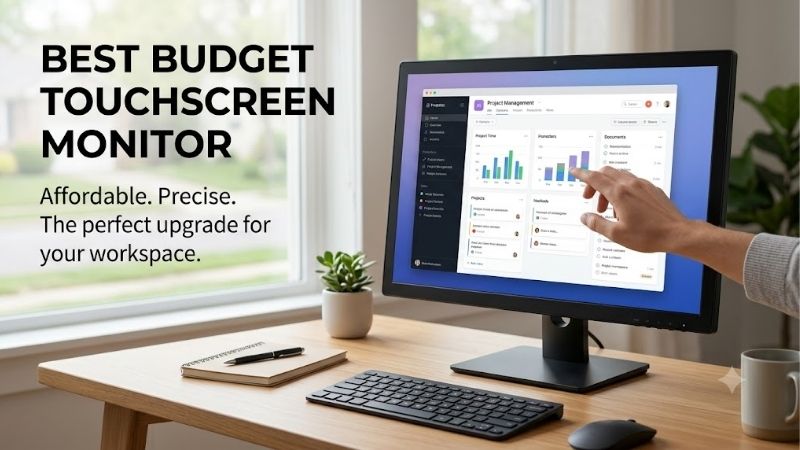
Quick answer: For most people in 2026, the best budget touchscreen monitor is the Monitor — our #1 rated choice. See the full ranked comparison, alternatives and buying advice below.
Best budget touchscreen monitor: quick verdict
For everyday desktop interaction, the ASUS VT169HE is a sensible starting point because it combines a 15.6-inch Full HD IPS panel, 10-point touch input, and VESA mounting compatibility. Choose the ASUS VT229H if you need a larger 21.5-inch desktop display. The UPERFECT BE156PF is a lower-cost portable alternative, and the Magedok T101G is worth considering for compact workstations and dashboards. The ViewSonic TD1655 offers a more polished portable package with an included protective cover and stylus, while the ASUS ProArt PA148CTV is the specialist choice for touch-enabled creative work.
This roundup uses a practical budget ceiling of $300 before taxes and shipping. It separates portable displays from desktop-style monitors because they solve different problems. None of these products should be treated as a guaranteed replacement for a laptop with a built-in touchscreen; the computer, operating system, and connection method determine which touch features work.
Quick comparison table
| Monitor | Best for | Screen and resolution | Distinguishing feature | Main drawback |
|---|---|---|---|---|
| ASUS VT169HE | Budget desktop and point-of-sale use | 15.6-inch, 1920 × 1080, IPS | 10-point touch and VESA mounting | Small for a primary desktop screen |
| ASUS VT229H | Traditional desktop touchscreen | 21.5-inch, 1920 × 1080, IPS | Larger display and 10-point touch | Basic stand and older connectivity |
| UPERFECT BE156PF | Affordable portable touch | 15.6-inch, 1920 × 1080, IPS | USB-C and mini HDMI | Glossy panel and no built-in battery |
| Magedok T101G | Compact mini-PC or dashboard display | 10.1-inch, 1280 × 800, IPS | 10-point touch in a small form factor | Limited workspace and resolution |
| ViewSonic TD1655 | Portable work and presentations | 15.6-inch, 1920 × 1080, IPS | Included stylus, case, and bidirectional USB-C power | Near the top of the budget |
| ASUS ProArt PA148CTV | Drawing and creative workflows | 14-inch, 1920 × 1080, IPS | 10-point touch and calibrated color | Small screen and limited value for basic office work |
How we selected these monitors
The shortlist favors identifiable models with manufacturer documentation, verified touchscreen functionality, and observed manufacturer-listed prices below or around $300. We considered screen size, native resolution, touch technology, connectivity, portability, mounting, and the practical limitations that affect everyday use. We did not assume that all touchscreen monitors support the same gestures or work equally well with every computer.
The products represent different use cases rather than a direct performance ranking. A 21.5-inch desktop screen is more comfortable for a permanent workstation, whereas a 10.1-inch panel makes sense for a small control display. A portable monitor with USB-C can simplify travel, but only when the connected computer supports the required video output and touch signaling. The recommendations are based on specifications, not detailed research. Direct Amazon listings and ASINs were not independently verified for every model, so the price evidence below comes primarily from manufacturer product pages and stores.
ASUS VT169HE: best budget choice for desktop touch
The ASUS VT169HE is a straightforward option for buyers who want touch input without paying for a premium creative display. It uses a 15.6-inch Full HD IPS panel with 10-point capacitive touch, allowing Windows users to tap, drag, pinch, zoom, and interact with compatible applications. ASUS also lists Windows 11 and Windows 10 compatibility, flicker-free technology, a low-blue-light feature, and a tilting stand.
The monitor is particularly suitable for a small home workstation, a point-of-sale terminal, a secondary control screen, or a desk where a mini PC can be mounted behind the display. It supports 75 × 75 mm VESA mounting, providing more installation flexibility than a portable display that relies entirely on a folio case. HDMI and VGA offer compatibility with a range of computers, although VGA is mainly relevant to older equipment.
ASUS listed the VT169HE at approximately $159 in its US touchscreen product catalog during research. That is an attractive entry point for a branded touch display, but the screen’s 15.6-inch size makes it less comfortable than a larger monitor for long document sessions or complex multitasking.
Buy it if you want a permanent touchscreen for basic applications, navigation, or a compact workstation. Skip it if you need a spacious primary monitor or want a portable screen with an integrated battery. The ASUS VT229H is the more practical alternative if physical screen size matters more than saving desk space.
ASUS VT229H: best for a traditional desktop setup
The ASUS VT229H provides a larger 21.5-inch Full HD IPS screen with 10-point capacitive touch. Its 1920 × 1080 resolution is appropriate for office applications, browser-based tools, simple creative tasks, and interactive interfaces. ASUS specifies a 5ms gray-to-gray response time, 178-degree viewing angles, HDMI and VGA inputs, and a touch surface with a stated 7H hardness rating.
Unlike a portable monitor, this is designed to remain on a desk. The larger display gives menus, virtual controls, and touch targets more physical space, making it more comfortable for frequent interaction. It also supports VESA mounting, so you can position it on a compatible arm or mount rather than relying exclusively on the bundled stand.
The limitation is its relatively basic connectivity and ergonomics. The stand supports tilt, but users seeking substantial height adjustment should budget for a suitable mount. Its 60Hz-class display is intended for general computing rather than high-refresh gaming, and Full HD is adequate rather than especially sharp at this screen size.
ASUS’s US product catalog listed the VT229H at approximately $219 during research. Confirm the live retailer price and exact model before purchasing, as older monitor listings can change.
Buy it if you want a more conventional desktop touchscreen for work, menus, or interactive applications. Skip it if portability, USB-C simplicity, or pen-oriented creative features matter more. For travel, the ViewSonic TD1655 is a better fit; for a compact, less expensive touchscreen, consider the VT169HE.
UPERFECT BE156PF: best affordable portable touchscreen
The UPERFECT BE156PF, also known as the UTouch E7, is a 15.6-inch portable IPS touchscreen with a native resolution of 1920 × 1080 and a 60Hz refresh rate. Its manufacturer-listed price was $219.99 during research, positioning it below the ViewSonic TD1655 while providing the core features needed for touch-enabled work on the move.
The screen supports 10-point touch input and uses two USB-C ports, a mini HDMI input, and a 3.5mm audio output. It also has built-in stereo speakers and comes with a smart cover. The manufacturer lists a weight of approximately 1.42 pounds, making the panel easier to carry alongside a laptop than a standard desktop touchscreen.
There are meaningful compromises. UPERFECT specifies 250-nit brightness and an 800:1 contrast ratio for this model. The glossy panel can reflect room lighting, and the display does not have a built-in battery, so it must receive power from a compatible connection or external supply. Its cover is useful for propping it up, but it is not a substitute for the adjustable stand and mounting options of a desktop monitor.
Buy it if you need affordable touch input for mobile work, presentations, browser tools, or casual creative applications. Skip it if you need high brightness, a matte screen, or a larger permanent display. The ViewSonic TD1655 costs more but includes a more complete portable-work setup, while the ASUS VT229H is a better match for a desk that does not need to move.
Magedok T101G: best for compact touch interfaces
The Magedok T101G is the smallest display in this roundup. It uses a 10.1-inch IPS panel with a native resolution of 1280 × 800 and supports 10-point touch. Magedok’s US-facing store displayed a price of $109 and listed stock during research, making it an option for small control screens, compact workstations, mini PCs, and certain maker projects.
The appeal is its form factor rather than its image area. A small touchscreen can sit alongside a primary display for monitoring system data, controlling compatible applications, managing music playback, or presenting a focused set of dashboard controls. It is also useful when a conventional 15.6-inch portable monitor would take up too much desk space.
The main limitation is resolution and workspace. At 1280 × 800, the T101G provides less room for full desktop applications and large spreadsheets than the Full HD options. Small text and complex interfaces can become crowded, so it should not be treated as a direct substitute for a regular laptop screen. Magedok describes USB-C connectivity and a 10-point touch interface, but you should still confirm the video-output and power requirements for your specific host device.
Buy it if you have a defined compact use case, such as a dashboard or secondary control display. Skip it if you plan to use the monitor as your only screen for normal desktop work. The UPERFECT BE156PF provides a much larger Full HD workspace for a relatively modest increase in cost.
ViewSonic TD1655: best portable package for mobile work
The ViewSonic TD1655 is a 15.6-inch Full HD IPS touchscreen with 10-point capacitive touch and a 60Hz refresh rate. ViewSonic’s US store listed it at $299.99 and in stock when checked. That puts it near the top of this roundup’s budget, but the package includes useful accessories and connectivity features that can justify the extra expense for frequent travelers.
The TD1655 weighs approximately 2 pounds and is around 0.6 inches thick. It includes a protective cover, a built-in stand that supports portrait and landscape positioning, and a passive stylus. Two USB-C ports support video and touch connections, while the power-capable port provides up to 60W of bidirectional power delivery. A mini HDMI input provides another way to receive a video signal.
This makes the monitor suitable for mobile productivity, presentations, note-taking, and working with touch-compatible Windows applications. It can also help reduce cable clutter when the host laptop supports video over USB-C. However, the 60Hz refresh rate and 250-nit brightness are conventional rather than premium, and power delivery should not be assumed to work identically with every laptop.
ViewSonic documents a vTouch driver for touch and gesture support on compatible Mac systems; its product page specifically excludes iPhone and iPad from this support statement. Mac users should confirm operating-system and application compatibility before purchasing.
Buy it if you want a supported, portable touchscreen package with a cover, stylus, and flexible USB-C power features. Skip it if the main requirement is simply an inexpensive extra screen. The UPERFECT BE156PF is less expensive, while the ASUS ProArt PA148CTV is more appropriate for color-focused creative work.
ASUS ProArt PA148CTV: best for creative touch workflows
The ASUS ProArt PA148CTV targets artists, editors, and creators who want a portable touchscreen for more than basic navigation. Its 14-inch Full HD IPS panel supports 10-point capacitive touch, and ASUS specifies 100% sRGB and 100% Rec. 709 color coverage. The display is Calman Verified and factory pre-calibrated to a stated Delta E below 2, making it a more credible choice for color-conscious workflows than a generic budget portable monitor.
It also includes a metal kickstand, tripod socket, two USB-C ports with DisplayPort Alt Mode, and a micro HDMI input. The physical ASUS Dial and software-based Control Panel can provide touch-oriented shortcuts in compatible creative applications, including selected Adobe programs, DaVinci Resolve, and Clip Studio Paint. These features can make a secondary display useful for controls, tool palettes, and adjustments while keeping the main workspace visible on another screen.
The trade-off is its size and specialization. At 14 inches, the panel provides less viewing area than a conventional desktop monitor, and creative controls may offer little value if you only browse websites or edit documents. The benefits of calibrated color are also less important for users who do not work with images or video.
ASUS’s US product catalog listed the PA148CTV at approximately $299 during research, although the exact checkout price and stock should be confirmed with an authorized seller.
Buy it if portability, touch input, and predictable color are all important. Skip it if you mainly need a cheap touch-enabled screen for ordinary office tasks. The ASUS VT169HE or UPERFECT BE156PF offers a less specialized route if color calibration and creative shortcuts are unnecessary.
How to choose the best budget touchscreen monitor
Decide whether you need a desktop or portable display
A desktop touchscreen is the better choice when the monitor will stay on a desk, connect to one or more fixed computers, and provide a generous touch surface. Models such as the ASUS VT229H are easier to use for repeated interactions because their physical screen area supports larger on-screen controls.
Portable displays work differently. They are designed to be carried with a laptop, positioned on a temporary work surface, or used as a secondary screen. Their covers and built-in stands prioritize portability over the adjustments available on a full desktop monitor. If you already own a laptop with a capable screen, a portable touchscreen can extend its workspace without requiring a permanent second monitor.
Think about viewing distance and how often you will touch the display. Frequent interaction can make screen stability, viewing angle, and stand design as important as resolution. A lightweight screen that wobbles when you tap it can be frustrating, even when its panel specifications look good.
Check the connection requirements for touch
A critical distinction is that video input and touch input are not always carried by the same cable. HDMI normally supplies the video signal, while many touchscreen monitors require a separate USB connection for touch data. Full-featured USB-C can simplify the setup by carrying video, touch data, and power, but both the computer and display must support the relevant functions.
Before buying, confirm the ports on your computer. A USB-C connector alone does not prove that a laptop supports DisplayPort Alt Mode or can provide enough power to run a monitor. If the laptop cannot output video over USB-C, you may need HDMI for video and USB for touch, plus a separate power source.
Also check compatibility with the operating system and the applications you intend to use. Touch gestures that work in Windows may require a manufacturer driver or behave differently in macOS or Linux. A monitor’s ability to display a desktop image does not automatically guarantee that every touch function will work on every device.
Choose the right touch technology and pen support
Capacitive touch is common on modern portable displays. It supports finger-based gestures such as tapping, swiping, and pinching. Ten-point touch means the controller can recognize up to ten simultaneous touch points under supported conditions; it does not mean every application uses ten fingers or supports identical gestures.
Pen support is a separate feature worth checking if you plan to draw, annotate, or take handwritten notes. The ASUS ProArt PA148CTV is designed around creative controls, while the Magedok MG156-FT03 is marketed with MPP stylus support. Pen compatibility depends on the display’s supported protocol and the particular stylus, so do not assume a generic active pen will work. Check whether the pen is included, what battery it uses, and whether pressure sensitivity is supported for your intended application.
Touchscreen overlays, passive styluses, and active pens should not be treated as interchangeable. A basic touch panel may be excellent for navigation while being unsuitable for detailed illustration. If drawing is your primary use, a properly supported pen system is more important than having the lowest price.
Balance resolution, brightness, and screen size
Full HD at 1920 × 1080 is the practical default for most 14- to 15.6-inch budget touchscreens. It provides enough detail for documents, browser applications, and common productivity tools. A 21.5-inch desktop monitor offers more physical screen area but spreads the same number of pixels over a larger panel.
A very small display, such as the 10.1-inch Magedok T101G, works well for focused controls but is less suitable for complex applications. For brightness, 250 nits is adequate for many indoor desks, though it may struggle in strongly lit spaces. A glossy surface can also make reflections more noticeable, even if the panel’s stated brightness seems sufficient.
Treat HDR and color-gamut claims cautiously. A touchscreen advertised for basic interaction is not automatically designed for color-critical work. If accurate color matters, prioritize the manufacturer’s stated gamut, calibration information, and independent evidence rather than relying on a generic HDR label.
Consider stand design, power, and accessories
The total cost is not limited to the monitor itself. A portable touchscreen may need a compatible cable, a separate power adapter, or a more stable stand. If you plan to use it every day at a desk, check whether the bundled cover provides enough angle adjustment and stability for repeated tapping.
For fixed installations, VESA compatibility is helpful because it opens the door to monitor arms and wall mounts. Confirm the exact mounting pattern and supported orientation. Also check the listed power requirements and whether USB-C power delivery is an input, an output, or bidirectional. A claim of 60W power delivery does not necessarily mean the monitor can charge every laptop at its full rate.
Common mistakes to avoid
Do not assume that all touchscreen monitors work with every computer or that one HDMI cable will provide touch functionality. Confirm the touch-data connection and operating-system support first.
Do not choose a small screen simply because it has a low price. A 10.1-inch monitor can be useful for a dashboard, but it will be restrictive as a primary display. Similarly, paying more for professional color calibration makes little sense if your only use is simple navigation or media playback.
Finally, do not overlook the stand, power supply, or return policy. Touchscreens invite physical interaction, so stability and reliable support matter. Check the exact model, included accessories, seller, warranty terms, and final price before ordering.
Frequently asked questions
Are budget touchscreen monitors worth buying?
Yes, when touch input provides a clear benefit, such as interacting directly with controls, annotating documents, or using a portable second screen. They are less compelling if you will mostly use a mouse and keyboard, because a non-touch monitor can often offer a larger panel or stronger specifications for the same budget.
Can I use a touchscreen monitor with a laptop?
Usually, provided the monitor supports the laptop’s video output and the appropriate touch-data connection. Some USB-C monitors can carry both through one cable, while others require video over HDMI or DisplayPort and a separate USB connection for touch. Verify the exact connection requirements before buying.
Will a touchscreen monitor work with a Mac?
Video output generally works when the connections are compatible, but touch support varies by monitor and software. ViewSonic documents its vTouch driver for supported Mac systems, while other displays may have different requirements. Confirm compatibility with your Mac model and intended apps before purchasing.
Is a portable touchscreen better than a desktop model?
A portable display is better for travel, laptop extension, and temporary workspaces. A desktop model is usually better for a permanent workstation where screen size, mounting, or a more stable stand matters. Choose based on where and how you will use the monitor, rather than assuming that portability automatically makes a product better.
Do I need a special stylus for a touchscreen monitor?
Not always. Basic capacitive touchscreens generally support finger input and may work with compatible passive styluses. Active pens require specific technology support. If you need pressure sensitivity or accurate drawing, verify the supported pen protocol and included accessories before buying.
Final verdict
For a budget desktop touchscreen, the ASUS VT169HE is a sensible starting point, while the ASUS VT229H is better when you want a larger fixed display. The UPERFECT BE156PF offers a lower-cost portable touch option, and the Magedok T101G fills a more specialized role for compact interfaces. The ViewSonic TD1655 is the stronger all-around portable package, while the ASUS ProArt PA148CTV is the clear specialist for creative work that benefits from touch controls and calibrated color.
Choose the cheapest model that genuinely fits your workflow, rather than spending more on features you will not use. Before ordering, verify the exact model, touch compatibility, required cables, accessories, stock, and checkout price.
Ready to decide? Our #1 pick for 2026 is the Monitor.
Live price & availability on Amazon.









