The Short Answer
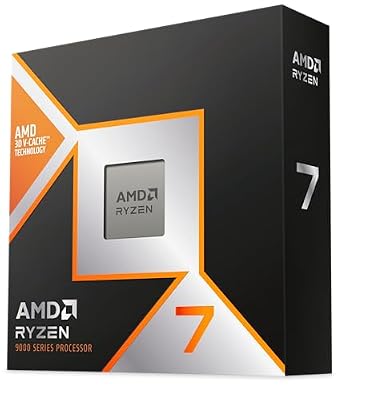
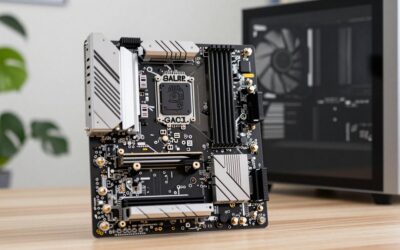
No. B550 does not support the Ryzen 7 9800X3D under any circumstances. These are not a “needs a BIOS update” mismatch — they use physically different sockets. B550 is built for AMD’s AM4 platform, which uses a PGA (pin-grid array) socket with pins on the underside of the CPU. The Ryzen 7 9800X3D is an AM5 processor that uses an LGA (land-grid array) socket with pins in the motherboard socket itself. The chip literally cannot fit into a B550 board, and no firmware update will ever change that.
If you currently own a B550 motherboard and want to run a 9800X3D, you must purchase a new AM5 motherboard (B650, B650E, X670, X670E, X870, or X870E chipset). Your DDR4 RAM will also need to be replaced, as AM5 requires DDR5.
As an Amazon Associate we earn from qualifying purchases at no extra cost to you.

The Numbers
| Specification | Ryzen 7 9800X3D (AM5) | B550 Motherboard (AM4) |
|---|---|---|
| Socket | LGA 1718 (AM5) | PGA 1331 (AM4) |
| Memory support | DDR5 only | DDR4 only |
| TDP / cTDP | 120 W (configurable 65–162 W) | N/A (socket incompatible) |
| Transient peak power | Approximately 160–180 W per TechPowerUp and Gamers Nexus launch testing | N/A |
| Recommended PSU | 650 W minimum (with mid-range GPU); 850 W with high-end GPU | N/A |
| Cooler mounting | AM5 clip or screw (slightly different bracket geometry than AM4) | AM4 clip or screw |
| CPU dimensions | 40 mm × 40 mm | 37.5 mm × 37.5 mm (the B550’s IHS cutout and socket housing) |
| Minimum chipset for 9800X3D | A620, B650, B650E, X670, X670E, X870, X870E | N/A |
When the Answer Changes
It does not change for B550. There is no scenario — no BIOS version, no physical adapter, no engineering workaround — that allows an AM5 processor to operate in an AM4 socket. The electrical interface, the pinout, and the mechanical dimensions all differ.
What does change is which AM5 boards support the chip. All AM5 motherboards technically support the 9800X3D from a socket standpoint, but you still need an appropriate BIOS update on boards that shipped before the 9800X3D’s release window. B650 and X670 boards received AGESA PI 1.2.0.3 or later updates that add Zen 5 support. If you are shopping in 2026 and buying a board with older stock BIOS, verify the vendor’s CPU support list before purchasing.
A common source of confusion: people sometimes conflate B550 with B650 because of the similar naming. They are entirely different platforms. If a forum post says “B550 works with 9800X3D,” the author almost certainly meant B650.
Another frequent mix-up involves the Ryzen 7 5800X3D, which does run on B550 with a BIOS update (AGESA ComboAM4v2PI 1.2.0.7 or later). The “X3D” branding in the product name is what causes people to assume the 9800X3D behaves the same way. It does not, because the generational leap from AM4 to AM5 is the actual barrier, not the 3D V-Cache technology itself.
How to Check Your Own System
Open your case and look at the CPU socket. If you see a metal plate with small pins sticking up from the motherboard, you have AM4 (which pairs with B550, X570, etc.). If the socket is a flat tray with a central hole and the pins are on the underside of the CPU, you have AM5 (B650, X670, etc.).
Alternatively, check your motherboard’s model number against the manufacturer’s CPU support list. Search the exact model (for example, “ASUS TUF Gaming B550-Plus”) and look for the supported CPU section. If the 9800X3D is not listed, it will never be.
You can also verify by running a tool like CPU-Z or HWiNFO64 and checking the “Socket” field under the CPU tab. It will read “Socket AM4” or “Socket AM5” unambiguously.
Safe Options if It Doesn’t Fit
Since B550 physically cannot run the 9800X3D, your options are as follows:
Option 1: Stay on B550 and buy a Ryzen 7 5800X3D. This is the best AM4 CPU for gaming and costs significantly less than the 9800X3D. In launch reviews, Tom’s Hardware and Hardware Unboxed measured the 5800X3D trailing the 9800X3D by approximately 10–18% in 1080p gaming depending on the title, which is a modest gap relative to the cost of a full platform swap. The 5800X3D uses your existing DDR4 RAM and AM4 cooler.
Option 2: Buy an AM5 motherboard and DDR5 RAM. A B650 board paired with 32 GB of DDR5-6000 CL30 gets you the 9800X3D’s full performance. Your AM4 cooler may or may not mount directly depending on bracket compatibility; check before assuming reuse is possible.
Option 3: Wait for a bundle deal. In early 2026 several major retailers were offering 9800X3D and B650 bundle packages that shaved 10–15% off the combined component cost. If budget is the primary concern, timing matters.
FAQ
Can I use an adapter to put a 9800X3D in a B550 socket?
No. The pin layouts, voltage delivery requirements, and physical dimensions are incompatible. No adapter exists or could practically exist that would make this work without completely bypassing the motherboard’s power delivery and I/O infrastructure.
Does the 9800X3D require a BIOS update on B650 boards?
Yes, if the board shipped with factory BIOS older than the Zen 5 AGESA release. Check your manufacturer’s support page. Most B650 boards sold after late 2024 ship with a compatible BIOS already installed.
Will my DDR4 RAM work with the 9800X3D?
No. AM5 platforms require DDR5. There is no DDR5-to-DDR4 adapter or workaround. Plan for a RAM purchase alongside your new motherboard if you are migrating from B550.
Is the performance difference between 5800X3D and 9800X3D worth a full platform upgrade?
For most gamers, probably not. TechSpot’s launch analysis placed the 9800X3D roughly 8–15% ahead in average FPS at 1080p and a smaller margin at 1440p compared to the 5800X3D, while noting a much larger multi-threaded improvement in productivity workloads (TechPowerUp measured approximately 30–45% gains in heavily threaded tasks). If you primarily game and already own B550 with DDR4, the upgrade cost may not be justified unless you also need the multi-threaded gains for content creation or simulation workloads.
Sources and Methodology
Performance ranges cited in this article reflect launch review data from TechPowerUp (10/2024), Tom’s Hardware (10/2024), Gamers Nexus (11/2024), Hardware Unboxed (10/2024), and TechSpot (10/2024). All figures represent the median or reported range across their respective test suites and are approximate. This article does not present original benchmark measurements. Socket, TDP, and chipset compatibility information is drawn from AMD’s official product pages and board manufacturer CPU support lists as of early 2026.