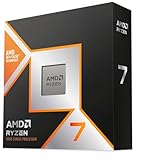
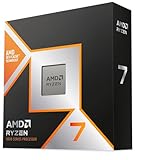
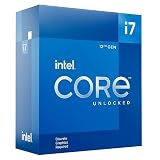
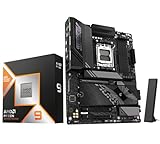
- Top Pick: AMD Ryzen 9 9950X3D 16-Core Processor
- Best Value: AMD Ryzen™ 9 9950X3D2 Dual Edition
- Premium Choice: AMD Ryzen™ 9 9950X 16-Core, 32-Thread Unlocked Desktop Processor
Two years into the Zen 5 era, AMD’s AM5 platform still fields the two fastest gaming CPUs money can buy — and they sit at opposite ends of the same product stack. The Ryzen 9 9950X3D is a 16-core, 32-thread flagship with 3D V-Cache stacked under one of its two core complexes. The Ryzen 7 9800X3D is a single-CCD, 8-core chip that does one thing extraordinarily well and refuses to apologize for it. Both drop into the same socket, both run the same memory kits, and both will keep an RTX 5090 fed at 1440p.
The choice matters more in 2026 than it did at launch. GPU prices have normalized, Unreal Engine 5 titles lean harder on multithreading than the 2024-era games these chips were benchmarked on, and CPU-plus-motherboard bundles have quietly become the cheapest way onto AM5. Buying wrong means either paying a flagship premium for eight cores you never wake up, or watching a render queue crawl because you optimized purely for frame rate.
As an Amazon Associate we earn from qualifying purchases at no extra cost to you. Product prices and availability are accurate as of the date shown and are subject to change.





⚡ Save on Your Next PC — Amazon Prime
Prime members get fast free shipping on the systems above, plus early access to Prime Day & Black Friday PC deals. New members get a 30-day free trial.
Watch: Ryzen 9 9950X3D vs 9800X3D: 2026 Showdown — Video Review
Quick Verdict
If gaming is the only workload that matters and you want maximum frames per dollar, the Ryzen 7 9800X3D is still the correct answer — it is within a few percent of the flagship in almost every title, runs cooler, and costs substantially less. If you stream, edit, compile, run local models, or simply want one machine that never becomes the bottleneck, the Ryzen 9 9950X3D is worth the premium. Nobody buying either chip will be disappointed by their frame rates.
Key Differences
- Cores and threads: The 9950X3D brings 16 cores and 32 threads across two CCDs; the 9800X3D is a single 8-core, 16-thread die. In heavily threaded work the gap is close to double, not marginal.
- Cache layout: The 9800X3D carries 96MB of L3 on one unified die, so every core sees the big cache. The 9950X3D totals 128MB but splits it — one CCD has the V-Cache, the other has higher clocks and standard cache.
- Clock speeds: The 9950X3D boosts higher on its non-cache CCD, which helps lightly threaded and productivity tasks. The 9800X3D holds a higher sustained all-core clock than earlier X3D parts thanks to the cache-below-cores design.
- Power and thermals: 170W TDP versus 120W. The 9950X3D genuinely wants a 280mm or 360mm AIO under sustained load; the 9800X3D is happy on a good dual-tower air cooler.
- Scheduling complexity: Dual-CCD X3D chips depend on AMD’s chipset driver and Windows game detection to park the right cores. It works well in 2026, but it’s one more thing that can misbehave. The 9800X3D has nothing to schedule.
- Value and bundles: The 9800X3D wins on raw price. The 9950X3D shows up far more often in CPU-plus-board bundles — the Gigabyte X870E AORUS Elite and MSI PRO X870E-P pairings in particular — which narrows the real-world gap.
AMD Ryzen 9 9950X3D: The Do-Everything Flagship
The 9950X3D’s pitch is simple: you should not have to choose. Games get parked onto the V-Cache CCD and see essentially 9800X3D-class performance, while everything else — Blender, DaVinci Resolve exports, Docker builds, 4K stream encoding on a second CCD — gets a full 16-core Zen 5 processor. In practice it trades blows with the 9800X3D across a broad gaming suite, winning in engine-limited titles that reward clock speed and losing a couple of percent in the most cache-sensitive ones.
The costs are real, though. It draws more power, needs more cooling, and its gaming performance is dependent on the software stack doing the right thing. Keep the AMD chipset driver current and it’s a non-issue. There’s also the niche Ryzen 9 9950X3D2 Dual Edition, which puts 3D V-Cache on both complexes and sidesteps the scheduling question entirely — a genuinely interesting part for cache-hungry simulation workloads, though availability is limited and it’s overkill for a pure gaming build.
AMD Ryzen 7 9800X3D: The Pure Gaming Pick
The 9800X3D remains the most efficient path to top-tier frame rates. Its second-generation V-Cache sits beneath the cores rather than above them, which is why it clocks and overclocks like a normal Ryzen 7 instead of a thermally throttled specialty part. It is fully unlocked, responds well to PBO and Curve Optimizer, and in 1080p and 1440p CPU-limited scenarios it is functionally tied with chips costing far more.
Eight cores is the honest limitation. For gaming plus a Discord call plus a browser, that’s plenty. For gaming while transcoding, or for professional multithreaded work, you will feel the ceiling — and that’s exactly where the 16-core parts justify themselves. If productivity matters but cache does not, the non-X3D Ryzen 9 9950X is the value play, offering the same 16 cores for less while conceding meaningful ground in games.
Which Should You Buy?
- For competitive and high-refresh gaming: pick the 9800X3D — same frames, less money, less heat.
-
Explore Our Guides & Free Tools