
The Arc B580 is the better gaming purchase for most 2026 buyers because it offers stronger 1440p performance, 12GB of faster VRAM, and considerably better ray tracing; choose the Radeon RX 7600 XT instead if you value AMD’s more mature drivers, 16GB of VRAM, lower platform complexity, or a particularly good discount.
- Arc B580 vs RX 7600 XT: specifications at a glance
- 1080p gaming performance
- 1440p gaming: the B580 pulls further ahead
- VRAM: RX 7600 XT has the capacity advantage
- Ray tracing and upscaling support
- Power use, connectors, and system requirements
- Driver maturity and compatibility
- Current value in 2026
- Verdict: which GPU should you buy?
Quick answer: Our top pick in 2026 is the GPU generation — our #1 rated choice. See the full ranked comparison, alternatives and buying advice below.
Arc B580 vs RX 7600 XT: specifications at a glance
| Specification | Intel Arc B580 | AMD Radeon RX 7600 XT |
|---|---|---|
| GPU generation | Xe2, Battlemage | RDNA 3 |
| Video memory | 12GB GDDR6 | 16GB GDDR6 |
| Memory bus | 192-bit | 128-bit |
| Memory bandwidth | 456GB/s | 288GB/s |
| Rated board power | 190W | 190W |
| Upscaling | XeSS, FSR support in compatible games | FSR, XeSS support in compatible games |
| Ray-tracing hardware | Yes | Yes |
| Recommended target | High-refresh 1080p or 1440p | High-refresh 1080p, entry-level 1440p |
Both cards are nominally 190W products, so the important differences are not basic power draw. The Arc B580 has a wider memory interface and substantially more bandwidth, while the RX 7600 XT has 4GB more capacity. That makes the choice a performance-versus-capacity decision rather than a simple “more VRAM is better” comparison.

GIGABYTE Radeon RX 7600 XT Gaming OC 16G Graphics Card, 3X WINDFORCE Fans 16GB 128-bit GDDR6, GV-R76XTGAMING OC-16GD Video Card (Renewed)
Included for 'Arc B580 vs RX 7600 XT: Which GPU Should You Buy?' because the listing specifies 3X WINDFORCE Fans 16GB 128-bit GDDR6 and GV-R76XTGAMING OC-16GD Video Card (Renewed), details this guide uses to compare options.
View on Amazon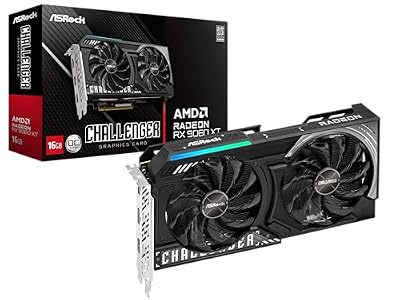
ASRock Radeon RX 9060 XT Challenger 16GB OC, RDNA 4, 3290MHz Boost, 16GB GDDR6 128-bit, PCIe 5.0, Dual Fans, 0dB Silent, LED Indicator, DisplayPort 2.1a, HDMI 2.1b
Included for 'Arc B580 vs RX 7600 XT: Which GPU Should You Buy?' because the listing specifies RDNA 4 and 3290MHz Boost, details this guide uses to compare options.
View on AmazonGIGABYTE Radeon RX 7600 XT Gaming OC 16G Graphics Card, 3X WINDFORCE Fans 16GB 128-bit GDDR6, GV-R76XTGAMING OC-16GD Video Card
Included for 'Arc B580 vs RX 7600 XT: Which GPU Should You Buy?' because the listing specifies 3X WINDFORCE Fans 16GB 128-bit GDDR6 and GV-R76XTGAMING OC-16GD Video Card, details this guide uses to compare options.
View on Amazon1080p gaming performance
At 1080p, both GPUs are suitable for modern games, but the Arc B580 is typically the faster card in published comparisons. Depending on the game, CPU, graphics preset, and patch, the difference can range from negligible to roughly 15–30% in the B580’s favor. The largest gains usually appear in newer games, demanding engines, and titles that benefit from the B580’s stronger memory subsystem.
In practical terms, either card can often deliver well over 60 frames per second at high settings in ordinary 1080p games. Competitive games may run far faster, although the CPU becomes an important limit at high frame rates. If you are targeting a 144Hz or 165Hz monitor, the B580 gives you more headroom in demanding releases, while the RX 7600 XT remains competent when settings are adjusted.
Do not treat any FPS range as a guarantee. Results vary substantially with the processor, resizable BAR or Smart Access Memory configuration, game version, driver, and whether ray tracing is enabled.
1440p gaming: the B580 pulls further ahead
1440p places greater pressure on memory bandwidth and GPU throughput, which generally benefits the Arc B580. Across published reviews, it commonly delivers approximately 60–90 FPS at high settings in many modern rasterized games, while the RX 7600 XT often lands around 50–80 FPS under comparable conditions. These are broad typical ranges, not fixed results; demanding games can fall below them and lighter games can exceed them.
The B580’s 456GB/s of bandwidth is 1.58 times the RX 7600 XT’s 288GB/s. That does not translate directly into 58% more FPS, because shader performance, game engines, and CPU limits also matter. It does explain why the B580 tends to retain performance better when moving from 1080p to 1440p.
A useful resolution calculation
1440p renders 3,686,400 pixels per frame, compared with 2,073,600 pixels at 1080p. That is about 78% more pixels. At 144Hz, the display workload rises from approximately 291 million pixels per second at 1080p to about 516 million pixels per second at 1440p, before accounting for shading, textures, and effects.
This is why a card that feels comfortably fast at 1080p may need upscaling or reduced settings at 1440p. The B580’s wider bus does not remove that workload, but it gives the card more bandwidth to feed its rendering hardware.
VRAM: RX 7600 XT has the capacity advantage
The RX 7600 XT’s 16GB of VRAM is attractive for heavily modded games, large texture packs, and future releases. It can also help prevent texture-streaming problems when a game’s ultra texture setting exceeds what a 12GB card handles comfortably. However, VRAM capacity is only one part of memory performance: the B580’s 12GB is connected through a 192-bit bus and has 456GB/s of bandwidth, compared with 128-bit and 288GB/s on the RX 7600 XT.
For a normal 1080p or 1440p build using high rather than ultra texture settings, 12GB is generally workable in 2026. At 4K, with ray tracing and high-resolution texture packs, neither card is an ideal long-term choice. The RX 7600 XT is safer when your priority is avoiding VRAM exhaustion, but the B580 is usually faster before that limit is reached.
VRAM decision rule
- Choose the B580 if you play standard, unmodded games at 1080p or 1440p and want higher average FPS.
- Choose the RX 7600 XT if you install large texture mods, keep cards for many years, or regularly use settings that exceed 12GB.
- Do not select “ultra” textures automatically. If VRAM usage approaches the card’s capacity, reduce texture quality one step before lowering resolution; textures often have a smaller visual impact on image sharpness.
Ray tracing and upscaling support
The Arc B580 is normally the stronger ray-tracing option. Its newer Xe2 architecture provides better RT performance than the RX 7600 XT in many published game comparisons, although the exact gap depends on the engine. At 1440p with ray tracing, both cards may need upscaling and reduced effects, but the B580 is more likely to maintain a playable frame rate.
Intel XeSS is available in a growing selection of games and can provide a good quality-performance balance when its game integration is competent. AMD’s FSR has broader adoption across the PC and console ecosystem, and FSR support can often be enabled on either GPU. Upscaling is not exclusive to the company that makes the graphics card.
For a demanding title, a sensible starting point is 1440p output with the game’s Quality upscaling mode, ray tracing set to medium, and shadows one step below maximum. If performance remains below your monitor’s target, use Balanced upscaling before disabling every visual effect. Frame-generation features can improve displayed smoothness where supported, but they do not replace adequate base rendering performance and can add latency or visual artifacts.
Power use, connectors, and system requirements
Both cards have a rated board power of 190W, so neither has a major efficiency advantage on paper. A quality 550W power supply is commonly sufficient for a typical single-GPU system, assuming a mainstream processor and no extreme overclocking. A 650W unit provides more comfortable headroom for a higher-power CPU, additional drives, or future upgrades.
Actual wall power depends on the specific board design, game, frame rate, and power limit. Capping an uncapped menu or a 300-FPS esports game can reduce consumption far more effectively than choosing between these two cards. Check the exact model’s power connector and output configuration before buying, since board partners can vary in cooler size, connector choice, and port layout.
Driver maturity and compatibility
AMD has the longer-established driver ecosystem. The RX 7600 XT is the safer low-maintenance choice for older games, unusual software combinations, and users who do not want to troubleshoot a new graphics platform. AMD’s Adrenalin software also provides a familiar set of tuning, recording, and overlay features.
Intel’s Arc drivers have improved significantly, and the B580 is a much more practical choice than early Arc cards. Nevertheless, game-to-game behavior can still be less predictable, especially in older DirectX 9 or DirectX 11 titles. A modern system should have Resizable BAR enabled, current motherboard firmware, and up-to-date chipset and graphics drivers. Without Resizable BAR, Arc performance can suffer noticeably in some workloads.
Before buying the B580, verify that your motherboard supports Resizable BAR, your processor platform is reasonably modern, and you are comfortable updating drivers. This is not a reason to reject the card, but it is part of its real ownership cost.
Current value in 2026
Market pricing changes by region and board model, but the Arc B580 is usually found around $250–$300, while the RX 7600 XT commonly sits around $300–$350. At those general ranges, the B580 offers better value for average FPS, 1440p gaming, and ray tracing. The RX 7600 XT becomes compelling when it is at least roughly $50 cheaper than the B580 or when its extra VRAM directly matches your workload.
| Your situation | Better choice | Reason |
|---|---|---|
| 1440p high settings and rasterized games | Arc B580 | Higher typical performance and 456GB/s bandwidth |
| Ray tracing at 1080p or 1440p | Arc B580 | Generally stronger RT performance and useful XeSS support |
| Large texture mods and long-term VRAM priority | RX 7600 XT | 16GB capacity provides more memory headroom |
| Older games or minimal troubleshooting | RX 7600 XT | More mature driver history and broad compatibility |
| B580 costs no more than the RX 7600 XT | Arc B580 | Stronger overall gaming value |
| RX 7600 XT is at least $50 cheaper | RX 7600 XT | The discount can outweigh its performance disadvantage |
Verdict: which GPU should you buy?
Buy the Arc B580 for the best all-around gaming value. It is typically faster at 1080p, more convincing at 1440p, better suited to ray tracing, and equipped with a wider memory interface. It is the stronger choice for a new gaming PC when the price is similar and your system supports Resizable BAR.
Buy the RX 7600 XT when 16GB of VRAM matters more than peak performance, when you play many older titles, or when its street price is substantially lower. Its extra memory does not make it the faster card, but it can make it the less restrictive card for texture-heavy and modded games.
Ready to decide? Our #1 pick for 2026 is the GPU generation.
Live price & availability on Amazon.









