
A monitor cannot fix Tarkov’s uneven frame rates or make distant players magically easier to see, but it can make movement cleaner and give you a sharper image to work with. The best gaming monitor for tarkov for most players is a 27-inch, 2560 × 1440 display with a genuinely fast panel and variable refresh rate. OLED is the premium option for instant pixel response and deep shadows; fast IPS is the sensible alternative if you want to avoid burn-in concerns or play for long sessions with static HUD elements.
- Quick verdict: which monitor should you choose?
- Quick comparison table
- How we selected these monitors
- Dell Alienware AW2725DF — best overall
- LG 27GX790B-B — best premium high-refresh option
- Dell Alienware AW2726DM — best entry-level 240Hz OLED
- ASUS ROG Swift PG27AQN — best competitive LCD
- Gigabyte M27Q X — best for gaming and everyday work
- MSI MAG 274QPF X30MV — best high-refresh Mini LED LCD
- What matters most when buying a Tarkov monitor
- Frequently asked questions
- Final verdict
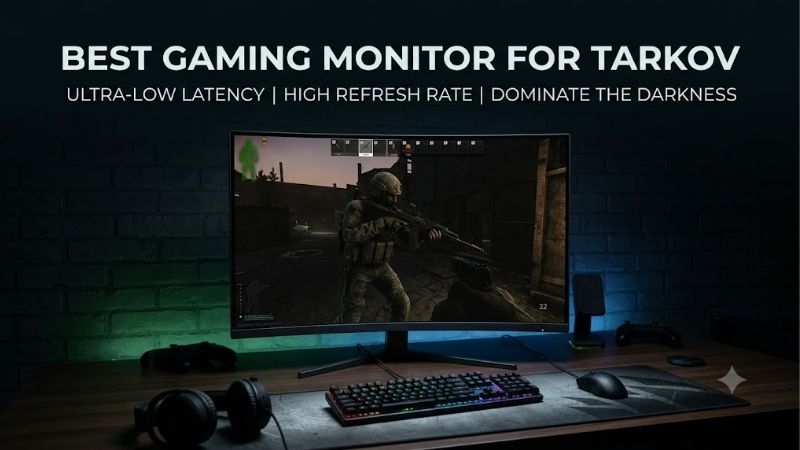
Quick answer: For most people in 2026, the best gaming monitor for tarkov is the Monitor — our #1 rated choice. See the full ranked comparison, alternatives and buying advice below.
Quick verdict: which monitor should you choose?
The Dell Alienware AW2725DF is the strongest all-round premium pick, thanks to its 1440p 360Hz QD-OLED panel and exceptionally crisp motion. For players with a very fast PC, the LG 27GX790B-B reaches 540Hz at 1440p or 720Hz at 720p; the ASUS PG27AQN offers 360Hz without OLED. Most players will be well served by a good 240Hz monitor. Tarkov’s performance changes by map, patch, settings, and system, and a high-refresh screen cannot create frames or fix game-engine stutters.
Quick comparison table
| Monitor | Best fit | Main deciding attributes | Main drawback |
|---|---|---|---|
| Dell Alienware AW2725DF | Best overall | 27-inch 1440p QD-OLED, 360Hz, very fast response | OLED burn-in precautions; limited HDMI bandwidth |
| LG 27GX790B-B | Premium high-refresh play | 1440p Tandem OLED, 540Hz; 720Hz at 720p | Expensive, and 720Hz requires lower resolution |
| Dell Alienware AW2726DM | Entry-level 240Hz OLED | 1440p QD-OLED, 240Hz, 0.03ms rated response | Limited brightness and HDMI refresh support |
| ASUS ROG Swift PG27AQN | Competitive non-OLED | 1440p Fast IPS, 360Hz, G-SYNC and ULMB 2 | Expensive for an older LCD design; weaker black levels than OLED |
| Gigabyte M27Q X | Gaming plus desk work | 1440p IPS, 240Hz, USB-C and KVM | Moderate contrast; check the product revision |
| MSI MAG 274QPF X30MV | High-refresh Mini LED LCD | 1440p, 300Hz, 1,152-zone Mini LED | VA dark-scene smearing and possible VRR flicker |
How we selected these monitors
We prioritized motion handling, resolution, input lag, adaptive sync, dark-scene behavior, and practical everyday use. RTINGS’ independent monitor reviews informed response, input lag, contrast, VRR, and known drawbacks; manufacturer pages confirmed key specifications and stated warranty details. Response-time marketing figures are not treated as directly comparable test results.
No monitor was tested side by side inside Tarkov, and no Tarkov FPS scores are claimed. Recommendations combine general monitor testing with verified specifications. Picture modes cannot reveal a target that the game has not rendered or that is hidden by foliage or line of sight. We also favored standard 16:9 desktop displays over ultrawides because they are easier to compare at the same resolution and refresh rate. Price-sensitive labels are avoided where a consistent, date-stamped US price comparison was not completed.
Dell Alienware AW2725DF — best overall
The AW2725DF is a strong default for players who want sharp motion and high image quality without paying for a 480Hz panel. Its 26.7-inch QD-OLED screen runs at 2560 × 1440 and 360Hz over DisplayPort. RTINGS reports near-instantaneous response, very low input lag, and deep blacks in dark rooms—useful characteristics for tracking movement and reading scene detail.
Per-pixel OLED lighting can keep dark areas black beside bright highlights, while fast pixel transitions reduce trailing during quick turns. That improves image quality, but it cannot guarantee that enemies in shadows become easier to see; the game’s own rendering and settings still matter.
The drawbacks are noticeable VRR flicker when frame rates fluctuate and black levels that can look lifted in strong ambient light. Its HDMI bandwidth is limited compared with full-bandwidth HDMI 2.1 gaming displays, so DisplayPort is best for PC use at 1440p/360Hz. Dell states that its three-year warranty includes OLED burn-in coverage.
Buy if: you want premium 1440p motion clarity and usually play in controlled lighting.
Skip if: your room is very bright, OLED care is a deal-breaker, or your PC rarely sustains high frame rates.
LG 27GX790B-B — best premium high-refresh option
The 27GX790B-B is a newer 27-inch OLED built around an RGB Tandem OLED panel. LG lists native 2560 × 1440 at 540Hz, with a dual mode that reaches 720Hz only when resolution drops to 720p. Its headline features include a 0.02ms GTG claim, DisplayPort 2.1, HDMI 2.1, G-SYNC compatibility, and FreeSync Premium Pro. RTINGS’ independent review reports very sharp motion and low input lag.
This is for players who want one of the fastest current displays and can feed it very high frame rates. At 540Hz, a refresh interval is about 1.85ms, but the game still has to render frames at that pace for the extra headroom to matter. The 720Hz mode reduces resolution to 720p, which is a major trade-off for spotting fine detail in Tarkov; most players should stay at native 1440p.
The RGB Tandem panel is brighter than older OLED generations, and its matte coating reduces reflections, but it can look hazier than a glossy screen and OLED still needs burn-in precautions. RTINGS notes distracting VRR flicker with changing frame rates and some HDR accuracy issues. This is a premium specialist pick, not an upgrade that will fix unstable frame times.
Buy if: you also play high-FPS competitive shooters and want 540Hz at native 1440p.
Skip if: you cannot approach very high frame rates or would be tempted to sacrifice 1440p clarity just to claim 720Hz.
Dell Alienware AW2726DM — best entry-level 240Hz OLED
The AW2726DM is a 26.5-inch QD-OLED monitor with a 2560 × 1440 resolution, 240Hz refresh, and a 0.03ms GTG specification. RTINGS independently found very fast response, low input lag, and deep blacks, making it a practical way to get OLED motion clarity without paying for a 360Hz or 540Hz ceiling. Dell’s US product page lists a three-year OLED burn-in warranty.
It is deliberately simpler than premium displays. The screen is rated at around 200 nits for typical SDR use, so it is not ideal for a very bright room, and the HDMI inputs are limited to 1440p at 120Hz. Connect a gaming PC over DisplayPort to use the full 240Hz refresh. There is no USB hub, either, so its appeal is the panel rather than extra desk connectivity.
QD-OLED offers rich color and strong contrast, but black levels can look purple under bright ambient light. The screen’s anti-burn-in features reduce risk rather than eliminating it, so leave its protection functions enabled. A 240Hz ceiling is plenty for many Tarkov players, especially when stable 240 FPS is unrealistic on their current system.
Buy if: you want an OLED panel and 240Hz performance without investing in flagship refresh rates.
Skip if: you need high full-screen brightness, a USB hub, or HDMI high-refresh support beyond 120Hz.
ASUS ROG Swift PG27AQN — best competitive LCD
The PG27AQN is a 27-inch 1440p Fast IPS monitor with a 360Hz ceiling. It avoids OLED-specific burn-in risks, and ASUS lists G-SYNC, ULMB 2 backlight strobing, NVIDIA Reflex Analyzer, and DisplayPort 1.4 with DSC. RTINGS’ independent testing reports excellent motion handling and a responsive feel. IPS also avoids the dark-transition smearing seen on some VA panels.
The compromise is contrast. Dark rooms look grayer than on OLED, and ASUS rates typical contrast at 1,000:1. The PG27AQN is also a mature, premium-priced design, so its strengths need to matter to you. Use DisplayPort and confirm that Windows and the GPU control panel are set to the intended refresh rate. ULMB 2 can improve clarity in supported configurations, but it has operating restrictions and may reduce brightness.
Buy if: you want fast 1440p LCD performance, especially with an NVIDIA GPU, and prefer to avoid OLED care.
Skip if: deep blacks are your priority or you rarely exceed 200–240 FPS.
Gigabyte M27Q X — best for gaming and everyday work
The M27Q X is a 27-inch 1440p IPS display with a 240Hz ceiling. Gigabyte lists 350-nit typical brightness, DisplayHDR 400, USB-C video, and a KVM function for sharing a keyboard and mouse between two computers. That mix suits a desk used for gaming and everyday work rather than a setup dedicated solely to esports.
RTINGS found low input lag and fast response at high refresh rates, with more blur at lower refresh rates and modest contrast. An advertised 1ms GTG rating does not describe every pixel transition at every refresh. Its limited native contrast means dark scenes look grayer than on OLED or a good Mini LED display.
Check the revision before buying. RTINGS tested revision 1.0 and notes that revision 2.0 exists; specifications are similar, but retailer inventory may not make the version obvious. It also lacks HDMI 2.1 bandwidth, which matters less for a DisplayPort PC setup than for console use.
Buy if: you want 240Hz IPS plus USB-C/KVM convenience.
Skip if: dark-room contrast is a priority or a newer alternative is similarly priced.
MSI MAG 274QPF X30MV — best high-refresh Mini LED LCD
The X30MV combines a 27-inch 1440p Rapid VA panel, 300Hz refresh, and 1,152-zone Mini LED backlight. MSI lists 400-nit typical SDR brightness, 1,000-nit peak HDR brightness, HDMI 2.1, and adaptive sync. RTINGS’ September 2026 review reports low input lag, fast response, and strong HDR contrast.
Mini LED can deepen blacks while keeping highlights bright, and its high brightness suits rooms where OLED screens may struggle. The drawback is important for Tarkov: RTINGS reports visible black smearing around moving objects in dark scenes, distracting VRR flicker with changing frame rates in dark content, and some haloing around highlights. Those issues make it a trade-off rather than a universal competitive pick.
Consider it if you prioritize bright-room use and Mini LED contrast. If tracking movement in dark interiors is the main concern, fast IPS or OLED is safer. Check the exact code MAG 274QPF X30MV; similarly named MSI models may have different specifications.
Buy if: you want high-refresh Mini LED brightness and accept its measured VA limitations.
Skip if: dark-scene smearing or VRR flicker bothers you.
What matters most when buying a Tarkov monitor
Choose resolution before chasing refresh rate
For most desktops, 27 inches at 2560 × 1440 is the best starting point. It is sharper than 1080p at a similar size without the rendering load of native 4K. Extra pixel detail helps only when settings, anti-aliasing, and render scale preserve it; a monitor cannot recover detail lost to low settings or aggressive upscaling.
A 24- or 25-inch 1080p screen makes sense if you deliberately lower resolution for frame rate or prefer a smaller competitive display. Native 4K is sharper but harder to drive at very high frame rates. Ultrawide offers more horizontal space but changes the field of view and requires checking current game support, so 16:9 is the safer default.
Match refresh rate to real frame rates
Refresh rate is how often the display can update; frame rate is how often the PC renders an image. At 240Hz, the refresh interval is about 4.17ms; at 360Hz, 2.78ms; at 480Hz, 2.08ms; and at 540Hz, 1.85ms. Higher refresh helps most when the PC supplies new frames at a similar pace.
Check frame rates and frame times during real raids, not just an empty-area benchmark. Adaptive sync can reduce tearing when FPS varies, but cannot eliminate stutters originating in the game or PC. If you usually see 120–220 FPS, a good 240Hz screen is a sensible choice. Pay for 360Hz or 540Hz when your system and other games can use the extra headroom. The LG’s 720Hz mode is tied to 720p, so it is a poor default for a detail-heavy game.
Remember that enabling frame generation, where available, can raise displayed FPS but does not make generated frames identical to newly rendered frames or fix underlying frame-time spikes. For competitive decisions, judge responsiveness in actual play rather than relying on a single overlay number.
Panel type changes how dark scenes look
OLED pairs very fast pixel transitions with per-pixel blacks, but can burn in, often has lower full-screen brightness than bright LCDs, and may render fine text less crisply. Keep protection routines enabled. IPS usually offers good motion, viewing angles, and text with no OLED burn-in risk, but its blacks look grayer in dark rooms. VA offers higher native contrast and often pairs with Mini LED, yet some models smear during dark transitions—a meaningful downside when tracking motion against shadowed backgrounds. Independent motion tests matter more than the GTG number alone.
Do not buy for a marketing response-time number
A 0.03ms or 1ms claim is a manufacturer specification, not a direct comparison of the whole monitor. Actual response changes by panel, refresh rate, overdrive, and pixel transition. Excessive overdrive can create inverse trails; some VA panels remain slow in dark transitions. Check independent tests at multiple refresh rates.
Input lag and pixel response are different: one measures signal-to-screen delay, the other measures how quickly pixels change. Neither fixes game-engine delays, inconsistent frame pacing, or network problems.
Check the signal path and set it up properly
Use a suitable DisplayPort cable for high-refresh PC gaming and confirm the GPU and input support the target resolution. Some DisplayPort 1.4 modes need Display Stream Compression. Then select the maximum refresh rate in Windows, enable adaptive sync in the monitor and GPU settings, and verify the game resolution.
Start with balanced brightness and avoid settings that crush shadows. “Black equalizer” or “Shadow Boost” can lift dark areas but also flatten contrast or make bright details harder to judge. Change one setting at a time and compare the same scene. Keep the screen away from direct window glare, which reduces perceived contrast—particularly on OLED.
Avoid stacking the monitor’s shadow enhancement on top of aggressive driver-level color filters until you know what each change does. If you use an ICC profile or a calibrated preset for work, keep a separate gaming profile so you can switch back without losing your preferred desktop image.
Frequently asked questions
Is 240Hz enough for Escape from Tarkov?
Yes. A good 240Hz display is smooth without requiring the frame rates needed to fully use 360Hz or 540Hz. Higher refresh is worth considering if actual raids deliver consistently high FPS and you play other competitive games.
Is OLED better than IPS for Tarkov?
OLED usually wins on pixel response and black levels. IPS avoids OLED burn-in concerns and suits mixed work, but has lower contrast. Neither panel type guarantees better enemy visibility; game lighting and settings matter.
Does a 360Hz monitor make Tarkov run at 360 FPS?
No. The PC and game must render 360 FPS to fully use 360Hz. CPU and GPU limits, map complexity, memory, patches, and settings affect performance. Adaptive sync can help lower or fluctuating frame rates look smoother, but cannot create missing frames.
Should I choose 1440p or 4K?
1440p is the balanced choice for high-refresh play: sharper than 1080p at 27 inches and easier to drive than native 4K. Choose 4K if your GPU can maintain the desired frame rate or resolution matters more than refresh.
Can monitor settings help me spot players in shadows?
They change how shadows appear but cannot reliably reveal every target. Modest shadow lifting may help in some scenes; aggressive settings can wash out contrast. Start neutral, avoid crushed blacks, and change one setting at a time. No monitor feature substitutes for line of sight or correct in-game settings.
Also avoid judging a monitor only from showroom HDR demos: check ordinary SDR gameplay, since HDR badges and peak brightness are not reliable measures of competitive clarity.
Final verdict
For most serious Tarkov players, the Dell Alienware AW2725DF best combines 1440p, 360Hz, OLED contrast, and fast response. The Dell Alienware AW2726DM is a more measured 240Hz OLED choice, while the ASUS PG27AQN suits buyers who prefer fast IPS. Choose the LG 27GX790B-B’s 540Hz ceiling only if your system can use it. The MSI X30MV brings bright Mini LED contrast, but its dark-scene smearing may trouble competitive players.
Buy the right size and resolution first, then ensure your PC can drive it before paying extra for refresh rate. Stable frame times and balanced image settings matter more than the largest number on the box.
Editorial Source Log
Research date: October 12, 2026. US-market specifications and review pages were checked on this date. No direct Tarkov side-by-side monitor test or benchmark data was provided, so recommendations are based on manufacturer specifications and independent general monitor testing, not claimed in-game detailed research.
1. Dell Alienware AW2725DF — official specs and US warranty details: https://www.dell.com/en-us/shop/alienware-27-360hz-qd-oled-gaming-monitor-aw2725df/apd/210-bljd/monitors-monitor-. Independent testing: https://www.rtings.com/monitor/reviews/dell/alienware-aw2725df. RTINGS reports 1440p, 360Hz QD-OLED behavior, very fast response, low input lag, VRR flicker, HDMI bandwidth limitation, and OLED risks. Official Dell page states three-year Advanced Exchange and Premium Panel Exchange including burn-in.
Amazon verification: RTINGS exposes an Amazon price link, but this research did not verify a specific live Amazon listing, seller, stock status, or price.
2. LG 27GX790B-B — official US specifications: https://www.lg.com/us/monitors/lg-27gx790b-b-gaming-monitor. Independent testing updated October 5, 2026: https://www.rtings.com/monitor/reviews/lg/27gx790b-b. LG lists native 2560 × 1440 at 540Hz and dual-mode 720Hz at 720p, with DisplayPort 2.1. RTINGS reports sharp motion, low input lag, VRR flicker, and some HDR accuracy issues.
Amazon verification: the RTINGS page has an Amazon search link, but no exact live offer, seller, stock status, or price was independently confirmed.
3. Dell Alienware AW2726DM — official US model and warranty page: https://www.dell.com/en-us/shop/monitors/apd/alienware-27-240hz-qd-oled-gaming-monitor-aw2726dm/aw2726dm/-. Independent testing: https://www.rtings.com/monitor/reviews/dell/alienware-aw2726dm. Official specs confirm 26.5-inch QD-OLED, 2560 × 1440, 240Hz and 0.03ms GTG; Dell’s US page states a three-year OLED burn-in warranty and HDMI inputs limited to QHD/120Hz. RTINGS reports fast response and low input lag, with limited brightness and high-bandwidth connectivity.
Dell’s US store product page showed $319.99 in the page snapshot retrieved for this research; the price can change: https://www.dell.com/en-us/shop/monitors/apd/alienware-27-240hz-qd-oled-gaming-monitor-aw2726dm/aw2726dm/jw05f. Amazon verification: not independently confirmed.
4. ASUS ROG Swift PG27AQN — official specifications: https://rog.asus.com/us/monitors/27-to-31-5-inches/rog-swift-360hz-pg27aqn-model/spec/. Independent testing: https://www.rtings.com/monitor/reviews/asus/rog-swift-360hz-pg27aqn/. ASUS lists 27-inch 1440p Fast IPS, up to 360Hz, G-SYNC, and ULMB 2. The independent test supports the motion-handling and responsive-play claims.
Amazon verification: the review has retailer links, but a specific current Amazon offer was not verified.
5. Gigabyte M27Q X — official specification page for Rev. 1.0: https://www.gigabyte.com/vn/Monitor/M27Q-X-rev-10/sp. Independent testing: https://www.rtings.com/monitor/reviews/gigabyte/m27q-x. RTINGS tested Rev. 1.0 and notes a Rev. 2.0 exists; the exact inventory revision may vary. Manufacturer specs list 27-inch 1440p SS IPS, 240Hz and USB-C; RTINGS notes USB-C/KVM features, limited contrast and lack of HDMI 2.1 bandwidth.
6. MSI MAG 274QPF X30MV — official US model specifications: https://us.msi.com/Monitor/MAG-274QPF-X30MV/Specification. Independent testing updated October 2026: https://www.rtings.com/monitor/reviews/msi/mag-274qpf-x30mv. Official specifications confirm 1440p Rapid VA, 300Hz and 1,152-zone Mini LED. RTINGS confirms fast gaming response and low input lag while identifying black smearing, VRR flicker in dark content, and haloing.
7. Context source — AOC Q27G3XMN, used to check current Mini LED trade-offs: https://www.rtings.com/monitor/reviews/aoc/q27g3xmn. RTINGS describes its 180Hz 1440p VA Mini LED panel, good contrast, and some black smearing.
Measured article body: 2,699 words, excluding SEO Title, Meta Description, and Editorial Source Log. Editorial limitations: no exact market-wide live price comparison was performed, so no product is called “best budget” or “best value” based on price. The review pages include retailer links, but those were not treated as proof of a current Amazon price or stock. No Build-PC-Guide existing URLs were supplied, so a cannibalization check against the site could not be completed.
Ready to decide? Our #1 pick for 2026 is the Monitor.
Live price & availability on Amazon.









