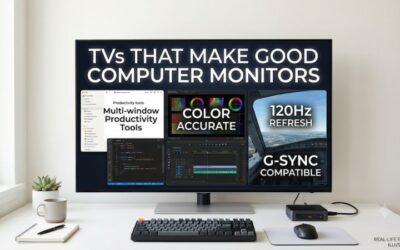
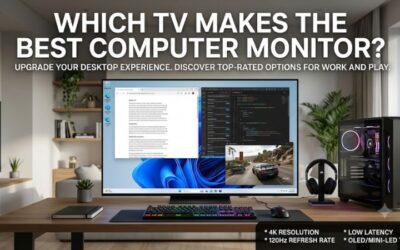
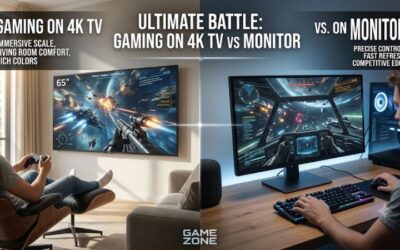
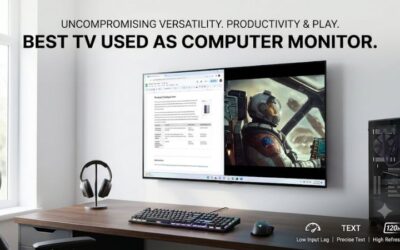
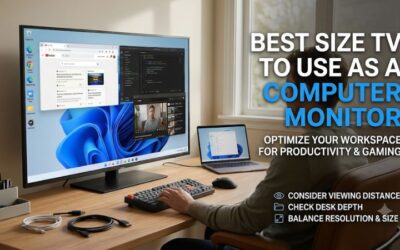
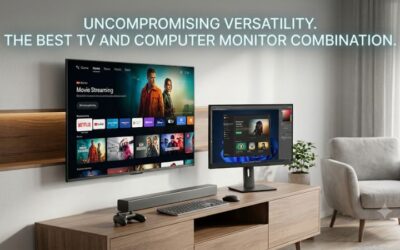
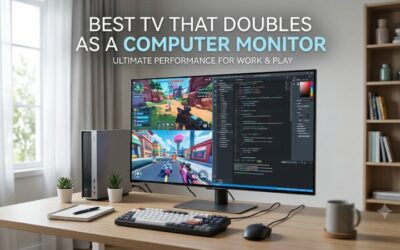
A large TV can replace a traditional computer monitor when you want more screen space for PC gaming, entertainment, multitasking and media consumption. However, size alone does not make a television suitable for desktop use. Resolution, text clarity, input lag, refresh rate, HDMI bandwidth and viewing distance all matter. For shoppers searching best large tv for computer monitor, the LG OLED evo C6 is an excellent overall choice, while the Samsung S90H, LG B5 and TCL QM7L offer alternatives for different rooms, budgets and gaming requirements.
- Best large TV for computer monitor use: Quick verdict
- Quick comparison of the best large TVs for computer monitors
- How we selected these large TVs
- Best OLED TVs for computer monitor use
- Best Mini LED TVs for large PC setups
- How to choose the best large TV for computer monitor setups
- FAQs about large TVs as computer monitors
- Final verdict: Which large TV should you buy for your computer?
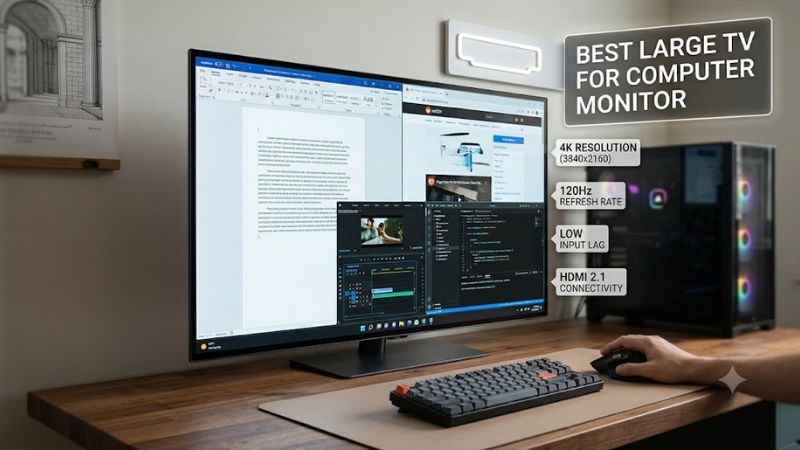
Best large TV for computer monitor use: Quick verdict
The LG OLED evo C6 is the strongest overall recommendation for most people who want a large TV that can also function as a PC monitor. Its 42-inch version combines 4K resolution, a 165Hz refresh rate, OLED contrast, four HDMI 2.1 ports and support for variable refresh rate technologies.
The Samsung S90H is an interesting alternative for bright rooms because its matte OLED coating handles reflections better than the glossy finish on many competing televisions. The LG B5 is a more accessible 48-inch OLED option with 4K 120Hz gaming, while the TCL QM7L is worth considering when you want a much larger 55-inch Mini LED television.
For even larger setups, the Hisense UR9SG offers a 65-inch screen, RGB Mini LED technology and high-refresh PC connectivity. Meanwhile, the Vizio Mini LED Quantum 4K is a budget-oriented alternative for casual gaming and general desktop use, although its 60Hz 4K limitation makes it unsuitable for players who want high-refresh 4K gaming.
The recommendations are not interchangeable. A 42-inch OLED may work well on a deep desk, while a 65-inch TV is generally better suited to a large workstation or couch-based gaming setup.
Quick comparison of the best large TVs for computer monitors
| TV model | Best for | Available size of interest | Native resolution | Maximum relevant refresh rate |
|---|---|---|---|---|
| LG OLED evo C6 | Best overall | 42 inches | 4K | 165Hz |
| Samsung S90H OLED | Bright-room gaming | 42 inches | 4K | 165Hz |
| LG B5 OLED | More accessible OLED | 48 inches | 4K | 120Hz |
| TCL QM7L | Large-screen LCD gaming | 55 inches | 4K | 144Hz |
| Hisense UR9SG | Extra-large PC gaming | 65 inches | 4K | 180Hz |
| Vizio Mini LED Quantum 4K | Budget casual use | 43 inches | 4K | 60Hz |
The specifications above refer to the relevant US models, not every regional version. Some televisions support alternative high-refresh modes at reduced resolutions, and those modes should not be confused with their native 4K refresh rates.
How we selected these large TVs
Choosing a TV for computer use requires different considerations from choosing one exclusively for watching movies. A television may deliver excellent cinematic image quality but still be inconvenient when displaying small desktop text.
The selection therefore prioritizes several PC-specific characteristics.
Resolution is important because a large screen needs sufficient pixel density to keep text and interface elements readable. At 42 inches, 4K provides approximately 105 pixels per inch. At 55 inches, the same resolution produces approximately 80 pixels per inch. Neither is equivalent to a conventional 27-inch 4K monitor, but both can work when viewed from an appropriate distance.
Refresh rate and response behavior also matter. A high native refresh rate improves motion smoothness, but independently measured pixel transitions determine whether fast-moving objects remain clear.
Connectivity is another requirement. HDMI 2.1, VRR and 4:4:4 chroma support are useful when connecting a modern gaming desktop. USB-C with DisplayPort Alt Mode can be helpful when using a compatible laptop.
We also considered screen finish, subpixel arrangement, local dimming, brightness and the limitations associated with OLED burn-in.
RTINGS’ PC monitor TV comparison provides particularly useful independent evidence because it specifically examines television performance when connected to computers. Its current recommendations emphasize the importance of TV size, gaming responsiveness, text clarity and image quality.
No direct testing is claimed in this article. The selections are based on manufacturer specifications and published independent reviews.
Best OLED TVs for computer monitor use
LG OLED evo C6 – Best overall large TV for PC gaming
Specifications: 42-inch OLED42C6PUA or 48-inch OLED48C6PUA, 3840 × 2160 resolution, WOLED panel, 165Hz refresh rate.
The LG OLED evo C6 is the strongest overall option for gamers who want a television that can genuinely double as a large computer display. Its 42-inch version is particularly practical because it offers substantially more screen space than a conventional monitor without becoming as difficult to accommodate as a 55-inch television.
The OLED panel is the main attraction. Every pixel produces its own light, allowing individual pixels to switch off when displaying black. This creates deep black levels and strong contrast without the blooming found on conventional LCD televisions.
The 4K resolution provides enough detail for gaming, streaming and ordinary desktop applications. Its 165Hz refresh rate also makes it more responsive than many older 4K televisions that were limited to 60Hz or 120Hz.
LG specifies four HDMI 2.1 ports, NVIDIA G-SYNC compatibility, AMD FreeSync support and a 0.1ms response-time rating. The TV also supports Dolby Vision and webOS smart features.
RTINGS’ September 2026 PC-monitor roundup selects the LG C6 as its best TV monitor. Independent testing identifies nearly instantaneous pixel transitions, low input lag and proper 4:4:4 chroma support as important strengths. <Cite refs={[“turn375434view0″,”turn785535view1″,”turn960724view0”]}/>
There are some limitations. The glossy surface can reflect directly facing lamps and windows. The panel’s nonstandard subpixel structure also means text is not quite as crisp as it would be on a conventional RGB computer monitor.
OLED burn-in is another consideration. Protection functions help manage image retention, but buyers who keep static desktop windows visible for many hours should understand the potential risk.
For a typical gaming desk, the 42-inch version is the more practical choice. The 48-inch model is better suited to deeper desks or users who sit farther away.
Buy if you want excellent 4K gaming, deep blacks and high refresh rates in a large display. Skip if you primarily work with static text-heavy applications or cannot accommodate a 42-inch screen comfortably.
Samsung S90H OLED – Best large TV for bright-room PC gaming
Specifications: 42-inch QN42S90H series, WOLED, 4K resolution, up to 165Hz.
The Samsung S90H is an attractive alternative for users who prefer an OLED television but have difficulty controlling ambient lighting. Its matte screen coating is one of its biggest advantages.
Many OLED televisions use glossy finishes that can produce distracting reflections around windows and desk lamps. Samsung’s matte treatment significantly reduces visible reflections, making the S90H more practical in certain bright environments.
The television uses a 4K WOLED panel with a 165Hz native refresh rate. It also supports HDMI 2.1 connectivity and variable refresh rate technologies, allowing compatible gaming PCs to deliver smooth motion without conventional screen tearing.
RTINGS’ review identifies excellent motion clarity, low input lag and strong bright-room performance. The publication also notes that the S90H supports 4K 165Hz through all four HDMI 2.1 inputs. <Cite refs={[“turn865775search2″,”turn375434view2″,”turn785535view2”]}/>
An important size distinction deserves attention. RTINGS tested the 65-inch version and reports that the 42-inch model is likely less bright. The 48-inch and 77-inch sizes also use a different RGB tandem panel configuration, so their results should not automatically be transferred to the 42-inch model.
The absence of Dolby Vision is another disadvantage compared with LG’s OLED lineup. Users who watch Dolby Vision content may prefer an LG alternative.
For desktop gaming, the 42-inch S90H makes the most sense when reflection handling is more important than obtaining the brightest possible OLED image. Its matte finish is particularly useful when the display cannot be positioned away from windows.
Buy if you want OLED contrast, a matte finish and high-refresh PC gaming. Skip if you specifically require Dolby Vision or need the brightness of a larger S90H variant.
LG B5 OLED – Best 48-inch OLED alternative
Specifications: 48-inch OLED48B5PUA, 4K WOLED, 120Hz.
The LG B5 OLED is a sensible option for buyers who want a larger OLED television without necessarily needing the higher refresh rate of the C6.
Its 48-inch screen offers additional room for multitasking, gaming and watching videos. The 4K resolution produces detailed images, while OLED’s pixel-level illumination delivers deep blacks and excellent contrast.
The B5 supports 120Hz at native 4K resolution, making it suitable for console gaming and mainstream PC gaming. All four HDMI inputs support the required HDMI 2.1 gaming features, including compatible high-refresh signals and VRR.
Another advantage is its support for chroma 4:4:4. This allows the television to preserve full color information in text and desktop graphics when the correct PC input configuration is used.
RTINGS identifies fast response times, low input lag and excellent gaming responsiveness as strengths. However, the independent review also notes that its SDR brightness is limited compared with brighter television models, particularly when dealing with direct reflections in a bright room. <Cite refs={[“turn960724view2″,”turn785535view6″,”turn777909search1”]}/>
The B5 also has the usual OLED burn-in considerations. Its 120Hz ceiling is lower than the C6’s 165Hz, so competitive players who want the highest refresh rates should consider a newer model.
The 48-inch size is important to consider before purchasing. It offers plenty of screen space, but it requires more desk depth than a 42-inch TV. A wall mount or a sufficiently deep desk can make positioning easier.
Buy if you want a relatively large OLED television with 4K 120Hz gaming. Skip if you need 165Hz or higher, stronger SDR brightness or a screen that will display static productivity applications throughout the day.
Best Mini LED TVs for large PC setups
TCL QM7L – Best 55-inch large-screen gaming TV
Specifications: 55QM7L, 55-inch LCD, HVA 2.0 Pro panel, SQD Mini LED, 4K resolution, 144Hz native.
The TCL QM7L is an interesting choice for users who want a genuinely large television rather than a 42-inch screen positioned close to a desk. Its 55-inch display provides a substantially larger viewing area, making it suitable for couch gaming, large workstations and setups where the viewer sits farther away.
The television uses SQD Mini LED backlighting combined with an HVA 2.0 Pro LCD panel. Mini LED allows the backlight to dim individual zones, improving HDR contrast compared with conventional LCD televisions.
TCL specifies a native refresh rate of 144Hz, along with Game Accelerator 288 for compatible lower-resolution high-refresh gaming. The television also supports VRR, FreeSync Premium Pro and Auto Low Latency Mode.
One particularly useful PC feature is proper chroma 4:4:4 support. This helps preserve text clarity when displaying computer output. Its PC mode and RGB subpixel arrangement make it a more suitable large desktop display than televisions with less favorable text rendering characteristics.
RTINGS’ October 2026 testing identifies low input lag and strong HDR brightness as advantages. However, the review also found very slow pixel transitions, producing noticeable blur during fast-moving games. <Cite refs={[“turn865775search0″,”turn960724view3″,”turn750280view4”]}/>
There is another important connectivity detail. Although the QM7L has four HDMI 2.1 inputs according to TCL, the highest 4K 144Hz mode is available on the specified high-bandwidth inputs rather than every connection. Buyers should confirm the exact port requirements before connecting multiple gaming devices.
The 55-inch screen is not particularly practical for a shallow desk. Sitting too close can make it difficult to view the entire display comfortably, while small interface elements may require Windows scaling adjustments.
Buy if you want a large Mini LED television for gaming and entertainment from a deeper workstation or couch. Skip if you play fast competitive shooters where pixel response and motion clarity are more important than screen size.
Hisense UR9SG – Best extra-large TV for PC and entertainment
Specifications: 65UR9SG, 65-inch RGB Mini LED, 4K resolution, 180Hz native, up to 330Hz at 1080p.
The Hisense UR9SG is aimed at users who want a very large television with modern PC gaming capabilities. Its 65-inch version is considerably larger than traditional desktop monitors, so it is better suited to a couch-based gaming setup, a very deep desk or a shared entertainment room.
Its RGB Mini LED backlighting is a major selling point. Unlike conventional Mini LED models that primarily control white or blue backlight output through local dimming, RGB Mini LED uses separate red, green and blue light sources to produce color more directly.
Hisense specifies a 180Hz refresh rate at 4K and a maximum 330Hz mode at 1080p. The higher refresh mode requires a resolution reduction, so buyers should not interpret 330Hz as the native 4K refresh rate.
The television includes three HDMI 2.1 inputs and a USB-C port supporting DisplayPort Alt Mode. The USB-C connection is particularly useful because it can accept compatible computer video signals without requiring a separate HDMI adapter.
RTINGS’ testing identifies strong HDR brightness, low input lag, broad gaming connectivity and proper 4:4:4 chroma support as advantages. However, it also reports noticeable motion blur in certain situations. <Cite refs={[“turn865775search3″,”turn960724view5″,”turn750280view8”]}/>
There is an important desktop-specific disadvantage. The tested model uses a BGR subpixel arrangement, which can make small text less clear when used as a PC monitor. This is less important when playing games from a couch, but more noticeable during prolonged desktop work.
Its viewing angle is also relatively limited for such a large display. Sitting directly in front of the center of the screen is preferable to working at an extreme angle.
Buy if you want an extremely large, bright HDR television with strong gaming connectivity. Skip if you spend most of your time reading text, using spreadsheets or working close to the screen.
Vizio Mini LED Quantum 4K – Best budget large-screen option for casual use
Specifications: 43-inch VQM43C-1001, IPS LCD with Mini LED backlighting, 4K 60Hz.
The Vizio Mini LED Quantum 4K is a budget-oriented choice for users who want a television that can function as a large secondary computer display. Its 43-inch version is particularly relevant because it provides more screen space than a conventional monitor without moving into the much larger 55-inch category.
Its IPS LCD panel offers relatively wide viewing angles, making it suitable for general desktop use and shared viewing. Mini LED backlighting also provides local dimming, helping improve contrast compared with basic edge-lit LCD televisions.
The most important limitation is its refresh rate. The 43-inch VQM43C-1001 is limited to 4K 60Hz, although it can accept 1080p 120Hz signals. It does not provide the HDMI 2.1 bandwidth required for modern high-refresh 4K gaming.
RTINGS found low input lag and proper 4:4:4 chroma support, which help make the television usable for everyday PC applications. However, the review also identified very blurry motion, slow response times and limitations in VRR behavior. <Cite refs={[“turn865775search1″,”turn960724view4″,”turn785535view3″,”turn750280view6”]}/>
It is therefore not a recommended purchase for demanding competitive gaming. Its strongest use case is casual gaming, streaming, browsing and general secondary-display duties.
An important variant warning applies here. Other sizes in the Vizio Mini LED Quantum 4K family use different panels and refresh capabilities. The 50-inch model uses VA, while the 43-inch and several other sizes use IPS. Do not transfer specifications between these versions.
Buy if you want a large 4K display for casual gaming and general PC use. Skip if you need 4K 120Hz, HDMI 2.1 or consistently clear motion.
How to choose the best large TV for computer monitor setups
Pick the right screen size for your desk
Screen size is one of the most important differences between televisions and conventional monitors. A 42-inch TV can already feel substantially larger than a 27-inch desktop monitor.
For a desk setup, 42–48 inches is usually a more manageable starting point. A 55-inch TV is better suited to a deeper desk or a setup where the viewer sits farther away. A 65-inch model is generally more appropriate for couch gaming or a dedicated entertainment workstation.
Consider these general guidelines:
| TV size | Suggested usage |
|---|---|
| 42 inches | Large desktop gaming |
| 48 inches | Deep desks and mixed entertainment |
| 55 inches | Large workstations or couch gaming |
| 65 inches | Couch gaming and dedicated media rooms |
These are practical starting points rather than strict ergonomic rules. Your viewing distance, eyesight, resolution and preferred interface scaling all influence comfort.
Prioritize 4K resolution and text clarity
A large television should generally have 4K resolution if it will function as a computer display.
At 43 inches, 4K provides approximately 102 pixels per inch. At 55 inches, the pixel density falls to approximately 80 pixels per inch. This affects how sharp text and small interface elements look at a given viewing distance.
Chroma 4:4:4 support is equally important. Without full chroma information, colored text and fine interface details can look blurred.
Also check the subpixel layout. TVs with unusual RWBG or BGR arrangements can display text less clearly than conventional RGB computer monitors, even when they support 4:4:4 signals.
For office work, test Windows ClearType and scaling settings before deciding that a particular TV is suitable for everyday productivity.
Understand refresh rate and HDMI bandwidth
The refresh rate describes how frequently the television updates its image. A 120Hz TV can display more frames per second than a 60Hz TV, assuming the graphics source can provide them.
For modern PC gaming, HDMI 2.1 is useful because it supports higher-bandwidth video modes, including 4K 120Hz on compatible devices.
Some newer televisions go beyond 120Hz, supporting 144Hz, 165Hz or 180Hz. These modes require compatible graphics hardware, the correct port and a suitable HDMI cable.
Always check the exact port rather than assuming every HDMI input supports the television’s highest refresh rate.
Consider OLED burn-in and Mini LED blooming
OLED is excellent for image quality, but repeated exposure to static desktop content can contribute to permanent image retention.
Enable pixel-protection features, automatic screen-off functions and desktop power-saving settings when using OLED as a computer display. Avoid leaving bright static interface elements visible unnecessarily.
Mini LED offers a different trade-off. It does not have OLED’s organic-pixel burn-in concern, but local dimming can create halos around bright objects on dark backgrounds.
For users who spend many hours working with static windows, Mini LED or conventional LCD may be a more practical choice.
Check PC mode, VRR and input lag
Many televisions offer a dedicated PC input mode. This can disable unnecessary image processing and improve the accuracy of computer signals.
Game Mode is also important because it reduces processing delay. Check whether the television supports HDMI Forum VRR, AMD FreeSync or NVIDIA G-SYNC compatibility.
Variable refresh rate synchronizes the display with the GPU’s changing frame rate, reducing screen tearing and improving smoothness.
Input lag and pixel response are different measurements. A television can have low input lag but slow pixel transitions, meaning the game responds quickly while moving objects still appear blurry.
Independent testing of both characteristics provides a much better assessment of desktop gaming suitability than a manufacturer’s single response-time claim.
FAQs about large TVs as computer monitors
Is a 55-inch TV too large for a computer monitor?
Not necessarily. A 55-inch television can work well for gaming when positioned farther away from the user. However, it may be uncomfortable on a shallow desk because the edges of the screen are difficult to view without moving your eyes or head.
Is OLED better than Mini LED for PC gaming?
OLED generally provides better black levels, contrast and pixel response. Mini LED can deliver greater brightness and avoids OLED-specific burn-in concerns. The better choice depends on room lighting and desktop usage.
Can I use a 4K TV as a gaming PC monitor?
Yes. A compatible 4K TV can receive a computer signal through HDMI or USB-C where DisplayPort Alt Mode is supported. Enable PC Mode and confirm that the TV accepts 4:4:4 chroma for clearer text.
Does a TV have more input lag than a monitor?
Not necessarily. Modern gaming televisions can offer low input lag when Game Mode is enabled. However, picture processing and different operating modes can affect the final result, so independent measurements are important.
Should I buy a 42-inch or 48-inch TV for my desk?
A 42-inch TV is generally easier to accommodate on a desk. A 48-inch model offers more screen space but requires additional viewing distance and desk depth.
Can I use a TV for both work and gaming?
Yes. Choose a model with 4K resolution, clear text reproduction, proper 4:4:4 chroma, VRR and appropriate brightness. For extended productivity use, consider an LCD model if OLED burn-in is a concern.
Final verdict: Which large TV should you buy for your computer?
The LG OLED evo C6 is the strongest overall recommendation for users who want a large TV that functions as a gaming monitor. Its 42-inch 4K OLED panel, 165Hz refresh rate, HDMI 2.1 connectivity and VRR support offer an excellent combination of desktop gaming and entertainment features.
The Samsung S90H is a strong alternative for brighter environments because its matte finish handles reflections effectively. The LG B5 is worth considering when a 48-inch OLED display and 120Hz gaming are sufficient.
For larger setups, the TCL QM7L provides a 55-inch Mini LED alternative, while the Hisense UR9SG targets users who want a 65-inch display with advanced PC gaming connectivity.
Finally, the Vizio Mini LED Quantum 4K is suitable for casual use, but its 4K 60Hz limitation makes it difficult to recommend for serious PC gaming.
Ultimately, the best purchase depends on how far you sit from the display, whether you need high-refresh gaming and how much time you spend using desktop applications. Choose the largest screen that remains comfortable at your actual viewing distance, and prioritize PC compatibility over television marketing specifications.