
The RTX 3090 is the better card if your budget and power supply allow it. It runs roughly 20-25% faster than the RTX 3070 Ti at 1440p and around 30% faster at 4K, and its 24 GB of VRAM avoids the stutter that the 3070 Ti’s 8 GB now causes in many new games. The RTX 3070 Ti only makes sense as a cheaper 1080p-to-1440p card for builds that cannot fit or power a 350 W, three-slot GPU, and only if it is substantially cheaper. The 3070 Ti launched later, but it is a lower-tier Ampere card, not an upgrade over the 3090.
Quick answer: Our top pick in 2026 is the Architecture — our #1 rated choice. See the full ranked comparison, alternatives and buying advice below.
Where These Two Sit in the Ampere Lineup
Both are NVIDIA Ampere cards on the same 8 nm process. The RTX 3090 launched in September 2020 at $1,499 as the generation’s halo product: 10,496 CUDA cores, 24 GB of GDDR6X on a 384-bit bus and 936.2 GB/s of bandwidth. The RTX 3070 Ti followed in May 2021 at $599: 6,144 CUDA cores, 8 GB of GDDR6X on a 256-bit bus and 608.3 GB/s. They share the same features, including second-generation RT cores, third-generation Tensor cores and DLSS support, so the comparison is mostly about scale and memory.

NVIDIA GeForce RTX 3090 Founders Edition Graphics Card (Renewed)
Included for 'RTX 3090 vs RTX 3070 Ti: Which Graphics Card Should You Buy?' as a relevant option in this category; details come from the product listing.
View on Amazon
ASUS ROG Strix GeForce RTX 3090 OC Edition 24GB GDDR6X Gaming Graphics Card with Axial-tech Fans & Central Static Pressure Fan ROG-STRIX-RTX3090-O24G-GAMING (Renewed)
Included for 'RTX 3090 vs RTX 3070 Ti: Which Graphics Card Should You Buy?' as a relevant option in this category; details come from the product listing.
View on Amazon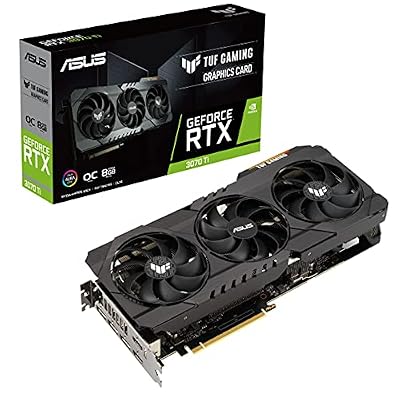
ASUS TUF Gaming NVIDIA GeForce RTX 3070 Ti OC Edition Graphics Card (PCIe 4.0, 8GB GDDR6X, HDMI 2.1, DisplayPort 1.4a, Dual Ball Fan Bearings, Military-Grade Certification, GPU Tweak II) (Renewed)
Included for 'RTX 3090 vs RTX 3070 Ti: Which Graphics Card Should You Buy?' because the listing specifies 8GB GDDR6X and HDMI 2.1, details this guide uses to compare options.
View on Amazon
NVIDIA - GeForce RTX 3070 Ti 8GB GDDR6X PCI Express 4.0 Graphics Card - Dark Platinum and Black (Renewed)
Included for 'RTX 3090 vs RTX 3070 Ti: Which Graphics Card Should You Buy?' because the listing specifies GeForce RTX 3070 Ti 8GB GDDR6X PCI Express 4.0 Graphics Card and Dark Platinum and Black (Renewed), details this guide uses to compare options.
View on AmazonSpecifications Side by Side
| Spec | RTX 3090 | RTX 3070 Ti |
|---|---|---|
| Architecture | Ampere | Ampere |
| Release date | 1 September 2020 | 31 May 2021 |
| Launch MSRP | $1,499 | $599 |
| CUDA cores | 10,496 | 6,144 |
| Boost clock | 1695 MHz | 1770 MHz |
| Process | 8 nm | 8 nm |
| TDP | 350 W | 290 W |
| VRAM | 24 GB GDDR6X | 8 GB GDDR6X |
| Memory bus | 384-bit | 256-bit |
| Bandwidth | 936.2 GB/s | 608.3 GB/s |
| L2 cache | 6 MB | 4 MB |
| Interface | PCIe 4.0 x16 | PCIe 4.0 x16 |
| Power connector | 1x 12-pin (Founders Edition) | 1x 12-pin (Founders Edition) |
| Length | 336 mm | 267 mm |
| Width | 3-slot | 2-slot |
| Display outputs | 1x HDMI, 3x DisplayPort | 1x HDMI, 3x DisplayPort |
The 12-pin connector applies to NVIDIA’s Founders Edition cards, which shipped with an adapter. Most partner models of both cards use standard 8-pin PCIe connectors instead: typically two for the 3070 Ti and two or three for the 3090.
Gaming Performance Gap
Few reviews test these two directly against each other, but the launch data chains together cleanly. In TechPowerUp’s 3070 Ti testing at 1440p, the RTX 3080 was about 13% faster than the 3070 Ti, and Tom’s Hardware found the same 13% gap overall. TechSpot’s RTX 3090 review then measured the 3090 about 8% faster than the 3080 at 1440p and about 10% faster at 4K. Combining those results gives the 3090 a lead of roughly 20-25% at 1440p. TechSpot also observed the 3070-class cards falling off sharply at 4K relative to the 3080, which puts the 4K gap at roughly 30% or more.
- 1080p: Roughly 15-20%. Both cards are often CPU-limited, so the gap compresses.
- 1440p: Roughly 20-25%. In a demanding AAA game at high settings, a 3070 Ti might land in the 70-90 fps range while a 3090 sits around 90-110 fps. Results vary with settings, CPU and patch.
- 4K: Around 30% or more, and the gap grows further whenever the 3070 Ti runs out of VRAM.
The 8 GB Problem
Average frame rates understate the real difference. When a game needs more than 8 GB, the 3070 Ti has to stream textures over PCIe, which shows up as stutter, texture pop-in and collapsing 1% lows rather than a tidy drop in average fps. Typical VRAM needs in recent AAA releases:
- 1080p high: about 6-8 GB, borderline on the 3070 Ti in the newest games
- 1440p high/ultra: about 8-11 GB, often over the 3070 Ti’s limit
- 4K ultra with ray tracing: about 10-16 GB, comfortable on the 3090
With 24 GB, the 3090 will never be memory-limited in games during its useful life. It can also run local AI models, high-resolution texture mods and large Blender scenes that an 8 GB card simply cannot load.
Ray Tracing and DLSS Support
Both cards use the same generation of RT and Tensor cores, so their relative ray-tracing performance follows their raster gap. The 3090’s lead grows in heavy RT titles, partly because ray tracing adds to VRAM use. Feature support is identical:
- DLSS Super Resolution, including the newer DLSS 4 transformer model, on both
- Ray Reconstruction and Reflex on both
- No DLSS Frame Generation on either (RTX 40 and newer only)
- No Multi Frame Generation on either (RTX 50 only)
Both can use FSR 3 frame generation in games that offer it as an alternative.
Power, PSU and Physical Fit
Despite the 3090’s much bigger chip, the TDP difference is only 60 W, because the 3070 Ti’s GDDR6X memory and high clocks made it an unusually power-hungry 70-class card.
PSU Sizing
- RTX 3090: 350 W + 125 W CPU + 150 W headroom = 625 W, so a quality 750 W unit is the realistic minimum, in line with NVIDIA’s guidance. Use 850 W with a high-end CPU.
- RTX 3070 Ti: 290 W + 125 W + 150 W = 565 W, so a quality 650-750 W unit is recommended. NVIDIA listed 750 W for the Founders Edition.
The real difference is size. A 336 mm, three-slot 3090 rules out many compact cases and can block extra PCIe slots. A 267 mm, two-slot 3070 Ti fits nearly any mid-tower. Ampere cards are also known for sharp transient power spikes, so a quality PSU matters more than headline wattage.
Value Then and Now
Launch Cost per Performance
Taking the 3070 Ti as 100 and the 3090 as about 122 at 1440p:
- RTX 3070 Ti: $599 / 100 = about $6.00 per performance point
- RTX 3090: $1,499 / 122 = about $12.30 per performance point
At MSRP the 3090 cost roughly twice as much per frame. That premium bought VRAM, not gaming speed.
Used Prices in 2026
The used market narrows the price gap but not entirely. A used RTX 3070 Ti usually sells for roughly $250-$320. A used RTX 3090 usually trades around $650-$850, supported by demand from local-AI users who value its 24 GB. On a used 3090, check GDDR6X memory temperatures, since many models have memory on the back of the board, and ask about past mining use. Also compare against a new RTX 5070 or RX 9070. Both offer modern features and warranties at performance around or above the 3090, with 12 GB and 16 GB of VRAM respectively.
Choose by Resolution and Budget
| Scenario | Better choice |
|---|---|
| 1080p esports, tight budget | RTX 3070 Ti |
| 1440p AAA gaming at high settings | RTX 3090 |
| 4K gaming | RTX 3090 |
| Local AI, 3D rendering, video work | RTX 3090 |
| Compact case or 650 W PSU | RTX 3070 Ti |
| Want frame generation and a warranty | Neither; consider RTX 5070 or RX 9070 |
Frequently Asked Questions
How much faster is the RTX 3090 than the RTX 3070 Ti?
Combining TechPowerUp, Tom’s Hardware and TechSpot launch data, the RTX 3090 is roughly 20-25% faster at 1440p and around 30% or more faster at 4K. At 1080p the gap shrinks to around 15-20% because CPU limits come into play. In games that exceed 8 GB of VRAM, the real-world difference is larger.
Is 8 GB of VRAM on the RTX 3070 Ti still enough?
For 1080p and lighter 1440p gaming, mostly yes, with texture settings managed. Many recent AAA games use more than 8 GB at 1440p high or ultra, which causes stutter and texture issues. It is the card’s biggest weakness compared with the 24 GB RTX 3090.
Do the RTX 3090 and 3070 Ti support DLSS 3 frame generation?
No. DLSS Frame Generation requires an RTX 40-series or newer GPU. Both cards support DLSS Super Resolution, including the DLSS 4 transformer model, Ray Reconstruction and Reflex. Both can use FSR 3 frame generation where games offer it.
What power supply do I need for each card?
Plan on a quality 750 W unit for the RTX 3090, or 850 W with a high-end CPU. For the RTX 3070 Ti, a quality 650-750 W unit is suitable. Founders Edition cards need the included 12-pin adapter, while most partner cards use two or three standard 8-pin connectors.
Is a used RTX 3090 better than a new RTX 5070?
For gaming, the RTX 5070 typically offers similar or better performance with DLSS Multi Frame Generation, lower power draw and a warranty. The used RTX 3090 wins on VRAM, with 24 GB against 12 GB, which matters for AI, heavy mods and 4K textures. Choose by whether memory capacity or modern features matter more to you.
Ready to decide? Our #1 pick for 2026 is the Architecture.
Live price & availability on Amazon.


