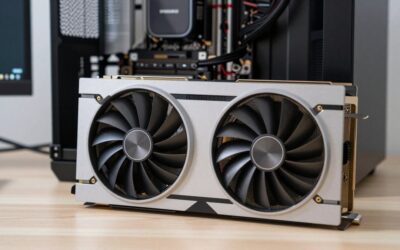
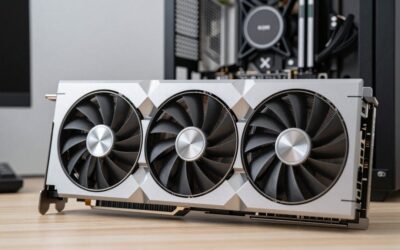
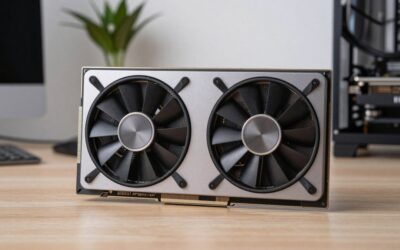
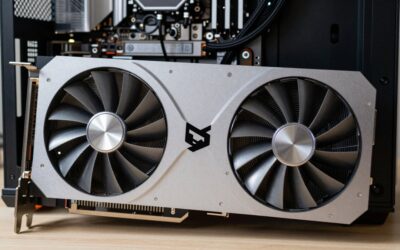
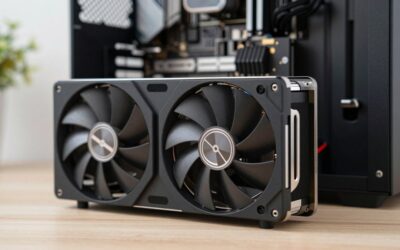
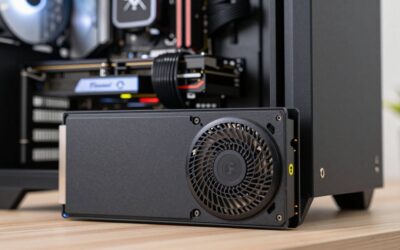
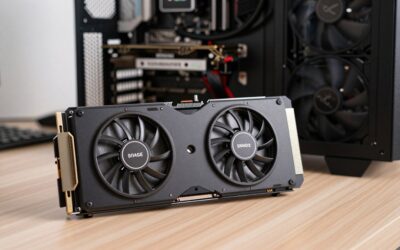
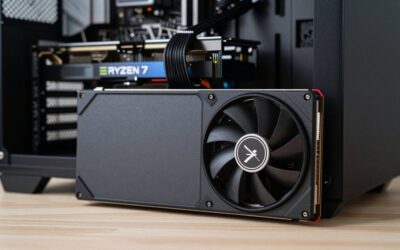
The best video editing GPU in 2026 is a 16 GB card from the current generation: the GeForce RTX 5070 Ti is the sweet spot for most editors, the RTX 5060 Ti 16 GB is the best budget entry point, and the RTX 5090 (32 GB) is the pick if you cut 8K RAW, multi-camera footage, or heavy Fusion and After Effects comps. For most timelines, VRAM capacity and hardware codec support matter more than shader throughput, so a cheaper 16 GB card will usually beat a faster 12 GB card once you add a second camera angle or a noise-reduction node.
- Quick comparison
- Best overall: GeForce RTX 5080
- Best value: GeForce RTX 5070 Ti
- Best budget: GeForce RTX 5060 Ti 16 GB
- Best for 8K and heavy compositing: GeForce RTX 5090
- Best AMD option: Radeon RX 9070 XT
- Best cheap AV1 and 4:2:2 decode: Intel Arc B580
- How to choose a video editing GPU
- Frequently Asked Questions
- Related Guides
Two spec-sheet numbers decide whether a GPU feels fast in an NLE: how much memory it has, and which codecs its media engine can decode and encode in hardware. Everything else — core count, clock speed, memory bandwidth — is a tiebreaker after those two.

ASUS Dual GeForce RTX 3050 6GB GDDR6 OC Edition Gaming Graphics Card
Included for 'Best Video Editing Graphics Cards (GPUs)' as a relevant option in this category; details come from the product listing.
View on Amazon
msi Gaming RTX 3050 Ventus 2X 6G OC Graphics Card (NVIDIA RTX 3050, 96-Bit, Boost Clock: 1492 MHz, 6GB GDDR6 14 Gbps, HDMI/DP, Ampere Architecture)
Included for 'Best Video Editing Graphics Cards (GPUs)' because the listing specifies 96-Bit and Boost Clock: 1492 MHz, details this guide uses to compare options.
View on AmazonQuick answer: For most people in 2026, the best video editing graphics cards (gpus) is the GeForce RTX 5090 — our #1 rated choice. See the full ranked comparison, alternatives and buying advice below.
Quick comparison
| Pick | Best for | Key specs (per manufacturer spec sheets) | Typical price range |
|---|---|---|---|
| GeForce RTX 5090 | 8K RAW, 3+ camera multicam, Fusion/After Effects | 32 GB GDDR7, 512-bit bus, 575 W TGP, DisplayPort 2.1b | usually $2,000–$2,600 |
| GeForce RTX 5080 | Best overall for 4K–6K professional work | 16 GB GDDR7, 256-bit bus, 360 W TGP | usually $1,000–$1,400 |
| GeForce RTX 5070 Ti | Best value for most editors | 16 GB GDDR7, 256-bit bus, 300 W TGP | usually $750–$900 |
| GeForce RTX 5060 Ti 16 GB | Best budget 16 GB option | 16 GB GDDR7, 128-bit bus, 180 W TGP | usually $430–$520 |
| Radeon RX 9070 XT | Best AMD card for Resolve | 16 GB GDDR6, 256-bit bus, 304 W total board power | usually $650–$800 |
| Intel Arc B580 | Cheapest card with strong AV1 and 4:2:2 decode | 12 GB GDDR6, 192-bit bus, 190 W total board power | usually $250–$320 |
Best overall: GeForce RTX 5080
16 GB of GDDR7 on a 256-bit bus, 360 W TGP, and the current NVENC media engine make the RTX 5080 the card that covers 4K and 6K editing, moderate multicam, and GPU-accelerated effects without a compromise you’ll notice in a normal week. It suits editors working in Premiere Pro, DaVinci Resolve, and After Effects on a 4K or 5K monitor who occasionally push into 6K or two-camera timelines. The trade-off is price per gigabyte of VRAM: you pay a large premium over the 5070 Ti for roughly 15–25% more render throughput in typical published comparisons, which varies with the effect stack, resolution, CPU, and application version. If your work is 90% single-camera 4K, the 5070 Ti is the better buy.
Best value: GeForce RTX 5070 Ti
This is the card most editors should buy. It matches the RTX 5080’s 16 GB capacity and 256-bit bus, so anything that is memory-limited — a 4K multicam, a temporal noise-reduction node, a Fusion comp with cached frames — behaves the same. Only raw compute differs. Its 300 W TGP also keeps case airflow and PSU requirements reasonable, and it fits in a normal mid-tower without a 1000 W power supply. Trade-off: for heavy 8K or three-plus angle work, you will feel the missing shader throughput, and 16 GB becomes the ceiling rather than a comfortable margin.
Best budget: GeForce RTX 5060 Ti 16 GB
The 16 GB version of the RTX 5060 Ti is the cheapest current card that gives you the memory headroom that actually matters for 4K editing, plus the same generation of NVENC as the more expensive cards. Buy the 16 GB model, not the 8 GB one — the 8 GB card runs the same GPU but will stall on 4K multicam and effects-heavy timelines, which is the whole reason to buy a modern card. Trade-off: a 128-bit memory bus means lower bandwidth, so heavy GPU effects, noise reduction, and Fusion work render more slowly than on a 5070 Ti. Fine for single-camera 4K; tight for three-camera work.
Best for 8K and heavy compositing: GeForce RTX 5090
32 GB of GDDR7 on a 512-bit bus is the reason to buy this card, not the shader count. 8K RAW, 4+ camera multicam, long Fusion node trees, and GPU-accelerated AI features in Resolve all consume VRAM in ways that scale badly when you run out — the app falls back to CPU and the timeline becomes unusable. Trade-offs are real: 575 W TGP means a 1000 W+ power supply and serious case airflow, the card is physically large enough to block drive bays, and the price is roughly double an RTX 5080 for benefits most 4K editors never see.
Best AMD option: Radeon RX 9070 XT
16 GB on a 256-bit bus at 304 W total board power makes this the AMD card to consider if you edit mainly in DaVinci Resolve, where OpenCL acceleration is well supported, and want to avoid the NVIDIA price premium. Its AV1 encoder is competitive with the competition in published codec-quality comparisons. Trade-off: AMD’s hardware H.264/HEVC encoder has generally trailed NVENC and Intel Quick Sync in quality at the same bitrate, and some third-party plugins and AI features in Premiere Pro and After Effects are optimized for CUDA first. If you deliver H.264 for clients, encode on the CPU or check your app’s AMD support before committing.
Best cheap AV1 and 4:2:2 decode: Intel Arc B580
Intel’s Arc line carries dual media engines and hardware decode for 10-bit 4:2:2 HEVC, the format many Canon, Fujifilm, and Sony mirrorless cameras record internally. That single feature can turn a stuttering 4K 4:2:2 timeline into a smooth one without transcoding to proxies. At 12 GB and 190 W it is also cheap to run. Trade-off: 12 GB limits how far you can push multicam and effects, and application support, while much improved, still sees fewer optimizations than CUDA in some Adobe and third-party plugins.
How to choose a video editing GPU
Work out your VRAM budget first
Memory is the spec that decides whether a timeline plays back or falls back to CPU. Use these floors as a starting point, then add headroom if you run two monitors or keep background apps open:
| Workload | Timeline resolution | Suggested VRAM floor |
|---|---|---|
| Single camera, light grade, few effects | 1080p | 6 GB |
| Single camera, 1–2 effects or a LUT stack | 4K | 8 GB |
| 2–3 camera multicam, or temporal noise reduction | 4K | 12 GB |
| RAW or log footage, 3+ angles, Fusion comps | 6K–8K | 16–24 GB |
| 8K RAW with temporal NR and cached Fusion | 8K | 24 GB+ |
If you are between two tiers, go up. Running out of VRAM is not a gradual slowdown — it is a cliff, and it usually happens on the client-facing timeline rather than the test one.
Match the codec to your camera, not the card tier
Check what your camera actually records before anything else. H.264 and HEVC 4:2:0 8-bit decode in hardware on every current card. 10-bit 4:2:2 HEVC is different: Intel Arc has supported it since the Alchemist generation, and NVIDIA added it with the RTX 50 series. Support is not universal across a product line, so verify the specific model on the manufacturer’s spec sheet rather than assuming a generation covers it. For encoding, AV1 hardware encode is present on RTX 40 and 50 series, RX 7000 and 9000 series, and Arc — useful if you upload to platforms that accept AV1. Also check the number of encode engines: some cards at the top of a stack ship with two, which roughly halves export time for multi-stream jobs like exporting several deliverables at once, but the count varies within a generation.
Do the power budget arithmetic
Add up sustained worst-case draw, not idle. A typical high-end editing build: RTX 5090 at 575 W + a 16-core desktop CPU pulling about 200–230 W package power under an all-core render + motherboard, RAM, NVMe drives, fans and a capture card at roughly 60–75 W = about 850–880 W sustained. Add 15–20% for transient spikes and capacitor aging, and a 1000 W unit is the sensible floor, with 1200 W if you also run a lot of drives and USB peripherals. Scale the same way for smaller cards: a 300 W RTX 5070 Ti with a 150 W CPU lands near 530 W, so a quality 750 W supply is comfortable. Also check the connector type — the top cards use the 16-pin 12V-2×6 connector and need the cable fully seated, while lower tiers often use standard 8-pin PCIe.
Check software and driver support
Premiere Pro and Media Encoder are best optimized for CUDA and NVENC, with Quick Sync a strong second and AMD’s AMF encoder improving but still behind on H.264/HEVC quality. DaVinci Resolve runs well on all three vendors, but several GPU-heavy features such as Magic Mask and Super Scale are Resolve Studio-only, so a faster card will not unlock them. Final Cut Pro is Mac-only and tuned for Apple’s media engines, which is why an M-series Mac Studio or MacBook Pro with unified memory remains a legitimate alternative to a discrete GPU for ProRes workflows. For Avid Media Composer, most processing is CPU-bound and GPU choice matters much less. Whichever vendor you pick, use the studio/professional driver branch rather than the game-ready one on a machine that earns money.
Frequently Asked Questions
Is 16 GB of VRAM enough for 4K video editing?
Yes, for almost all 4K work. 16 GB comfortably handles single-camera 4K, two-to-three camera multicam, noise reduction, and moderate Fusion or After Effects comps. You would only need more for 6K or 8K RAW, long Fusion node trees, or many simultaneous streams. Below 12 GB is where 4K multicam starts to fall back to CPU.
Do I need a professional workstation card instead of a gaming card?
For editing and most motion graphics, no. Consumer cards use the same media engines and generally offer more VRAM per dollar. Workstation cards such as NVIDIA’s RTX PRO line matter mainly for certified driver support, ECC memory, and very large multi-GPU or virtualized setups in a studio environment.
Does a faster GPU speed up exports, or is the encoder what counts?
Both, in different phases. Effects rendering, scaling, and noise reduction are GPU-compute bound, so a faster card helps there. The final encode is handled by the dedicated media engine, so a mid-range card with a current encoder exports nearly as fast as a flagship when the timeline is simple. If exports feel slow, check whether you are encoding in hardware at all.
Will an AMD GPU work in Premiere Pro and DaVinci Resolve?
Yes. Resolve supports AMD through OpenCL and performs well, and Premiere Pro supports AMD through OpenCL and the AMF encoder. The main caveats are lower H.264/HEVC encode quality at equal bitrate and fewer CUDA-specific plugin optimizations. If your pipeline is Resolve-centric, AMD is a reasonable choice.
How much power supply do I need for a video editing GPU?
Budget roughly 750 W for a 300 W card with a mainstream CPU, 850 W for a 360 W card, and 1000–1200 W for a 575 W flagship. Add headroom if you run many drives, a capture card, or a heavily overclocked CPU, and confirm the PSU has the right connector type and enough separate cables.
Is Apple Silicon a real alternative to a discrete GPU?
For ProRes and Final Cut Pro workflows, yes — the media engines in M-series chips handle ProRes encode and decode efficiently, and unified memory avoids VRAM limits entirely. For CUDA-dependent plugins, Windows-only tools, or heavy 8K RAW in Resolve, a discrete NVIDIA card is usually the faster and more flexible path.
Ready to decide? Our #1 pick for 2026 is the GeForce RTX 5090.
Live price & availability on Amazon.