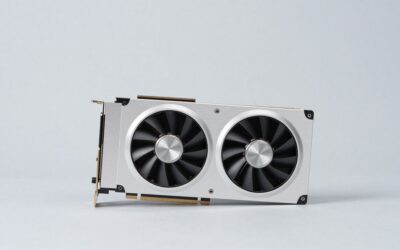
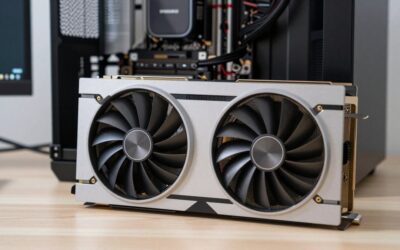
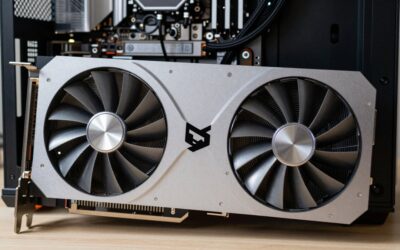
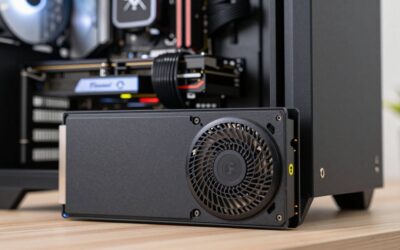
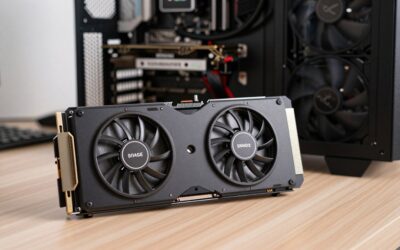
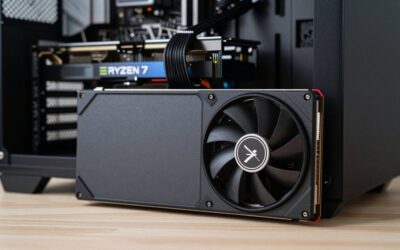
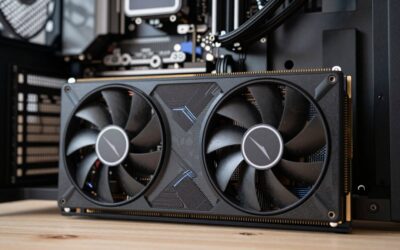
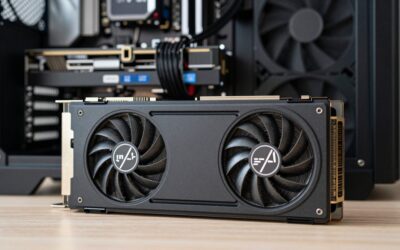
The best low profile GPU for gaming in 2026 is a low-profile GeForce RTX 5060-class card if your small form factor PC has a power supply with an 8-pin PCIe connector and room for a dual-slot card; if you are limited to slot power only (75W) the best options are the RTX 3050 6GB low-profile cards for gaming or workstation cards such as the RTX 2000 Ada and Intel Arc Pro B50. For a true single-slot, low-profile fit, NVIDIA’s RTX A1000 and RTX A400 are the realistic choices.
- Start with three measurements, not a product list
- Decision matrix: which low-profile card fits your PC
- Spec comparison of the realistic options
- Worked power budget for an office SFF conversion
- Thermals: the hidden limit of low-profile cards
- The best low power GPU when height is not the issue
- Common mistakes
- Bottom line
Quick answer: For most people in 2026, the best low profile gpu for sff pcs is the Dual slot, 8-pin available, PSU 350W+ — our #1 rated choice. See the full ranked comparison, alternatives and buying advice below.
Start with three measurements, not a product list
Low-profile shopping goes wrong when people pick a card first and then discover it does not fit or cannot be powered. Check these three constraints on your PC before anything else:

msi Gaming RTX 3050 LP 6G OC Graphics Card (NVIDIA RTX 3050, 96-Bit, Boost Clock: 1492 MHz, 6GB GDDR6 14 Gbps, HDMI/DP, Ampere Architecture)
Included for 'Best Low Profile GPU for SFF PCs: What Fits, What Powers On, What Performs' because the listing specifies 96-Bit and Boost Clock: 1492 MHz, details this guide uses to compare options.
View on Amazon
MSI GeForce RTX 3050 LP 6G OC Gaming Graphics Card - 6GB GDDR6, 1492 MHz, PCI Express Gen 4, 96-bit, 1x DP (v1.4a), 2X HDMI 2.1 (Supports 4K)
Included for 'Best Low Profile GPU for SFF PCs: What Fits, What Powers On, What Performs' because the listing specifies 6GB GDDR6 and 1492 MHz, details this guide uses to compare options.
View on Amazon
maxsun GeForce RTX 3050 6GB Graphics Cards GDDR6 Video Graphics Card GPU for Gaming PC Mini Small Form Factor SSF Slim Low Profile Design PCI Express 4.0, HDMI 2.1, DisplayPort 1.4a
Included for 'Best Low Profile GPU for SFF PCs: What Fits, What Powers On, What Performs' because the listing specifies HDMI 2.1 and DisplayPort 1.4a, details this guide uses to compare options.
View on Amazon
maxsun AMD Radeon RX 550 4GB Low Profile Small Form Factor Video Graphics Card for Gaming Computer PC GPU GDDR5 ITX SFF HDPC 128-Bit DirectX 12 PCI Express X16 3.0, HDMI, DisplayPort
Included for 'Best Low Profile GPU for SFF PCs: What Fits, What Powers On, What Performs' because the listing specifies HDMI and DisplayPort, details this guide uses to compare options.
View on Amazon- Bracket height. A low-profile (half-height) bracket is about 79mm tall, versus about 121mm for full height. The card’s PCB and cooler must stay under roughly 69mm above the slot to clear the case. Office SFF desktops such as the Dell OptiPlex SFF, HP EliteDesk SFF and Lenovo ThinkCentre SFF require this.
- Slot width. Count how many expansion slots are free below the x16 slot. Some SFF cases allow two; some only one, often because a drive cage or the power supply sits right below.
- Power. The PCIe x16 slot supplies up to 75W. Anything above that needs a 6-pin or 8-pin cable from the power supply, which many OEM SFF power supplies do not have and cannot easily be adapted to safely.
Your answers place you in one of four groups, and each group has a different best low profile graphics card.
Decision matrix: which low-profile card fits your PC
| Your constraints | Best choice | Why | Typical price range |
|---|---|---|---|
| Dual slot, 8-pin available, PSU 350W+ | Low-profile RTX 5060-class card | Most gaming performance that fits half-height, 8GB, DLSS 4 | $300–$380 |
| Dual slot, 8-pin available, older platform | Low-profile RTX 4060 (e.g. Gigabyte RTX 4060 OC Low Profile) | 115W, efficient, widely compatible | $280–$350 |
| Dual slot, no power cable (75W slot only), gaming | RTX 3050 6GB low profile | 70W, no connector, solid 1080p medium | $170–$220 |
| Dual slot, slot power only, creative or AI work | RTX 2000 Ada (16GB) or Intel Arc Pro B50 (16GB) | 70W, large VRAM, pro drivers | $350–$750 |
| Single slot, slot power only | NVIDIA RTX A1000 (8GB) or RTX A400 (4GB) | 50W, single-slot, low-profile | $150–$450 |
| Single slot, media or display output only | Intel Arc A310 low profile | AV1 decode and encode, minimal power | $100–$130 |
Spec comparison of the realistic options
| Card | VRAM | Power | External connector | Slots | Rough 1080p gaming level |
|---|---|---|---|---|---|
| RTX 5060 low profile | 8GB GDDR7 | ~145W | 8-pin | 2 | High settings, 60–100+ FPS in most AAA |
| RTX 4060 low profile | 8GB GDDR6 | ~115W | 8-pin | 2 | High settings, about 15–20% below RTX 5060 |
| RTX 3050 6GB low profile | 6GB GDDR6 | 70W | None | 2 | Medium settings, 45–70 FPS in AAA |
| RTX 2000 Ada | 16GB GDDR6 | 70W | None | 2 | Medium-high, workstation drivers |
| Intel Arc Pro B50 | 16GB GDDR6 | 70W | None | 2 | Medium, pro-focused drivers |
| RTX A1000 | 8GB GDDR6 | 50W | None | 1 | Low-medium, esports titles fine |
| Intel Arc A310 | 4GB GDDR6 | ~75W | None | 1–2 (model dependent) | Light gaming only |
Check the exact model you are considering: some low-profile designs ship with both a full-height and half-height bracket in the box, and slot width can vary between brands of the same GPU.
Worked power budget for an office SFF conversion
A common project is turning a refurbished SFF office PC into a light gaming machine. Many of these use a 180–260W proprietary power supply with no PCIe cable. Here is how the math looks for a typical example with a 65W Intel Core i5:
- CPU under gaming load: about 50–65W
- Motherboard, RAM, SSD, fan: about 25–35W
- GPU: 70W (RTX 3050 6GB LP)
- Total: about 145–170W
A 180W supply leaves very little margin; a 240–260W supply is comfortable. Keep sustained load below about 80% of the rating, so on a 180W unit that means staying under 144W, which this build can exceed. If your SFF has the smaller unit, consider a 50W card such as the RTX A1000, which brings the total to roughly 125–150W.
A 145W RTX 5060 low-profile card does not belong in a stock OEM SFF unless the power supply has an 8-pin connector and enough capacity. Adapters from SATA or Molex to 8-pin are a fire risk at this power level and should not be used.
Thermals: the hidden limit of low-profile cards
Low-profile coolers have small heatsinks and small fans, which means more fan noise per watt than full-size cards. SFF office cases also have weak airflow, often a single intake near the CPU. Practical steps that help:
- Leave the slot below the card empty when possible so the fans can breathe.
- Apply a modest power limit (for example, 85–90% in the driver or a tuning utility). On efficient modern GPUs this usually costs only a few percent of performance while cutting temperature and fan noise noticeably.
- Cap frame rate to your monitor’s refresh rate to avoid the card working harder than necessary.
- Clean dust from the case intake every few months; small fans clog faster.
The best low power GPU when height is not the issue
If you searched for low profile but your real concern is power draw, the field opens up. Full-height cards with modest power, such as the RTX 5060 (145W) or the Radeon RX 9060 XT 16GB (about 160W), outperform every low-profile card while running cool and quiet in a normal case. They are the better choice for any compact ITX or micro-ATX build that accepts full-height cards.
Common mistakes
Ignoring the bracket
Many cards marketed as compact or ITX are short but still full height. Only cards explicitly sold as low profile or half height will fit an SFF office case.
Expecting full-size performance
A 70W card cannot match a 160W card. The RTX 3050 6GB is a medium-settings 1080p card; set expectations accordingly.
Forgetting display outputs
Low-profile cards often use mini-DisplayPort outputs. Budget for a mini-DP to DP or HDMI cable or adapter if your monitor needs one, and confirm the adapter supports your target refresh rate.
Bottom line
With an 8-pin connector and two free slots, choose a low-profile RTX 5060-class card for real gaming performance. With slot power only, the RTX 3050 6GB low profile is the gaming pick, while the RTX 2000 Ada and Arc Pro B50 suit creators who need 16GB. With only one slot available, the RTX A1000 is the most capable option that fits.
Ready to decide? Our #1 pick for 2026 is the Dual slot, 8-pin available, PSU 350W+.
Live price & availability on Amazon.