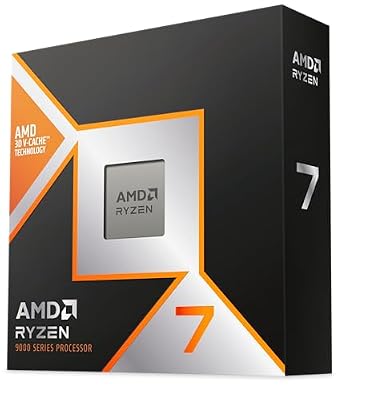
The question of whether to upgrade from the Ryzen 7 7800X3D to the Ryzen 7 9800X3D is one of the most common searches among PC enthusiasts right now, and for good reason. The 7800X3D spent over a year as the definitive gaming CPU, and its successor carries the same 3D V-Cache branding but introduces a fundamentally different physical design that AMD claims solves the thermal limitations of the previous generation. At $449 for the 9800X3D, the cost of entry is not trivial, especially when you already own a chip that still handles virtually every game you throw at it without breaking a sweat.
If you are a high-refresh competitive player, a content creator who also games, or someone who simply wants to extract every frame possible from a top-tier GPU, this guide will help you decide whether the upgrade is justified or whether your money is better spent elsewhere. Here is the honest, numbers-driven breakdown.
As an Amazon Associate we earn from qualifying purchases at no extra cost to you.

Quick Verdict
For most gamers, the 7800X3D remains an excellent processor and the upgrade to the 9800X3D is not a meaningful leap unless you are chasing the absolute highest framerates at 1080p or 1440p with a top-end GPU. The gains are real but modest in the scenarios where most players actually game. If you already own the 7800X3D and your GPU is below an RTX 4080 or RX 7900 XT equivalent, you will likely see little to no difference because your GPU is the bottleneck, not the CPU. Spend the $449 elsewhere.
If you are a competitive gamer running a 360Hz or 500Hz monitor, or if you want a CPU that stays relevant through the next two or three GPU generations without becoming a clear bottleneck, the 9800X3D earns its place in your build.
Specs: Old vs New
| Specification | Ryzen 7 7800X3D | Ryzen 7 9800X3D |
|---|---|---|
| Architecture | Zen 4 | Zen 5 |
| Process Node | TSMC 5nm (compute) + 6nm (cache) | TSMC 4nm |
| Cores / Threads | 8 / 16 | 8 / 16 |
| Base Clock | 4.2 GHz | 4.7 GHz |
| Boost Clock | 5.0 GHz | 5.2 GHz |
| Total L3 Cache | 96 MB | 96 MB |
| 3D V-Cache Design | Stacked above compute dies | Beneath compute dies (redesigned) |
| TDP | 120W | 120W |
| Socket | AM5 | AM5 |
| Launch MSR | $449 | $479 |
| Current Street Price | ~$280-320 (used/new-old-stock) | ~$449 |
The most important spec change is not listed in the table: the 9800X3D moves the 3D V-Cache below the compute dies instead of stacking it on top. This eliminates the thermal insulating layer that previously limited clock speeds on the 7800X3D. The practical result is that the 9800X3D can sustain higher boost clocks and, critically, supports full overclocking, which the 7800X3D did not.
Performance Gain
The following ranges are drawn from launch-window reviews by multiple independent outlets. Treat them as approximate, since results vary by title, settings, and GPU pairing.
1080p Gaming
At 1080p, where the CPU is most likely to be the limiting factor, the 9800X3D delivers a meaningful uplift. Tom’s Hardware reported gains in the range of 15-25% across their test suite when comparing both CPUs paired with an RTX 4090. TechPowerUp’s benchmark suite showed a similar spread, with certain titles like Cyberpunk 2077 (without ray tracing) and Hitman 3 pushing toward the upper end around 25-30%, while less CPU-bound titles like Red Dead Redemption 2 landed closer to 10-15%. Hardware Unboxed generally aligned with these figures, noting that the average gain across their tested lineup hovered around 18-22%.
In practical terms, if you were getting 200 fps in a competitive shooter on the 7800X3D, expect roughly 235-250 fps on the 9800X3D. Whether that difference justifies $449 depends entirely on your display and competitive ambitions.
1440p Gaming
At 1440p the gains compress noticeably. Gamers Nexus observed improvements in the range of 8-15% across their CPU benchmark suite, with the spread depending heavily on how demanding the game is at that resolution. TechSpot’s testing showed similar results, with the average across their titles sitting around 10-12%. The GPU is doing more of the work at 1440p, so the additional CPU headroom from the 9800X3D matters less unless you are targeting 240+ fps in lighter titles.
4K Gaming
At 4K, the upgrade is essentially a non-event for pure gaming. Every outlet tested converges on the same conclusion: gains fall in the 0-5% range and are frequently within the margin of error. If you game at 4K and your primary concern is visual quality rather than raw framerate, the 7800X3D will continue to serve you perfectly well with no measurable penalty versus the 9800X3D.
Hidden Costs
The good news is that both chips sit on AM5, so no motherboard replacement is required. A BIOS update (which takes about two minutes) is all that is needed on most 600-series boards. No new cooler is strictly necessary, though the 9800X3D will benefit slightly from a cooler with good thermal paste coverage given its higher sustained clocks.
The CPU bottleneck question deserves attention. If your GPU is an RTX 4070, RX 7800 XT, or anything below that tier, you are almost certainly GPU-bound at every resolution above 1080p. Upgrading to the 9800X3D in that scenario produces zero visible benefit. Your next meaningful upgrade should be the graphics card.
Resale value works in your favor here. The 7800X3D still commands roughly $250-300 on the used market, depending on condition and whether it came with a retail box. That means the net cost of the 9800X3D for someone with a 7800X3D is closer to $150-200, which makes the upgrade case more reasonable for enthusiasts who want to stay ahead of the curve. Check local listings and platform pricing before committing, as values shift with each new GPU release cycle.
Power supply and case requirements are unchanged. Both chips draw the same 120W TDP and fit the same socket dimensions, so your existing hardware is fully compatible.
Worth It For
- Competitive gamers running 240Hz or higher refresh rate monitors at 1080p or 1440p
- Owners of an RTX 4090, RTX 5090, RX 9070 XT, or equivalent top-tier GPU where the CPU is the limiting factor
- Enthusiasts who want the current best gaming CPU and plan to keep their platform through 2026 and beyond without a bottleneck
- Content creators who game heavily and benefit from the Zen 5 IPC gains in productivity workloads, where the 9800X3D pulls ahead of the 7800X3D by a wider margin (20-35% in multi-threaded tasks depending on the workload)
Not Worth It For
- Average gamers playing at 1440p or 4K where the GPU is the bottleneck
- Owners of mid-range GPUs (RTX 4060 Ti and below, RX 7700 XT and below)
- Budget-conscious builders who could put $449 toward a GPU upgrade instead and see a larger framerate improvement
- Anyone whose 7800X3D is already handling their current workload without issue
Alternatives
If you want to stay in the Ryzen X3D ecosystem but cannot justify the price difference, keeping the 7800X3D and investing the $449 into a GPU upgrade (for example, moving from an RTX 4070 Ti Super to an RTX 5080) will deliver a far more noticeable framerate improvement in every game above 1080p.
The Ryzen 7 9700X at its current reduced price is not a replacement for either X3D part and should not be considered as an upgrade from a 7800X3D for gaming purposes.
On the Intel side, the Core Ultra 7 265K offers comparable gaming performance to the 9800X3D at a similar price point, though it trails in multi-threaded productivity due to its smaller core count and architecture differences. It is worth considering if you are building fresh, but for a drop-in upgrade from AM5, it would require a new motherboard and DDR5 RAM validation, negating the simplicity advantage that makes the 9800X3D appealing.
FAQ
Do I need a new cooler for the 9800X3D?
No. The 9800X3D uses the same AM5 mounting hardware and has identical TDP to the 7800X3D. Any cooler that handled the previous chip will handle this one. In practice, thermal performance is slightly better on the 9800X3D due to the redesigned cache placement, so you may even see lower temperatures at the same fan speed.
Will my current motherboard support the 9800X3D without a BIOS update?
Most B650 and X670 boards will require a BIOS update before they will boot with a 9800X3D. Check your motherboard manufacturer’s support page for the specific board revision. Many 600-series boards launched before the 9800X3D and need updated firmware. Some newer X870 boards ship with out-of-box support.
Is the overclocking headroom actually useful?
AMD unlocked full overclocking on the 9800X3D for the first time in an X3D chip, which is a genuine architectural achievement. In practice, overclocking headroom is modest (the chip already boosts to 5.2 GHz) and most users will not see more than a few percent additional performance from manual tuning. It is a nice-to-have rather than a reason to buy the chip, but it does mean the 9800X3D is more versatile than any X3D part that came before it.
Should I just sell my 7800X3D and buy a new build instead?
Not in this scenario. The 7800X3D is still an excellent gaming CPU that will remain viable for several more years. If you want the 9800X3D, swap it in directly, keep your motherboard, sell the old chip on the secondary market, and pocket the difference. A full rebuild adds cost and complexity for zero additional benefit.
Sources and Methodology
Performance ranges cited in this guide are synthesized from launch-window reviews published by Tom’s Hardware, TechPowerUp, Gamers Nexus, Hardware Unboxed, and TechSpot. Individual results vary by test configuration, game selection, driver version, and GPU pairing. No benchmarks were run by this site. The ranges presented here represent the consensus spread across these outlets and should be treated as indicative rather than definitive for any specific hardware combination.