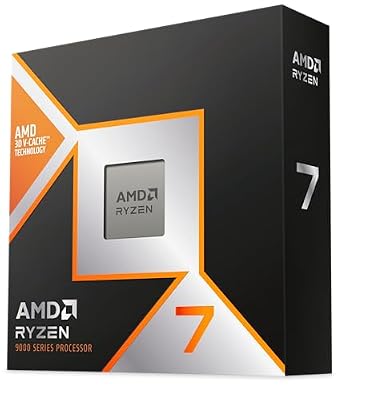
If you are running a Ryzen 7 5800X3D in your gaming rig and you see AMD’s newest 3D V-Cache chip on sale at $449, the math feels simple at first glance. Both chips pack eight cores, both carry 96 megabytes of L3 cache, and both target the exact same audience: gamers who care about frame rates more than render throughput. The question that lands on the forum threads and the Discord channels is whether the generational jump from Zen 3 to Zen 5, combined with the move from AM4 to AM5, actually justifies the cost. This guide breaks down the upgrade path so you can make that call with real numbers instead of hype.
Quick Verdict
For pure gaming performance, the 9800X3D delivers a meaningful but not dramatic gain over the 5800X3D in CPU-bound scenarios. At 1080p, you are looking at roughly 10 to 15 percent higher average frame rates across a broad mix of titles, with some games showing closer to 20 percent and others showing single-digit movement. At 1400p that gap narrows, and at 4K it mostly disappears because the GPU becomes the limiting factor. The real cost is not the $449 processor itself but the platform swap to AM5, which means a new motherboard and DDR5 memory. If you already own a compatible B650 or X670 board sitting in a drawer, the upgrade makes more sense. If you are starting from scratch on AM5, the total outlay climbs past $700 and the value proposition weakens considerably.
As an Amazon Associate we earn from qualifying purchases at no extra cost to you.

Specs: Old vs New
| Specification | Ryzen 7 5800X3D | Ryzen 7 9800X3D |
|---|---|---|
| Architecture | Zen 3 (7nm) | Zen 5 (4nm) |
| Cores / Threads | 8 / 16 | 8 / 16 |
| Base Clock | 3.4 GHz | 4.7 GHz |
| Boost Clock | 4.5 GHz | 5.2 GHz |
| L3 Cache | 96 MB (3D V-Cache) | 96 MB (3D V-Cache) |
| Socket | AM4 | AM5 |
| Memory Support | DDR4-3200 | DDR5-5600 |
| PCIe Version | 4.0 | 5.0 |
| TDP | 105W | 120W |
| Launch Price | $449 | $449 |
Performance Gain
The 9800X3D benefits from three architectural advantages over the 5800X3D: a higher clock speed by roughly 700 MHz at boost, improved IPC from Zen 5 over Zen 3, and a revised 3D V-Cache layout that places the cache die below the compute die rather than above it. That last change lowers operating temperatures and allows higher sustained clocks, which matters in longer gaming sessions.
1080p Gaming
This is where the upgrade is most visible because the CPU is doing more of the work. Across launch coverage from Tom’s Hardware and Hardware Unboxed, the 9800X3D showed average gaming gains in the range of approximately 10 to 15 percent over the 5800X3D at 1080p when paired with a high-end GPU like an RTX 4080 or RX 7900 XTX. In esports and older titles such as Counter-Strike 2 and League of Legends, TechPowerUp recorded gains closer to 15 to 20 percent. In heavier single-threaded or open-world titles, Gamers Nexus noted the gap narrowing to around 8 to 12 percent. 1% low frametimes improved by a similar margin, which translates to a noticeably smoother experience during combat-heavy moments.
1440p Gaming
At 1440p the GPU load increases and the CPU advantage compresses. TechSpot’s review suite placed the gap between roughly 5 and 10 percent on average, with the variance depending on how demanding the title is and whether you are using an RTX 4070 Ti or something faster. If your GPU is already struggling at 1440p, the 5800X3D is not the bottleneck and swapping it out will do very little.
4K Gaming
At 4K, the practical difference between these two chips is negligible. Most outlets reported single-digit percentage gains, often in the 0 to 5 percent range, which falls inside the margin of error for typical frame-time variance. If you game at 4K with a top-tier GPU, the 9800X3D will not move your numbers in any way you can perceive without a benchmarking tool open on a second monitor.
Hidden Costs
Platform swap. This is the big one. The 9800X3D requires an AM5 motherboard and DDR5 memory. A decent B650 board runs roughly $140 to $200, and 32 GB of DDR5-6000 CL30 adds another $80 to $110. That puts the realistic total for a fresh build around $680 to $760 when you include the processor itself.
Cooler compatibility. Most AM4 coolers with bracket adapters will mount on AM5, but AMD’s own Wraith Prism and several third-party solutions require a small clip kit. Budget five to fifteen dollars for the adapter if your current cooler does not ship with AM5 hardware out of the box.
Power supply. The jump from 105W to 120W TDP is modest, and any PSU that was adequate for the 5800X3D will handle the 9800X3D without issue. There is no hidden PSU cost here unless your current unit is already at its limit from the GPU draw.
Case clearance. The 9800X3D’s revised thermal profile means it runs cooler under sustained load than the 5800X3D did, so case airflow is not a concern for most builds. This is a non-issue unless you are running a tower cooler at the edge of your case width.
Resale of the old chip. The 5800X3D retains some value on the used market, but it has fallen substantially from its peak. Expect to recover somewhere in the range of $120 to $180 depending on condition and local demand. That offsets the platform cost modestly but does not erase it.
Worth It For
Upgraders who already own an AM5 motherboard and DDR5 memory. The chip drops in, you update your BIOS, and you get the performance gain without any additional expenditure beyond the $449 processor. This is the scenario where the upgrade makes the most financial sense.
Players who game at 1080p or 1440p with a powerful GPU and feel CPU-limited in competitive titles. The gains are real, and the improved 1% lows matter for fast-paced games.
Enthusiasts who want the best available gaming CPU and view the platform cost as a long-term investment in AM5, which AMD has committed to supporting through future generations.
Not Worth It For
4K gamers whose GPU is the clear bottleneck. The upgrade will not change your experience in any measurable way at that resolution.
Users building on a tight budget who would need to buy a motherboard and RAM on top of the processor. The total cost of entry makes alternatives more attractive.
People whose 5800X3D is already paired with a GPU that struggles at their target resolution. If your RTX 3070 is limiting you at 1440p, swapping the CPU will not fix that.
Alternatives
Ryzen 7 7800X3D. If you are moving to AM5 anyway, the 7800X3D delivers roughly 85 to 90 percent of the 9800X3D’s gaming performance at a lower price point, often in the $330 to $360 range. It uses the older 3D V-Cache layout, so it runs slightly hotter and clocks a bit lower, but for pure gaming it remains an excellent value.
Stay on AM4 and upgrade the GPU instead. A $400 graphics card swap will move your frame rates far more than a $449 CPU swap at any resolution above 1080p. If your budget is limited, this is the smarter allocation of funds.
Intel Core Ultra 7 265K. For mixed workloads that include productivity alongside gaming, Intel’s Arrow Lake chips offer stronger multi-threaded performance in the same price bracket. Purely for gaming, however, the 9800X3D still holds a clear advantage.
FAQ
Will the 9800X3D work in an AM4 motherboard?
No. The 9800X3D uses the AM5 socket, which is physically incompatible with AM4 boards. You will need a B650, X670, B850, or X870 series motherboard.
Do I need a new cooler for the 9800X3D?
Not necessarily. The 9800X3D actually runs cooler than the 5800X3D under gaming loads due to its inverted cache die placement. Most AM4-compatible coolers will work on AM5 with a mounting bracket adapter, which is often included with newer aftermarket coolers.
Is the 9800X3D worth upgrading to in 2026 if I already have a 7800X3D?
Generally no. The 7800X3D already delivers strong gaming performance on AM5, and the jump to the 9800X3D is smaller because both chips share the same socket and architecture generation. The gain is closer to 5 to 8 percent in most titles, which is not compelling when you already own a compatible platform.
What RAM speed is optimal for the 9800X3D?
DDR5-6000 with CL30 timings is the sweet spot recommended by AMD and confirmed in independent testing by outlets like Tom’s Hardware and Hardware Unboxed. Going beyond DDR5-6000 provides negligible gaming gains on this platform due to the Infinity Fabric clock relationship.
Sources and Methodology
All performance ranges cited in this guide are drawn from publicly available launch and follow-up reviews published by Tom’s Hardware, TechPowerUp, Hardware Unboxed, Gamers Nexus, and TechSpot. Frame-rate percentages represent approximate ranges across multiple titles and test configurations as reported by those outlets. No benchmarks were conducted for this article, and all figures should be treated as representative estimates rather than site-specific measurements. Pricing reflects typical street prices at the time of writing.