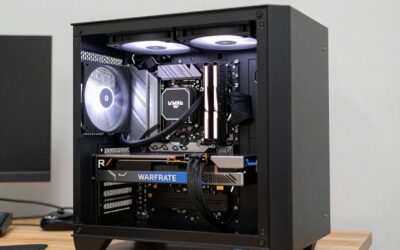
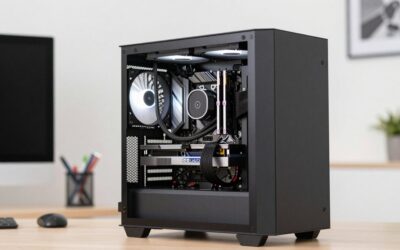
Building an RTX 5090 gaming PC means accepting that no other component matters more than the GPU itself. This build pairs NVIDIA’s flagship with a top-end AMD X3D CPU, a motherboard with enough PCIe lanes to spare, and a power supply rated for the 5090’s documented transient spikes.
- Parts List
- The Part Most RTX 5090 Lists Forget: CPU Cooling and Case Fans
- Storage: Why 2TB Is the Real Starting Point
- Gaming-First Alternative: Ryzen 7 9850X3D Instead of the 9950X3D
- RTX 5090 Gaming PC Build Tiers: Flagship, Gaming-First, and Lean
- Compatibility Check
- 12V-2×6 Power Connector: How to Install It Safely on an RTX 5090
- How Much Power Does an RTX 5090 Gaming PC Draw?
- Expected Performance
- Normal Temperatures for an RTX 5090 Build
- Is the RTX 5090 Worth It Over the RTX 5080 or RTX 4090?
- Founders Edition vs ASUS ROG Astral: Which RTX 5090 Fits Your Build?
- Pick the Right Monitor for an RTX 5090 Build
- DLSS 4 and Frame Generation: Reading Expected FPS Correctly
- Intel Alternative: Core Ultra 9 285K With an RTX 5090
- Optional Tuning: Undervolting the RTX 5090 and Tuning the Ryzen CPU
- Using an RTX 5090 Build for Local AI
- Mistakes to Avoid With an RTX 5090 Build
- Keeping an RTX 5090 Build Quiet
- Windows Settings Worth Checking on a New RTX 5090 PC
- Maintenance Schedule for an RTX 5090 Build
- Upgrade Path
- Case Airflow and Fan Layout for the Lian Li O11D EVO
- RTX 5090 Build Assembly Checklist
- First Boot, BIOS Settings, and Drivers
- Troubleshooting: 8 Common RTX 5090 Build Problems
- Upgrading From an Older PC: What to Keep and What to Replace
- How We Chose These RTX 5090 Build Parts
- FAQ
- Sources and Methodology
- Related Guides
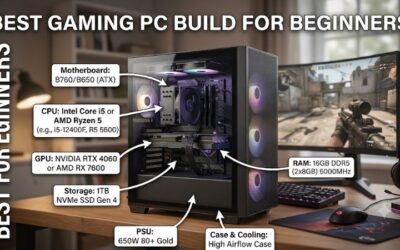
Updated October 2026 — A balanced RTX 5090 gaming PC build needs an X3D Ryzen CPU (Ryzen 7 9850X3D for pure gaming, Ryzen 9 9950X3D if you also create), an X870E board, 32-64GB of DDR5-6000 CL30, 2TB+ of NVMe storage, a 1000-1200W ATX 3.1 PSU with a native 12V-2×6 cable, and a 360mm AIO. Every RTX 5090 gaming PC part below is chosen to keep the GPU as the only limit at 4K.
- GPU: NVIDIA GeForce RTX 5090 · 32GB GDDR7 · 575W board power
- CPU: AMD Ryzen 9 9950X3D (creator + gaming) or AMD Ryzen 7 9850X3D (gaming-first)
- Cooling: ARCTIC Liquid Freezer III Pro 360 or similar 360mm AIO, plus 3-4 intake fans
- Power: 1000W is NVIDIA’s recommended floor; the CORSAIR HX1200i leaves margin for transients
- Storage: 2TB is the practical minimum now that many AAA games pass 100GB
- Target: 4K at high refresh with ray tracing, using DLSS for path-traced titles
Parts List
| Part | Model | Price | Why |
|---|---|---|---|
| CPU | AMD Ryzen 9 9950X3D 16-Core Processor | Check price | Strong gaming performance plus 16 cores for creator work; 3D V-Cache keeps the CPU from limiting the GPU at 4K |
| Motherboard | ASUS ROG Crosshair X870E Hero | Check price | PCIe 5.0 x16 slot, 18+2+2 VRM, Wi-Fi 7, and USB4 for a build that won’t need a board swap for years |
| RAM | G.SKILL Trident Z5 Neo RGB 64GB DDR5-6000 CL30 | Check price | 64GB covers gaming plus streaming; CL30 is the Ryzen 9000 sweet spot for Infinity Fabric synchronization |
| Storage | Samsung SSD 990 PRO with Heatsink 1TB | Check price | PCIe 4.0 throughput handles game loads without competing for PCIe 5.0 bandwidth |
| Power Supply | CORSAIR HX1200i (2025) 1200W ATX 3.1 | Check price | Native 12V-2×6 connector, ATX 3.1 transient tolerance, and enough headroom for the 575W TDP card |
| Case | Lian Li O11D EVO RGB | Check price | Supports GPUs up to 422mm; excellent airflow with bottom intake and top exhaust for the 5090’s heat output |
| GPU | ASUS ROG Astral RTX 5090 32GB GDDR7 OC Edition | Check price | The card this entire build exists around; 32GB GDDR7 handles every current title at 4K with RT |
AMD Ryzen 9 9950X3D
The 9950X3D earns its place by stacking 3D V-Cache on top of 16 Zen 5 cores, delivering gaming performance that leads Intel’s Core Ultra lineup in most reviews. In practice, this means the CPU is effectively invisible during 4K gaming, letting the 5090 saturate its pipeline. The 128MB L3 cache also helps in simulation-heavy titles and streaming workloads.

AMD Ryzen 9 9950X3D 16-Core Processor
Included for 'RTX 5090 Gaming PC Build in 2026: Full Parts List and Expected FPS' as a representative home product in this roundup; selection reflects the product set returned for this topic.
View on Amazon
ASUS ROG Crosshair X870E Hero AMD X870E AM5 ATX Motherboard, Advanced AI PC Ready, 18+2+2 Power Stages, DDR5, PCIe® 5.0, 5X M.2, Wi-Fi 7, USB4®, AI Overclocking, Core Flex, PCIe Slot Q-Release Slim
Included for 'RTX 5090 Gaming PC Build in 2026: Full Parts List and Expected FPS' as a representative home product in this roundup; selection reflects the product set returned for this topic.
View on Amazon
G.SKILL Trident Z5 Neo RGB Series DDR5 RAM (AMD EXPO) 64GB (2x32GB) Up to 6000MT/s CL30-40-40-96 1.40V Desktop Computer Memory U-DIMM - Matte Black (F5-6000J3040G32GX2-TZ5NR)
Included for 'RTX 5090 Gaming PC Build in 2026: Full Parts List and Expected FPS' as a representative home product in this roundup; selection reflects the product set returned for this topic.
View on Amazon
Samsung SSD 990 PRO with Heatsink 1TB, NVMe M.2, Up to 7,450MB/s | NVMe Internal Solid State Hard Drive best for PlayStation 5 (PS5 SSD) Console Expansion (MZ-V9P1T0CW)
Included for 'RTX 5090 Gaming PC Build in 2026: Full Parts List and Expected FPS' as a representative home product in this roundup; selection reflects the product set returned for this topic.
View on Amazon
CORSAIR HX1200i (2025) ATX 3.1 PCIe 5.1 Ready 1200W Power Supply – Black | Native 12V-2x6 Cable Included, Ultra Low-Noise, Fully Modular, Cybenetics Platinum, Fluid Dynamic Bearing Fan, NA
Included for 'RTX 5090 Gaming PC Build in 2026: Full Parts List and Expected FPS' as a representative home product in this roundup; selection reflects the product set returned for this topic.
View on Amazon
LIAN LI O11D EVO RGB Black E-ATX Case, 420mm Radiator (O11DERGBX.US) | Pillarless glass view, dual RGB strips, flexible motherboard layout, 455.7mm GPU clearance, and 420mm radiator support.
Included for 'RTX 5090 Gaming PC Build in 2026: Full Parts List and Expected FPS' as a representative home product in this roundup; selection reflects the product set returned for this topic.
View on AmazonASUS ROG Crosshair X870E Hero
This board provides the PCIe 5.0 x16 slot needed for the 5090 without bandwidth compromise, plus five M.2 slots so storage expansion never requires a second controller. The 18+2+2 power stages handle the 9950X3D even under sustained multi-core loads with AI overclocking enabled. Wi-Fi 7 and USB4 future-proof connectivity.
G.SKILL Trident Z5 Neo RGB 64GB DDR5-6000 CL30
Ryzen 9000’s 1:1 Infinity Fabric ratio tops out near DDR5-6000, making CL30 the optimal latency-to-frequency combination without requiring manual tuning. The 64GB capacity covers 4K gaming with texture packs, background applications, and a stream encoder without pagefile reliance. Tight timings matter more than frequency on AM5, so this kit avoids the instability that plagues 6400+ kits on some silicon.
Samsung SSD 990 PRO 1TB
At 7,450MB/s sequential read, this drive loads open-world assets fast enough that the 5090 never waits on streaming. The integrated heatsink ensures sustained performance without throttling inside the O11D EVO’s airflow path. PCIe 4.0 is sufficient because game engines rarely saturate more than 1,000MB/s during actual gameplay streaming, so the extra bandwidth of PCIe 5.0 drives would be wasted.
CORSAIR HX1200i 1200W ATX 3.1
The 5090’s 575W rating can be exceeded for brief transient spikes, and the HX1200i’s ATX 3.1 design absorbs these without triggering over-current protection. Native 12V-2×6 cabling eliminates the adapter dongle that plagued early 40-series builds. The iCUE software reports real-time load, letting you verify the 5090 and 9950X3D together rarely exceed 750W in gaming. A 1000W unit technically fits but leaves almost no margin if you add a second GPU for compute or a high-wattage NVMe array.
Lian Li O11D EVO RGB
With 422mm of GPU clearance and dual-chamber airflow, the O11D EVO handles the Astral’s quad-fan design without thermal compromise. The bottom-to-top airflow pattern suits the 5090’s vertical heat dissipation, and the side-panel window showcases the card’s RGB shroud. The case’s 4.5mm GPU bracket supports heavy cards without sag. If you prefer a smaller footprint, the Lancool III offers similar clearance but restricts top radiator mounting to 280mm, which matters if you plan a 360mm AIO over the 9950X3D.
ASUS ROG Astral RTX 5090 32GB GDDR7 OC Edition
The Astral ships with a factory overclock and a vapor chamber cooler built for sustained loads. 32GB of GDDR7 handles 4K texture packs, RT reflections, and path tracing simultaneously without VRAM spillover. The 3.8-slot design demands the O11D EVO’s width.
The Part Most RTX 5090 Lists Forget: CPU Cooling and Case Fans
The parts list above has no CPU cooler, and the Ryzen 9 9950X3D does not ship with one. That is not optional: the chip is rated at 170W and will throttle without a capable cooler. The case also needs a full set of fans to move the heat a 5090 produces, so check what your O11D EVO version includes and budget for a fan kit if it is short.
ARCTIC Liquid Freezer III Pro 360 — Best-Value 360mm AIO for This Build
Key specs: 360mm · 38mm-thick radiator · 3 x P12 Pro fans up to 3,000 RPM · AM5 offset mount · VRM fan
A 360mm AIO is the standard pairing for a 5090 build because it moves CPU heat straight out of the case instead of adding it to the hot air already coming off the graphics card. The Liquid Freezer III Pro 360 is the pick most reviewers point to when value matters, and it is built with Ryzen in mind.
- Radiator: 398 x 120 x 38mm aluminum, thicker than the usual 27mm
- Fans: 3 x P12 Pro 120mm, 600 to 3,000 RPM, up to 77 CFM
- Pump: PWM, 800 to 2,800 RPM, with a small built-in VRM fan on the pump block
- Mounting: AM5 offset mount shifts the cold plate about 5mm toward the CCDs on Ryzen 7000/9000
- Clearance: about 63mm total thickness with fans attached
Pros
- Strong cooling per dollar for a 170W 16-core X3D chip
- VRM fan helps the area around the socket in a hot, GPU-heavy case
- Offset mount is designed specifically for chiplet Ryzen CPUs
Cons
- 38mm radiator plus fans needs more roof or side clearance than slim AIOs
- Fans get loud near 3,000 RPM; set a sensible fan curve in the BIOS
Skip it if… you want an LCD pump screen to match a showcase build; the NZXT Kraken Elite 360 or ASUS ROG Ryujin III 360 cost far more for similar cooling plus a display.
Case fans. In the O11D EVO, the usual layout is three 120mm intake fans on the bottom feeding the GPU, three on the side as intake, and the AIO on the top as exhaust. Lian Li’s UNI FAN series daisy-chains to cut cable clutter, while ARCTIC P12 Pro or Noctua NF-A12x25 fans are quieter value picks. Aim for slightly more intake than exhaust so dust stays on the filters, not inside the case.
Storage: Why 2TB Is the Real Starting Point
The listed 1TB 990 PRO fills fast. After Windows and updates, you have roughly 850GB of usable space, and a handful of current AAA games with high-resolution texture packs can take that on their own. A 2TB drive in the primary slot avoids juggling installs.
Samsung 990 PRO 2TB — Best Primary Drive Upgrade

Samsung SSD 990 PRO 2TB, PCIe 4.0 M.2 2280, Up to 7,450 MB/s | NVMe Internal Solid State Hard Drive for High End Computing, Gaming, and Heavy Duty Workstations, (MZ-V9P2T0B/AM)
Included for 'RTX 5090 Gaming PC Build in 2026: Full Parts List and Expected FPS' as a representative home product in this roundup; selection reflects the product set returned for this topic.
View on AmazonKey specs: 2TB · PCIe 4.0 x4 NVMe · up to 7,450MB/s read · 1,200 TBW · 5-year warranty
The 2TB version of the same drive keeps the build consistent: identical controller and firmware family, double the space. The X870E Hero includes M.2 heatsinks, so the bare version (without its own heatsink) is fine here.
- Interface: PCIe 4.0 x4 NVMe, M.2 2280
- Sequential speeds: up to 7,450MB/s read and 6,900MB/s write
- Capacity: 2TB, single-sided
- Warranty: 5 years, limited by rated endurance (1,200 TBW for 2TB)
Pros
- Fast enough that DirectStorage-style asset streaming is not held back
- Runs cooler and draws less power than PCIe 5.0 drives
- Uses the board’s own heatsink, so no clearance issues under the GPU
Cons
- SSD prices rose sharply through 2026, so 2TB costs well above its 2024 level
- Not the fastest option if you move very large video projects daily
Skip it if… you edit 8K video or train large AI models; a PCIe 5.0 drive such as Samsung’s 9100 PRO roughly doubles sequential throughput for scratch work.
Gaming-First Alternative: Ryzen 7 9850X3D Instead of the 9950X3D
The 9950X3D makes sense if you stream, edit, compile, or run local AI models alongside gaming. If the machine is for games, the 8-core 9850X3D delivers effectively the same frame rates at a lower cost and is easier to cool.
AMD Ryzen 7 9850X3D — Best CPU for a Pure Gaming 5090 Build

AMD Ryzen™ 7 9850X3D Desktop Processor
Included for 'RTX 5090 Gaming PC Build in 2026: Full Parts List and Expected FPS' as a representative home product in this roundup; selection reflects the product set returned for this topic.
View on AmazonKey specs: 8 cores / 16 threads · up to 5.6GHz · 96MB L3 3D V-Cache · 120W · AM5
Launched in January 2026, the 9850X3D is a faster-clocked 9800X3D. Reviews from Tom’s Hardware and Gamers Nexus put it about 2 to 4 percent ahead of the 9800X3D in games, which made it the fastest gaming processor at launch. At 4K with a 5090, either chip leaves the GPU as the limit in most titles; the gap shows up at 1440p high refresh and in CPU-heavy games.
- Cores/threads: 8 Zen 5 cores, 16 threads
- Boost clock: up to 5.6GHz (400MHz above the 9800X3D)
- Cache: 96MB L3 with 3D V-Cache (104MB total cache)
- TDP: 120W, socket AM5, no cooler included
Pros
- Top-tier gaming performance with a single CCD, so no core-parking quirks
- Lower heat than the 16-core 9950X3D, easier on the AIO
- Drops straight into the X870E Hero with current BIOS
Cons
- Only a few percent faster than the cheaper 9800X3D
- Half the cores of the 9950X3D for rendering, encoding, or compiling
Skip it if… you already own a 9800X3D, or your workload includes heavy multi-threaded creative work.
RTX 5090 Gaming PC Build Tiers: Flagship, Gaming-First, and Lean
The main parts list is a no-compromise creator-and-gaming machine. Most buyers can match its gaming performance while spending less on the platform, because at 4K the graphics card sets the frame rate. Price bands below are relative rather than exact, since memory and SSD prices moved sharply during 2026.
| Part | Flagship (this guide) | Gaming-first | Lean 5090 |
|---|---|---|---|
| CPU | AMD Ryzen 9 9950X3D | AMD Ryzen 7 9850X3D | AMD Ryzen 7 9800X3D |
| Motherboard | X870E flagship (ASUS ROG Crosshair X870E Hero class) | Mid-range X870E or X870 ATX | B850 ATX with a PCIe 5.0 x16 slot |
| Memory | 64GB DDR5-6000 CL30 | 32GB DDR5-6000 CL30 | 32GB DDR5-6000 CL30-CL36 |
| Storage | 2TB + second NVMe | 2TB PCIe 4.0 | 2TB PCIe 4.0 |
| PSU | 1200W ATX 3.1, native 12V-2×6 | 1000-1200W ATX 3.1 | 1000W ATX 3.1 Gold, native 12V-2×6 |
| Cooler | 360mm AIO | 360mm AIO | 240-360mm AIO or dual-tower air |
| 4K gaming vs. flagship | Baseline | About the same | Within a few percent |
| Best for | Gaming + streaming, editing, local AI | Enthusiast gaming | Getting a 5090 without overspending on the rest |
Flagship Tier: Gaming Plus Creator Work
Core spec: Ryzen 9 9950X3D · X870E · 64GB DDR5-6000 CL30 · 2TB+ NVMe · 1200W ATX 3.1 · 360mm AIO
- Sixteen cores handle streaming, video export, code compiles, and local AI models alongside a game
- 64GB of system RAM keeps large projects and many background apps out of the pagefile
- X870E boards add USB4, more M.2 slots, and stronger power delivery for long all-core loads
- Gaming frame rates match the gaming-first tier; you pay for the extra cores and platform features
Gaming-First Tier: Same 4K Frame Rates, Smarter Spend
Core spec: Ryzen 7 9850X3D · X870E or X870 · 32GB DDR5-6000 CL30 · 2TB NVMe · 1000-1200W ATX 3.1 · 360mm AIO
- The single-CCD 9850X3D is among the fastest gaming CPUs available and needs no core-parking software
- 32GB is enough for every current game; 64GB only matters for heavy multitasking
- A mid-range X870 board still provides a PCIe 5.0 x16 graphics slot and PCIe 5.0 M.2
- Savings over the flagship tier can go toward a better monitor, which matters more at this level
Lean Tier: An RTX 5090 Without Overspending
Core spec: Ryzen 7 9800X3D · B850 · 32GB DDR5-6000 · 2TB NVMe · 1000W ATX 3.1 Gold · 240-360mm cooler
- The 9800X3D trails the 9850X3D by only a few percent in games
- Pick a B850 board with a PCIe 5.0 x16 slot; on a PCIe 4.0 x16 slot the loss is small, about 1-2% in launch scaling reviews
- A quality 1000W ATX 3.1 unit meets NVIDIA’s recommendation, with less headroom for future upgrades
- Do not cut the case: a 5090 still needs room for a near-4-slot card and strong bottom or front intake
Summary: For most gamers, the best combination is the NVIDIA GeForce RTX 5090 with an AMD Ryzen 7 9850X3D, a 360mm AIO such as the ARCTIC Liquid Freezer III Pro 360, and a 1000-1200W ATX 3.1 supply such as the CORSAIR HX1200i. Choose the AMD Ryzen 9 9950X3D only if creator workloads justify the extra eight cores.
Compatibility Check
Socket: AM5 on the Crosshair X870E matches the 9950X3D physically and in BIOS support out of the box. RAM: DDR5 U-DIMM is the only option on this platform; the XMP/EXPO profile activates immediately. PSU: 1200W provides 1.6x the combined 5090 and 9950X3D TDP, well within ATX 3.1 transient specifications. GPU length: The Astral measures approximately 358mm; the O11D EVO clears 422mm, leaving 64mm for front intake fans without obstruction. Case clearance: The top 360mm radiator mount accommodates a full AIO without GPU contact because the 5090 sits lower in the PCIe slot than the radiator bracket.
12V-2×6 Power Connector: How to Install It Safely on an RTX 5090
The RTX 5090 draws all of its power through a single 16-pin 12V-2×6 connector rated for 600W. The card’s 575W rating puts it close to that ceiling, so a partly seated plug or a sharply bent cable leaves little margin. Melted connectors reported on early 40- and 50-series cards were overwhelmingly linked to incomplete insertion, adapters, or cable stress near the plug.
The 12V-2×6 design improved on the earlier 12VHPWR plug by shortening the four sense pins, so the card should not request full power unless the connector is fully seated. That helps, but it does not replace careful installation.
- Use the PSU’s native cable. An ATX 3.1 unit like the CORSAIR HX1200i ships with a direct 12V-2×6 cable. Avoid 3- or 4-way 8-pin adapters and third-party extensions unless they come from your PSU maker.
- Push until it clicks, then check the gap. Seat the plug straight, listen for the latch, and look along the edge: there should be no visible gap between the plug and the socket.
- Leave a straight section before any bend. Keep at least about 35mm (roughly 1.4 inches) of straight cable before the first bend, and never bend the cable sideways at the plug.
- Plan the routing before closing the case. In the O11D EVO, the side glass panel sits close to the connector on large cards; make sure the panel does not press against the cable.
- Re-check after moving the PC. Shipping or carrying a finished build can loosen a heavy cable. Reseat it before the first long gaming session.
- Watch for warning signs. A burning plastic smell, discoloration on the plug, or sudden black screens under load mean you should shut down and inspect the connector immediately.
How Much Power Does an RTX 5090 Gaming PC Draw?
The estimates below combine published component ratings with typical gaming loads reported by reviewers. They show why a 1000W unit is the floor and why 1200W is comfortable rather than excessive.
| Component | Rated / typical gaming draw (estimate) | Notes |
|---|---|---|
| NVIDIA GeForce RTX 5090 | 575W rated; often 450-575W in demanding 4K games | Brief transient spikes can exceed the rating |
| AMD Ryzen 9 9950X3D | 170W TDP; often under 150W while gaming | All-core rendering pushes it higher than gaming |
| AMD Ryzen 7 9850X3D | 120W TDP; often around 80-110W while gaming | Single CCD, easier to cool |
| Motherboard, RAM, SSDs | About 50-80W | X870E boards with many features sit at the higher end |
| Fans, pump, RGB | About 20-40W | Depends on fan count and speed |
| Total system, gaming | About 650-850W | Leaves headroom on a 1200W unit for transients |
PSU efficiency also changes what the wall outlet sees. A Platinum-rated unit like the HX1200i wastes less as heat, so expect wall draw roughly 6-10% above the internal load. If the PC shares a 15-amp household circuit with a space heater or another high-draw device, move one of them before long sessions.
Expected Performance
All figures below represent approximate ranges drawn from launch-review benchmarks published by TechPowerUp, Tom’s Hardware, Hardware Unboxed, Gamers Nexus, and TechSpot. Actual results vary by driver version, thermal conditions, and title updates.
4K Ultra + Ray Tracing
Path-traced titles such as Cyberpunk 2077 and Alan Wake 2 depend heavily on DLSS and frame generation at 4K, and native-resolution results in published reviews are far lower, so check the settings behind any figure. Call of Duty Black Ops 6 at Ultra: 140-170 FPS (TechSpot, Hardware Unboxed). Baldur’s Gate 3 at Ultra: 120-150 FPS (TechPowerUp). Expect DLSS Quality to push demanding titles into the 130-160 range without noticeable artifacting.
1440p Ultra + Ray Tracing
Hogwarts Legacy (RT High): 150-185 FPS (Tom’s Hardware). Forza Horizon 5 Ultra: 200-250+ FPS (TechSpot). The 5090 at this resolution increasingly becomes CPU-limited, which is precisely where the 9950X3D’s cache advantage shows.
1080p Competitive
At 1080p in esports titles like Valorant or Counter-Strike 2, frame rates exceed 400 FPS but become almost entirely CPU-bound. The 9950X3D maintains 350-500+ FPS in these scenarios, per TechSpot and Hardware Unboxed reviews. The 5090’s contribution diminishes at this resolution, which is an inherent property of any modern flagship GPU on a fast CPU.
Normal Temperatures for an RTX 5090 Build
Once the build is running, temperatures are the quickest way to confirm the cooling plan works. The ranges below are typical figures from published reviews of these parts in well-ventilated cases, not guarantees; room temperature, fan curves, and the specific card model all shift them.
| Sensor | Idle | Gaming load | Investigate if |
|---|---|---|---|
| RTX 5090 GPU core (large partner card, e.g. ASUS ROG Astral) | About 30-40°C | About 60-72°C | Consistently above 83°C |
| RTX 5090 GPU core (Founders Edition, 2-slot) | About 30-40°C | About 70-78°C | Consistently above 85°C |
| RTX 5090 GDDR7 memory | About 40-50°C | About 70-90°C | Above 95°C |
| Ryzen 9 9950X3D / Ryzen 7 9850X3D (360mm AIO) | About 35-50°C | About 60-80°C | Gaming temps near 90°C |
| NVMe SSD (with heatsink) | About 30-45°C | About 40-60°C | Above 70°C during game installs |
Ryzen X3D chips boost until they reach thermal or power limits, so brief spikes during shader compilation are normal. What matters is steady gaming temperature. If the GPU runs hot while the CPU is fine, the problem is usually case intake: the 5090 needs cool air at its fans, which is why the O11D EVO’s bottom intake fans matter more than extra exhaust.
Is the RTX 5090 Worth It Over the RTX 5080 or RTX 4090?
For a pure 4K gaming machine, the RTX 5090 is the fastest consumer card available, but it is not the only sensible choice. Launch reviews from TechPowerUp, Tom’s Hardware, and others put it roughly 25-35% ahead of the RTX 4090 at 4K in rasterized games, and roughly 50% ahead of the RTX 5080.
| Card | VRAM | Board power | 4K gaming position | Best for |
|---|---|---|---|---|
| NVIDIA GeForce RTX 5090 | 32GB GDDR7 | 575W | Fastest; baseline | 4K 144Hz+, path tracing, local AI, 8K experiments |
| NVIDIA GeForce RTX 4090 | 24GB GDDR6X | 450W | About 25-35% behind | Owners who already have one; no need to upgrade |
| NVIDIA GeForce RTX 5080 | 16GB GDDR7 | 360W | About a third slower | 4K with DLSS at a much lower total build cost |
- Buy the RTX 5090 if you play at 4K 144Hz or higher, want path tracing without dropping DLSS to Performance mode, or run local AI models that need more than 16-24GB of VRAM.
- Keep your RTX 4090 if you already own one; the uplift rarely justifies the cost of switching.
- Choose the RTX 5080 if you game at 1440p high refresh or 4K with DLSS; the whole build gets cheaper, cooler, and quieter, with an 850-1000W PSU.
Founders Edition vs ASUS ROG Astral: Which RTX 5090 Fits Your Build?
The parts list uses the ASUS ROG Astral, but the RTX 5090 comes in very different sizes. Card dimensions decide which cases work, how much airflow you need, and whether a support bracket is mandatory.
| Card | Length | Thickness | Cooling | Build notes |
|---|---|---|---|---|
| NVIDIA GeForce RTX 5090 Founders Edition | 304mm | 2 slots | Dual flow-through fans | Fits small-form-factor cases; runs warmer and exhausts more heat toward the CPU cooler |
| ASUS ROG Astral RTX 5090 OC | 357.6mm | 3.8 slots | Four fans, vapor chamber, phase-change pad | Needs a large case and a support bracket; cooler and quieter under load |
| Typical triple-fan partner cards | About 330-360mm | About 3-3.5 slots | Three fans | Check the exact model’s length against your case before ordering |
For the O11D EVO, any of these fit. For a compact case under about 340mm of GPU clearance, the Founders Edition is often the only realistic RTX 5090. Both expose DisplayPort 2.1b, which matters for the monitors below.
Pick the Right Monitor for an RTX 5090 Build
An RTX 5090 is wasted on a 1080p 144Hz screen. The card makes the most sense with one of these display types:
- 4K 240Hz OLED: The best match. The 5090 can push high frame rates at 4K in many games, especially with DLSS, and OLED response times make the extra frames visible.
- 4K 144-165Hz IPS or Mini-LED: A cheaper match that the 5090 can drive near its refresh ceiling in most titles without frame generation.
- 1440p 360-500Hz: Suits competitive players, but at this resolution the CPU becomes the limit sooner, which is where the X3D chips earn their place.
- Ultrawide 3440 x 1440 or 5120 x 2160: A strong fit for racing, flight, and open-world games.
Use a certified DisplayPort cable rated for the monitor’s bandwidth. For 4K 240Hz without compression on monitors that support it, that means a DP 2.1 cable rated for UHBR20 speeds.
DLSS 4 and Frame Generation: Reading Expected FPS Correctly
RTX 50-series cards support DLSS 4 Multi Frame Generation, which can create up to three extra frames for every frame the GPU renders. That is why some published RTX 5090 results show very high frame rates in path-traced games while native-resolution results are far lower.
- Native rendering: Every frame is drawn by the GPU. This is the number that sets responsiveness.
- DLSS Super Resolution: Renders below 4K and upscales. Quality mode gives a large boost with little visible loss.
- Frame Generation (2x) and Multi Frame Generation (3x-4x): Inserts AI-generated frames for smoother motion, but input feel still follows the rendered frame rate. Aim for at least 60 rendered frames per second before turning it on.
When comparing FPS figures, including the ranges in this guide’s performance section, check whether the source used native rendering, DLSS upscaling, or frame generation. They are not interchangeable.
Intel Alternative: Core Ultra 9 285K With an RTX 5090
If you prefer Intel, the Core Ultra 9 285K on a Z890 board is the matching flagship. Its 24 cores (8 performance and 16 efficient) suit creator work, and Thunderbolt support is common on Z890 boards. In games, launch reviews placed it behind AMD’s X3D chips, especially at 1080p and 1440p. At 4K the gap narrows because the RTX 5090 does most of the work. Choose it for specific Intel-optimized workflows, not for gaming alone.
Optional Tuning: Undervolting the RTX 5090 and Tuning the Ryzen CPU
Many owners undervolt the RTX 5090 to cut heat and noise. Reports from reviewers and enthusiasts commonly show a sizable power reduction for a single-digit performance loss, though every card behaves differently.
- Simplest method: Lower the power limit to about 75-80% in MSI Afterburner or the card maker’s tool. Gaming performance usually drops only a few percent while power and temperatures fall noticeably.
- Curve undervolt: Lock a lower voltage point on the voltage-frequency curve. More efficient, but test stability in several games before trusting it.
- Ryzen Curve Optimizer: Negative per-core offsets in PBO can lower CPU temperature and sometimes raise boost clocks. Start small and test.
- Leave the memory alone at first: DDR5-6000 CL30 with EXPO is already the efficient setting for AM5.
Tuning is optional. The build runs well at stock settings with the cooling described above.
Using an RTX 5090 Build for Local AI
The RTX 5090’s 32GB of GDDR7 is a big reason some buyers choose it over the 5080. That memory can hold local language models of roughly 30 billion parameters at 4-bit quantization, run image generators such as Stable Diffusion XL or FLUX comfortably, and handle video upscaling work that would overflow a 16GB card. For these uses, the flagship tier makes more sense: the Ryzen 9 9950X3D’s extra cores help with data preparation, and 64GB of system RAM prevents swapping when models load. Keep a second 2TB or larger NVMe drive just for models and datasets, which can grow quickly.
Mistakes to Avoid With an RTX 5090 Build
- Reusing an old PSU with adapters. An older 850W unit with an 8-pin-to-16-pin adapter is the riskiest shortcut in this build. Use a 1000W+ ATX 3.x unit with a native cable.
- Skipping the CPU cooler budget. X3D Ryzen chips ship without coolers. Plan for a 360mm AIO or a high-end dual-tower air cooler from the start.
- Buying a case for looks, not airflow. Glass-front cases with no intake starve the card. Confirm bottom or front intake for at least three 120mm fans.
- Ignoring M.2 lane sharing. Filling every M.2 slot on some X870E boards drops the graphics slot to x8. Read the manual’s bandwidth table first.
- Pairing the card with a 1080p monitor. The CPU becomes the limit and much of the GPU’s cost buys nothing visible.
- Overspending on RAM speed. DDR5-8000 kits cost more and often run worse on AM5 than DDR5-6000 CL30 at the 1:1 memory ratio.
- Forgetting the anti-sag support. A near-4-slot card can pull on the PCIe slot and the 12V-2×6 plug over time.
Keeping an RTX 5090 Build Quiet
A system that moves up to about 850W of heat while gaming will never be silent, but it does not have to be loud. Noise comes mostly from fans spinning faster than they need to.
- Use more fans at lower speed. Six to nine 120mm fans at moderate RPM are quieter than three fans at full speed moving the same air.
- Set gentle fan curves. Let AIO fans follow CPU temperature but stay below about 50-60% until the CPU passes 75°C. Case fans can follow GPU temperature if the board supports it.
- Cap frame rates. A frame cap a few frames below your monitor’s refresh rate stops the GPU from working flat out for frames you never see, cutting heat, noise, and coil whine.
- Consider a power limit. Running the RTX 5090 at a 75-80% power limit noticeably reduces fan speed for a small performance cost.
- Pick the right card. Larger coolers such as the ASUS ROG Astral generally run quieter than the compact two-slot Founders Edition under the same load.
Windows Settings Worth Checking on a New RTX 5090 PC
- Hardware-accelerated GPU scheduling: Must be on for DLSS Frame Generation. Find it under Settings, System, Display, Graphics.
- Game Mode: Keep it on, especially with the dual-CCD Ryzen 9 9950X3D.
- Power plan: Balanced is correct for Ryzen with the AMD chipset driver installed; there is no need for third-party power plans.
- Display refresh rate: Windows often defaults to 60Hz. Set the full refresh rate under Advanced display and enable G-SYNC in the NVIDIA app if your monitor supports it.
- Memory integrity (VBS): It can cost a few percent in some games. Weigh that against its security benefits before turning it off.
Maintenance Schedule for an RTX 5090 Build
| Interval | Task | Why it matters |
|---|---|---|
| Monthly | Clean dust filters on bottom and side intakes | Clogged filters raise GPU temperature first |
| Every 3-6 months | Blow dust from the GPU heatsink, radiator fins, and fans | Keeps fan speeds and noise low |
| After moving the PC | Reseat the 12V-2×6 cable and check the GPU support bracket | Vibration can loosen heavy cables and connectors |
| Every few months | Update the GPU driver, chipset driver, and BIOS when fixes apply | Stability, X3D scheduling, and game fixes |
| Yearly | Check AIO pump noise and CPU temperatures against your baseline | A rising baseline can signal pump wear or dust |
| Every 5-6 years | Plan to replace the AIO | Sealed loops slowly lose coolant over time |
Upgrade Path
This platform has no meaningful upgrade target below a full socket change. AM5 support extends through at least the next two AMD generations, meaning a future 9950X3D successor could drop into the Crosshair X870E with a BIOS update. Storage upgrades are immediate: add a second NVMe drive, but check the manual’s bandwidth table first because some M.2 slots share lanes with the graphics slot. The 1200W PSU absorbs a theoretical RTX 6090 without replacement. RAM is already at 64GB dual-channel; moving to 96GB requires different kit compatibility checks due to AM5’s two-slot per channel topology.
Case Airflow and Fan Layout for the Lian Li O11D EVO
A dual-chamber case like the O11D EVO has no front intake in its default layout, so airflow has to be planned around the bottom, side, and top mounts. With an RTX 5090 pulling up to 575W, the goal is simple: feed the card cool air from below and get the hot air out through the top.
- Bottom (3 x 120mm, intake): The most important fans in the build. They push fresh air straight into the 5090’s coolers.
- Side (3 x 120mm, intake): Adds cool air for the CPU radiator and the motherboard area.
- Top (360mm AIO radiator, exhaust): Removes CPU heat and the warm air rising off the GPU.
- Rear (1 x 120mm, exhaust, optional): Helps clear heat trapped near the VRM and rear I/O.
Keep total intake slightly above exhaust for positive pressure, which keeps dust on the filters instead of inside the case. Fans pointed the wrong way are the most common cause of high GPU temperatures in new builds: the frame side of a fan, where the struts are, is the exhaust side.
The ASUS ROG Astral RTX 5090 is 357.6mm long and 3.8 slots thick, and it weighs about 3kg. Use the anti-sag bracket that comes with the card or the case support, because a sagging card stresses the PCIe slot and the power connector.
RTX 5090 Build Assembly Checklist
Follow this order to avoid redoing steps. A first-time builder should plan on roughly two to four hours including the operating system install.
- Prepare the workspace. Work on a hard table, not carpet. Touch a grounded metal object before handling parts. Keep the motherboard on its box, not on the anti-static bag.
- Install the CPU. Lift the AM5 retention lever, align the triangle on the CPU with the one on the socket, lower it straight in, and close the lever. The plastic cover pops off on its own.
- Install the memory. With two sticks, use slots A2 and B2 (second and fourth from the CPU on most boards). Press firmly until both latches click.
- Install the M.2 SSDs. Use the top Gen5 slot nearest the CPU for the boot drive. Remove the plastic film from the thermal pad before refitting the board’s heatsink.
- Prepare the case. Fit the I/O shield if the board needs one, check standoffs line up with the ATX holes, and mount fans before the motherboard goes in.
- Mount the motherboard. Lower it at an angle into the I/O cutout, then fasten all screws snugly without overtightening.
- Install the power supply. In the O11D EVO it sits in the rear chamber; orient its fan toward a vented panel as the case manual shows. Connect the 24-pin, both 8-pin CPU (EPS) cables, and the 12V-2×6 cable now, leaving the GPU end loose.
- Mount the 360mm AIO. Install the AM5 offset bracket, apply paste if the cold plate has none, and fit the radiator on the top as exhaust. Connect the pump to the AIO_PUMP header and fans to CPU_FAN.
- Connect front-panel cables. Power switch, reset, LEDs, front USB-C, USB 3.x, and HD audio. The board manual shows the pinout.
- Install the RTX 5090. Remove the needed slot covers (four for the Astral), press the card into the top PCIe 5.0 x16 slot until it clicks, screw it in, and fit the support bracket.
- Attach the 12V-2×6 cable. Push until it latches, confirm no gap, and leave a straight run before any bend.
- Pre-boot check. Confirm every power cable is seated at both ends, the monitor cable goes into the GPU (not the motherboard), and no cable touches a fan.
First Boot, BIOS Settings, and Drivers
The first power-on of an AM5 system can sit on a black screen for a minute or more while the board trains the DDR5 memory. That is normal. Do not switch off during this step.
- Update the BIOS first. Use the board’s USB BIOS Flashback button with the latest file from the maker’s site. Newer BIOS versions improve memory stability and X3D support.
- Enable EXPO. Without it, the DDR5-6000 CL30 kit runs at a slower default speed. Select the EXPO profile in the BIOS memory menu.
- Enable Memory Context Restore. This shortens boot times after the first training run on most AM5 boards. If the system becomes unstable, turn it back off.
- Confirm Resizable BAR is on. It is normally enabled when CSM is disabled; NVIDIA’s app or GPU-Z will show the status.
- Check the PCIe link. In GPU-Z, the bus interface should read PCIe x16 5.0 under load. If it shows x8, check the board manual for M.2 slots that share lanes with the graphics slot.
- Set fan curves. Base the AIO fans on CPU temperature and case fans on a blend of CPU and GPU temperature if the board allows it.
- Install drivers in order. Windows 11, then the AMD chipset driver from AMD’s site, then the latest NVIDIA Game Ready driver. On the dual-CCD 9950X3D, the chipset driver installs the 3D V-Cache optimizer that steers games onto the cache-equipped cores; keep Windows Game Mode enabled.
Troubleshooting: 8 Common RTX 5090 Build Problems
No power, no fans, no lights
Check the PSU rocker switch and the wall outlet first, then the 24-pin and front-panel power switch pins. A single misplaced power-switch connector is the most common cause.
Fans spin but there is no display
Make sure the monitor is plugged into the RTX 5090, not the motherboard’s video ports. Then reseat the 12V-2×6 cable and the card itself. Give the first boot a full two to three minutes for memory training before assuming a fault.
Debug LED stuck on DRAM
Reseat both memory sticks in A2 and B2, clear CMOS, and boot with EXPO disabled. If it then boots, update the BIOS before enabling EXPO again.
Debug LED stuck on CPU
Usually a BIOS that predates the CPU or a seating problem. Use BIOS Flashback to update without a CPU-dependent boot, then check the socket for bent pins with a flashlight.
Random shutdowns or reboots in games
Typical of a power problem. Confirm the native 12V-2×6 cable is fully seated and that the PSU meets ATX 3.x. Remove any adapter. If shutdowns continue with a known-good PSU, check GPU and CPU temperatures for throttling or thermal shutdown.
Memory running below its rated speed
EXPO is off, or the BIOS reset after a failed boot. Re-enable the profile and save. Check the speed in Task Manager under Memory.
Graphics card shows PCIe x8 or Gen4
Some X870E boards split the main slot when certain M.2 slots are populated. Move the second SSD to a slot that does not share lanes, as shown in the manual’s bandwidth table.
Stutter in games on the Ryzen 9 9950X3D
Games landing on the non-cache CCD can cause uneven frame times. Install the latest AMD chipset driver, keep Game Mode on, and update the game. Disabling one CCD in the BIOS is a last resort.
Upgrading From an Older PC: What to Keep and What to Replace
- Keep: monitor, keyboard, mouse, headset, and NVMe drives (as secondary storage). Older SATA SSDs work fine as game libraries.
- Maybe keep the case: only if it fits a 358mm, near-4-slot card, has a 360mm radiator mount, and allows strong intake under or in front of the GPU.
- Maybe keep the PSU: only if it is a quality ATX 3.0/3.1 unit of 1000W or more with a native 12V-2×6 or 12VHPWR cable. Replace older units rather than relying on adapters.
- Replace: DDR4-era platforms (AM4, Intel 12th-14th gen with DDR4). An AM4 Ryzen 7 5800X3D can run a 5090 at 4K, but it leaves noticeable performance on the table at 1440p and in CPU-heavy games.
- Replace: any air cooler or AIO without an AM5 mounting kit, and memory, since AM5 requires DDR5.
How We Chose These RTX 5090 Build Parts
This build is research-based; no parts were compared for this guide. We compared manufacturer specifications from NVIDIA, AMD, ASUS, CORSAIR, Lian Li, Samsung, and ARCTIC; read launch and follow-up reviews from TechPowerUp, Tom’s Hardware, Gamers Nexus, Hardware Unboxed, and TechSpot; and checked compatibility points such as card length, slot width, radiator support, and lane sharing against published manuals. Parts were chosen to keep the RTX 5090 as the only performance limit at 4K, to stay within the 12V-2×6 connector’s safe operating guidance, and to remain upgradeable on AM5.
FAQ
Is 64GB RAM necessary for the RTX 5090?
No, 32GB runs every current game without limitation. The 64GB kit serves users who stream, run virtual machines, or keep browser tabs open during play. The 5090’s 32GB of VRAM handles texture data independently of system RAM.
Does the 5090 need a 1200W power supply?
NVIDIA recommends a 1000W power supply for the RTX 5090, and the 1200W HX1200i covers that with room to spare. The 5090 and 9950X3D together rarely exceed 750W during gaming. A 1000W ATX 3.1 unit works, but 1200W leaves more margin for transients and added peripherals.
Can this build handle 8K gaming?
Native 8K in demanding AAA titles is well below 60 FPS in published launch reviews. DLSS Performance mode helps, though image quality degradation becomes visible. Practically, this card targets 4K, not 8K.
Is the ASUS Astral significantly better than the Founders Edition?
The Astral offers a factory overclock and a much larger cooler, which generally means lower temperatures and less noise under load. Performance gains are small, a few percent at most, which many buyers find imperceptible. The premium buys acoustics and thermal headroom, not a tier jump.
What are the best flagship gaming PC 2026 parts for an RTX 5090 with a Ryzen 9?
Pair the RTX 5090 with an AMD Ryzen 9 9950X3D, an X870E board, 64GB DDR5-6000 CL30, a 2TB PCIe 4.0 or 5.0 SSD, a 1200W ATX 3.1 PSU, and a 360mm AIO. This guide’s list uses the ASUS ROG Crosshair X870E Hero, G.SKILL Trident Z5 Neo, Samsung 990 PRO, CORSAIR HX1200i, and Lian Li O11D EVO, with the ARCTIC Liquid Freezer III Pro 360 covering CPU cooling.
Will a Ryzen 7 9800X3D bottleneck an RTX 5090?
No, not at 4K, where the RTX 5090 remains the limit in nearly every game. At 1080p and 1440p high refresh, any CPU can become the limit, but the 9800X3D and 9850X3D are among the fastest gaming chips available, so they leave the least performance on the table.
Can the 12V-2×6 connector melt on an RTX 5090?
It can if the plug is not fully seated or the cable is bent hard at the connector. Use the PSU’s native 12V-2×6 cable, push until it clicks with no visible gap, keep a straight run before bending, and avoid adapters and extensions.
Does the RTX 5090 lose performance on a PCIe 4.0 slot?
Only slightly: launch scaling reviews measured roughly a 1-2% average loss on PCIe 4.0 x16 compared with PCIe 5.0 x16. Running at x8 on PCIe 4.0 costs more, so check that no M.2 drive is splitting the graphics slot’s lanes.
Sources and Methodology
Performance ranges reference launch and post-launch reviews from TechPowerUp, Tom’s Hardware, Gamers Nexus, Hardware Unboxed, and TechSpot. All cited figures come from those publishers’ own published reviews. Ranges are broadened to account for driver updates, game patches, and thermal variability across systems. No original benchmarking was performed for this guide.