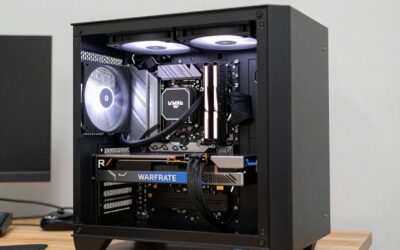
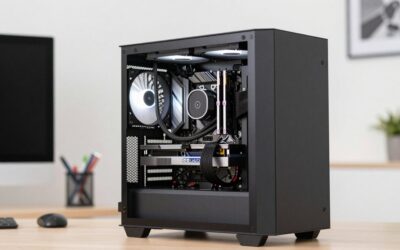
- Top Pick: AMD Ryzen™ 7 9700X 8-Core, 16-Thread Unlocked Desktop Processor
- Best Value: GIGABYTE GeForce RTX 5070 Eagle OC SFF 12G Graphics Card, 12GB 192-bit GDDR7, PCIe 5.0, WINDFORCE Cooling System, GV-N5070EAGLE OC-12GD Video Card
- Premium Choice: MSI MAG B850 Tomahawk MAX WiFi Motherboard, ATX – Supports AMD Ryzen 9000/8000 / 7000 Processors, AM5-80A SPS VRM, DDR5 Memory Boost 8400+ MT/s (OC), PCIe 5.0 x16, M.2 Gen5, Wi-Fi 7, 5G LAN
Apex Legends is a high-refresh game first. Respawn’s modified Source engine is well threaded and scales cleanly with GPU power, so the target for a serious build is not 60 fps but a locked 240 fps at 1080p or 165 fps at 1440p with settings that still let you see through smoke and foliage. This build aims exactly there: an eight-core Zen 5 processor to keep frame times flat in end-game rings with twenty players alive, an RTX 5070 that comfortably drives 1440p high refresh, and a platform with PCIe 5.0 and fast storage for the long haul. Expect roughly $1,500 to $1,700 depending on GPU pricing, with the balance tilted toward the components Apex actually rewards.
Parts List
| Part | Model | Approx. price | Why |
|---|---|---|---|
| CPU | AMD Ryzen 7 9700X | $300-330 | Eight fast cores for flat frame times |
| GPU | Gigabyte GeForce RTX 5070 Windforce OC 12G | $550-600 | 1440p high refresh with Reflex and DLSS 4 |
| Motherboard | MSI MAG B850 Tomahawk WiFi | $220-250 | PCIe 5.0 GPU slot, strong VRM, Wi-Fi 7 |
| RAM | Corsair Vengeance 32GB DDR5-6000 CL30 | $110-130 | Low-latency EXPO kit for Ryzen |
| SSD | Samsung 990 EVO Plus 2TB | $130-160 | Fast, cool, and big enough for a full library |
| PSU | Corsair RM750e | $100-120 | ATX 3.1 with native 12V-2×6, quiet |
| Case | Lian Li Lancool 207 | $80-100 | Exceptional airflow for the price |
AMD Ryzen 7 9700X

Apex Legends scales across cores better than most shooters, and the Ryzen 7 9700X delivers eight Zen 5 cores with excellent single-thread speed at a 65W default that stays cool and quiet. In TechPowerUp’s and Tom’s Hardware’s launch reviews it edged the six-core 9600X in gaming and pulled clearly ahead in multitasking, which matters if you stream. It ships without a cooler, so plan on a 120mm tower. On AM5 it leaves a drop-in path to a Ryzen 7 9800X3D. Swap option: the 9800X3D now if 240Hz at 1440p is the goal and budget allows.
As an Amazon Associate we earn from qualifying purchases at no extra cost to you.


Gigabyte GeForce RTX 5070 Windforce OC 12G
The RTX 5070 is the sweet spot for 1440p Apex. In TechPowerUp’s launch review it landed roughly 20-30 percent ahead of the RTX 5060 Ti class, which is the difference between 165Hz and 240Hz at 1440p on competitive settings. NVIDIA Reflex keeps input latency low and DLSS 4 quality mode adds margin if you turn settings up. Gigabyte’s Windforce cooler is quiet and around 280mm long. Twelve gigabytes of VRAM is plenty for Apex at any resolution. Swap option: the Sapphire Pulse Radeon RX 9070 XT 16GB for more rasterization and memory if you also play heavier games at 4K.
MSI MAG B850 Tomahawk WiFi
The B850 Tomahawk WiFi brings a PCIe 5.0 x16 slot for the graphics card, a PCIe 5.0 M.2 slot, Wi-Fi 7, 5-gigabit Ethernet, and a VRM that handles any AM5 processor including the 170W Ryzen 9 parts. MSI’s BIOS makes enabling EXPO memory profiles a single click. It is a step above the B650 boards in connectivity while costing far less than X870E. Swap option: the MSI B650 Gaming Plus WiFi to save money if you do not need PCIe 5.0 or Wi-Fi 7.
Corsair Vengeance 32GB DDR5-6000 CL30
DDR5-6000 CL30 is the proven sweet spot for Ryzen’s memory controller, and Apex Legends benefits from low latency in frame-time consistency. Corsair’s Vengeance kit is a low-profile, EXPO-certified pair of 16GB modules that clears any air cooler and runs at rated speed with one BIOS setting. Thirty-two gigabytes covers Apex, Discord, a browser, and OBS with room to spare. Swap option: a 64GB kit at the same speed only if you edit video or run heavy creative software; Apex alone will never need it.
Samsung 990 EVO Plus 2TB
The 990 EVO Plus is a fast, efficient PCIe 4.0 drive that runs cool without a heatsink and loads Apex’s maps in seconds. Two terabytes hold Windows, Apex, and a large library of other games without juggling installs. Samsung’s firmware and Magician software are mature and reliable. It drops into the board’s primary M.2 slot under the included heatsink. Swap option: the WD Black SN850X 2TB if you want a DRAM-equipped drive with slightly higher sustained performance for large file work.
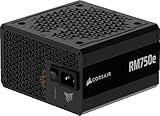
Corsair RM750e
This system peaks around 400W under gaming load, so the Corsair RM750e runs at a quiet, efficient mid-load with headroom for a future GPU upgrade. It is fully modular, ATX 3.1 compliant, 80 Plus Gold rated, and includes a native 12V-2×6 cable for the RTX 5070, avoiding adapters. Corsair’s RMe line has an excellent reliability record. Swap option: the Corsair RM850e if you plan to move to an RX 9070 XT or RTX 5080 later and want the headroom in place.
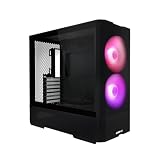
Lian Li Lancool 207
The Lancool 207 delivers airflow that embarrasses cases twice its price: two 140mm front fans plus two 120mm bottom fans blowing directly onto the graphics card, all included. It supports graphics cards up to roughly 400mm and CPU coolers up to about 180mm, with a clean, tool-free build. The power supply mounts at the front behind the motherboard tray, keeping the bottom free for GPU cooling. Swap option: the NZXT H5 Flow if you prefer a more understated look and simpler cable channels.
Compatibility Check
Socket: the Ryzen 7 9700X and MSI MAG B850 Tomahawk WiFi are both AM5, and B850 boards ship with Zen 5 support out of the box. RAM type: AM5 is DDR5 only and the Corsair Vengeance kit is EXPO-certified for DDR5-6000. PSU headroom: the RTX 5070 is rated around 250W and the 9700X around 88W at peak, so the system stays near 400W and the RM750e’s native 12V-2×6 cable plugs directly into the card. GPU length: the Gigabyte Windforce RTX 5070 is about 280mm, well within the Lancool 207’s roughly 400mm clearance. Case clearance: coolers up to about 180mm fit, and the 990 EVO Plus uses the board’s PCIe 5.0 M.2 slot under its heatsink.
Expected Performance
1080p
Apex Legends sits at its 300 fps cap on competitive settings and roughly 240-290 fps at high, based on the RTX 5070’s positioning in Hardware Unboxed’s and TechPowerUp’s testing. Counter-Strike 2 runs around 300-380 fps. Call of Duty: Warzone lands near 180-220 fps on balanced settings. Cyberpunk 2077 ultra without ray tracing runs roughly 130-150 fps.
1440p
Apex Legends at high settings holds roughly 220-260 fps, and competitive settings push toward the cap. Counter-Strike 2 stays above 250 fps. Warzone on balanced settings runs around 150-180 fps. Cyberpunk 2077 ultra without ray tracing lands near 95-110 fps, with DLSS 4 quality adding a comfortable margin.
4K
Apex Legends at high settings runs roughly 130-150 fps natively and higher with DLSS 4 quality. Counter-Strike 2 lands around 170-200 fps. Warzone on balanced settings runs near 90-110 fps. Cyberpunk 2077 ultra without ray tracing drops to about 50-60 fps natively and needs DLSS 4 to become a smooth experience.
Upgrade Path
Every part here was chosen to make upgrades painless. The CPU path is a Ryzen 7 9800X3D drop-in, which lifts frame times in end-game fights and pairs well with a faster GPU. The GPU path is an RTX 5080 or RX 9070 XT into the PCIe 5.0 slot; the RM750e handles the RX 9070 XT at the edge, so pair a flagship with the RM850e. Storage expands through the board’s additional M.2 slots. The case, memory, and motherboard will carry two more generations of parts.
FAQ
Can this PC run Apex Legends at 240Hz?
Yes at 1080p on high or competitive settings, and at 1440p on competitive settings. At 1440p high you will see roughly 220-260 fps, ideal for a 240Hz display.
Is the Ryzen 7 9700X enough for Apex Legends?
Yes. Apex is well threaded and the 9700X keeps frame times flat. The 9800X3D adds a further gain in the busiest end-game fights if you want the ceiling.
Does Apex Legends benefit from DLSS 4?
Quality-mode upscaling helps at 1440p and 4K. Leave frame generation off for competitive play because it adds input latency.
Why PCIe 5.0 on the motherboard?
The RTX 5070 runs fine on PCIe 4.0, but the B850 Tomahawk’s PCIe 5.0 slot and M.2 future-proof the build for the next GPU and SSD without a board swap.
Sources and Methodology
The frame-rate ranges in this guide are approximate and reflect the relative positioning of the RTX 5070 and Ryzen 7 9700X in launch reviews published by TechPowerUp, Hardware Unboxed, Tom’s Hardware, Gamers Nexus, and TechSpot, several of which test Apex Legends, Counter-Strike 2, Warzone, and Cyberpunk 2077 directly. None of these figures were measured by this site, and results vary with settings, drivers, and match state. Prices are approximate and fluctuate.
Top picks from this guide
 msiMSI MAG B850 Tomahawk MAX WiFi Motherboard, ATX - Supports…$210 \xc2\xb7 99/100
 AMDAMD Ryzen™ 7 9700X 8-Core, 16-Thread Unlocked Desktop Processor$310 \xc2\xb7 99/100
 CorsairCORSAIR RM750e ATX 3.1 PCIe 5.1 Ready 750W Power Supply…$90 \xc2\xb7 95/100
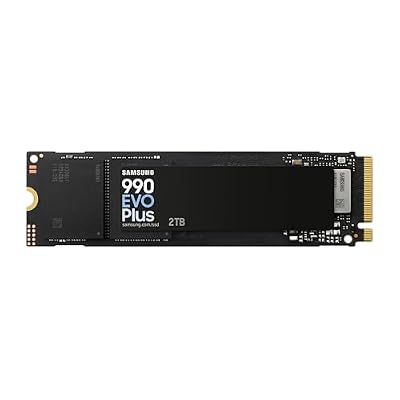 SamsungSamsung SSD 990 EVO Plus 2TB, PCIe Gen 4x4 |…$367 \xc2\xb7 95/100