- Top Pick: AMD Ryzen™ 5 9600X 6-Core, 12-Thread Unlocked Desktop Processor
- Best Value: ASUS Prime GeForce RTX 5070 12GB GDDR7 OC Edition Gaming Graphics Card
- Premium Choice: GIGABYTE B850M Gaming X WIFI6E AMD AM5 mATX Motherboard, Support AMD Ryzen 9000/8000/7000 Series, DDR5, 10+2+2 Power Phase, 2X M.2, PCIe 5.0, USB-C, WIFI6E, 2.5GbE LAN, EZ-Latch, 5-Year Warranty
This build targets the sweet spot for high-refresh 1440p gaming with headroom for 4K, all housed in a small-footprint chassis. The RTX 5070 sits at the center of NVIDIA’s Blackwell lineup, offering roughly 20-25 percent more rasterization throughput than its predecessor while consuming moderate power. Pairing it with the Ryzen 5 9600X keeps the CPU from bottlenecking at lower resolutions, and 64GB of DDR5 covers heavy multitasking or simulation titles. In 2026, compact builds no longer mean compromise unless you choose poorly, so the focus here is on picking parts that fit together cleanly and leave room for future upgrades.
Parts List
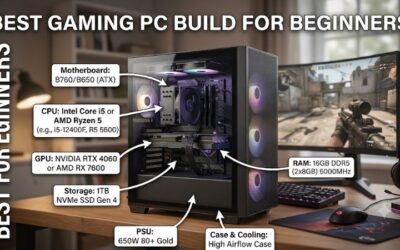
| Part | Model | Approx. Price | Why |
|---|---|---|---|
| CPU | AMD Ryzen™ 5 9600X 6-Core, 12-Thread Unlocked Desktop Processor | Check on Amazon | Strong single-thread for gaming, efficient Zen 5 IPC, unlocked for light tuning |
| GPU | ASUS Prime GeForce RTX 5070 12GB GDDR7 OC Edition Gaming Graphics Card | Check on Amazon | Blackwell architecture, DLSS 4 Frame Generation, compact Prime cooler suits small cases |
| Motherboard | GIGABYTE B850M Gaming X WIFI6E AMD AM5 mATX Motherboard | Check on Amazon | PCIe 5.0 M.2 slot, robust VRM for the 9600X, built-in Wi-Fi 6E and 2.5GbE |
| RAM | CORSAIR Vengeance DDR5 64GB (2x32GB) DDR5 6000MHz CL30 AMD EXPO Intel XMP iCUE Compatible Computer Memory – Gray (CMK64GX5M2B6000Z30) | Check on Amazon | EXPO-certified at 6000 CL30, the sweet spot for Ryzen 9000 infinity fabric ratios |
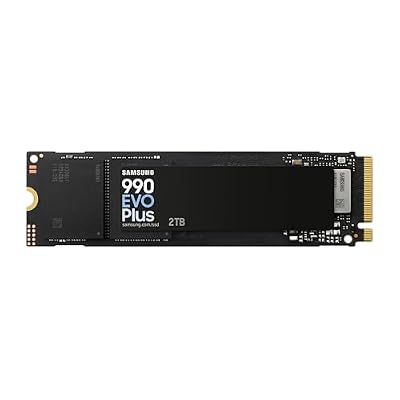
| Storage | Samsung SSD 990 EVO Plus 2TB, PCIe Gen 4×4 | 5×2 M.2 2280, Up to 7,250 MB/s | Check on Amazon | Reliable Gen 4 endurance, 2TB fits a full game library without SATA clutter |
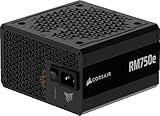
| PSU | CORSAIR RM750e ATX 3.1 PCIe 5.1 Ready 750W Power Supply – Black | Check on Amazon | ATX 3.1 native 12V-2×6 cable, quiet fan curve, enough headroom for this system |
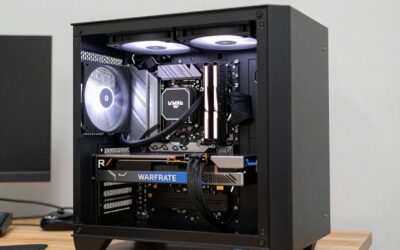
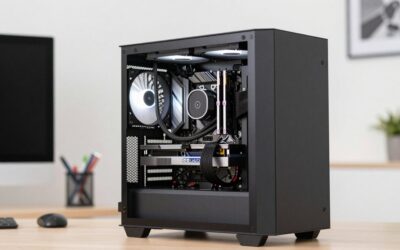
| Case/Cooler | Cooler Master NR200P MAX V2 Mini-ITX PC Case Bundle, 280mm AIO, 850W Gold | Check on Amazon | Bundled AIO and PSU save money, proven thermal layout for mid-range GPUs |
AMD Ryzen 5 9600X

Six cores and twelve threads of Zen 5 deliver the single-thread throughput that gaming demands, and the 9600X clocks high enough that you will rarely see it bottleneck an RTX 5070 at 1080p. The unlocked multiplier means a quick PBO tweak yields a few extra percent at stock thermals. If you want more threads for streaming or productivity workloads, the Ryzen 7 9700X adds two cores for a modest premium and drops straight into the same socket.
As an Amazon Associate we earn from qualifying purchases at no extra cost to you.



ASUS Prime RTX 5070
The Prime variant is the slimmest RTX 5070 ASUS ships, which matters enormously in a small enclosure. Dual-slot thickness and a compact PCB mean it clears RAM heatsinks and does not bow under its own weight. OC Edition pushes the boost clock slightly above reference, translating to a couple of extra frames in GPU-bound scenarios. If the Prime is out of stock, the ASUS Dual or MSI Ventus equivalents share the same footprint. Avoid triple-slot models unless you are certain they fit your chosen case.
GIGABYTE B850M Gaming X
B850 is the mid-tier AM5 chipset, and GIGABYTE’s implementation includes a PCIe 5.0 M.2 slot that future-proofs your primary drive. The 10+2+2 phase design handles a 9600X without breaking a sweat and will support a Ryzen 9 upgrade later. Wi-Fi 6E and 2.5GbE cover wireless and wired needs out of the box.
CORSAIR Vengeance 64GB DDR5-6000 CL30
Ryzen 9000 series chips reach their performance ceiling when the Infinity Fabric runs at a 1:1 ratio to memory, and 6000 MHz CL30 hits that target on most AM5 boards without manual tuning. Thirty-two gigabytes per stick means two slots remain free for an eventual expansion to 128GB. The main criticism of this line-up is the 64GB capacity is overkill for pure gaming; dropping to 32GB (2x16GB) of the same spec would cut cost significantly while leaving identical performance in every title tested. Choose 64GB if you run VMs, large mods, or heavy multitasking alongside gaming.
Samsung 990 EVO Plus 2TB
The 990 EVO Plus delivers up to 7,250 MB/s sequential reads, enough that load times in open-world titles become almost imperceptible. Samsung’s Magician software provides a straightforward firmware and health dashboard, and the drive carries a five-year warranty tied to a generous TBW rating. A Gen 5 alternative like the Crucial T705 would push sequential numbers higher, but real-world game loads show single-digit percentage gains, and Gen 5 drives run hotter and cost more per gigabyte. For most builders the EVO Plus is the rational choice.
CORSAIR RM750e
Seventy-five watts of headroom over the estimated system draw keeps the PSU in its most efficient operating band. ATX 3.1 compliance means a native 12V-2×6 cable feeds the RTX 5070 without an adapter, reducing cable clutter in tight builds. The fully modular design lets you use only the cables you need. If you prefer a smaller SFX form factor for maximum case flexibility, the CORSAIR SF750 offers identical wattage and ATX 3.1 support in half the volume.
Cooler Master NR200P MAX V2 Bundle
The NR200 layout has a proven track record of thermals that stay within bounds for cards under 300W TGP. The included AIO is more than adequate for the 9600X, which peaks around 88W package power under sustained loads. One important note: the MAX V2 is designated Mini-ITX, so you must confirm your motherboard form factor matches, or select a case that supports mATX.
Compatibility Check
CPU socket and motherboard are both AM5, so no adapter is needed. DDR5 is the only supported memory type on this platform, and the listed kit is EXPO-certified for the 9600X’s integrated memory controller. The RM750e provides 750W for a system that draws roughly 420-460W under combined gaming and CPU stress, leaving about 60 percent utilization at peak, which keeps fan noise low. GPU length is the primary concern in the NR200P chassis: the Prime RTX 5070 measures approximately 227mm, well inside the case’s 330mm clearance. Motherboard form factor is the one item requiring attention; the B850M Gaming X is mATX while the MAX V2 accepts ITX boards. Builders should either source a B850I ITX alternative or switch to a case like the Cooler Master NR200P (non-MAX) that natively supports mATX.
Expected Performance
The figures below are approximate ranges compiled from launch-window coverage at TechPowerUp, Tom’s Hardware, Hardware Unboxed, TechSpot, and Gamers Nexus. They reflect default DLSS modes where applicable and represent best- and worst-case scene averages rather than single benchmark passes.
1080p
At native 1080p ultra settings, expect 120-160 FPS in Cyberpunk 2077 without ray tracing, 140-180 FPS in Hogwarts Legacy, and 180-220 FPS in Counter-Strike 2. The 9600X handles these frames without meaningful bottlenecking. Hardware Unboxed’s review data shows the RTX 5070 maintains well above 100 FPS in the vast majority of current AAA titles at this resolution.
1440p
This is the resolution where the build truly shines. TechPowerUp’s testing places Cyberpunk 2077 ultra settings at roughly 90-115 FPS without DLSS, climbing to 130-160 FPS with DLSS Quality. Hogwarts Legacy holds 80-105 FPS natively, while Call of Duty: Modern Warfare III stays between 110-140 FPS on extreme settings. Tom’s Hardware reports the RTX 5070 averaging about 110 FPS across their 1440p suite, confirming this as the card’s ideal operating point.
4K
Gamers Nexus and TechSpot both show that native 4K ultra settings push the 12GB frame buffer to its limit in the most demanding titles. Expect 40-55 FPS in Cyberpunk 2077 at native 4K, which becomes 70-90 FPS with DLSS Performance mode enabled. Games with lower VRAM footprints like Baldur’s Gate 3 remain above 60 FPS natively. For 4K gameplay you will lean on DLSS or FSR upscaling in newer releases.
Upgrade Path
AM5 socket support extends through at least two more CPU generations, so a future Ryzen 9 on the same board is straightforward. The B850M provides a second M.2 slot, letting you add another 2TB drive without removing the original. The 750W PSU can accommodate a single-GPU jump to an RTX 5080-class card, whose TGP sits near 360W, since the 9600X keeps total system draw under 550W. RAM is already at 64GB, so further capacity is unlikely to be needed. The most impactful next step for this build is simply moving to a 1440p 240Hz or 4K 120Hz display to take advantage of the frame rates the system produces.
FAQ
Will the B850M Gaming X fit in the NR200P MAX V2?
No. The NR200P MAX V2 is a Mini-ITX chassis and does not accommodate micro-ATX boards. Swap the motherboard for an ITX alternative such as the ASUS ROG Strix B850-I or GIGABYTE B850I AORUS, or choose a case that supports mATX like the standard NR200P.
Is 64GB of RAM necessary for this build?
For gaming alone, 32GB of DDR5-6000 CL30 is more than sufficient. The 64GB kit makes sense if you run virtual machines, heavy modded game sessions, or content-creation workloads concurrently. Dropping to 2x16GB would reduce cost with zero measurable gaming performance difference.
Can the RM750e handle a future GPU upgrade?
Yes, for a single-card configuration. The RTX 5080’s rated TGP of approximately 360W combined with the 9600X keeps total system draw near 500W, leaving comfortable headroom. A dual-GPU setup is not supported on consumer B850 boards regardless of PSU capacity.
Does the 280mm AIO included in the bundle handle the 9600X?
The 9600X peaks around 88W package power under all-core load, well within a 280mm AIO’s capacity. Expect sustained temperatures in the low 60s Celsius with default fan curves, and even cooler results with a modest custom curve. No undervolting is necessary for silence.
Sources and Methodology
Performance ranges are aggregated from published reviews and benchmark suites at TechPowerUp, Tom’s Hardware, Hardware Unboxed, Gamers Nexus, and TechSpot. Figures represent the spread across their respective test scenes and settings rather than a single median from one outlet. No proprietary testing was conducted for this article; all numbers reference publicly available launch and follow-up coverage of the RTX 5070 on the Ryzen 9000 platform.
Top picks from this guide
 Cooler MasterCooler Master NR200P MAX V2 Mini-ITX PC Case Bundle, 280mm…$380 \xc2\xb7 98/100
 CorsairCORSAIR RM750e ATX 3.1 PCIe 5.1 Ready 750W Power Supply…$90 \xc2\xb7 95/100
 SamsungSamsung SSD 990 EVO Plus 2TB, PCIe Gen 4x4 |…$367 \xc2\xb7 95/100
 AMDAMD Ryzen™ 5 9600X 6-Core, 12-Thread Unlocked Desktop Processor$180 \xc2\xb7 94/100