
Moving from an RX 6900 XT to an RX 7800 XT gains you almost nothing in gaming performance: the two cards land within a few percent of each other, and the older RX 6900 XT can even edge ahead at 4K, so this is a sidegrade rather than an upgrade. The RX 7800 XT only makes sense for an RX 6900 XT owner who specifically wants lower power draw, a slimmer card, AV1 encoding or slightly better ray tracing; anyone seeking a real performance jump should look at an RX 9070 XT or higher instead.
- Flagship vs Mid-Range: Why They End Up Even
- Specification Comparison
- Gaming Performance: What Reviews Show
- Where the RX 7800 XT Does Gain Ground
- Features That Do Not Change
- Power and PSU
- The Math of a Sidegrade
- Who Should and Should Not Switch
- If You Are Buying From Scratch
- Bottom Line
- Frequently Asked Questions
Quick answer: Our top pick in 2026 is the Architecture — our #1 rated choice. See the full ranked comparison, alternatives and buying advice below.
Flagship vs Mid-Range: Why They End Up Even
The RX 6900 XT was AMD’s RDNA 2 flagship, launched in October 2020 at $999 with 5120 stream processors, 16 GB of GDDR6 and a 128 MB Infinity Cache. The RX 7800 XT arrived in August 2023 at $499 on RDNA 3 with 3840 stream processors, 16 GB and 64 MB of Infinity Cache. It has far fewer shaders, but RDNA 3’s architectural changes, faster memory and slightly higher clocks let it reach the same performance class.

GIGABYTE PowerColor Red Devil AMD Radeon™ RX 6900 XT Gaming Graphics Card with 16GB GDDR6 Memory, Powered by AMD RDNA™ 2, Raytracing, PCI Express 4.0, HDMI 2.1, AMD Infinity Cache
Included for 'Upgrading From RX 6900 XT to RX 7800 XT: What You Actually Gain' because the listing specifies Powered by AMD RDNA™ 2 and Raytracing, details this guide uses to compare options.
View on Amazon
GIGABYTE Radeon RX 6900 XT Gaming OC 16G Graphics Card, WINDFORCE 3X Cooling System, 16GB 256-bit GDDR6, GV-R69XTGAMING OC-16GD Video Card
Included for 'Upgrading From RX 6900 XT to RX 7800 XT: What You Actually Gain' because the listing specifies WINDFORCE 3X Cooling System and 16GB 256-bit GDDR6, details this guide uses to compare options.
View on Amazon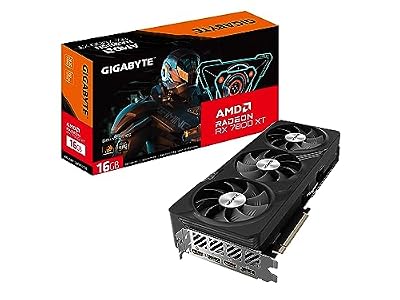
Gigabyte Radeon RX 7800 XT Gaming OC 16G Graphics Card, 3X WINDFORCE Fans 16GB 256-bit GDDR6, GV-R78XTGAMING OC-16GD Video Card
Included for 'Upgrading From RX 6900 XT to RX 7800 XT: What You Actually Gain' because the listing specifies 3X WINDFORCE Fans 16GB 256-bit GDDR6 and GV-R78XTGAMING OC-16GD Video Card, details this guide uses to compare options.
View on Amazon
PowerColor Fighter AMD Radeon RX 7800 XT 16GB GDDR6 Graphics Card
Included for 'Upgrading From RX 6900 XT to RX 7800 XT: What You Actually Gain' as a relevant option in this category; details come from the product listing.
View on AmazonThat is good news for anyone buying a 7800 XT new at half the old flagship’s launch price, but it means a 6900 XT owner already has 7800 XT-level performance.
Specification Comparison
| Specification | RX 6900 XT | RX 7800 XT |
|---|---|---|
| Architecture | RDNA 2.0 | RDNA 3.0 |
| Release date | 28 October 2020 | 25 August 2023 |
| Launch MSRP | $999 | $499 |
| Stream processors | 5120 | 3840 |
| Boost clock | 2250 MHz | 2430 MHz |
| Process | 7 nm | 5 nm |
| VRAM | 16 GB GDDR6 | 16 GB GDDR6 |
| Bus / bandwidth | 256-bit / 512.0 GB/s | 256-bit / 624.1 GB/s |
| Infinity Cache (L3) | 128 MB | 64 MB |
| L2 cache | 4 MB | 4 MB |
| Board power | 300 W | 263 W |
| Power connectors | 2x 8-pin | 2x 8-pin |
| Length / width | 267 mm / 3-slot | 267 mm / 2-slot |
| Outputs | 1x HDMI 2.1, 2x DP 1.4a, 1x USB-C | 1x HDMI 2.1a, 3x DP 2.1 |
Gaming Performance: What Reviews Show
Tom’s Hardware’s RX 7800 XT review placed the new card between the RX 6800 XT and RX 6900 XT, slightly closer to the 6900 XT, and noted that AMD’s own guidance pointed to near-6900 XT performance. TechSpot/Hardware Unboxed and KitGuru found the 7800 XT roughly level with or a few percent above the RX 6800 XT, which itself sits only around 5-8% below the 6900 XT.
Put together, the realistic picture is:
- 1080p: essentially a tie, with results trading back and forth by game.
- 1440p: within roughly 0-5%, with the 6900 XT often slightly ahead. A game running at about 110 FPS on one card will typically run within a handful of frames on the other.
- 4K: the 6900 XT’s extra shaders tend to give it a small lead of a few percent, though the 7800 XT’s higher bandwidth narrows it in some games.
Exact frame rates vary with settings, CPU and driver version. Newer titles that favor RDNA 3’s features can tilt slightly toward the 7800 XT, but nothing in the review data suggests a meaningful upgrade.
Where the RX 7800 XT Does Gain Ground
Ray tracing
RDNA 3’s improved ray accelerators let the 7800 XT pull a little ahead in ray-traced games. The gain is modest, and both cards remain well behind NVIDIA’s RTX 40 and RTX 50 equivalents in heavy RT and path tracing. It is not enough on its own to justify switching.
Media and display
The 7800 XT adds AV1 hardware encoding, which helps streamers and anyone recording gameplay at good quality with low file sizes. It also brings DisplayPort 2.1 outputs for future high-refresh 4K monitors. The RX 6900 XT includes a USB-C port that the 7800 XT reference spec drops, which matters only for a few VR headsets and monitors.
Efficiency and size
Board power falls from 300 W to 263 W, a modest reduction in heat and noise. The reference 7800 XT is also a two-slot card versus the 6900 XT’s three-slot design, which helps in tighter cases or builds with an adjacent PCIe card.
Features That Do Not Change
Both cards carry 16 GB of VRAM on a 256-bit bus, so there is no memory capacity gain. Both support FSR 3.1 upscaling and frame generation in supported games, and AMD Fluid Motion Frames at the driver level. FSR 4’s machine-learning upscaler targets RX 9000 cards, so moving to the 7800 XT does not unlock it. In everyday gaming, the experience on the two cards is close to identical.
Power and PSU
Because the 7800 XT draws less, any PSU that runs a 6900 XT will run it. For reference:
- RX 6900 XT: 300 W + ~125 W CPU + ~150 W headroom = about 575 W, typically paired with a quality 750 W unit.
- RX 7800 XT: 263 W + ~125 W CPU + ~150 W headroom = about 540 W, comfortable on 650-700 W.
Both use two 8-pin connectors on reference designs. The reduction in power is real but small, worth perhaps a few dollars a month for heavy gamers depending on local electricity prices.
The Math of a Sidegrade
A used RX 6900 XT usually sells for around $330-$400, and a used RX 7800 XT costs around $350-$420, with new units higher. A swap might therefore cost anywhere from nearly nothing to over $100 net, for effectively 0% performance gain. That money is better saved toward a real upgrade.
For contrast, if 6900 XT = 100, current cards like the RX 9070 XT typically sit well above it in raster and substantially above it in ray tracing, while adding FSR 4 support. Spending the net cost of a sidegrade toward that kind of card buys an actual performance change.
Who Should and Should Not Switch
| Your reason | Switch to RX 7800 XT? |
|---|---|
| More FPS at 1440p or 4K | No, performance is about the same |
| Better ray tracing | Small gain only; an RX 9070 XT or RTX card is a better target |
| AV1 streaming or recording | Reasonable reason, if the swap is near cost-neutral |
| Smaller case or a 3-slot card does not fit | Reasonable reason |
| Failing or noisy 6900 XT | A sensible replacement option |
| More VRAM | No, both have 16 GB |
| Want FSR 4 | No, look at RX 9000 cards |
If You Are Buying From Scratch
For a buyer without either card, the decision is different. A used RX 6900 XT and a used RX 7800 XT offer similar performance, so the cheaper one wins on raw value. The 7800 XT is the safer pick because it is younger, more efficient, two-slot and has AV1 encoding, while the 6900 XT is fine if it is clearly cheaper and you have the PSU and case room. When buying used, run a stress test, check hotspot temperatures and listen for fan rattle.
Bottom Line
The RX 7800 XT matched AMD’s old flagship at half the price, which made it a strong new purchase in 2023, but for an RX 6900 XT owner it offers no meaningful gaming uplift. Keep the 6900 XT unless you need AV1, a two-slot design or lower power, and save toward an RX 9070 XT or RTX 5070 Ti-class card for a true upgrade.
Frequently Asked Questions
Is the RX 7800 XT faster than the RX 6900 XT?
Not meaningfully. Reviews place the two within a few percent at 1080p and 1440p, with the RX 6900 XT sometimes slightly ahead at 4K. The 7800 XT gains a little in ray tracing.
Should I replace my RX 6900 XT with an RX 7800 XT?
Only for non-performance reasons such as AV1 encoding, a two-slot form factor or lower power draw. For more frame rates, a card like the RX 9070 XT is a much better target.
Do both cards have the same VRAM?
Yes. Both carry 16 GB of GDDR6 on a 256-bit bus. The 7800 XT has higher bandwidth at 624.1 GB/s versus 512 GB/s, while the 6900 XT has a larger 128 MB Infinity Cache.
What PSU does the RX 7800 XT need?
A quality 650-700 W unit with two 8-pin PCIe connectors is comfortable for the 263 W RX 7800 XT. Any PSU that runs an RX 6900 XT will handle it.
What is a real upgrade from the RX 6900 XT?
Current cards such as the RX 9070 XT or RTX 5070 Ti offer a clear jump in ray tracing and better upscaling, along with higher raster performance. For 4K, higher-tier cards like the RTX 5080 provide a larger leap.
Ready to decide? Our #1 pick for 2026 is the Architecture.
Live price & availability on Amazon.









