
The RX 6800 XT is the faster graphics card by a wide margin, so it is the better buy for 1440p and high-refresh gaming whenever a used or remaining-stock unit costs only modestly more than an RX 7600 XT; the newer RX 7600 XT is not an upgrade over it and only makes sense for buyers who need lower power draw, a shorter card, a new-card warranty, or the lowest possible price for 1080p play. Both cards carry 16 GB of GDDR6, which makes this comparison unusual: the memory capacity is identical, but almost everything else that drives frame rates favors the older RDNA 2 card.
That is the short version. The rest of this comparison explains how large the gap is, where the RX 7600 XT claws something back, and how power, case size and price should shape the final pick.

GIGABYTE AMD Radeon RX 6800 XT Gaming OC 16G Graphics Card, 16GB of GDDR6 Memory, Powered by AMD RDNA 2, HDMI 2.1, WINDFORCE 3X Cooling System, GV-R68XTGAMING OC-16GD (Renewed)
Included for 'RX 6800 XT vs RX 7600 XT: Which Graphics Card Should You Buy?' because the listing specifies 16GB of GDDR6 Memory and Powered by AMD RDNA 2, details this guide uses to compare options.
View on Amazon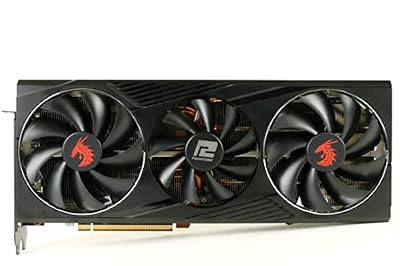
PowerColor AMD Radeon RX 6800 XT Gaming Graphics Card with 16GB GDDR6, Raytracing, PCIe 4.0, HDMI 2.1, AMD Infinity Cache (Renewed)
Included for 'RX 6800 XT vs RX 7600 XT: Which Graphics Card Should You Buy?' because the listing specifies Raytracing and PCIe 4.0, details this guide uses to compare options.
View on Amazon
GIGABYTE Radeon RX 7600 XT Gaming OC 16G Graphics Card, 3X WINDFORCE Fans 16GB 128-bit GDDR6, GV-R76XTGAMING OC-16GD Video Card (Renewed)
Included for 'RX 6800 XT vs RX 7600 XT: Which Graphics Card Should You Buy?' because the listing specifies 3X WINDFORCE Fans 16GB 128-bit GDDR6 and GV-R76XTGAMING OC-16GD Video Card (Renewed), details this guide uses to compare options.
View on AmazonQuick answer: Our top pick in 2026 is the Architecture — our #1 rated choice. See the full ranked comparison, alternatives and buying advice below.
Specs Side by Side
The table below uses the official reference specifications for each card. Partner models can differ in clocks, length and power connectors.
| Specification | RX 6800 XT | RX 7600 XT |
|---|---|---|
| Architecture | RDNA 2.0 | RDNA 3.0 |
| Release date | 28 October 2020 | 8 January 2024 |
| Launch MSRP | $649 | $329 |
| Stream processors | 4608 | 2048 |
| Boost clock | 2250 MHz | 2755 MHz |
| Process | 7 nm | 6 nm |
| Memory | 16 GB GDDR6 | 16 GB GDDR6 |
| Memory bus | 256-bit | 128-bit |
| Bandwidth | 512.0 GB/s | 288.0 GB/s |
| L2 / L3 (Infinity) cache | 4 MB / 128 MB | 2 MB / 32 MB |
| Board power (TDP) | 300 W | 190 W |
| Interface | PCIe 4.0 x16 | PCIe 4.0 x8 |
| Power connectors | 2x 8-pin | 1x 8-pin |
| Length / width | 267 mm / 2-slot | 204 mm / 2-slot |
| Display outputs | 1x HDMI, 2x DisplayPort, 1x USB Type-C | 1x HDMI 2.1a, 3x DisplayPort 2.1 |
The numbers that matter most are the shader count (more than double on the RX 6800 XT), the memory bus (256-bit versus 128-bit) and the Infinity Cache (128 MB versus 32 MB). The RX 7600 XT’s higher boost clock and RDNA 3 dual-issue shaders narrow the gap somewhat, but they cannot make up for a chip that is less than half the size.
How Far Apart Are They in Games?
Published reviews and benchmark aggregates agree on the direction and disagree mainly on the size of the lead. Aggregate comparison data built on review results places the RX 6800 XT roughly 45% to 75% ahead of the RX 7600 XT, with the smaller figures typically at 1080p and the larger ones at 1440p and 4K, where the RX 7600 XT’s narrow 128-bit bus and smaller cache become the bottleneck. In TechPowerUp’s RX 7600 XT review, the card landed only around 8% ahead of the RTX 4060 and about 10% ahead of the RX 7600, which puts it firmly in the mainstream 1080p class, while the RX 6800 XT sits in a much higher tier alongside cards like the RTX 3080.
In practical terms, a demanding modern game at 1440p high settings that runs in roughly the 60 to 70 fps range on an RX 7600 XT will usually run somewhere around 95 to 115 fps on an RX 6800 XT. Treat those as broad, approximate ranges: actual frame rates vary with game, settings, CPU, driver version and game patch.
1080p
At 1080p the RX 7600 XT is genuinely capable. It handles most current games at high settings around or above 60 fps, and competitive titles at well over 100 fps. The RX 6800 XT is still clearly faster here, but on a 60 Hz or 75 Hz monitor the extra speed may go unused, and in some lighter games both cards hit a CPU limit.
1440p and 4K
This is where the RX 6800 XT pulls away. Its 512 GB/s of bandwidth and large cache keep it comfortable at 1440p high refresh, and it can manage 4K in many games with upscaling. The RX 7600 XT can run 1440p, but it usually needs medium settings or upscaling in heavy titles to stay smooth, and 4K is out of reach for most modern AAA games.
Ray tracing
RDNA 3 improved ray tracing throughput per compute unit, but the RX 6800 XT simply has far more compute units, so it remains ahead in most ray-traced games as well. Neither card is a strong ray tracing performer by current standards; heavy path-traced settings are not realistic on either.
Upscaling, Frame Generation and Features
Both cards rely on the same software toolkit: FSR 3.1 upscaling and frame generation in supported games, plus AMD Fluid Motion Frames (AFMF) at the driver level for games without native support. FSR 4, AMD’s machine-learning upscaler, is aimed at the RX 9000 series (RDNA 4), so neither card gets its full benefits officially. That makes upscaling a wash between them.
The RX 7600 XT does have a few real feature advantages:
- AV1 encoding: RDNA 3 adds hardware AV1 encode, useful for streamers and video recording. The RX 6800 XT can decode AV1 but not encode it.
- DisplayPort 2.1: three DP 2.1 outputs versus older DisplayPort on the RX 6800 XT, though this only matters for very high refresh, high resolution monitors.
- Efficiency: 190 W versus 300 W board power means less heat, less noise and a smaller power supply.
- Newer silicon: a card released in 2024 should remain in AMD’s driver focus longer than a 2020 design.
VRAM: The Same 16 GB, Used Differently
Because both cards have 16 GB, neither will run into the capacity problems that hurt 8 GB cards in recent games with high-resolution textures. The difference is how fast that memory can be fed. The RX 6800 XT moves data almost 80% faster (512 GB/s versus 288 GB/s), backed by four times the Infinity Cache. On the RX 7600 XT, 16 GB is a safety net that lets you keep texture quality high at 1080p, not a ticket to 4K.
A rough VRAM guide by resolution for modern AAA games:
- 1080p high: about 6 to 9 GB in most games
- 1440p high: about 8 to 12 GB
- 4K high or ultra: about 10 to 14 GB or more, especially with ray tracing
Both cards clear every tier on capacity. Only the RX 6800 XT has the bandwidth and shader power to make good use of the upper tiers.
Power Supply, Connectors and Case Fit
A simple sizing rule is GPU board power plus CPU power plus about 150 W of headroom for the rest of the system and transient spikes. With a typical 125 W gaming CPU:
| Card | GPU | CPU | Headroom | Estimated load | Sensible PSU |
|---|---|---|---|---|---|
| RX 6800 XT | 300 W | 125 W | 150 W | 575 W | 650 to 750 W quality unit |
| RX 7600 XT | 190 W | 125 W | 150 W | 465 W | 550 W quality unit |
RDNA 2 high-end cards are known for short power spikes, so a well-built 750 W unit is the comfortable choice for the RX 6800 XT, and AMD’s own guidance for the reference card pointed in that direction. The RX 6800 XT needs two 8-pin PCIe cables; the RX 7600 XT needs one.
For case fit, the reference RX 6800 XT is 267 mm long against 204 mm for the RX 7600 XT. Many partner RX 6800 XT models are longer and thicker than reference, so measure the clearance in compact cases. The RX 7600 XT fits almost any mid-tower and many small form factor builds.
One more detail: the RX 7600 XT uses a PCIe 4.0 x8 link. On older PCIe 3.0 motherboards this halves the available bus bandwidth, which usually costs only a few percent, since the 16 GB buffer reduces how often the card spills over the bus. The RX 6800 XT uses a full x16 link and is unaffected.
Value: Launch Price Versus the Real Market
At launch MSRPs the math looks like this, using the RX 7600 XT as a 100-point baseline and placing the RX 6800 XT at roughly 160 points (the middle of the published range):
- RX 7600 XT: $329 / 100 = about $3.29 per performance point
- RX 6800 XT: $649 / 160 = about $4.06 per performance point
By launch pricing, the RX 7600 XT is the better value per frame. But nobody pays the 2020 launch price for an RX 6800 XT in 2026. It is now largely a used-market card, often found somewhere around $300 to $380 used depending on region, model and condition. At that level, the RX 6800 XT delivers far more performance per dollar than a new RX 7600 XT, with the trade-offs being no new-card warranty, an older design and higher power draw.
When buying used, ask whether the card was used for mining, look for even fan behavior and no coil whine complaints, and confirm both 8-pin sockets are undamaged. Repasting a 2020-era card can also restore temperatures.
Which One to Pick
| Situation | Better pick | Why |
|---|---|---|
| 1440p high refresh on a mid-range budget | RX 6800 XT | Roughly half again or more performance at 1440p |
| 1080p at 60 to 144 Hz, tight budget | RX 7600 XT | Enough performance, lower power, new warranty |
| Small form factor or older 500 to 550 W PSU | RX 7600 XT | 204 mm length, 190 W, single 8-pin |
| 4K with upscaling | RX 6800 XT | Bandwidth and cache to handle higher resolutions |
| Streaming with AV1 | RX 7600 XT | Hardware AV1 encoder |
| Want FSR 4 and better ray tracing | Neither | Consider an RX 9060 XT 16GB or RX 9070 instead |
For most gamers comparing these two specific cards, the RX 6800 XT is the safer pick for raw performance, provided the PSU and case can handle it and a reasonably priced used unit is available. The RX 7600 XT is the better choice when efficiency, size and warranty matter more than frame rates. It is also worth noting that the current RX 9060 XT 16GB sits in a similar price class to the RX 7600 XT while adding FSR 4 support and a substantial performance step, so new-card buyers should weigh it as well.
Frequently Asked Questions
Is the RX 7600 XT faster than the RX 6800 XT?
No. The RX 7600 XT is newer but slower. Published benchmark data places the RX 6800 XT roughly 45% to 75% ahead depending on resolution, with the biggest gap at 1440p and 4K. The RX 7600 XT’s advantages are lower power, a smaller size and a newer feature set, not speed.
Is 16 GB on the RX 7600 XT as useful as 16 GB on the RX 6800 XT?
The capacity is the same, so both avoid the texture and stutter problems that affect 8 GB cards. However, the RX 6800 XT has a 256-bit bus and 512 GB/s of bandwidth versus 128-bit and 288 GB/s on the RX 7600 XT. That means the RX 6800 XT can actually push the resolutions and settings that use all 16 GB, while the RX 7600 XT mainly benefits from the extra headroom at 1080p and light 1440p.
What power supply does an RX 6800 XT need?
A good-quality 650 W unit is the practical minimum with a mainstream CPU, and 750 W is the comfortable recommendation because RDNA 2 cards can produce brief power spikes. The card needs two separate 8-pin PCIe cables. Avoid using a single daisy-chained cable for both connectors when the PSU offers separate leads.
Can either card use FSR 4?
FSR 4 is designed for the RX 9000 series and is officially supported there. Both the RX 6800 XT and RX 7600 XT use FSR 3.1 upscaling and frame generation in supported games, plus driver-level AFMF frame generation. Upscaling quality is therefore similar between them.
Is a used RX 6800 XT still worth buying in 2026?
It can be, if the price is close to that of a new mainstream card and the unit is in good condition. Its raster performance is still strong for 1440p, and 16 GB of VRAM keeps it relevant for texture-heavy games. The main downsides are higher power draw, weaker ray tracing than current cards, and no FSR 4.
Ready to decide? Our #1 pick for 2026 is the Architecture.
Live price & availability on Amazon.









