The fastest SSD for gaming in 2026 is the Crucial T705 or a similarly specced Phison E26-based PCIe 5.0 drive, which push sequential reads past 14,000 MB/s, but that number barely matters for load times. What actually moves the needle for games is random 4K performance, sustained write behavior once the cache fills, and whether your motherboard and GPU cooler even let you use a 5.0 drive without throttling it. Here’s how the real contenders stack up on the numbers that affect gameplay instead of the ones that look good in marketing slides.
- PCIe 5.0 vs PCIe 4.0: what actually changes for gaming
- Head-to-head: the drives worth considering
- Sustained writes: what happens after the SLC cache runs out
- DirectStorage level-load times: where the gains actually show up
- Controller temperatures: heatsink or not?
- M.2 clearance under the GPU: a real compatibility problem
- Cost per terabyte: where extra speed stops paying off
- Which drive fits your build
PCIe 5.0 vs PCIe 4.0: what actually changes for gaming
Sequential read speed is the spec everyone quotes, but almost nothing in gaming reads data in long sequential streams. Texture streaming, asset loading, and DirectStorage decompression all hit the drive with small, scattered requests, which is a random 4K read/write workload. PCIe 5.0 drives win on paper sequential numbers by a factor of two over 4.0 drives, but random 4K performance only improves by 15-30% depending on the controller, because NAND latency and queue depth matter more than interface bandwidth at that block size.

SAMSUNG - SOLID STATE DRIVES (SS SSD 4TB 990 PRO PCIE 4.0 X4 NVME 2.0 M.2 2280, MZ-V9P4T0BW
Included for 'Fastest SSDs for Gaming in 2026: PCIe 5.0 Picks Compared' because the listing specifies MZ-V9P4T0BW, details this guide uses to compare options.
View on AmazonIn practical terms, a PCIe 5.0 drive loads a level maybe 1-3 seconds faster than a good PCIe 4.0 drive in the same game, and in many titles the difference is within margin of error because the CPU and game engine’s own loading logic become the bottleneck, not the SSD.
Head-to-head: the drives worth considering
| Drive | Interface | Seq Read / Write | Random 4K Read (approx) | Controller temp (bare) | Typical price (2TB) |
|---|---|---|---|---|---|
| Crucial T705 | PCIe 5.0 | 14,500 / 12,700 MB/s | ~1,500K IOPS | 75-85°C under load | $200-$260 |
| Samsung 9100 Pro | PCIe 5.0 | 14,800 / 13,400 MB/s | ~1,600K IOPS | 70-80°C under load | $220-$280 |
| WD Black SN8100 | PCIe 5.0 | 14,900 / 14,000 MB/s | ~1,550K IOPS | 72-82°C under load | $210-$270 |
| Samsung 990 Pro | PCIe 4.0 | 7,450 / 6,900 MB/s | ~1,000K IOPS | 55-65°C under load | $120-$160 |
| WD Black SN850X | PCIe 4.0 | 7,300 / 6,600 MB/s | ~1,100K IOPS | 50-62°C under load | $110-$150 |
Prices are general market ranges for 2TB capacity and will shift with NAND pricing cycles. PCIe 5.0 drives have closed a lot of the price gap versus their 2023-2024 launch pricing, but they still carry a meaningful premium per terabyte over 4.0 drives.
Sustained writes: what happens after the SLC cache runs out
Every consumer SSD uses a chunk of its NAND as a fast SLC write cache. Benchmarks that run for 10-20 seconds never drain it, so advertised write speeds are often cache-speed numbers, not real sustained numbers. This matters for installing games, moving large mod folders, or copying a Steam library between drives.
On a 2TB PCIe 5.0 drive, the SLC cache is typically 100-250GB depending on how full the drive already is. Once that’s exhausted, write speed drops to the native TLC speed, which lands in a very different range:
- PCIe 5.0 drives (Crucial T705, Samsung 9100 Pro, WD SN8100): cache speed 10,000+ MB/s, post-cache speed typically 2,000-3,500 MB/s
- PCIe 4.0 drives (990 Pro, SN850X): cache speed 6,000+ MB/s, post-cache speed typically 1,500-2,000 MB/s
For gaming specifically this rarely bites you, since game installs are mostly reads after the initial write and DirectStorage workloads are read-heavy. It matters more if you’re a content creator recording long 4K sessions onto the same drive, where sustained write throughput can fall well below what the box advertises.
DirectStorage level-load times: where the gains actually show up
DirectStorage lets the GPU decompress assets directly, cutting out CPU overhead, but it still needs the SSD to deliver data fast enough to keep the GPU fed. The practical gain from PCIe 5.0 shows up most in open-world games with large texture streaming budgets and in games built specifically around DirectStorage 1.1+, rather than in older titles patched in after launch.
Rough load-time comparisons across recent DirectStorage-supported titles put a PCIe 5.0 drive 10-20% ahead of a strong PCIe 4.0 drive, and both well ahead of a SATA SSD, which is now closer to a bottleneck than an upgrade path for any newer game. The jump from SATA to PCIe 4.0 is far more noticeable than the jump from 4.0 to 5.0.
Controller temperatures: heatsink or not?
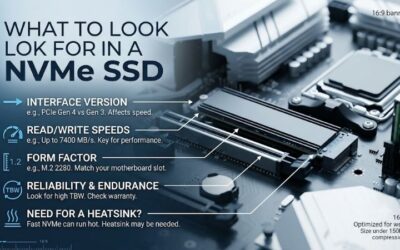
PCIe 5.0 controllers run hot enough that thermal throttling is a real concern, not a theoretical one. Bare, uncooled 5.0 drives can hit 80-85°C under sustained load, at which point the controller throttles bandwidth to protect itself, sometimes dropping sequential speeds by 30-50% mid-transfer.
- No heatsink, no airflow: expect throttling within 60-90 seconds of sustained sequential writes on PCIe 5.0 drives.
- Motherboard M.2 heatsink (stock): usually enough to keep temps in the 65-75°C range and avoid throttling in normal gaming use.
- Aftermarket heatsink with fin stack: drops peak temps by another 10-15°C, mainly useful if the drive sits in a poorly ventilated case or near a hot GPU.
- PCIe 4.0 drives: generally fine without a heatsink for gaming workloads, since they don’t push the same power draw.
Most current motherboards already include a heatsink on at least the primary M.2 slot, so this is less of a DIY problem than it was at PCIe 5.0 launch. Check that the drive’s heatsink isn’t double-stacked with the board’s own heatsink, since that combination can sometimes trap heat rather than dissipate it.
M.2 clearance under the GPU: a real compatibility problem
The primary M.2 slot on most ATX boards sits directly beneath the PCIe x16 slot, which means a thick GPU cooler can sit within a few millimeters of your SSD heatsink. This is where PCIe 5.0 drives create a genuine fitment issue, since their heatsinks are often taller than PCIe 4.0 heatsinks to handle the extra heat.
| Situation | Recommendation |
|---|---|
| Thin GPU (blower-style or 2-slot) or primary M.2 slot above the PCIe slot | Any heatsink size is fine, including tall aftermarket fin-stack coolers |
| Thick 3-4 slot GPU, M.2 slot directly under it | Use the drive’s bare low-profile heatsink or the motherboard’s built-in heatsink; skip tall aftermarket heatsinks |
| No clearance at all even with low-profile heatsink | Move the SSD to a secondary M.2 slot (often further down the board) or use a PCIe adapter card in an open slot |
| Case has poor front-to-back airflow near the M.2 area | Prioritize a drive with a motherboard-integrated heatsink plus a case fan angled across that zone over a taller aftermarket heatsink |
Before buying an aftermarket heatsink, measure the gap between your GPU’s backplate and the motherboard with the card installed. Most GPUs list cooler thickness in slots (2-slot, 2.5-slot, 3-slot, etc.), and most tall PCIe 5.0 heatsinks need 8-10mm of clearance above the slot, which a 3+ slot GPU often doesn’t leave.
Cost per terabyte: where extra speed stops paying off
Here’s the calculation that actually decides most purchases. Taking the price ranges above for 2TB capacity:
- PCIe 5.0 drive at $240 for 2TB = $120/TB
- PCIe 4.0 drive at $140 for 2TB = $70/TB
- SATA SSD at $90 for 2TB = $45/TB
You’re paying roughly 70% more per terabyte to move from a good PCIe 4.0 drive to PCIe 5.0, for a real-world gaming gain that’s usually a couple of seconds per level load and rarely a difference you’d notice blind. That premium makes more sense if you’re also doing video editing, large asset work, or you specifically want headroom for DirectStorage titles releasing over the next few years. For a pure gaming build on a budget, a 2TB PCIe 4.0 drive remains the better value, and the money saved is better spent on GPU or RAM.
Which drive fits your build
- Budget gaming build, no DirectStorage requirement: PCIe 4.0 drive like the SN850X or 990 Pro class, 1-2TB.
- High-end build with a PCIe 5.0-capable motherboard already: go with a 5.0 drive like the T705, 9100 Pro, or SN8100, and confirm GPU clearance first.
- Thick 3-4 slot GPU in the case: pick the drive with the lowest-profile heatsink option, not the fastest one, to avoid a clearance conflict.
- Content creation plus gaming on the same drive: PCIe 5.0 is worth it for sustained write headroom beyond what the SLC cache covers.
- Older PCIe 3.0 or early 4.0 motherboard: a 5.0 drive will run at reduced speeds and won’t justify its price; buy a 4.0 drive instead.