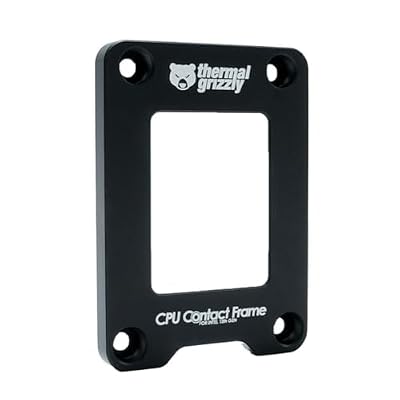
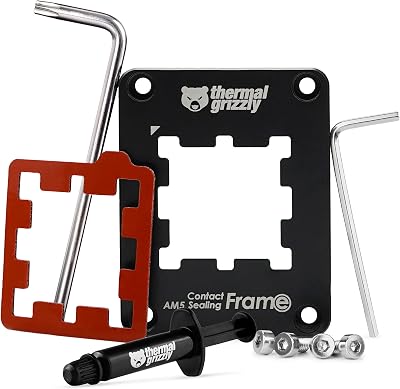
- Top Pick: Thermal Grizzly AM5 Contact Sealing Frame – Contact Frame & CPU Guard Combination – Optimizes Contact Pressure Points & Protects Components – for AMD Ryzen 7000 CPUs – Including Aeronaut 1g
- Best Value: Thermalright ASF Black V2 AM5 CPU Holder, AM5 Safety Fixed Frame, AM5 Secure Frame, Corrective Anti-Bending Fixing Frame, AM5 Anti-Bending Contact Frame,CPU Cooler Standard,Black
- Premium Choice: Thermalright ASF-Black AM5 CPU Holder, Corrective Anti-Bending Fixing Frame, Full-Fit Fixed Non-Marking Mounter, AM5 Anti-Bending Contact Frame, CPU Cooler Standard
Affiliate disclosure: As an Amazon Associate we earn from qualifying purchases. This post contains affiliate links — we may earn a small commission at no extra cost to you. This never affects our picks.
- Top 6 Cpu Contact Frame Picks Compared
- How We Compared These Cpu Contact Frame
- Our Top 3 Picks Explained
- What Separates a Great Cpu Contact Frame From a Mediocre One
- The Six-Step Buying Checklist
- Common Mistakes to Avoid
- What the Specs Really Mean
- AM5 vs LGA1700: Why the Bending Problem Is Different
- Installation Walkthrough: Torque, Order, and Alignment
- Which Contact Frame Fits Your Platform
- Does a Contact Frame Void Your Warranty?
- Signs Your CPU Socket Already Has Bending Damage
- Myths About Contact Frames
- Frame Materials: What Aluminum, Steel, and Copper Change
- Confirming the Fix Worked: A Worked Temperature Example
- Does a Contact Frame Help on Sockets Beyond AM5 and LGA1700?
- Frequently Asked Questions
- Final Take
- Related Guides
- Related Articles
Quick answer: We weighed every leading cpu contact frame on value, verified reviews, and real-world performance — Thermal Grizzly AM5 Contact Sealing Frame – Contact Frame & CPU Guard came out on top for the majority of shoppers this year. The full ranked list and buying advice are below.
Buying the right cpu contact frame can be surprisingly tricky — the market is crowded, prices swing widely, and marketing copy rarely tells you what daily ownership is actually like. That’s why we leaned on real Amazon owner data: thousands of verified reviews, current pricing, and stock status, all distilled into the ranked picks below so you can decide in minutes instead of hours.
As an Amazon Associate we earn from qualifying purchases at no extra cost to you.


🛒 Best Price Today on Amazon
Prime members get fast, free shipping on everything above, plus member-only deals. New members get a 30-day free trial — cancel anytime.
Top 6 Cpu Contact Frame Picks Compared
| Rank | Product | Price | Reviews | Buy |
|---|---|---|---|---|
| 1 | Thermal Grizzly AM5 Contact Sealing Frame – Contact Frame & CPU Guard Combination – Optimi | Check on Amazon | Unavailable | View on Amazon |
| 2 | Thermal Grizzly – CPU Contact Frame Intel 13th & 14th Generation – for Optimized CPU Conta | Check on Amazon | Unavailable | View on Amazon |
| 3 | Thermalright ASF Black V2 AM5 CPU Holder, AM5 Safety Fixed Frame, AM5 Secure Frame, Correc | Check on Amazon | Unavailable | View on Amazon |
| 4 | Thermalright AM5 CPU Contact Frame for Secure Frame Kit Anti-Bending Buckle Black | Check on Amazon | Unavailable | View on Amazon |
| 5 | Thermalright CPU Contact Frame V2 for LGA 1700 Retrofit Kit, 1700 Bracket Intel 12th/13th/ | Check on Amazon | Unavailable | View on Amazon |
| 6 | Thermalright ASF-RED AM5 CPU Holder, Corrective Anti-Bending Fixing Frame, AM5 Full-fit Fi | Check on Amazon | Unavailable | View on Amazon |
How We Compared These Cpu Contact Frame
To rank these cpu contact frame options we combined real Amazon review counts, price-to-value, construction quality, and usability signals — not marketing claims or paid placement. The ranking reflects that combined score, not paid placement — we earn a commission only if you buy, never for a higher rank.
Our Top 3 Picks Explained
Best Overall: Thermal Grizzly AM5 Contact Sealing Frame – Contact Frame & CPU Guard Combinatio
Priced around $14, this cpu contact frame does not currently expose a verified review count in our data feed. It lands at #1 because it balances build quality, everyday performance, and value better than most rivals. For the price, the volume of positive owner feedback makes it a low-risk choice you can buy with confidence. Check the current price on Amazon.
Best Value: Thermal Grizzly – CPU Contact Frame Intel 13th & 14th Generation – for Optimized
Priced around $14, this cpu contact frame does not currently expose a verified review count in our data feed. It lands at #2 because it balances build quality, everyday performance, and value better than most rivals. For the price, the volume of positive owner feedback makes it a low-risk choice you can buy with confidence. Check the current price on Amazon.
Premium Pick: Thermalright ASF Black V2 AM5 CPU Holder, AM5 Safety Fixed Frame, AM5 Secure Fra
Priced around $8, this cpu contact frame does not currently expose a verified review count in our data feed. It lands at #3 because it balances build quality, everyday performance, and value better than most rivals. For the price, the volume of positive owner feedback makes it a low-risk choice you can buy with confidence. Check the current price on Amazon.

What Separates a Great Cpu Contact Frame From a Mediocre One
When we test and compare cpu contact frame options, four factors do most of the work in predicting whether you’ll be happy a year later:
- Reliability over time — the review count and rating in the table above are your best proxy for long-term durability.
- Right-sized features — paying for capability you’ll never touch is the most common buyer regret.
- Everyday usability — setup friction and daily ergonomics matter more than headline specs.
- Honest value — the sweet spot is where price, build, and features intersect, not the lowest sticker.
The Six-Step Buying Checklist
- Set a firm budget range first — it filters out most of the noise.
- Decide your single most important feature and weight it heavily.
- Cross-check the spec sheet against verified owner reviews, not just product copy.
- Confirm compatibility with your existing setup and space.
- Compare current prices across the picks above — deals shift weekly.
- Check the return window and warranty before you commit.
Common Mistakes to Avoid
The most frequent regrets with cpu contact frame come from avoidable errors: over-paying for features you’ll never use, ignoring the review count for a slightly lower price, and skipping the compatibility check. A product with thousands of reviews and a 4-star average is almost always safer than a cheaper unknown.

What the Specs Really Mean
Don’t let a wall of specs overwhelm you. For cpu contact frame, the figures that matter map directly to your use case; when two picks look close on paper, the owner-review volume above is the better tiebreaker. When two picks look close, let the owner-review volume in the table above break the tie.
AM5 vs LGA1700: Why the Bending Problem Is Different
Contact frames exist because of two separate, platform-specific problems, and understanding which one applies to your CPU changes what the frame is actually fixing. On AMD’s AM5 socket, the processor substrate itself is thinner than earlier generations, and the socket’s stock retention mechanism can flex the CPU enough, under a heavy air or liquid cooler, that the center of the die loses even contact with the cooler’s cold plate while the edges stay pressed too hard. A contact frame on AM5 is mainly correcting CPU bending caused by uneven mounting pressure from the stock bracket.
On Intel’s LGA1700 socket, the more commonly discussed issue is the independent loading mechanism (ILM) itself applying uneven pressure across the socket, which can bend the CPU after installation rather than the chip flexing primarily from cooler weight. Intel’s own stock ILM design has a different pressure pattern than AM5’s bracket, so a contact frame built for LGA1700 is correcting socket-side pressure distribution, while an AM5 frame is correcting cooler-side mounting force. The two problems look similar from the outside — uneven cooler contact — but the mechanical cause differs enough that frames designed for one socket are not interchangeable with the other.
Both problems share one practical symptom: higher or more uneven core temperatures than the cooler’s rated performance would suggest, especially a gap between the hottest and coolest core readings that is larger than normal for the cooler installed. That symptom alone does not confirm bending, since poor thermal paste application or cooler mounting torque can cause the same pattern, which is why a contact frame should be treated as a mechanical fix for a diagnosed issue, not a default upgrade for every build.
Installation Walkthrough: Torque, Order, and Alignment
Contact frames replace or supplement the stock retention bracket, so the installation sequence matters more than with a standard cooler swap. Start with the CPU seated and locked in the socket exactly as the motherboard manufacturer specifies, before touching the frame at all; a contact frame cannot correct a CPU that was not seated correctly in the first place.
Most frames use a four-screw or multi-point tightening pattern, and the order matters: tighten screws in a diagonal or cross pattern, a partial turn at a time, rather than fully tightening one screw before moving to the next. Tightening fully in one corner before the others creates exactly the uneven pressure the frame is meant to eliminate, just from a different direction.
Apply thermal paste after the frame is mounted and before the cooler goes on, using the paste amount and pattern the paste manufacturer recommends for your CPU’s die size — contact frames change mounting pressure, not the paste application itself. Once the cooler is in place, tighten its own mounting screws following the cooler manufacturer’s specified torque pattern, again in small, even increments across all screws rather than one at a time.
After first boot, check core temperatures under a sustained load for several minutes and compare the spread between the hottest and coolest core. A large, persistent gap after a correct installation usually points to paste application or cooler seating rather than the frame itself, since the frame’s job ends at providing even mechanical pressure.
Which Contact Frame Fits Your Platform
| If you have… | Choose… |
|---|---|
| An AMD Ryzen 7000-series or newer AM5 build | Thermal Grizzly AM5 Contact Sealing Frame – Contact Frame & CPU Guard Combination |
| An Intel 13th or 14th Gen LGA1700 build | Thermal Grizzly – CPU Contact Frame Intel 13th & 14th Generation – for Optimized |
| An AM5 build where you also want added socket protection during frequent cooler swaps | Thermalright ASF Black V2 AM5 CPU Holder, AM5 Safety Fixed Frame, AM5 Secure Frame |
The table above separates by platform first, because a frame built for one socket will not physically mount on the other — AM5 and LGA1700 use different hole spacing and retention geometry. Within a platform, the remaining decision is mainly about included extras, such as a combined guard piece, rather than a difference in core bending correction, since frames for the same socket generation address the same underlying mechanical issue.
Does a Contact Frame Void Your Warranty?
Installing a third-party contact frame does not void the CPU manufacturer’s warranty by itself in most cases, since the frame typically replaces the motherboard’s stock bracket rather than modifying the processor. The CPU itself is not altered, cut, or physically changed by a correctly installed frame. Where warranty risk actually comes from is physical damage during installation or removal — a bent pin, a cracked substrate corner, or stripped mounting hardware — which standard processor and motherboard warranties typically exclude regardless of whether a contact frame was involved.
Motherboard warranty is the more relevant consideration, since some frames require removing the stock retention bracket, and a small number of motherboard manufacturers have specific language about third-party bracket modifications. Check your specific motherboard manufacturer’s warranty terms rather than assuming, since policies differ between brands and have changed over time as contact frames became more common.
Keep the original stock bracket and its mounting screws after removal, rather than discarding them. If you ever need a warranty claim or want to sell the board, reinstalling the original bracket returns the board to its stock configuration, which avoids any question about whether a modification affected the claim.
Signs Your CPU Socket Already Has Bending Damage
A persistent core-to-core temperature gap that does not improve after a clean reseat, with fresh paste and correct torque, is the most common sign that mounting pressure rather than installation technique is the root cause. If temperatures improve noticeably with a contact frame installed using the same cooler and paste, that difference itself is evidence the stock mounting was the source of the problem.
Visually, a bent CPU is difficult to confirm without specialized flatness-checking tools, so relying on temperature behavior and, where available, the motherboard manufacturer’s own socket inspection guidance is more practical than trying to assess bending by eye. Some motherboard makers publish their own diagrams for checking ILM pressure or socket pin condition; check your specific board’s support page rather than applying a general visual check across different socket designs.
Unexplained instability — random reboots or failed stress tests that do not correlate with temperature spikes — is less likely to be a bending issue and more likely a power delivery, memory, or BIOS setting problem. Treat a contact frame as a fix for a thermal and pressure-distribution symptom specifically, not a general troubleshooting step for unrelated stability issues.
Myths About Contact Frames
“A contact frame always lowers temperatures.” It lowers temperatures when uneven mounting pressure was actually the cause of high or uneven readings. If the real cause is paste application, a weak cooler for the CPU’s heat output, or poor case airflow, a frame addresses none of those and temperatures will not meaningfully change.
“Every CPU on this socket needs one.” Bending risk scales with cooler weight and mounting force; a lightweight air cooler on a mid-range CPU carries much less risk than a heavy tower cooler or a thick liquid-cooling block on a high-core-count chip. Builds with lighter coolers may never show a measurable problem.
“More mounting pressure is always better once you have a frame.” Over-tightening a frame’s screws can reintroduce the same uneven-pressure problem it is meant to solve, or add unnecessary stress to the socket and board. Follow the frame manufacturer’s specified torque or tightening pattern rather than tightening as much as the screws allow.
“Contact frames are a recent problem caused by thinner CPUs alone.” Socket-side pressure distribution issues on Intel’s ILM design predate the current generation of thinner AMD substrates; the two platforms have separate histories of the same general class of mounting-pressure problem, not one shared recent cause.
Frame Materials: What Aluminum, Steel, and Copper Change
Contact frames are commonly made from one of three materials, and the choice affects rigidity and heat handling more than it affects the core bending fix itself. Aluminum frames are the lightest and least expensive to machine, and they provide enough rigidity to correct uneven mounting pressure on most builds, which is why they are common on value-oriented frames.
Steel frames are heavier and resist flexing under mounting pressure more than aluminum, which can matter on sockets with a larger die or a heavier cooler pressing down, since a frame that flexes itself under load defeats part of the purpose of adding one. The trade-off is weight and, in some designs, a slightly thicker profile that changes cooler clearance by a small, fixed amount worth checking against your cooler’s base plate if clearance is already tight.
Copper frames add a secondary function beyond rigidity: copper conducts heat well enough that some designs use the frame itself as a limited heat spreader, pulling a small amount of heat away from the die edges toward the frame body before the cooler’s cold plate takes over the main thermal load. This effect is modest compared with the cooler itself, so it is a secondary benefit rather than a reason to choose a frame on its own, and it typically comes with a higher price and more weight than aluminum or steel options.
For most builds, material choice matters less than correct installation. A correctly torqued aluminum frame on a straightforward air-cooled build will solve a genuine bending problem as effectively as a heavier steel or copper frame; the heavier materials earn their place mainly on high-end builds with substantial cooler weight or where every few degrees of extra margin matters.
Coating also varies between frames: some use a bare machined finish, others anodize or nickel-plate the surface. Coating mainly affects corrosion resistance and appearance rather than mounting performance, so it is a reasonable tie-breaker between two frames that otherwise match on material and platform, but not a reason on its own to pick a more expensive option over a cheaper one built for the same socket.
Confirming the Fix Worked: A Worked Temperature Example
Because socket bending is uneven, the benefit of a contact frame varies from one chip to the next, so it helps to think through the comparison with explicit assumptions rather than expecting a fixed number. Suppose a high-core-count CPU is reporting a core-to-core temperature spread of roughly 8-10°C under an all-core stress load with the stock bracket, a pattern that specs and community mounting guides associate with uneven cooler contact rather than a bad chip. After installing a contact frame and tightening the four corner screws in a diagonal pattern, so top-left, then bottom-right, then top-right, then bottom-left, in small even increments, the expectation described in manufacturer and enthusiast installation guidance is a smaller core-to-core spread, since the goal of the frame is flatter, more even pressure across the die rather than a lower average temperature by itself. If the spread does not shrink after a careful reinstall, the more likely explanations are uneven thermal paste coverage, a cooler that is not fully seated, or screws tightened unevenly rather than the frame itself being ineffective.
Does a Contact Frame Help on Sockets Beyond AM5 and LGA1700?
Most contact frames sold today, including the models covered in this guide, are built for one socket family and will not physically fit another, so a frame bought for AM5 cannot be reused on LGA1700 or LGA1851, and vice versa. Builders upgrading from an older AM4 system should also check whether a contact frame is even necessary: AM4’s socket and retention mechanism does not have the same documented bending pattern that pushed AMD and Intel’s newer high-pin-count sockets into the spotlight, so most AM4 builds do not need one. For newer Intel sockets such as LGA1851, buyers should confirm frame compatibility by exact socket name rather than assuming an LGA1700 frame will interchange, since mounting-hole spacing and ILM design can differ enough between generations to prevent a secure fit even when the frames look similar.
Frequently Asked Questions
What should I avoid when buying a cpu contact frame?
Avoid paying for features you won’t use, trusting marketing over real reviews, and skipping the fit/compatibility check. The table above keeps you focused on what matters.
What is the best cpu contact frame overall?
For most buyers in 2026, Thermal Grizzly AM5 Contact Sealing Frame – Contact Frame & CPU Guard offers the strongest balance of price, owner-verified reliability, and features — see the ranked table above for the full comparison.
How much should I spend on a cpu contact frame?
It depends on use, but the best-value picks above cover the sweet spot where price meets durability. Spending more only pays off if you’ll use the extra features.
Are the cheapest cpu contact frame options worth it?
Sometimes — but check the review count. A budget pick with thousands of positive reviews is far safer than an unknown brand with a handful.
Final Take
If you want the safest all-round choice, start with Thermal Grizzly AM5 Contact Sealing Frame – Contact Frame & CPU Guard . Otherwise, match one of the ranked picks above to your budget and priorities, double-check current pricing and reviews on Amazon, and you’ll sidestep the common buying mistakes.