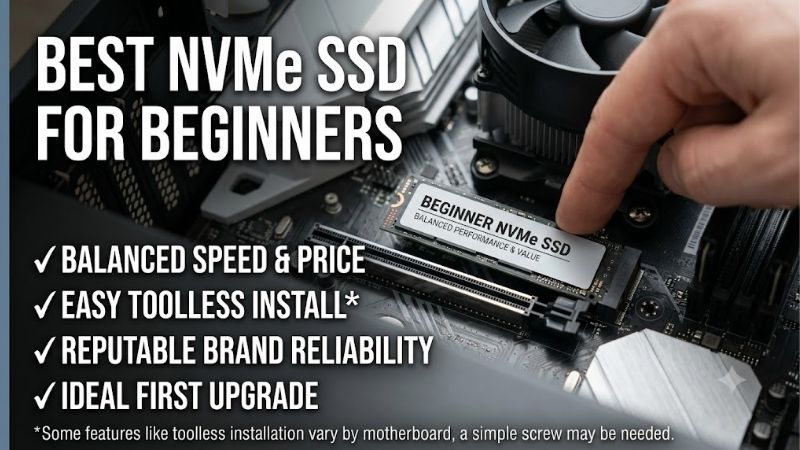
Best NVMe SSD for beginners decisions are easier when the drive is matched to the motherboard, workload, and storage budget instead of headline speed alone. A first-time builder can avoid most buying mistakes by checking the M.2 slot, capacity, endurance, and cooling needs before comparing benchmark numbers or chasing premium PCIe generations.
Quick answer: For most people in 2026, the best nvme ssd for beginners is the WD Blue SN580 — our #1 rated choice. See the full ranked comparison, alternatives and buying advice below.
How to Choose an NVMe SSD
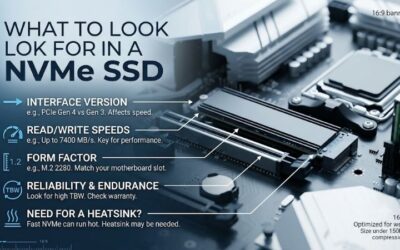
How to choose the best nvme ssd for beginners starts with four practical checks: compatibility, capacity and endurance, real-world performance, and thermals. A beginner-friendly drive should fit the system cleanly, provide enough room for the intended library, and offer a sensible warranty without needless complexity that brings little benefit to a first PC build.
Compatibility And Installation
best nvme ssd for beginners buyers should confirm an M.2 2280 slot that supports NVMe before purchasing. PCIe generation is also important to check because a Gen4 drive can work in a compatible older slot but will run at that slot’s limit. Physical clearance also matters when the motherboard has a substantial M.2 heatsink.
Check the motherboard manual when several M.2 sockets are present, since some share lanes with SATA ports or expansion slots. WD Blue SN580, Samsung 990 EVO Plus, Kingston KC3000, and Crucial P3 Plus use standard M.2 2280 designs, making them straightforward choices when the board has compatible NVMe support for a first-time installation.
Capacity And Endurance
best nvme ssd for beginners should usually start at 1TB for a main Windows and gaming drive unless the budget is extremely tight. Capacity affects how quickly a drive fills, while TBW gives a useful endurance reference for repeated writing. A larger drive can be the more practical purchase when game sizes keep growing.
WD Blue SN580 provides 1TB and 2TB capacities, Samsung 990 EVO Plus scales to 4TB, Kingston KC3000 reaches 4TB, and Crucial P3 Plus also reaches 4TB. For write-intensive workloads, KC3000’s 800TBW at 1TB provides more endurance headroom than P3 Plus’s 220TBW at 1TB, while P3 Plus favors capacity value for large libraries.
Speed And Workload
best nvme ssd for beginners should be selected around what the computer actually handles. Sequential speed matters for large file transfers, while everyday booting and application work depend substantially on smaller random-access operations and latency. A fast Gen4 model is already more than enough for most gaming PCs.
Samsung 990 EVO Plus reaches up to 7,150MB/s sequential read and 6,300MB/s sequential write at 1TB, while KC3000 reaches 7,000MB/s and 6,000MB/s. SN580 tops out at 4,150MB/s in both directions at 1TB, and P3 Plus reaches 5,000MB/s read and 3,600MB/s write, giving each a clear role for different real-world workloads.
Thermals And Warranty
best nvme ssd for beginners should also be easy to keep within its normal operating range. NVMe drives can warm up during long transfers, particularly beneath a graphics card. A motherboard heatsink can help, but laptop buyers must also check clearance. A five-year warranty is another useful confidence signal for first-time owners.
Samsung 990 EVO Plus, SN580, KC3000, and P3 Plus are designed for standard consumer systems and provide five-year warranty coverage. The KC3000 includes a thin graphene aluminum heat spreader, while P3 Plus lists adaptive thermal protection. Use the board’s supplied M.2 heatsink when available and keep airflow around the slot unobstructed.
Top Picks
The best nvme ssd for beginners is not the fastest model for everyone. These four drives cover practical entry points: WD Blue SN580 for balanced everyday use, Samsung 990 EVO Plus for performance, Kingston KC3000 for demanding workloads, and Crucial P3 Plus for high-capacity builds where cost per gigabyte matters most.
| Product | Best For | Key Spec | Watch Out For |
|---|---|---|---|
| WD Blue SN580 | Best Overall | PCIe Gen4; 4,150/4,150MB/s; 600TBW at 1TB | Slower sequential speeds than premium Gen4 drives |
| Samsung 990 EVO Plus | Best For Fast Gaming | PCIe 4.0 x4 / 5.0 x2; 7,150/6,300MB/s at 1TB; 600TBW | Premium pricing and diminishing gaming returns |
| Kingston KC3000 | Best For Heavy Workloads | PCIe 4.0 x4; 7,000/6,000MB/s at 1TB; 800TBW; DRAM | Higher power and heat under demanding loads |
| Crucial P3 Plus | Best For Large Libraries | PCIe 4.0; 5,000/4,200MB/s at 2TB; 440TBW | Lower endurance than stronger TLC alternatives |
WD Blue SN580 — Best Overall
WD Blue SN580 is the most straightforward all-around recommendation for a first PC build because its specification balance is easy to understand for first-time builders. The 1TB model uses PCIe Gen4 NVMe, reaches up to 4,150MB/s read and write, uses WDC TLC NAND, and carries 600TBW endurance with a five-year limited warranty.
Its advantage is a sensible mix of speed, efficiency, and endurance without requiring a premium platform. The limitation is straightforward: its sequential speeds trail newer high-end Gen4 drives, so large transfers finish more slowly. For Windows, applications, gaming, and general school or office work, that tradeoff is usually easy to accept.
Samsung 990 EVO Plus — Best For Fast Gaming
Samsung 990 EVO Plus is the performance-focused choice for first-time builders who want a high-speed drive and plan to keep it through multiple future upgrades. Its 1TB version uses PCIe 4.0 x4 or PCIe 5.0 x2, Samsung V-NAND TLC flash, and reaches 7,150MB/s read and 6,300MB/s write, with a rated 600TBW endurance figure.
The advantage is excellent bandwidth and a flexible interface that can take advantage of newer compatible platforms. The downside is cost and diminishing returns in ordinary gaming. A midrange PC may show little loading-time difference versus SN580, so the premium makes more sense for frequent large transfers or higher-end hardware.
Kingston KC3000 — Best For Heavy Workloads
Kingston KC3000 is the more capable choice for beginners who expect demanding work beyond gaming alone. Its 1TB model uses PCIe 4.0 x4, Phison E18, 3D TLC NAND, and DRAM cache, with rated sequential read and write speeds of 7,000MB/s read and 6,000MB/s write plus a substantial 800TBW endurance rating.
The advantage is the combination of TLC NAND, DRAM, high throughput, and strong endurance for content creation or repeated file work. Its drawback is power and heat compared with simpler drives, particularly at larger capacities. A motherboard heatsink is helpful, and it can be more drive than an everyday office PC actually needs.
Crucial P3 Plus — Best For Large Libraries
Crucial P3 Plus is the capacity-focused option for beginners building a game-heavy or media-heavy desktop PC. The 2TB version reaches up to 5,000MB/s read and 4,200MB/s write, while the series extends to 4TB. It carries a five-year limited warranty and is available across several capacities for straightforward expansion.
The advantage is getting ample space without moving into an expensive flagship class. Its weakness is endurance: the 1TB model is rated for 220TBW, lower than the SN580, 990 EVO Plus, or KC3000 at comparable capacity. It is therefore better for general storage and gaming than constant heavy writes over a long working life.
Frequently Asked Questions
For beginners, the best nvme ssd for beginners choice usually comes down to compatibility first, then capacity and workload. Avoid selecting from sequential-speed charts alone. A drive that fits the board, has enough space, and matches your write pattern will be easier to live with than a technically faster model used outside its strengths.
Is NVMe Better Than SATA SSD For A Beginner?
Yes, NVMe is generally the better choice for a new PC when the motherboard supports it because the M.2 format removes SATA data cables and modern PCIe drives provide substantially higher sequential bandwidth. Installation is also especially tidy because the drive mounts directly onto the motherboard for a cleaner build.
SATA still has value when adding storage to an older system or filling a vacant 2.5-inch bay. For a new build with an available NVMe slot, the simpler cabling and stronger bandwidth make an M.2 NVMe drive the more sensible default, especially when prices are close between equivalent capacities and the board already supports the format.
How Much NVMe Storage Should A Beginner Buy?
A 1TB drive is the most practical starting point for most first-time gaming or general-use PCs because it leaves room for Windows, applications, and several large games. A 500GB model can work for a basic office system, but it fills faster and leaves considerably less flexibility for future software and regular updates.
Choose 2TB when the computer will hold a large game library, media collection, or creative projects locally. Samsung 990 EVO Plus, KC3000, and P3 Plus all offer 2TB+ capacities, while SN580’s 2TB option remains a balanced choice for buyers who want more room without moving to flagship pricing. That extra space reduces storage cleanup.
Do Beginners Need A PCIe 5.0 SSD?
No, most first-time builders do not need PCIe 5.0. A strong PCIe 4.0 SSD already delivers sufficient bandwidth for gaming, everyday productivity, and most creator applications. The Samsung 990 EVO Plus is unusual in this group because it can operate through PCIe 5.0 x2 while remaining compatible with PCIe 4.0 x4 systems.
PCIe 5.0 makes more sense when the platform supports it and the workload benefits from sustained transfers. Otherwise, the money is often better spent on capacity, memory, or a stronger graphics card. A balanced Gen4 drive is usually the more practical foundation for a first PC build, for mainstream gaming and office workloads.
Does An NVMe SSD Need A Heatsink?
Not every beginner needs an aftermarket heatsink. Ordinary gaming and desktop work usually do not require an elaborate cooler, but an M.2 heatsink supplied by the motherboard can help during long transfers. Pay particular attention when the SSD sits directly under a graphics card or in a laptop with restricted airflow and clearance.
The KC3000 includes a graphene aluminum heat spreader, while P3 Plus specifies adaptive thermal protection. Other drives can use compatible motherboard heatsinks. The practical rule is to follow the motherboard and SSD installation guidance, preserve clearance, and avoid oversized coolers that create assembly complications during installation or service.
Final Thoughts
The best nvme ssd for beginners is the one that fits the motherboard, gives enough capacity, and matches the workload without paying for speed you will rarely use in practice. SN580 is the balanced pick, 990 EVO Plus the faster premium option, KC3000 the heavy-workload choice, and P3 Plus the capacity-focused alternative.
Ready to decide? Our #1 pick for 2026 is the WD Blue SN580.
Live price & availability on Amazon.