Is an OLED monitor worth it in 2026? For serious gaming, yes, when you will use its strengths. OLED delivers per-pixel blacks, extremely fast response, and high refresh rates, while current models add better panel care and clearer burn-in policies. This roundup compares four strong 4K OLED choices and the buyers each suits.
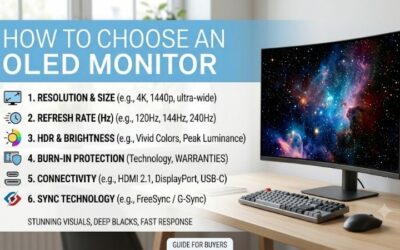
How to Choose an OLED Monitor
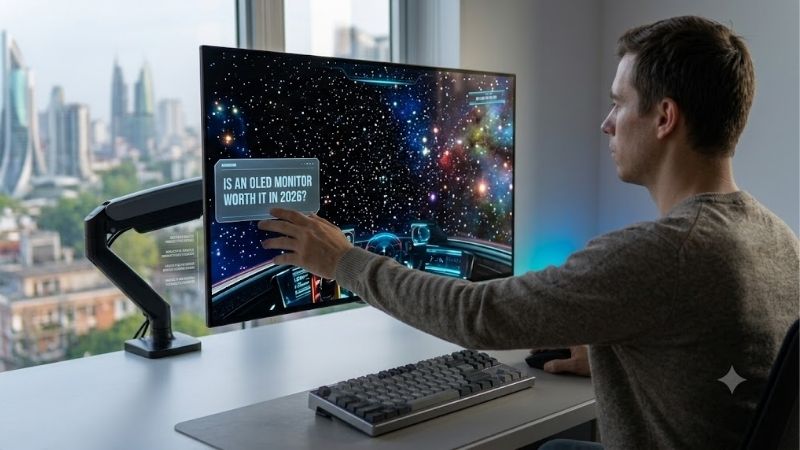
The real answer to is an oled monitor worth it in 2026 depends on whether you will notice the upgrade daily. OLED makes the biggest difference in dark scenes, HDR effects, and fast motion, but static desktop use, bright rooms, and the cost of high-resolution hardware can change the value equation for each buyer practically.
Resolution And Refresh Rate
Resolution and refresh rate form the first decision. A 4K OLED at 240Hz is a strong target for a powerful PC because it combines high pixel density with fluid motion. For is an oled monitor worth it in 2026, LG’s 32GS95UE-B adds a 480Hz Full HD mode, creating a deliberate tradeoff for esports players who value speed over native 4K detail.
Refresh rate only matters when your GPU can push enough frames to use it. A 240Hz OLED panel refreshes every 4.17 milliseconds, while 480Hz cuts that interval to about 2.08 milliseconds. For most games, 240Hz is already blistering; LG makes more sense when competitive titles are central to the build in demanding games, too.
Panel Type And Surface
Panel type and surface treatment shape how the image looks in a room. MSI, Samsung, and Alienware use QD-OLED, while LG uses WOLED. QD-OLED can provide especially vivid colors, but room lighting matters too: Samsung’s glare-reducing surface favors bright spaces, while Alienware’s curved panel favors immersion at the desktop.
For the best oled monitor for a high end build, do not treat the OLED label as the whole buying guide. Consider surface finish, curve, and color behavior together. Samsung is easier near windows, MSI keeps flat geometry, and Alienware adds a 1700R curve for an enveloping gaming view without requiring an ultrawide display on the same desk.
HDR Performance
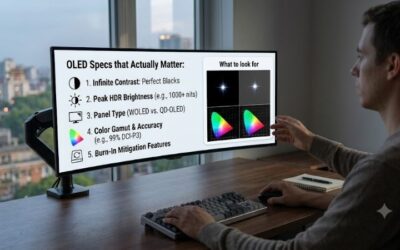
HDR performance deserves its own check because OLED contrast and HDR brightness are separate strengths. A monitor can produce perfect blacks yet show less dramatic highlights than a brighter display. LG rates the 32GS95UE-B for a 1300 cd/m² peak at a small HDR window, while Alienware and MSI target the 1000-nit class for HDR playback.
If HDR is central to your gaming, room lighting should influence the choice. Alienware is compelling for cinematic scenes, LG offers the highest stated peak here, and MSI provides a balanced 4K 240Hz QD-OLED package. Samsung focuses more on glare control and versatility than maximum peak brightness, which helps near windows.
Burn-In And Connectivity
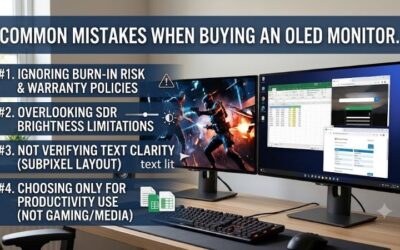
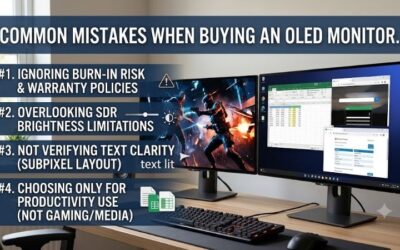
Burn-in protection is the practical OLED question for anyone using one monitor for both gaming and work. Current models use panel-care routines, screen savers, pixel shifting, and logo controls, while warranty terms differ by brand. MSI and Alienware explicitly advertise three-year burn-in coverage, which makes them easier picks for mixed desktop use.
Warranty language matters almost as much as panel technology when static desktop use is part of the plan. Taskbars and software panels can remain visible for long periods, so buyers should use the monitor’s care features and read the exact U.S. warranty rather than assume every brand covers burn-in under identical conditions.
Top Picks
For is an oled monitor worth it in 2026, connectivity can decide whether a premium monitor is also a useful desk hub. MSI offers USB-C with up to 90W power delivery and KVM, Samsung adds Wi-Fi, Bluetooth, speakers, and a smart platform, while Alienware and LG focus on high-bandwidth gaming connections and modern inputs.
| Product | Best For | Key Spec | Watch Out For |
|---|---|---|---|
| MSI MPG 321URX QD-OLED | Best Overall | 31.5-inch 4K 240Hz QD-OLED; 0.03ms GTG | 250-nit typical brightness |
| Samsung Odyssey OLED G8 G80SD | Best Value | 32-inch 4K 240Hz OLED; 0.03ms GTG | Modest typical HDR brightness |
| LG 32GS95UE-B | Best For Competitive Gaming | 4K 240Hz / FHD 480Hz; 0.03ms GTG | 480Hz mode uses FHD |
| Alienware AW3225QF | Best For Immersive Gaming | 31.6-inch 4K 240Hz QD-OLED | Curved geometry, no speakers |
MSI MPG 321URX QD-OLED
MSI MPG 321URX QD-OLED is the Best Overall pick for a powerful PC that mixes gaming with serious desk work. Its 31.5-inch flat QD-OLED panel runs at 3840 x 2160 and 240Hz with 0.03ms GTG response. Two HDMI 2.1 ports and USB-C with 90W power delivery add useful flexibility.
The advantage is the amount of useful gaming-desk hardware. MSI adds KVM, OLED Care 2.0, a custom heatsink, and three-year burn-in coverage. Its 250-nit typical brightness is not class-leading for bright HDR scenes. That makes is an oled monitor worth it in 2026 compelling when you need a desk hub.
Samsung Odyssey OLED G8 G80SD
Samsung Odyssey OLED G8 G80SD is the Best Value pick for users wanting a 32-inch 4K 240Hz OLED that also works as an entertainment hub. It offers 0.03ms GTG response, 99% DCI coverage, 250-nit typical brightness, HDMI 2.1, Gaming Hub, Wi-Fi, Bluetooth, and built-in speakers for everyday media use.
Samsung’s strength is versatility. OLED Glare Free reduces reflections, while OLED Safeguard+ combines heat management, logo detection, and a saver. The weakness is its modest typical brightness, so HDR highlights will not look as forceful as on brighter alternatives. That makes Samsung stronger for mixed-use rooms rather than maximum HDR alone.
LG 32GS95UE-B
LG 32GS95UE-B is the Best For Competitive Gaming because Dual Mode switches between 3840 x 2160 at 240Hz and 1920 x 1080 at 480Hz. The 31.5-inch WOLED panel offers 0.03ms GTG response, 98.5% DCI-P3 coverage, 275-nit typical brightness, and a stated 1300 cd/m² HDR peak.
This is where is an oled monitor worth it in 2026 becomes especially convincing for esports. LG lets one screen prioritize 4K gaming or extreme refresh for competitive titles. The drawback is clear: 480Hz requires Full HD output, so players who want maximum resolution should stay with native 4K 240Hz.
Alienware AW3225QF
Alienware AW3225QF is the Best For Immersive Gaming, pairing a 31.6-inch 4K QD-OLED panel with 240Hz, 0.03ms GTG response, a 1700R curve, Dolby Vision, and a 1000 cd/m² HDR peak. It provides two HDMI 2.1 ports, DisplayPort 1.4, USB connectivity, and Dell’s premium panel service.
Its advantage is presentation rather than desktop features. Its curved screen makes games and movies more enveloping, while QD-OLED color and Dolby Vision strengthen HDR. The tradeoff is curvature for design work, and there are no built-in speakers, so external audio is required.
Frequently Asked Questions
The clearest answer to is an oled monitor worth it in 2026 depends on how often you will notice its strengths. Dark games, HDR effects, and fast motion reveal OLED’s advantages quickly. Routine office work alone makes the premium harder to justify, especially when a strong IPS display can already handle static productivity tasks well.
Is OLED Worth It For Gaming?
A conventional IPS or Mini LED display can still win for sunlit rooms or workloads dominated by static spreadsheets and application windows. OLED becomes easier to recommend when gaming is primary, content changes frequently, and your PC is powerful enough to exploit high-resolution, high-refresh output without overbuying.
Does OLED Improve Gaming?
Yes, an OLED monitor can justify it for gaming in 2026, especially with a high-end GPU. Deep blacks, fast pixel transitions, and 4K 240Hz are difficult to match in one panel. The exception is a buyer whose use is mostly static desktop work, where longevity concerns matter more and the visual gain may not justify the extra cost.
Burn-in remains a real consideration, but current OLED monitors use several mitigation systems rather than leaving it unprotected. Pixel shift, screen savers, logo detection, panel refresh routines, and brightness management reduce risk. The important step is simply using them during long desktop sessions at home daily.
Is OLED Burn-In Covered?
Warranty coverage is another reason to compare brands. OLED policies are not equal. MSI and Alienware specify three-year burn-in coverage, Samsung covers normal-use burn-in, and LG lists a two-year U.S. limited warranty. Check exact terms before purchase.
For most high-end gamers, 4K 240Hz is the sweet spot. It delivers excellent sharpness at around 32 inches and enough motion headroom for demanding GPUs. The jump to 480Hz is specialized, so LG is the better fit only when competitive games and very high frame rates genuinely drive your play. Native 4K remains more versatile.
Do I Need HDMI 2.1?
HDMI 2.1 is useful when the monitor must handle current consoles or high-bandwidth external sources at 4K. MSI, Samsung, and Alienware provide HDMI 2.1, while LG is built around modern gaming connectivity too for consoles and PCs. For PC-first setups, DisplayPort can remain a simpler route to maximum desktop refresh behavior and PC graphics features.
Another practical point is value: a premium OLED does not need every premium feature to be a good purchase. The strongest choices here all deliver 4K resolution, high refresh, and fast response, but MSI adds desk-hub features, Samsung adds smart functions, LG adds Dual Mode, and Alienware adds curved HDR immersion for different users.
Final Thoughts
A final buying decision should follow the feature you will notice every day. is an oled monitor worth it in 2026 has a qualified yes for gamers: MSI is the strongest all-rounder, Samsung is the versatile value pick, LG is the esports specialist, and Alienware is the immersion choice. Buy OLED for a benefit you can actually use.