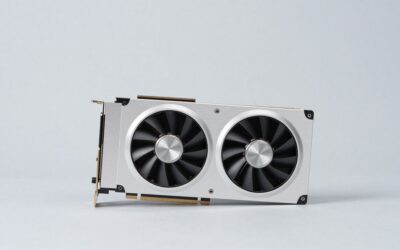
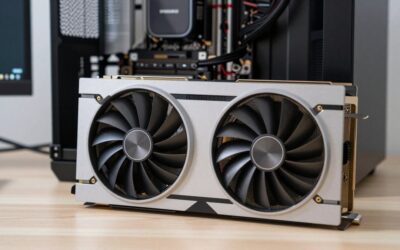
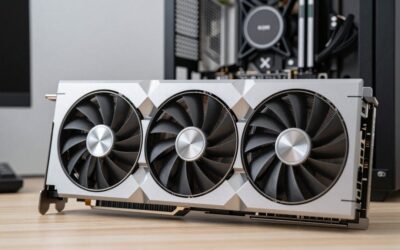
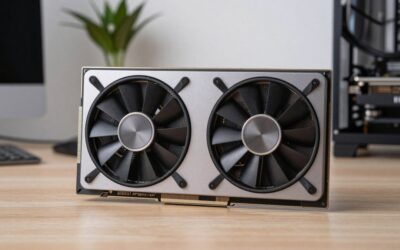
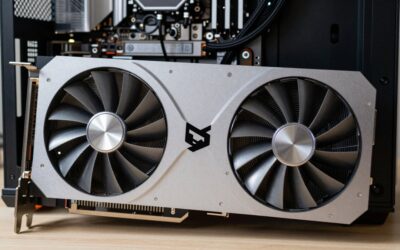
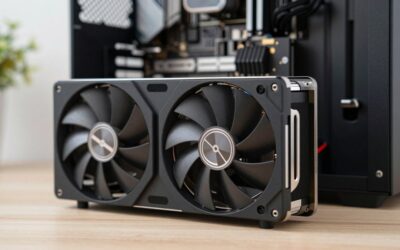
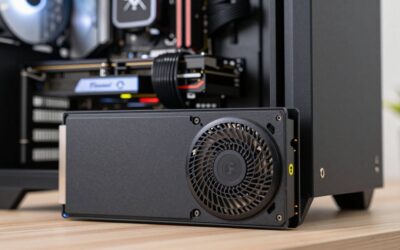
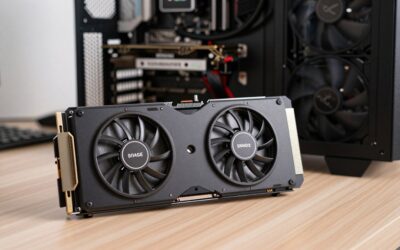
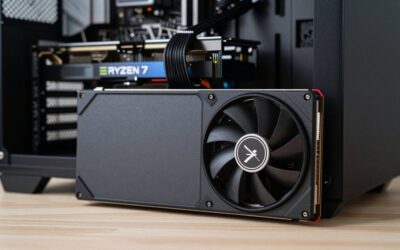
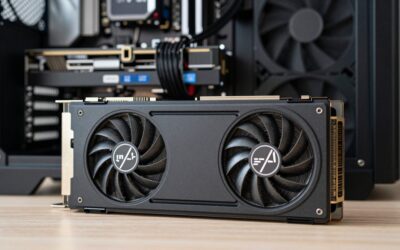
The best GPU for a Ryzen 5 5600X in 2026 is a Radeon RX 9070 or GeForce RTX 5070 for 1440p gaming, or a 16GB RX 9060 XT or RTX 5060 Ti for 1080p; going beyond RTX 5070 Ti / RX 9070 XT class mostly buys frames the 5600X cannot feed unless you play at 4K. The right card also depends on whether your motherboard is a B450/X470 (PCIe 3.0) or a B550/X570 (PCIe 4.0), which is the detail most pairing guides skip.
Quick answer: For most people in 2026, the best gpu for ryzen 5 5600x is the 1080p high refresh — our #1 rated choice. See the full ranked comparison, alternatives and buying advice below.
Where a Ryzen 5 5600X runs out of breath
The 5600X is a 6-core, 12-thread Zen 3 chip with a 32MB L3 cache and boost clocks up to 4.6GHz. It is still a capable gaming processor, but it has a practical frame-rate ceiling in CPU-heavy games. In demanding modern titles, it typically tops out somewhere around 100–140 FPS on average regardless of graphics card; in lighter esports games it can push well past 300 FPS.

Gigabyte GeForce RTX 4060 WINDFORCE OC 8G Graphics Card, 2X WINDFORCE Fans, 8GB 128-bit GDDR6, GV-N4060WF2OC-8GD Video Card
Included for 'Best GPU for Ryzen 5 5600X: Pairings by Resolution and Motherboard' because the listing specifies 2X WINDFORCE Fans and 8GB 128-bit GDDR6, details this guide uses to compare options.
View on Amazon
ASUS Dual GeForce RTX 4060 Ti EVO OC Edition 8GB GDDR6 (PCIe 4.0, 8GB GDDR6, DLSS 3, HDMI 2.1a, DisplayPort 1.4a, Axial-tech Fan Design, Auto-Extreme Technology), 3 Year Warranty
Included for 'Best GPU for Ryzen 5 5600X: Pairings by Resolution and Motherboard' because the listing specifies 8GB GDDR6 and DLSS 3, details this guide uses to compare options.
View on Amazon
MSI GeForce RTX 4060 Ventus 2X Black 8G OC Gaming Graphics Card - 8GB GDDR6X, PCI Express Gen 4, 128-bit, 3X DP v 1.4a, HDMI 2.1a (Supports 4K & 8K HDR)
Included for 'Best GPU for Ryzen 5 5600X: Pairings by Resolution and Motherboard' because the listing specifies 8GB GDDR6X and PCI Express Gen 4, details this guide uses to compare options.
View on AmazonThat ceiling is the key to choosing a graphics card. The idea is to buy a GPU that reaches roughly the same frame rate the CPU can deliver at your resolution. Below that, you leave CPU performance unused; above it, you pay for GPU power that sits idle.
| Resolution | Who limits FPS with a 5600X | Sensible GPU ceiling | Overkill zone |
|---|---|---|---|
| 1080p high refresh | Mostly the CPU above ~RTX 5060 Ti class | RX 9060 XT 16GB / RTX 5060 Ti 16GB | RTX 5070 Ti and up |
| 1440p | Balanced up to ~RTX 5070 / RX 9070 | RX 9070 XT / RTX 5070 Ti | RTX 5080 and up |
| 4K | Mostly the GPU | RTX 5070 Ti / RX 9070 XT, RTX 5080 if budget allows | RTX 5090 |
Recommended graphic cards for the Ryzen 5 5600X
Best overall for 1440p: Radeon RX 9070
With 16GB of VRAM, a 220W board power and a PCIe 5.0 x16 interface that runs comfortably at PCIe 4.0 or 3.0 speeds, the RX 9070 is the most balanced match. It is fast enough to reach the 5600X’s ceiling in most 1440p games, and its efficiency means a quality 650W power supply is enough. Expect to pay roughly $550–$620.
NVIDIA alternative: GeForce RTX 5070
Similar raster performance with stronger ray tracing and DLSS 4 support. Its 12GB of VRAM is adequate for 1440p today, but it leaves less margin than the 9070’s 16GB. Choose it if you stream with NVENC or prefer DLSS. Typical range is $550–$620.
Best for 1080p: RX 9060 XT 16GB
At 1080p, the 5600X becomes the bottleneck with anything much faster, so the 9060 XT is the sweet spot. It draws about 160W, uses a full x16 link, and usually sells for $350–$400.
Higher ceiling: RX 9070 XT or RTX 5070 Ti
Worth it only if you play at 1440p 165Hz with demanding ray tracing, or at 4K. Both will be CPU-limited in some 1440p games with a 5600X, but they give you a GPU that carries over to a future platform.
The PCIe detail: B450 vs B550 matters for some cards
A 5600X on a B550 or X570 board runs the main graphics slot at PCIe 4.0 x16. On a B450 or X470 board it runs at PCIe 3.0 x16. That difference barely matters for full-width x16 cards, but several budget and midrange GPUs only use eight PCIe lanes.
| GPU | Native link | On B550 (PCIe 4.0) | On B450 (PCIe 3.0) | Effective bandwidth on B450 |
|---|---|---|---|---|
| RX 9070 / 9070 XT | PCIe 5.0 x16 | 4.0 x16 | 3.0 x16 | ~16 GB/s |
| RX 9060 XT | PCIe 5.0 x16 | 4.0 x16 | 3.0 x16 | ~16 GB/s |
| RTX 5070 / 5070 Ti | PCIe 5.0 x16 | 4.0 x16 | 3.0 x16 | ~16 GB/s |
| RTX 5060 / 5060 Ti | PCIe 5.0 x8 | 4.0 x8 | 3.0 x8 | ~8 GB/s |
| Intel Arc B580 | PCIe 4.0 x8 | 4.0 x8 | 3.0 x8 | ~8 GB/s |
The bandwidth figures come from PCIe 3.0 offering roughly 1 GB/s per lane per direction: 16 lanes give about 16 GB/s, 8 lanes about 8 GB/s. Halving that link mainly hurts when a game’s textures exceed the card’s VRAM and have to be pulled from system memory. That is why an 8GB x8 card on a B450 board is the weakest combination you can build around a 5600X. If you are on B450, favor x16 cards or at least the 16GB versions of x8 cards.
Power supply check for a 5600X build
The 5600X is rated at 65W TDP and usually draws well under 90W while gaming, so the GPU decides your power supply needs. A quick estimate: CPU ~80W + rest of system ~70W + GPU board power, then add about 30% headroom.
- RX 9060 XT 16GB: 80 + 70 + 160 = 310W, x1.3 = ~400W. A quality 550W unit is plenty.
- RX 9070: 80 + 70 + 220 = 370W, x1.3 = ~480W. Use 650W.
- RTX 5070: 80 + 70 + 250 = 400W, x1.3 = ~520W. Use 650W.
- RX 9070 XT / RTX 5070 Ti: 80 + 70 + 300 = 450W, x1.3 = ~585W. Use 750W.
Pairing for the Ryzen 5 7600X and Ryzen 5 3600
Ryzen 5 7600X
The 7600X is a Zen 4 chip on AM5 with DDR5 support and noticeably higher gaming throughput than the 5600X, often 20–30% in CPU-bound games. That raises the sensible GPU ceiling by about one tier: an RX 9070 XT or RTX 5070 Ti is a natural 1440p match, and an RTX 5080 is reasonable for 4K. B650E and X670E boards provide a PCIe 5.0 graphics slot, while many plain B650 boards run it at PCIe 4.0, which is still ample for every current card.
Ryzen 5 3600
The Zen 2 3600 is noticeably slower in games, with a lower frame-rate ceiling. On a B450 board it is limited to PCIe 3.0. The best GPU for a Ryzen 5 3600 is usually an RX 9060 XT 16GB, which keeps a full x16 link. Spending more than that is rarely efficient; dropping a 5600X or 5700X3D into the same AM4 board after a BIOS update is often the better next step before buying a bigger card.
Decision matrix
| Your setup | Best pick | Budget pick | Avoid |
|---|---|---|---|
| 5600X, B550, 1080p 144Hz+ | RX 9060 XT 16GB | Intel Arc B580 | RTX 5080/5090 |
| 5600X, B450, 1080p | RX 9060 XT 16GB | RTX 5060 Ti 16GB | 8GB x8 cards |
| 5600X, 1440p | RX 9070 | RTX 5070 | 8GB cards |
| 5600X, 4K | RX 9070 XT / RTX 5070 Ti | RX 9070 | Anything under 16GB |
| 7600X, 1440p high refresh | RX 9070 XT / RTX 5070 Ti | RX 9070 | Entry cards |
| 3600, any | RX 9060 XT 16GB | Arc B580 (B550 only) | RTX 5070 Ti and up |
FAQ
Will an RTX 5080 bottleneck a Ryzen 5 5600X?
The CPU will bottleneck the 5080 at 1080p and in many 1440p games. At 4K the pairing is more reasonable, but you would still gain from a faster CPU.
Do I need a BIOS update for a new GPU?
Not normally, but enabling Resizable BAR (Smart Access Memory) may need a newer BIOS on older B450 boards. It is worth turning on for Radeon and Arc cards in particular.
Ready to decide? Our #1 pick for 2026 is the 1080p high refresh.
Live price & availability on Amazon.