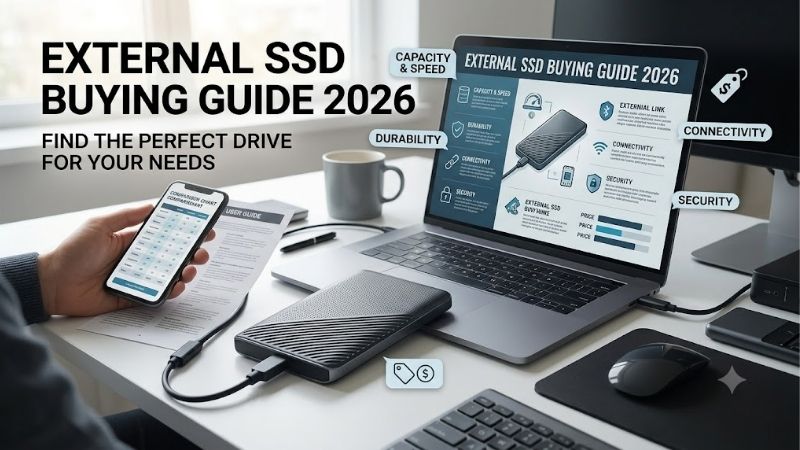
External ssd buying guide 2026 helps you avoid paying for speed your computer cannot use or capacity you will never fill. This guide compares four current portable SSDs by interface, capacity, durability, and size, then matches each model to practical needs for backups, travel, gaming, and content creation without unnecessary bulk.
Quick answer: For most people in 2026, the best external ssd buying guide 2026 is the Samsung T9 Portable SSD — our #1 rated choice. See the full ranked comparison, alternatives and buying advice below.
How to Choose an External SSD
This external ssd buying guide 2026 starts with the problem many buyers overlook: headline speed matters only when the computer, cable, and workload can use it. A 20Gbps SSD can perform only marginally faster than a 10Gbps model on the wrong port, while extra capacity may cost more without improving routine daily transfers.
Speed And Interface
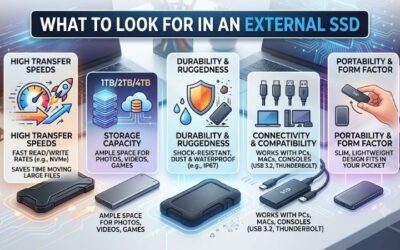
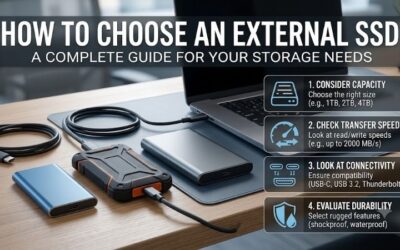
Interface speed sets the maximum file-transfer rate. That is why this external ssd buying guide 2026 checks host ports before comparing drive labels. USB 3.2 Gen 2 reaches roughly 10Gbps, while Gen 2×2 reaches 20Gbps. That difference matters most for video projects, huge game files, and frequent backups in sustained workloads.
For a 20Gbps laptop or desktop, Samsung T9 Portable SSD and Crucial X10 Pro Portable SSD can justify their faster interface; on a 10Gbps port, that advantage mostly disappears in practice. The trade-off is paying for unused performance, so match your USB controller and choose Samsung T9 or Crucial X10 Pro when 20Gbps is available.
Capacity
Capacity determines how often you delete or archive files, and 2TB is a sensible starting point because photos, games, and video projects accumulate quickly. A 1TB drive can suit documents and smaller, lighter libraries, while 4TB makes more sense when one portable drive must hold active media files alongside routine backups.
Plan for the next two years, not just today’s folder size, because filling an SSD leaves less usable workspace. Kingston XS1000 reaches 2TB in a tiny enclosure, while Crucial X10 Pro offers up to 4TB for heavier creative libraries. Higher storage capacity costs more, but these two choices reduce constant file shuffling.
Durability
Within this external ssd buying guide 2026, durability starts with basic drop protection plus dust and water resistance. Treat an IP rating as protection against specific laboratory test conditions, not permission to submerge the drive. A ruggedized enclosure is useful for travel, field shoots, commuting, and routine accidental bumps and knocks.
SanDisk Extreme Portable SSD is the clearest practical fit for exposed travel because it combines IP65 protection with rated three-meter drop resistance protection. Samsung T9 also handles drops up to three meters, while Crucial X10 Pro is rated to two meters and IP55. For rugged travel, SanDisk remains the focused choice.
Portability And Size
Size and weight strongly affect whether an SSD stays in your bag or gets left behind. Compare enclosure dimensions, cable length, and connector needs, especially when paired with a thin laptop, tablet, or phone. A pocket-friendly design matters most of all when the drive is a daily companion rather than a desk-side archive.
Kingston XS1000 is only 69.54 x 32.58 x 13.5mm and weighs 28.7g, making it exceptionally easy to carry every single day. SanDisk Extreme Portable SSD is larger, but also adds a carabiner loop and protective shell, while Samsung T9 weighs 122g. Smaller dimensions improve portability, but these picks balance size with protection or speed.
Top Picks
This external ssd buying guide 2026 compares four practical roles. Samsung T9 leads where 20Gbps performance matters, Kingston XS1000 emphasizes compact value, SanDisk Extreme Portable SSD prioritizes outdoor durability, and Crucial X10 Pro targets demanding creators. All four support useful 2TB configurations with USB-C connectivity.
| Product | Best For | Key Spec | Watch Out For |
|---|---|---|---|
| Samsung T9 Portable SSD | Best Overall | 2TB; USB 3.2 Gen 2×2; up to 2,000/1,950MB/s (Samsung) | Full performance requires a compatible 20Gbps host |
| Kingston XS1000 | Best Value | 2TB; USB 3.2 Gen 2; up to 1,050/1,000MB/s (Kingston) | No listed IP dust or water rating |
| SanDisk Extreme Portable SSD | Best for Travel | 2TB; USB 3.2 Gen 2; up to 1,050/1,000MB/s (SanDisk) | Peak speed is limited by the 10Gbps interface |
| Crucial X10 Pro Portable SSD | Best for Video Creators | 2TB; USB 3.2 Gen 2×2; up to 2,100/2,000MB/s (Crucial) | Full performance needs a compatible 20Gbps USB-C host |
Samsung T9 Portable SSD — Best Overall
Samsung T9 Portable SSD — Best Overall fits buyers routinely moving large folders, game libraries, or high-resolution media from a computer with USB 3.2 Gen 2×2. The 2TB version reaches up to 2,000MB/s read and 1,950MB/s write, uses AES-256 hardware encryption, and carries Samsung’s five-year limited warranty.
The catch is that T9 speed depends on a 20Gbps host and cable, so older USB connections can limit it. It is also 122g and 88 x 60 x 14mm, noticeably larger than the smallest pocket SSDs. That added size remains manageable in many laptop bags while delivering useful speed, security, and measured drop resistance for daily commuting.
Kingston XS1000 — Best Value
Kingston XS1000 — Best Value suits students, laptop owners, and everyday backup users who want a full 2TB without an unnecessarily bulky enclosure. It uses USB 3.2 Gen 2 and is rated for up to 1,050MB/s read and 1,000MB/s write, while the included adapter supports legacy USB-A computer ports and accessories.
Its biggest advantage is portability: XS1000 measures 69.54 x 32.58 x 13.5mm and weighs 28.7g. The main compromise is protection, because Kingston does not list an IP-rated dust or water protection for this model. Use a protective case for rougher travel, and choose it when compact storage matters more than rugged field protection.
SanDisk Extreme Portable SSD — Best For Travel
SanDisk Extreme Portable SSD — Best for Travel suits frequent commuters, photographers, and creators who carry storage through unpredictable outdoor environments. The 2TB model uses USB 3.2 Gen 2, reaches up to 1,050MB/s read and 1,000MB/s write, and adds IP65 water and dust resistance plus rated three-meter drop protection.
The enclosure includes a durable silicone exterior and carabiner loop, making the drive especially practical for a camera bag or backpack. Its weakness is the standard 10Gbps interface, so it cannot match 20Gbps-class drives at peak transfer rates. For frequent travel, protection can matter more than that performance ceiling.
Crucial X10 Pro Portable SSD — Best For Video Creators
This external ssd buying guide 2026 favors Crucial X10 Pro for editors handling large professional video footage over a compatible 20Gbps USB-C host connection on the computer. Its 2TB configuration is rated for up to 2,100MB/s reads and 2,000MB/s writes, with 256-bit AES hardware encryption and IP55 dust and water resistance.
The X10 Pro is compact at just 65 x 50mm and can handle drops up to two meters without data impact under Crucial’s stated test conditions. Its main limitation is interface dependence: full performance needs USB 3.2 Gen 2×2, while USB-A support still requires a separately available adapter. Check your host computer port first.
Frequently Asked Questions
This external ssd buying guide 2026 also answers the questions that commonly decide a purchase after the spec sheet looks similar. The important details are not simply raw speed; they include whether your port supports that speed, how much free space you need, and how much protection your daily routine actually demands.
Do You Really Need A 20Gbps External SSD?
Do you really need a 20Gbps external SSD? No, not for most ordinary everyday documents, photos, routine backups, and media. A 10Gbps drive such as SanDisk Extreme Portable SSD or Kingston XS1000 is already more than fast enough for many users, especially when the computer lacks a 20Gbps USB port and compatible controller.
Choose a 20Gbps model when you regularly move extremely large files or edit directly from the SSD and your host supports USB 3.2 Gen 2×2. Samsung T9 and Crucial X10 Pro can exploit that higher maximum ceiling. Otherwise, the faster interface becomes additional purchase cost without matching real-world transfer benefits.
Is 2TB Enough For An External SSD?
Is 2TB enough for an external SSD? For many people, yes. Two terabytes gives substantial useful room for a large photo library, several games, work files, and local media without immediately jumping to premium high-capacity storage. It is also a practical size for keeping an active project set portable, manageable, and organized.
Move to 4TB when the SSD will hold an extensive high-resolution video archive, multiple substantial game libraries, or many project folders active simultaneously together. Crucial X10 Pro supports up to 4TB, while Kingston XS1000 tops out at 2TB. Do not buy capacity alone; keep a separate, independent backup for irreplaceable data.
Can An External SSD Replace A Backup Drive?
Can an external SSD replace a backup drive? It can be one part of a backup strategy, but one SSD should not be the only copy of important irreplaceable files. SSDs are convenient, quiet, and remarkably fast, yet accidental deletion, theft, corruption, or device failure can still affect stored user data without warning, unexpectedly.
For valuable photos or important work, keep another copy on a separate device or secure location and update it regularly. The external SSD can serve as the fast working-storage or local-backup layer, while the second copy provides redundancy. This external ssd buying guide 2026 prioritizes redundancy over close benchmark comparisons.
Are Rugged External SSDs Worth Paying More For?
Are rugged external SSDs worth paying more for? They are worth seriously considering when the drive regularly travels, but the benefit depends heavily on your workflow. IP ratings and drop figures describe tested resistance; they do not make a drive indestructible, waterproof, or universally safe for every possible environment.
SanDisk Extreme Portable SSD is the most travel-focused pick because its IP65 rating, three-meter drop protection, silicone exterior, and carabiner loop specifically target mobile use. For desk work, those features may add comparatively little value, so a smaller or faster model can make more sense within the same spending range.
Final Thoughts
An external ssd buying guide 2026 should end with one rule: buy for the port, workload, and environment you actually have. Samsung T9 suits high-speed general use, Kingston XS1000 stays compact, SanDisk Extreme Portable SSD favors travel, and Crucial X10 Pro gives creators extra headroom when 20Gbps USB-C is available.
Ready to decide? Our #1 pick for 2026 is the Samsung T9 Portable SSD.
Live price & availability on Amazon.