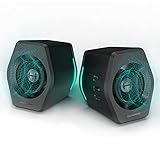
- Top Pick: BESTISAN Computer Speakers, 20W Peak Power Bluetooth 5.4, USB & USB-C Powered PC Speakers with 9 RGB Light Modes, Gaming Desktop Speakers, Plug & Play Stereo & Enhanced Bass for Laptop Desktop Monitor
- Best Value: LENRUE G11 Computer Speakers for Desktop, Touch Lights PC Speakers with Surge Clear Sound, USB C/USB Powered, AUX Audio for Computer Desktop PC Laptop Desk
- Premium Choice: Nylavee Computer Speakers, Plug-and-Play PC Speakers for Desktop & Laptop
A decent set of PC speakers brings games, music, and movies to life with room-filling sound that headsets can’t touch for shared listening. By 2026 the best desktop speakers run from compact budget sets to premium powered studio monitors. Here are our top picks for every budget, along with a clear guide to speaker types, connectivity, and how to get the best sound from your desk without overspending on features you’ll never use.
- Watch: Best PC Speakers 2026 — Top Desktop Speakers for Gaming — Video Review
- Best PC Speakers of 2026
- PC Speaker Comparison Table
- Best Premium: Audioengine A2+
- Best for Bass & Gaming: Logitech Z623
- Best Budget: Creative Pebble V3
- How to Choose PC Speakers
- Understanding Connectivity and Inputs
- Speaker Placement Tips for Better Sound
- Powered Monitors vs Multimedia Speakers
- Frequently Asked Questions
- Related Articles
⚡ Save on Your Next PC — Amazon Prime
Prime members get fast free shipping on the systems above, plus early access to Prime Day & Black Friday PC deals. New members get a 30-day free trial.
As an Amazon Associate we earn from qualifying purchases at no extra cost to you.




Watch: Best PC Speakers 2026 — Top Desktop Speakers for Gaming — Video Review
Best PC Speakers of 2026

Prime
Best Seller
C2G/Cables To Go Legrand – C2G 3.5MM to RCA Y-Cable, 6 Foot Y Splitter Audio Cable RCA, Male to Male 3.5MM to RCA Audio Cable, 1 Count, C2G 40423
PC Speaker Comparison Table
| Speakers | Type | Power | Best For | Price |
|---|---|---|---|---|
| Audioengine A2+ | Powered 2.0 | 60W | Premium audio | ~$269 |
| Logitech Z623 | 2.1 + sub | 200W | Bass & gaming | ~$129 |
| Logitech Z407 | 2.1 + sub | 80W | Wireless control | ~$99 |
| Creative Pebble V3 | Powered 2.0 | 16W | Budget | ~$39 |
Best Premium: Audioengine A2+
The Audioengine A2+ powered speakers deliver audiophile-grade sound from a compact desktop body, with a built-in DAC, USB input, and beautifully balanced audio. They’re perfect if you want accurate, detailed sound for music and gaming without a separate amp or a big footprint. The integrated DAC bypasses your PC’s noisy onboard audio for a cleaner signal, and the hand-built cabinets punch far above their small size for clarity and imaging. There’s no separate subwoofer, so bass is tight and controlled rather than thunderous — but a subwoofer output lets you add one later if you crave more low-end.
Best for Bass & Gaming: Logitech Z623
The Logitech Z623 is a THX-certified 2.1 system with a hefty subwoofer that pumps out deep, impactful bass for explosive game audio and music. With 200W on tap it fills a room easily, and it’s stayed a longtime favorite for gamers chasing big sound on a sensible budget. The chunky subwoofer delivers the kind of chest-thumping low-end that makes explosions and cinematic soundtracks genuinely exciting, and multiple inputs let you connect a PC, console, and phone at once. It’s larger than most desktop sets, so make sure you have the space, but for sheer fun-per-dollar it’s hard to beat.
4
Prime
C2G/Cables To Go Legrand – C2G 3.5MM to RCA Y-Cable, 6 Foot Y Splitter Audio Cable RCA, Male to Male 3.5MM to RCA Audio Cable, 1 Count, C2G 40423
In Stock


As an Amazon Associate we earn from qualifying purchases. Product prices and availability are accurate as of the date/time indicated.
Best Budget: Creative Pebble V3
The Creative Pebble V3 punches well above its price, throwing out clear, surprisingly full sound from a tiny USB-C powered design. For students, small desks, or anyone wanting a big step up from built-in monitor speakers without spending much, it’s an outstanding value. The angled drivers point sound directly at your ears for better clarity, and USB-C power plus a 3.5mm or USB audio connection keeps the cabling simple. There’s no dedicated subwoofer, so it won’t rattle the room, but for everyday gaming, music, and video at a desk it delivers remarkable quality for the money.
How to Choose PC Speakers
- 2.0 vs 2.1: 2.0 (two speakers) for balanced sound; 2.1 adds a subwoofer for bass
- Powered monitors: Studio-style speakers offer the most accurate sound
- Connectivity: USB, 3.5mm, Bluetooth, and optical inputs add flexibility
- Desk space: Compact speakers suit small desks; larger sets need room
For private late-night gaming, pair speakers with a quality gaming headset.
Understanding Connectivity and Inputs
How your speakers connect affects both sound quality and convenience. A USB connection uses the speaker’s built-in DAC to bypass your motherboard’s audio, which often reduces hiss and interference. A 3.5mm analog jack is universal and works with any PC, console, or phone. Bluetooth adds wireless convenience for streaming from a phone, though it can slightly compress audio and add latency, which matters for competitive gaming. Optical (TOSLINK) inputs, found on some 2.1 systems, carry a clean digital signal ideal for connecting a TV or console. Pick a set with the inputs that match the devices you actually use, and prioritize USB or optical if you want the cleanest possible sound from your PC.
Speaker Placement Tips for Better Sound
Even great speakers underperform if positioned poorly. Aim for the classic equilateral triangle: your two speakers and your head should form a triangle with equal sides, and the tweeters (the small top drivers) should sit at roughly ear height. Angle each speaker slightly inward toward your listening position for sharper stereo imaging. Small desktop monitors like the A2+ benefit from isolation pads or stands that tilt them up and reduce desk vibration and bass smearing. If you use a 2.1 system, the subwoofer can go on the floor since low bass is non-directional, but keeping it away from a corner prevents boomy, uneven bass. A few minutes of placement tuning often improves sound more than spending extra money.
Powered Monitors vs Multimedia Speakers
Powered studio monitors like the Audioengine A2+ chase accurate, flat reproduction, which makes them great for critical listening and gaming alike. Multimedia speakers like the Logitech Z623 lean into fun, bass-heavy sound that’s a blast for games and movies. Go monitors for accuracy and music, multimedia sets for bass and value. If you produce music, edit video, or simply prefer hearing recordings as the artist intended, monitors are the better tool; if you mostly want immersive, punchy sound for gaming and films, a 2.1 multimedia system delivers more excitement per dollar.
Frequently Asked Questions
Do I need a 2.0 or 2.1 speaker system for gaming?
A 2.0 system has two stereo speakers, while 2.1 adds a subwoofer for deeper bass. For explosive game audio and music, 2.1 delivers more impactful low-end and rumble. If desk space is tight or you prefer cleaner, more neutral sound, 2.0 bookshelf speakers can sound excellent. Choose 2.1 for cinematic punch, or quality 2.0 for accuracy and a smaller footprint.
How do PC speakers connect to my computer?
Speakers connect via 3.5mm analog, USB, optical, or Bluetooth. USB and optical carry digital audio and can bypass a noisy motherboard for cleaner sound. Analog 3.5mm is simplest and universal. Bluetooth adds wireless convenience for phones. Match the connection to your PC’s outputs and preference; USB speakers with a built-in DAC often provide the cleanest, most convenient plug-and-play experience.
Are powered or passive speakers better for a desktop?
Powered (active) speakers have built-in amplification, so you just plug them into your PC and power, making them the practical choice for most desktops. Passive speakers need a separate amplifier or receiver, adding cost and complexity but allowing higher-end audiophile setups. For gaming and general use, quality powered desktop speakers or studio monitors give great sound without extra equipment.
Should I consider studio monitors for gaming?
Studio monitors aim for flat, accurate sound rather than boosted bass, which some gamers love for clear, detailed positional audio and versatile music listening. They can lack the boomy fun-factor of consumer 2.1 systems, though. If you value precision and also create or mix audio, studio monitors are superb; if you want cinematic, bass-heavy excitement, a dedicated 2.1 gaming system may satisfy more.
How much power and size do desktop speakers need?
Wattage indicates loudness potential, but placement and room matter more than raw power for desk use. Compact speakers with 15 to 30 watts per channel fill a desk area easily. Larger speakers need space to breathe and can overpower a small setup. Consider your desk dimensions and listening distance, and prioritize sound quality and driver size over headline wattage figures.
Ready to decide? Our #1 pick for 2026 is the Audioengine A2+.
Live price & availability on Amazon.
Top picks from this guide
 EdifierEdifier G2000 32W PC Gaming Computer Speakers for Laptop Mac…$110 \xc2\xb7 99/100
 OFFSIRComputer Speakers, 2 in 1 PC Speaker , Gaming Speakers…$25 \xc2\xb7 99/100
 CreativeCreative Pebble V3, 2.0 USB-C Desktop Speakers, Bluetooth 5.0, Black…$43 \xc2\xb7 98/100
 LogitechLogitech Z207 2.0 Stereo Computer Speakers with Bluetooth | 10…$59 \xc2\xb7 97/100