The best desktop thermal-transfer printers for shipping departments produce labels that stay readable from the packing bench to the delivery dock. Thermal-transfer printing uses heat and a ribbon to bond the image to the label, so shipping labels resist smudging, moisture, and handling far better than labels printed without a ribbon. For a department that prints carrier labels, carton labels, and packing slips all day, that durability keeps barcodes scannable and addresses legible through sorting, transit, and storage.


A shipping department also needs speed, reliability, and easy integration. Printers sit on packing benches, connect to warehouse software, and run through hundreds of labels in a shift. The models below focus on those needs: 203 dpi resolution for clear barcodes and text, print speeds of 6 inches per second, 4-inch label widths for standard shipping formats, and connectivity that covers USB, Ethernet, and wireless options. Each one is a compact desktop unit that fits a bench without taking over the workspace.
How to Choose the Best Desktop Thermal-Transfer Printers for Shipping Departments
Choosing among the best desktop thermal-transfer printers for shipping departments begins with print method and resolution. Thermal-transfer models use a ribbon, which creates a durable image suited to labels that travel, sit in storage, or face moisture and abrasion. A resolution of 203 dpi is the standard for shipping labels, giving clear barcodes and readable text at 4-inch widths. A 300 dpi model adds finer detail for small barcodes and small text, which helps when labels carry dense information.
Print speed and volume matter next. Look for a speed of 6 inches per second at 203 dpi, so a 4-by-6-inch shipping label prints in about a second. A printer rated for daily use in a shipping department should handle continuous runs without frequent pauses, and a straightforward media path makes ribbon and label changes quick between batches. A tear bar, peeler, or cutter option helps match the printer to how labels are applied on the bench.
Connectivity should fit the department layout. USB suits a single packing station, while Ethernet allows a printer to be shared across several stations and managed from a central system. Wi-Fi and Bluetooth help when a printer moves between benches or connects to a mobile device for setup. Check that the printer supports the label software and carrier systems already in use, including common programming languages such as ZPL and EPL.
Media handling and ribbon capacity round out the decision. A 4-inch maximum print width covers standard shipping labels, and support for 74-metre and 300-metre ribbons affects how often ribbon needs changing. A printer with a clear media window, simple loading, and a modular connectivity slot adapts as the department grows, instead of forcing a replacement when a new connection type is needed.
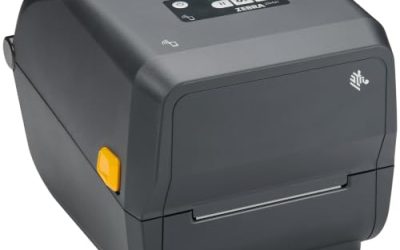
Zebra ZD421 Thermal-Transfer Printer
Zebra ZD421 with 203 dpi, 6 ips, and USB Connectivity
The Zebra ZD421 thermal-transfer model, part number ZD4A042-301M00EZ, prints at 203 dpi with a maximum speed of 6 inches per second and a maximum print width of 4.09 inches. That combination suits standard 4-by-6-inch shipping labels, carton labels, and barcode labels, with clear text and scannable codes. It uses a ribbon roll for thermal-transfer printing and can also run direct thermal media when a shorter-lived label is sufficient.
The ZD421 is compact for a bench, with a clear media window, simple ribbon loading, and a tear bar fitted as standard. USB connectivity suits a single packing station, and a modular connectivity slot allows Ethernet or wireless options to be added later. Bluetooth Low Energy helps with setup from a phone or tablet, and Zebra Print DNA software supports remote management and configuration.
This model suits a shipping department that needs a dependable, compact thermal-transfer printer for a single station or a small team. It is a good fit for daily carrier labels, carton identification, and barcode labels that must remain readable through handling and transit.
View the Zebra ZD421 Thermal-Transfer Printer on Amazon
Zebra ZD621 Thermal-Transfer Printer
Zebra ZD621 with Colour Touch Display, 203 dpi, and Ethernet
The Zebra ZD621 thermal-transfer model, part number ZD6A142-301L01EZ, prints at 203 dpi with a maximum speed of 8 inches per second and a maximum print width of 4.09 inches. A 4.3-inch colour touch display shows printer status, settings, and guidance, which helps staff on a busy bench check the printer at a glance and resolve common issues without a manual. The display also supports on-device configuration and media setup.
Connectivity is broad, with USB, USB Host, Ethernet, serial, and Bluetooth, so the ZD621 can join a wired network, serve several packing stations, and connect to warehouse systems. It supports thermal-transfer printing with 74-metre and 300-metre ribbons, plus direct thermal media, and it includes a real-time clock and advanced security features for managed environments.
This model suits a shipping department that needs a faster, networked printer with a clear display and shared access across stations. It is a good fit for a central packing area, a team that prints in high volume, and a department that wants remote management and clear on-screen status.
View the Zebra ZD621 Thermal-Transfer Printer on Amazon
TSC TTP-244 Pro Thermal-Transfer Printer
TSC TTP-244 Pro with 203 dpi, 5 ips, and USB Connectivity
The TSC TTP-244 Pro is a compact desktop thermal-transfer printer that prints at 203 dpi with a maximum speed of 5 inches per second and a maximum print width of 4.25 inches. That width covers standard shipping labels and wider carton labels, while the 203 dpi resolution keeps barcodes and addresses clear. It prints barcodes, QR codes, text, and logos, which suits shipping labels, inventory labels, and carton marking from one machine.
The TTP-244 Pro connects by USB and uses a straightforward media path with a ribbon and label roll that load quickly. Its small footprint fits a crowded packing bench, and its simple design suits a department that wants a reliable second printer for a station, a backup unit, or a smaller shipping area. It works with common label software and supports standard barcode formats used in shipping and inventory.
This model suits a shipping department that needs a straightforward, compact thermal-transfer printer for steady daily use. It is a good fit for a smaller team, a secondary packing station, or a department that wants a dependable backup printer alongside a main networked unit.
View the TSC TTP-244 Pro on Amazon
Comparison Table
| Product | Key Spec | Best For |
|---|---|---|
| Zebra ZD421 | 203 dpi, 6 ips, 4.09-inch width, USB | Dependable single-station shipping labels |
| Zebra ZD621 | 203 dpi, 8 ips, colour touch display, Ethernet | Networked, high-volume packing areas |
| TSC TTP-244 Pro | 203 dpi, 5 ips, 4.25-inch width, USB | Compact secondary stations and smaller teams |
Frequently Asked Questions
Why choose thermal-transfer printing for shipping labels?
Thermal-transfer printing uses a ribbon to bond the image to the label, so the print resists smudging, moisture, and abrasion better than a ribbon-free print. That durability keeps barcodes scannable and addresses readable through sorting, transit, and storage, which matters when a label travels with a parcel for several days.
What resolution do shipping labels need?
A resolution of 203 dpi is the standard for shipping labels, giving clear barcodes and readable text at 4-inch widths. A 300 dpi printer adds finer detail for small barcodes and small text, which helps when labels carry dense information or small fonts. For most carrier and carton labels, 203 dpi is sufficient.
How fast should a shipping department printer be?
Look for a speed of at least 6 inches per second at 203 dpi, so a 4-by-6-inch label prints in about a second. Faster models, such as the ZD621 at 8 inches per second, help during peak periods when several stations print in sequence. Speed matters less than reliability for a single station, but it matters more for a shared, high-volume printer.
Should a shipping printer use USB or Ethernet?
USB suits a single packing station where one computer drives one printer. Ethernet suits a shared printer that several stations use, or a printer managed from a central system. Many departments use USB for individual benches and Ethernet for a central printer, so a model with a modular slot or both options gives more flexibility.
Conclusion
The best desktop thermal-transfer printers for shipping departments balance durability, speed, and connectivity. The Zebra ZD421 is the most dependable pick for a single station, with clear 203 dpi output, a compact design, and simple ribbon loading. The Zebra ZD621 adds a colour touch display, faster output, and Ethernet for a networked, high-volume packing area. The TSC TTP-244 Pro covers compact secondary stations and smaller teams with straightforward thermal-transfer printing.
Choose the ZD421 for a reliable bench printer. Choose the ZD621 when several stations share one printer and speed matters. Choose the TTP-244 Pro for a compact second printer or a smaller shipping area. Any of the three gives a shipping department durable labels that stay readable through the journey.
Disclosure: As an Amazon Associate, we may earn from qualifying purchases.