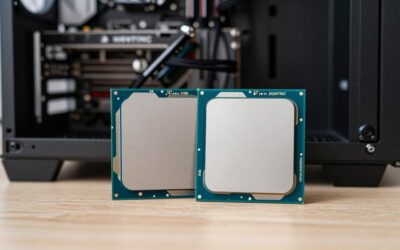
The best CPU for a home server in 2026 is the AMD Ryzen 5 7600 for most DIY builds: it offers six modern cores, low platform power, a basic integrated GPU for maintenance, and a motherboard ecosystem that can support unbuffered ECC memory when the board and firmware implement it.
That recommendation changes with your workload. An Intel N100-class system is cheaper and more efficient for file serving and light containers, an AMD Ryzen 7 8700G is better when you need a stronger iGPU for transcoding or a compact all-in-one machine, and an Intel Xeon E-2400 platform is the safer choice when validated ECC support and server-style management matter more than price.

Dell T7810 “Chia Farming” Workstation/Server, 2X Intel Xeon E5-2690 v4 up to 3.5GHz (28 Cores & 56 Threads Total), 128GB DDR4, Quadro K620 2GB Graphics Card, No HDD, No Operating System (Renewed)
Included for 'Best CPU for Home Server: Top Picks' because the listing specifies 128GB DDR4 and Quadro K620 2GB Graphics Card, details this guide uses to compare options.
View on Amazon
Dell PowerEdge T340 Tower Server, Windows 2019 STD OS, Intel Xeon E-2124 Quad-Core 3.3GHz 8MB, 32GB DDR4 RAM, 8TB Storage, RAID, Single PSU (Renewed)
Included for 'Best CPU for Home Server: Top Picks' because the listing specifies Windows 2019 STD OS and Intel Xeon E-2124 Quad-Core 3.3GHz 8MB, details this guide uses to compare options.
View on AmazonQuick answer: For most people in 2026, the best cpu for home server is the AMD Ryzen 5 7600 — our #1 rated choice. See the full ranked comparison, alternatives and buying advice below.
Best home-server CPUs at a glance
| CPU or class | Cores / threads | Typical platform cost | Typical idle power target | Best for | Main limitation |
|---|---|---|---|---|---|
| AMD Ryzen 5 7600 | 6 / 12 | Usually $300–$500 including board and cooler | 25–45 W for a sensible system | Balanced NAS, containers, VMs and media serving | ECC depends on motherboard and BIOS support |
| AMD Ryzen 7 8700G | 8 / 16 | Usually $400–$650 including board and cooler | 30–55 W | More CPU threads plus a capable integrated GPU | Higher cost and power than necessary for basic storage |
| Intel N100-class platform | 4 / 4 | Usually $150–$350 for a complete mini system | 8–20 W | Low-cost, low-power file serving and lightweight containers | Limited expansion, RAM and VM headroom |
| Intel Core i3-14100 | 4 / 8 | Usually $250–$450 including board and cooler | 25–50 W | Transcoding and responsive general-purpose servers | Consumer boards usually do not provide a clear ECC path |
| Intel Xeon E-2400 series | Up to 8 / 16 | Usually $600–$1,000 for CPU and server board | 35–70 W | ECC-first builds and long-running professional workloads | Higher platform price and less attractive performance per dollar |
These power figures describe a complete, sensibly configured system with one or two SSDs, not the processor alone. A large number of hard drives, add-in cards, fans and inefficient power supplies can dominate the total.
Why the Ryzen 5 7600 is the best all-round choice
The Ryzen 5 7600 has enough parallel performance for multiple Docker containers, software-defined networking, a home-assistant installation, a game server and occasional virtual machines without paying for a high-end desktop processor. Its six cores and twelve threads also leave useful headroom for background tasks such as parity checks, indexing and backups.
Its integrated graphics are modest, but that is an advantage for a server that only needs display output during installation or troubleshooting. You do not need a discrete graphics card merely to access BIOS settings or a local console. The AM5 platform also gives you a practical upgrade route to a higher-core-count Ryzen processor later.
ECC support requires checking the whole platform
Do not interpret “Ryzen supports ECC” as a guarantee that every AM5 board will correct memory errors. You need unbuffered ECC UDIMMs, a motherboard whose specifications explicitly support them, and firmware that enables error detection and correction. Some boards may accept ECC modules but operate them without correction, or expose limited error reporting.
For a server holding irreplaceable data, verify the board manual, memory-qualified list and operating-system reporting before buying. ECC also does not replace backups, snapshots or a tested restore procedure.
When a different CPU is the better choice
Choose an Intel N100-class system for minimum electricity use
An N100-class platform is compelling for a two- or four-drive NAS, DNS filtering, download services, home automation and a handful of low-resource containers. Its low idle draw can matter more than peak benchmark performance when the server runs all year.
Its four efficiency-focused cores are not ideal for several heavy virtual machines, software RAID calculations alongside media processing, or compiling large projects. Memory capacity and SATA expansion can also be restricted because many N100 systems are integrated mini PCs rather than standard socketed builds. Treat it as a focused appliance, not a universal server.
Choose the Ryzen 7 8700G when the iGPU is part of the plan
The Ryzen 7 8700G combines eight cores and sixteen threads with a much stronger integrated Radeon GPU than the basic graphics found on ordinary desktop CPUs. It suits a compact server that may also run a lightweight desktop, local game streaming, GPU-accelerated applications or media workflows that benefit from an integrated GPU.
For a headless file server, its graphics capability is mostly unused. In that situation, the Ryzen 5 7600 usually offers a better balance unless the additional cores are needed for virtual machines.
Choose the Core i3-14100 for inexpensive Intel media features
The Core i3-14100 is a useful option when Intel Quick Sync Video support fits your media software and you need a responsive four-core server. Its integrated graphics can handle display output and hardware video functions without a separate card.
It is less attractive for ECC-focused builds. Standard consumer Intel boards generally do not provide the same clear ECC support path as a server-oriented Xeon platform. It is also important to distinguish supported codecs and software configuration from raw CPU core count: hardware transcoding still depends on the media server, driver, container permissions and the source and target formats.
Choose Xeon E-2400 for validated reliability features
Intel Xeon E-2400 processors target entry-level servers and workstations. Paired with an appropriate server motherboard, they provide a clearer route to ECC memory, validated firmware and server-management features than mainstream desktop parts.
The extra platform cost is justified when the server supports a small business, stores critical records, or must be managed remotely in a rack or closet. For a personal media library that already has good backups, a Ryzen system usually delivers more compute performance per dollar.
Decision matrix: match the CPU to your workload
| Your situation | Recommended direction | Why | What to avoid |
|---|---|---|---|
| NAS, backups and a few containers | N100-class system | Very low idle consumption and sufficient everyday performance | Overspending on eight or sixteen CPU cores |
| NAS plus several containers and occasional VMs | Ryzen 5 7600 | Sixteen? No—six cores and twelve threads provide a useful middle ground without unnecessary power | Very low-core embedded platforms |
| Several VMs, development environments or game servers | Ryzen 7 8700G or a higher-core Ryzen | Eight or more cores improve simultaneous workloads | Four-thread CPUs with little memory headroom |
| ECC is a firm requirement | Xeon E-2400 platform, or a specifically verified ECC-capable Ryzen board | Reduces uncertainty around memory correction and reporting | Assuming ECC works because the DIMM physically fits |
| Hardware video transcoding is central | Intel Quick Sync-capable CPU or Ryzen 7 8700G after software verification | Integrated media engines can reduce CPU load | Buying by core count alone |
Calculate the electricity cost before choosing
Always-on efficiency is easier to compare with a simple annual calculation:
Annual cost = average watts ÷ 1,000 × 8,760 hours × electricity price.
Suppose an N100 system averages 15 W and a Ryzen 5 7600 system averages 35 W. At around $0 per kilowatt-hour:
- N100 system: 0.015 × 8,760 × around $0 = about $26 per year.
- Ryzen system: 0.035 × 8,760 × around $0 = about $61 per year.
- Difference: about $35 per year, before accounting for extra drives and cooling.
If the faster platform costs $200 more, electricity alone would take roughly six years to recover that difference. The faster CPU may still be the right choice if it replaces another computer, supports needed VMs, or shortens backup and maintenance jobs.
Platform cost matters more than CPU price
Budget for the processor, motherboard, memory, cooler, power supply, storage controller and case together. A cheap CPU can become expensive if it requires an add-in graphics card, a costly server board, or a separate HBA to provide the ports you need.
For a new build, 32 GB of RAM is a sensible starting point for containers and a few VMs; 64 GB is more comfortable for virtualization and ZFS caching workloads. Use a motherboard with enough SATA or M.2 connectivity, network hardware supported by your operating system, and a power supply with good low-load efficiency. Do not select an oversized gaming power supply if the server will spend most of its life drawing under 100 W.
Practical buying checklist
- Estimate simultaneous VMs, containers and transcodes rather than counting total applications.
- Confirm ECC type, motherboard support and operating-system reporting if data integrity matters.
- Check integrated graphics and codec support in the exact media software you plan to run.
- Count SATA ports, PCIe slots and networking requirements before selecting the board.
- Measure or estimate complete-system idle power; processor TDP is not an electricity bill.
- Prefer a platform with a clear upgrade path if you expect the server workload to grow.
For most home builders, the Ryzen 5 7600 is the safest balance of performance, efficiency, expansion and cost. Pick an N100-class system when low power and simplicity dominate, move to the Ryzen 7 8700G when integrated graphics and extra cores are useful, and pay for Xeon E-2400 when validated ECC and server-management features are worth the premium.
Ready to decide? Our #1 pick for 2026 is the AMD Ryzen 5 7600.
Live price & availability on Amazon.