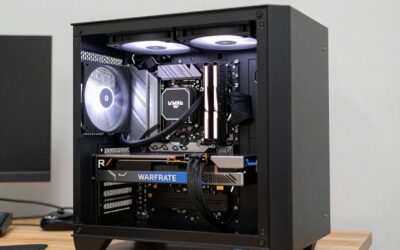
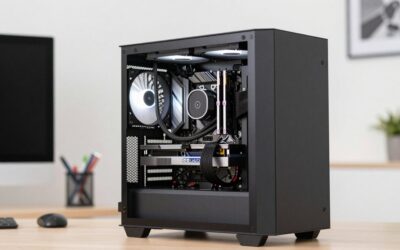
This build targets the upper echelon of PC gaming: uncompromised 4K frame rates, high-refresh 1440p play, and a foundation that will remain relevant for years. At this price point, every component is chosen for top-tier performance without the diminishing returns of enthusiast flagship hardware. The $3000 budget theme represents the sweet spot where you get the best consumer gaming experience AMD and NVIDIA currently offer. While street pricing fluctuates, the parts below represent a realistic high-end configuration in 2026 that prioritizes raw gaming throughput, platform longevity, and thermal headroom.
- Top Picks at a Glance for the Best $3000 Gaming PC Build
- Parts List
- Best $3000 Gaming PC Build by Budget Tier
- The Missing Part: CPU Cooler for a $3000 Gaming PC
- Smarter Alternatives to the Main Parts List
- Compatibility Check
- Expected Performance
- How We Chose the Best $3000 Gaming PC Build Parts
- Gaming PC Buying Guide: Thresholds That Decide the Build
- $3000 Gaming PC Build Mistakes to Avoid
- Which $3000 Gaming PC Build Should You Choose?
- What the Best $3000 Gaming PC Build Can Run: Estimates by Resolution
- Upgrade Path
- Prebuilt vs Building Your Own $3000 Gaming PC
- Pre-Order Compatibility Checklist
- FAQ
- Sources and Methodology
Updated October 2026 — The best $3000 gaming PC build in 2026 centers on an X3D processor and a 16GB RTX 50-series card: a Ryzen 7 9800X3D with an RTX 5080 or RTX 5070 Ti covers 1440p high refresh and 4K at high settings, and the Ryzen 9 9950X3D and 64GB build below is the no-compromise version of the same idea.
Quick answer: For the best $3000 gaming PC build, buy an AMD Ryzen 7 9800X3D, a 16GB RTX 5080 or RTX 5070 Ti, 32GB of DDR5-6000 CL30 and a 2TB NVMe drive, then spend what is left on a 360mm cooler and an 850W ATX 3.1 power supply. The three picks that matter most are the AMD Ryzen 7 9800X3D, the ASUS TUF Gaming GeForce RTX 5080 and the Arctic Liquid Freezer III Pro 360.
Top Picks at a Glance for the Best $3000 Gaming PC Build
- Best CPU for gaming value: AMD Ryzen 7 9800X3D — 8 cores · 96MB L3 · AM5
- Best CPU for gaming plus work: AMD Ryzen 9 9950X3D — 16 cores · 144MB total cache (main parts list)
- Best GPU for 4K: ASUS TUF Gaming GeForce RTX 5080 — 16GB GDDR7 (main parts list)
- Best GPU to save money: Gigabyte GeForce RTX 5070 Ti Gaming OC — 16GB GDDR7 · 256-bit
- Best cooler: Arctic Liquid Freezer III Pro 360 — 360mm AIO · three 120mm fans
- Best budget cooler: Thermalright Phantom Spirit 120 SE — dual tower · 7 heat pipes · 154mm tall
- Best power supply to save money: Corsair RM850e (2025) — 850W · ATX 3.1 · native 12V-2×6 cable
- Best monitor match: ASUS ROG Swift PG32UCDP — 32 inch · 4K 240Hz OLED
The sections below add what the parts list leaves out: a CPU cooler, cheaper swaps for every major part, and three budget tiers so you can see where the money goes.
Parts List
| Part | Model | Approx. price | Why |
|---|---|---|---|
| CPU | AMD Ryzen 9 9950X3D 16-Core Processor | Check on Amazon | 3D V-Cache delivers best-in-class gaming performance with 16 cores for productivity |
| GPU | ASUS TUF Gaming GeForce RTX 5080 16GB GDDR7 OC Edition | Check on Amazon | Handles 4K with ray tracing and DLSS 4 comfortably |
| Motherboard | ASUS TUF Gaming X870-PLUS WiFi AMD AM5 | Check on Amazon | PCIe 5.0, Wi-Fi 7, USB4, robust VRMs for sustained boost clocks |
| RAM | G.SKILL Trident Z5 Neo RGB 64GB DDR5-6000 CL30 (AMD EXPO) | Check on Amazon | Large capacity at the optimal frequency for AM5 with tight timings |
| Storage | Samsung SSD 9100 PRO 2TB PCIe 5.0 | Check on Amazon | Up to 14,700 MB/s sequential read for near-instant load times |
| PSU | CORSAIR RM1000x Shift ATX 3.1 1000W | Check on Amazon | ATX 3.1 native 12V-2×6 connector, fully modular, Gold efficiency |
| Case | LIAN LI LANCOOL III E-ATX (Black) | Check on Amazon | Four pre-installed 140mm fans, hinged glass door, broad GPU clearance |
AMD Ryzen 9 9950X3D
The 9950X3D combines 16 cores with AMD’s second-generation 3D V-Cache, delivering peak gaming performance while retaining multi-threaded strength for streaming or video editing. Its 144MB total cache reduces memory latency in CPU-bound titles, which directly benefits 1080p and 1440p frame rates. The AM5 socket guarantees upgrade paths through Zen 6 and beyond. If you want to save money and game purely, the Ryzen 7 9800X3D at eight cores costs significantly less and trades a modest amount in non-gaming workloads.
ASUS TUF Gaming GeForce RTX 5080
RTX 5080 with 16GB GDDR7 handles native 4K in most modern titles and dominates at 1440p with high refresh rates. The OC Edition ships with a factory boost above reference clocks. TUF’s triple-fan cooler and robust backplate keep thermals in check during extended sessions. DLSS 4 with multi-frame generation extends longevity in demanding ray-traced scenarios. If budget is tighter, the FE RTX 5080 typically sells at MSRP with a slightly blower-style cooler and smaller footprint.
ASUS TUF Gaming X870-PLUS WiFi
This X870 board supplies the PCIe 5.0 M.2 slot for the SSD, a PCIe 5.0 x16 slot for the GPU, USB4 40Gbps connectivity, and Wi-Fi 7 out of the box. The 16+2+1 power stage design with 80A SPS handles the 9950X3D’s sustained boost without VRM throttling. Four M.2 slots provide ample future storage expansion. For a lower-cost alternative, a B650 board would still work fine for gaming but forfeits PCIe 5.0 and USB4 features.
G.SKILL Trident Z5 Neo RGB 64GB DDR5-6000 CL30
6000 MT/s CL30 sits at the sweet spot for AMD’s AM5 platform, matching the Infinity Fabric clock without forcing an unstable 1:2 ratio. EXPO certification ensures one-profile overclocking on compatible boards. 64GB in a 2x32GB kit is generous for multitasking, future-proofing, and productivity alongside gaming. If 32GB suffices for your use case, a 2x16GB variant would reduce cost by roughly 55 percent while retaining identical latency characteristics for gaming workloads.
Samsung SSD 9100 PRO 2TB PCIe 5.0
Sequential read speeds up to 14,700 MB/s make DirectStorage titles load almost instantaneously. The 2TB capacity accommodates a large game library without juggling installs. A PCIe 5.0 x4 interface matches the motherboard slot directly. Random I/O performance exceeds PCIe 4.0 drives by a meaningful margin in heavy-mod scenarios.
CORSAIR RM1000x Shift 1000W
ATX 3.1 compliance with the native 12V-2×6 connector delivers clean power to the RTX 5080 without adapters. 1000W provides comfortable headroom for transient spikes common on Blackwell-class GPUs while keeping the unit below 60 percent load during gaming, which maximizes efficiency and minimizes fan noise. Fully modular cabling keeps the LANCOOL III’s clean aesthetic. A high-quality 850W unit could handle this system as well, though 1000W offers more safety margin for future upgrades.
LIAN LI LANCOOL III
Four 140mm PWM fans pre-installed provide excellent baseline airflow without additional purchase. The hinged tempered glass side panel simplifies access for cable management and upgrades. GPU clearance comfortably fits the TUF RTX 5080’s triple-slot design, and CPU cooler height accommodates most tower air coolers and 360mm AIOs. Mesh front and top panels prioritize airflow over sealed aesthetics. A more compact case could work but may require careful GPU length verification.
Best $3000 Gaming PC Build by Budget Tier
The parts list above is the top-spec version. Part prices move week to week, especially DDR5, so treat the tiers below as shopping targets rather than fixed totals.
Value Tier: Under $2,500
Ryzen 7 9800X3D · RTX 5070 Ti 16GB · 32GB DDR5-6000 CL30 · 2TB PCIe 4.0 SSD · 850W ATX 3.1 PSU
What to expect at this tier:
- Strong 1440p at high refresh and solid 4K with DLSS upscaling.
- The 9800X3D matches the 9950X3D in most games because both rely on the same 3D V-Cache design for gaming.
- A 240mm to 360mm cooler is enough for the 120W-class 9800X3D.
- You leave room for a monitor upgrade in the same budget.
Balanced Tier: About $3000
Ryzen 7 9800X3D · RTX 5080 16GB · 32GB DDR5-6000 CL30 · 2TB PCIe 4.0 or 5.0 SSD · 1000W ATX 3.1 PSU
What to expect at this tier:
- Native 4K at high settings in most current games, with DLSS 4 as a safety net in the heaviest ray-traced titles.
- 32GB of RAM is enough for gaming today; the saved money goes to the GPU.
- A 2TB drive is the practical minimum because modern games often exceed 100GB each.
No-Compromise Tier: Above $3000
Ryzen 9 9950X3D · RTX 5080 16GB · 64GB DDR5-6000 CL30 · 2TB PCIe 5.0 SSD · 1000W ATX 3.1 PSU
What to expect at this tier:
- This is the build in the parts list above, and it lands over a strict $3000 cap when RAM is expensive.
- The extra 8 cores and 32GB of RAM help streaming, editing and compiling, not frame rates.
- Choose it only if the PC also earns money or runs heavy creative work.
The Missing Part: CPU Cooler for a $3000 Gaming PC
The parts list above does not include a cooler, and the 9950X3D is not sold with one. Pick one of these before you order anything else.
Arctic Liquid Freezer III Pro 360 — Best for the Ryzen 9 9950X3D
- 360mm all-in-one liquid cooler · three 120mm fans · AM5 compatible
- Suits the 16-core 9950X3D, which has a higher power ceiling than the 9800X3D
- Radiator mounts in the front or top of most mid-tower cases
- Check that your case lists 360mm radiator support before buying
Pros: Strong cooling headroom for a 16-core chip; quiet at gaming loads; 360mm size keeps fan speeds low.
Cons: Needs a case with 360mm radiator clearance; more points of failure than an air cooler.
Skip it if you picked the 9800X3D and want the simplest, cheapest setup.
Thermalright Phantom Spirit 120 SE — Best Air Cooler
- Dual-tower air cooler · 7 heat pipes · two 120mm PWM fans
- About 154mm tall, so confirm side-panel clearance
- No pump, no leak risk, nothing to replace after a few years
- Best matched with an 8-core X3D chip such as the 9800X3D
Pros: Low cost for the cooling it delivers; simple to install; no pump noise.
Cons: Large tower can block the first RAM slot on some boards; limited headroom for the 16-core 9950X3D.
Skip it if you chose the 9950X3D or plan to run heavy all-core work.
Smarter Alternatives to the Main Parts List
AMD Ryzen 7 9800X3D — Best for Gaming-Only Builds
- 8 cores · 16 threads · 96MB L3 cache · AM5 socket
- Same 3D V-Cache approach as the 9950X3D, aimed purely at games
- Costs far less than the 9950X3D, which funds a stronger GPU
Pros: Top-tier gaming speed; runs cooler; easy to cool with air. Cons: Fewer cores for rendering or streaming. Skip it if you edit video or compile code every day.
Gigabyte GeForce RTX 5070 Ti Gaming OC — Best for Saving on the GPU
- 16GB GDDR7 · 256-bit bus · PCIe 5.0 · Windforce cooling
- Same VRAM amount as the RTX 5080 at a lower performance tier
- Lower power draw, so an 850W power supply is enough
Pros: Excellent 1440p performance; 16GB suits 4K textures; easier on the PSU. Cons: Slower than the RTX 5080 at native 4K. Skip it if you want 4K at high settings without upscaling.
MSI MAG B850 Tomahawk WiFi — Best Motherboard Value
- AM5 · DDR5 · 80A SPS power stages · built-in WiFi
- Supports Ryzen 9000, 8000 and 7000 processors
- B850 chipset keeps a PCIe 5.0 graphics slot at a lower price than X870
Pros: Strong VRM for X3D chips; lower cost than X870 boards. Cons: Fewer USB4 and M.2 options than the ASUS X870 board in the main list. Skip it if you need USB4 or four M.2 slots.
Patriot Viper Venom 32GB DDR5-6000 CL30 — Best RAM Value
- 2x16GB kit · DDR5-6000 · CL30 · 1.35V
- Same speed and latency target as the 64GB kit in the parts list
- Enable the EXPO or XMP profile in BIOS after installing
Pros: The AM5 sweet spot at half the capacity; frees budget for the GPU. Cons: Plain styling; 32GB limits heavy multitasking. Skip it if you stream, edit or keep many apps open while gaming.
Samsung 990 PRO 2TB — Best PCIe 4.0 SSD
- 2TB · PCIe 4.0 x4 · up to 7,450 MB/s read
- Fast enough that game load times are close to PCIe 5.0 drives
- Runs cooler than most PCIe 5.0 drives
Pros: Proven controller; lower heat; lower cost than the 9100 PRO. Cons: Lower peak speed for large file copies. Skip it if you move huge video files daily.
Corsair RM850e (2025) — Best Power Supply Value
- 850W · ATX 3.1 · PCIe 5.1 ready · native 12V-2×6 cable included
- Meets the 850W recommendation for an RTX 5080 and exceeds the 750W for an RTX 5070 Ti
Pros: Native modern GPU cable; low noise; lower cost than the 1000W unit. Cons: Less headroom for a future 600W-class GPU. Skip it if you may upgrade to a flagship card.
ASUS ROG Swift PG32UCDP — Best 4K Monitor Match
- 32 inch · 4K 240Hz OLED · dual mode to 1080p 480Hz · G-SYNC compatible
- Gives an RTX 5080 a display worth its output
Pros: Deep blacks; very fast response; flexible dual mode. Cons: Premium cost; OLED care habits needed. Skip it if you game at 1440p on a tight budget.
MSI MAG 272QP QD-OLED X50 — Best 1440p Monitor Match
- QD-OLED · 2560×1440 · 500Hz · 0.03ms response
- Pairs well with the RTX 5070 Ti value tier
Pros: Very high refresh rate; strong contrast; cheaper than 4K OLED. Cons: Lower pixel density than 4K. Skip it if you want a larger 32 inch canvas.
Also Consider
AMD Ryzen 7 9850X3D — 8-core X3D chip with higher clocks than the 9800X3D; worth it only if the price gap is small.
AMD Ryzen 7 7800X3D — previous-generation 8-core X3D; a fair step down if you find it discounted.
Gigabyte B850 AORUS Elite WIFI7 — a second B850 board option with Wi-Fi 7; pick it if the MSI board is out of stock.
Compatibility Check
Socket: AM5 CPU pairs with the X870 board. RAM: DDR5 UDIMMs are supported at the specified frequency and timings with EXPO enabled in BIOS. PSU: 1000W exceeds the estimated 700W system draw with headroom for transient spikes on the 5080. GPU length: The TUF RTX 5080 measures approximately 338mm; the LANCOOL III supports GPUs up to 400mm. CPU cooler: The Lancool III accommodates coolers up to 180mm tall, fitting any compatible AM5 solution.
Expected Performance
1080p High Refresh
At 1080p, the CPU becomes the limiting factor in many titles. The 9950X3D’s cache advantage pushes frame rates well beyond what the GPU alone would produce. In Call of Duty: Black Ops 6, reviewers at TechPowerUp and Hardware Unboxed report ranges in the low 300s to upper 300s FPS at 1080p high settings. Cyberpunk 2077 at 1080p ultra without ray tracing lands in the 250-280 FPS range per Tom’s Hardware benchmarks. This build excels in esports and competitive titles at 240Hz+ refresh rates.
1440p
At 1440p, the RTX 5080 becomes the primary driver. Hogwarts Legacy at ultra settings with DLSS quality mode yields approximately 130-160 FPS according to Gamers Nexus and TechSpot review data. Call of Duty at 1440p maximum settings ranges around 180-220 FPS per Hardware Unboxed measurements. Cyberpunk 2077 with medium ray tracing and DLSS 4 frame generation sits roughly 100-140 FPS native to generated as reported by Tom’s Hardware.
4K
At 4K, the 16GB frame buffer and GDDR7 bandwidth matter most. Hogwarts Legacy at 4K ultra without DLSS falls in the 55-75 FPS range per TechPowerUp’s launch review data. Enabling DLSS quality mode pushes this to 90-120 FPS. Cyberpunk 2077 at 4K with ray tracing medium and DLSS 4 multi-frame generation reportedly reaches 80-110 FPS based on Gamers Nexus testing. Without DLSS, native 4K ultra sits around 50-65 FPS according to TechSpot. Competitive titles like Counter-Strike 2 remain comfortably above 200 FPS at 4K.
How We Chose the Best $3000 Gaming PC Build Parts
This guide is research-based and does not rest on our own benchmark runs. We compared maker spec sheets, published CPU and GPU reviews from outlets such as TechPowerUp, Tom’s Hardware and Gamers Nexus, and current listing specifications. Each part had to meet five rules: current generation, AM5 and DDR5 compatible, 16GB of video memory or better, an ATX 3.1 power path for the GPU, and a brand with a clear warranty. We dropped anything that only made sense for a different budget, and we label every performance claim as an estimate based on the part’s tier.
Gaming PC Buying Guide: Thresholds That Decide the Build
CPU: Pick Cache Before Cores
For games, an 8-core X3D chip is the target. The Ryzen 7 9800X3D and the older 7800X3D both carry 96MB of L3 cache, which is what lifts frame rates in CPU-limited games. Move up to the 16-core 9950X3D only if you also stream, render or compile code, because the extra cores do not raise frame rates in most games.
GPU: Match the Card to Your Resolution
Use 16GB of VRAM as the floor at $3000. An RTX 5070 Ti is the right size for 1440p at high refresh. An RTX 5080 is the right size for 4K at high settings. If your monitor is 1080p, you are overspending on the GPU and should shift money to the display instead.
Power Supply: Watts and Connector
Nvidia recommends 750W for the RTX 5070 Ti and 850W for the RTX 5080. A 1000W unit adds headroom for transient spikes and a future upgrade. Choose an ATX 3.1 unit with a native 12V-2×6 cable so you do not need an adapter.
RAM: DDR5-6000 CL30 and 32GB
DDR5-6000 with CL30 is the practical sweet spot for AM5. Buy two sticks, not four, so the memory controller can hold its rated speed. Pick 32GB for gaming and 64GB only for creative work or heavy multitasking.
Storage: 2TB Minimum
Buy a 2TB NVMe drive as the main drive. A PCIe 4.0 drive such as the Samsung 990 PRO loads games almost as quickly as a PCIe 5.0 drive. Spend extra on PCIe 5.0 only if you copy very large files often.
Case and Cooling: Check Clearance
Add 20mm to your graphics card length and compare it with the case limit. For a 360mm radiator, confirm the case lists support for the front or top mount. For a tower air cooler, confirm the case supports its height, which is 154mm for the Phantom Spirit 120 SE.
$3000 Gaming PC Build Mistakes to Avoid
- Forgetting the cooler. The 9950X3D does not ship with one, so budget for a 360mm AIO.
- Overbuying RAM. 64GB costs far more than 32GB and adds no gaming speed.
- Pairing a 4K GPU with a 1080p monitor. Match the display to the card or the money is wasted.
- Using the wrong power cable. Use the native 12V-2×6 cable, not a chain of adapters.
- Running RAM at default speed. Turn on the EXPO or XMP profile in BIOS or the kit runs slower than rated.
Which $3000 Gaming PC Build Should You Choose?
- 1440p competitive player: Ryzen 7 9800X3D, RTX 5070 Ti and a 500Hz 1440p OLED.
- 4K single-player gamer: Ryzen 7 9800X3D, RTX 5080 and a 4K 240Hz OLED.
- Streamer or creator who games: Ryzen 9 9950X3D, RTX 5080 and 64GB of RAM, as in the main parts list.
- Tight on budget: Take the value tier and put the savings into a better monitor.
What the Best $3000 Gaming PC Build Can Run: Estimates by Resolution
These are tier-based estimates drawn from published reviews of the same chips and cards, not measurements from this page. Real results change with game, settings, driver and cooling.
1080p and 1440p High Refresh
Any X3D chip in this guide is the fastest gaming processor class available on AM5, so esports titles at 1440p can push well beyond 240Hz. An RTX 5070 Ti is enough to fill a 360Hz panel in lighter competitive games. A 500Hz monitor only pays off when the game itself runs past 400 frames per second.
4K High and Ultra Settings
An RTX 5080 handles most current games at 4K high settings, and DLSS 4 with frame generation extends that into ray-traced titles. An RTX 5070 Ti reaches the same visual quality with DLSS Quality mode enabled more often. Both cards carry 16GB of VRAM, which is the practical floor for 4K textures in new releases.
Creative and Streaming Work
Streaming with hardware encoding barely affects either GPU. Heavy video editing, 3D rendering and code compiling are where the 16-core 9950X3D and 64GB of RAM earn their extra cost. If you do not run those jobs, the cheaper tiers give identical gaming results.
Upgrade Path
The AM5 socket is confirmed to support Zen 6 and likely Zen 7 processors, so a future CPU swap requires only a BIOS update. The X870 board already provides PCIe 5.0 for both GPU and storage, meaning the next GPU generation will not require a board change. The 1000W PSU handles anything short of a theoretical 600W TDP GPU. RAM at 64GB DDR5-6000 is unlikely to become a bottleneck for years. Storage can be expanded via the three remaining M.2 slots or SATA devices. The LANCOOL III’s interior space accommodates larger coolers or additional radiators if needed.
Prebuilt vs Building Your Own $3000 Gaming PC
Building your own still wins on part quality, but the gap has narrowed while DDR5 prices stay high. Compare both routes before you commit.
When Building Wins
- You choose the cooler, power supply and case instead of accepting a generic bundle.
- You can reuse a keyboard, mouse and monitor, and add parts over time.
- Every part carries its own warranty, so you replace one component, not a whole system.
When a Prebuilt Makes Sense
- You want one support contact and one warranty.
- A system from a reputable builder is priced below the sum of the parts.
- You do not want to assemble parts or update BIOS settings yourself.
If you buy a prebuilt, check the power supply wattage and brand, the cooler type and whether the RAM runs at its rated speed. Those three are the places cheaper systems usually cut corners.
Pre-Order Compatibility Checklist
- CPU and board both use AM5, and the board BIOS supports your Ryzen 9000 chip.
- Case lists support for your radiator size or cooler height.
- Graphics card length plus 20mm fits the case limit.
- Power supply has a native 12V-2×6 cable and enough wattage for the GPU.
- RAM is a two-stick DDR5-6000 kit with an EXPO profile.
- Monitor input matches the GPU, with DisplayPort 1.4 or better for high refresh rates.
Whichever route you take, save the receipts and BIOS version notes for every part, because a clean record makes troubleshooting and warranty claims much faster later.
Finally, plan the first week: update the BIOS before installing Windows, install the chipset driver, enable the EXPO profile, then run a stress test so any weak part shows itself while returns are still easy.
FAQ
Is 64GB of RAM overkill for gaming?
For pure gaming, 32GB is sufficient today and likely for several years. However, 64GB removes all concern when running games alongside streaming software, virtual machines, browser tabs, and creative applications simultaneously. The price premium at launch may drop as supply increases. If your workload is strictly gaming, a 32GB kit saves substantial budget.
Do I need a liquid cooler for the 9950X3D?
A quality dual-tower air cooler rated for 220W+ TDP handles the 9950X3D under gaming loads. For sustained all-core productivity tasks, a 360mm AIO keeps temperatures lower and reduces fan noise. The LANCOOL III supports a 360mm top or front radiator without clearance conflicts.
Will PCIe 5.0 SSDs provide a meaningful gaming advantage over PCIe 4.0?
Most current titles do not saturate PCIe 4.0 bandwidth, so real-world load time differences are small. The advantage emerges with DirectStorage-enabled titles and large open-world games that stream assets heavily. The 9100 PRO’s sequential advantage also helps with file transfers and future API improvements.
Is this build suitable for content creation alongside gaming?
The 16-core 9950X3D and 64GB of DDR5 handle video editing, 3D rendering, and livestreaming competently. The RTX 5080 accelerates GPU-based render engines and encoding through NVIDIA’s hardware. For heavy multi-track audio production or 8K timelines, consider a dedicated workstation-class GPU alongside this system.
Is a Ryzen 7 9800X3D better than a Ryzen 9 9950X3D for gaming?
For most games they are close, so the 9800X3D is the better value. Both use 3D V-Cache, but the 9950X3D adds 8 more cores that only help streaming, rendering and compiling.
Is an RTX 5080 or RTX 5070 Ti better for a $3000 gaming PC?
Choose the RTX 5080 for 4K and the RTX 5070 Ti for 1440p. Both have 16GB of GDDR7, but the RTX 5080 is faster at native 4K and costs noticeably more.
What power supply do I need for a $3000 gaming PC?
Use 850W as the minimum for an RTX 5080 and 1000W if you want headroom. Pick an ATX 3.1 unit with a native 12V-2×6 cable so no adapter is needed.
Should I buy a prebuilt or build my own $3000 gaming PC?
Compare the two when RAM prices are high, because some prebuilt systems can be priced below the sum of their parts. Building still gives you better parts choices, a real cooler and a longer upgrade path.
What monitor should I pair with a $3000 gaming PC?
Pair an RTX 5080 with a 4K 240Hz OLED and an RTX 5070 Ti with a 1440p 360Hz to 500Hz OLED. The display should match what the GPU can push.
What is the best $3000 gaming PC build for 4K?
A Ryzen 7 9800X3D with an RTX 5080, 32GB of DDR5-6000 CL30 and a 2TB SSD is the best 4K target at this budget. Add a 360mm cooler and an 850W to 1000W ATX 3.1 power supply.
Sources and Methodology
All FPS ranges cited in this guide are approximations derived from publicly available launch and follow-up reviews published by TechPowerUp, Tom’s Hardware, Gamers Nexus, Hardware Unboxed, and TechSpot. Figures are presented as ranges rather than single values because review results vary by driver version, test scene, and ambient conditions. This site does not perform its own benchmark testing on this build. Prices listed reflect approximate street pricing and fluctuate daily.