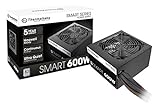
- Top Pick: Thermaltake Smart 600W ATX 12V V2.3/EPS 12V 80 Plus Certified Active PFC Power Supply PS-SPD-0600NPCWUS-W
- Best Value: ASUS ROG Strix 1000W Platinum (Fully Modular Power Supply, 80 Plus Platinum Certified, ATX 3.1, Cybenetics Lambda A+, GaN MOSFET, GPU-First Intelligent Voltage Stabilizer, 10-Year Warranty)
- Premium Choice: 850W Fully Modular Power Supply, 80+ Gold Certified PSU | ATX 3.1 & PCIe 5.1 Ready | 12V-2×6 Connector | 140mm Low-Noise Fan | 105℃ Japanese Capacitors | Black PSU
The power supply (PSU) is the quiet hero of a gaming PC — it feeds every component and shields them from electrical trouble. A quality unit means stable, efficient delivery and long life. By 2026, ATX 3.1 PSUs with native PCIe 5.1 (12V-2×6) connectors are essential for modern RTX 5000 GPUs. Here are the best gaming power supplies, plus how to size and choose one for your build.
- Best Gaming Power Supplies of 2026
- Power Supply Comparison Table
- Best Overall: Corsair RM850x (2026)
- Best High-Wattage: Corsair HX1000i
- Best Quiet PSU: be quiet! Straight Power 12
- How Much Wattage Do You Need?
- Why Transient Spikes Make Headroom Essential
- Fully Modular vs Semi-Modular vs Non-Modular
- Why ATX 3.1 and PCIe 5.1 Matter
- Efficiency Ratings Explained
- Frequently Asked Questions
- Related Articles
- Related Guides
🛒 Best Price Today on Amazon
Prime members get fast, free shipping on everything above, plus member-only deals. New members get a 30-day free trial — cancel anytime.
As an Amazon Associate we earn from qualifying purchases at no extra cost to you.


Best Gaming Power Supplies of 2026
Power Supply Comparison Table
| PSU | Wattage | Efficiency | Standard | Price |
|---|---|---|---|---|
| Corsair RM850x (2024) | 850W | 80+ Gold | ATX 3.1 | ~$140 |
| Corsair HX1000i | 1000W | 80+ Platinum | ATX 3.1 | ~$220 |
| be quiet! Straight Power 12 | 850W | 80+ Platinum | ATX 3.1 | ~$160 |
| Corsair SF750 | 750W | 80+ Platinum | SFX (ATX 3.0) | ~$160 |
| Seasonic Focus GX-1000 | 1000W | 80+ Gold | ATX 3.1 | ~$180 |
Best Overall: Corsair RM850x (2026)
The Corsair RM850x is the best PSU for most builds. With 850W of fully modular, 80+ Gold power, ATX 3.1 compliance, and a native 12V-2×6 connector for RTX 5000 GPUs, it covers everything a modern rig needs. The quiet fan, excellent build, and 10-year warranty make it a reliable, no-worry choice. Its zero-RPM fan mode keeps it silent under light loads, and the fully modular cabling means you only install the leads your build actually uses — a big help for clean cable management.
Best High-Wattage: Corsair HX1000i
For high-end builds running an RTX 5090, or anyone who wants maximum headroom, the Corsair HX1000i delivers 1000W of 80+ Platinum power with digital monitoring through Corsair iCUE. Premium components, near-silent running, and the muscle to feed the most demanding builds make it the pick for flagship systems. The iCUE software lets you watch real-time power draw, efficiency, and temperatures per rail — useful for enthusiasts pushing overclocks or planning future GPU upgrades.
Best Quiet PSU: be quiet! Straight Power 12
True to the name, the be quiet! Straight Power 12 runs near-silent with 80+ Platinum efficiency and ATX 3.1 compliance. High-quality components and excellent voltage regulation make it ideal for silent builds where noise is the priority. Its low-noise fan and tight voltage regulation also make it a great match for small, quiet living-room or studio PCs where every decibel counts.
How Much Wattage Do You Need?
Match your PSU wattage to your components with headroom:
- RTX 5060 Ti / RX 9060 builds: 650W is sufficient
- RTX 5070 Ti / RX 9070 XT builds: 750-850W recommended
- RTX 5080 builds: 850-1000W recommended
- RTX 5090 builds: 1000W+ recommended for safe headroom
It’s smart to leave 20-30% headroom over your system’s peak draw for efficiency, longevity, and future upgrades.
Why Transient Spikes Make Headroom Essential
Modern GPUs don’t draw power smoothly — RTX 5000 and RX 9000 cards produce brief transient spikes that can momentarily hit two to three times their rated draw for milliseconds at a time. A PSU sized too tightly to the average load can trip its protection circuitry during these spikes, causing sudden shutdowns or reboots mid-game even though the “average” numbers looked fine. This is exactly why the 20-30% headroom guidance matters, and why ATX 3.1 units — which are specifically rated to ride out these transients — are the safe choice for the latest GPUs. When in doubt, sizing up one wattage tier costs little and buys real stability.
Fully Modular vs Semi-Modular vs Non-Modular
PSU cabling comes in three styles. Fully modular units let you detach every cable, so you install only what your build needs — the cleanest option and the easiest for cable management, which also improves airflow. Semi-modular units hard-wire the essential 24-pin and CPU cables while leaving peripheral leads detachable, a sensible middle ground at a lower price. Non-modular units have all cables permanently attached, which is cheapest but leaves unused cables to tuck away. For most gaming builds a fully or semi-modular unit is worth the small premium, especially in compact cases where spare cable bulk is a real problem.
Why ATX 3.1 and PCIe 5.1 Matter
Modern RTX 5000 GPUs use the 12V-2×6 connector (an improved take on 12VHPWR). An ATX 3.1 PSU with a native 12V-2×6 cable delivers clean, safe power and absorbs the transient spikes these GPUs produce. Going ATX 3.1 spares you messy adapter cables and improves reliability with the latest GPUs.
Efficiency Ratings Explained
80 PLUS ratings track efficiency: Gold (87-90%) is the sweet spot for most builds, balancing cost and efficiency. Platinum (90-92%) brings better efficiency and often quieter running for premium builds. Higher efficiency means less wasted power, less heat, and lower electricity bills over time.
Frequently Asked Questions
How many watts does my gaming PC need?
Size the PSU to your GPU and CPU with headroom for efficiency and future upgrades. Mainstream gaming builds do well with 650 to 750 watts, while high-end GPUs may call for 850 watts or more. Use an online PSU calculator or the GPU maker’s recommendation. Buying moderately above your calculated draw improves efficiency and leaves room for a future graphics card upgrade.
What does the 80 Plus rating mean?
The 80 Plus rating, from Bronze up through Gold, Platinum, and Titanium, measures power efficiency, meaning how much wall power reaches your components versus lost as heat. Higher tiers waste less energy and often run cooler and quieter. Gold is the popular value sweet spot for gaming. A higher rating costs more upfront but saves electricity and typically indicates better build quality.
Should I get a modular power supply?
Fully modular PSUs let you attach only the cables you need, greatly improving cable management, airflow, and looks. Semi-modular units hardwire essential cables and detach the rest. Non-modular include all cables permanently, cluttering the case. For most builds, especially in glass cases, a fully or semi-modular PSU is worth the modest premium for a cleaner, easier build.
What is the new 12VHPWR or 12V-2×6 connector?
Modern high-end GPUs use a 16-pin 12VHPWR or updated 12V-2×6 connector to deliver lots of power over one cable. Newer ATX 3.0 and 3.1 power supplies include this connector natively and handle GPU power spikes better. If you plan a high-end graphics card, choosing an ATX 3.x PSU with the native connector avoids adapters and ensures reliable, safe power delivery.
Why should I not cheap out on a power supply?
The PSU feeds every component, and a low-quality unit can deliver unstable power, run inefficiently, or in worst cases fail and damage other parts. A reliable PSU from a reputable brand protects your investment with clean power and safety features like over-voltage protection. Since a good PSU lasts through multiple builds, it is one component where spending a bit more truly pays off.
Ready to decide? Our #1 pick for 2026 is the Corsair RM850x (2024).
Live price & availability on Amazon.
Top picks from this guide
 ARESGAMEARESGAME AGV Series 500W Power Supply, 80 Plus Bronze Certified,…$38 \xc2\xb7 97/100
 SKYLZOR850W Fully Modular Power Supply, 80+ Gold Certified PSU |…$70 \xc2\xb7 95/100
 RjmubaiusROG Thor PSU Power Cord Compatible for Thermaltake Smart,ARESGAME AGV…$10 \xc2\xb7 95/100
 ASUSASUS ROG Strix 1000W Platinum (Fully Modular Power Supply, 80…$215 \xc2\xb7 94/100