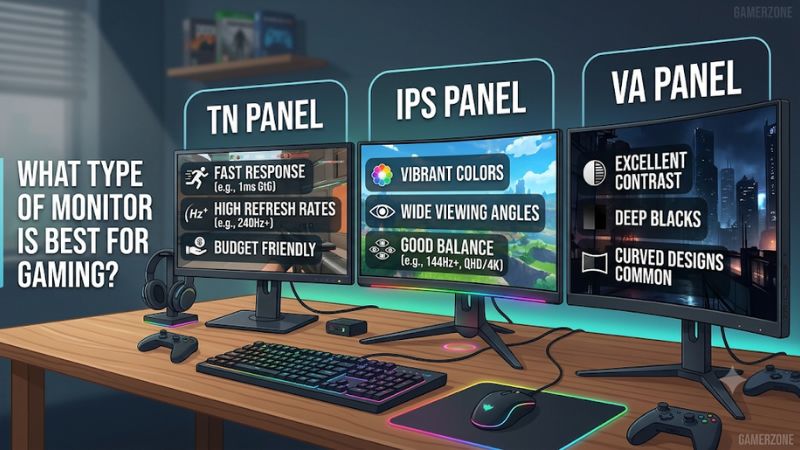
Choosing the right gaming monitor starts with understanding how different display technologies affect image quality, motion clarity, contrast and responsiveness. OLED generally delivers the best picture quality, IPS offers the most versatile experience, VA provides stronger LCD contrast, and TN remains a specialist option for competitive players. If you are wondering what type of monitor is best for gaming, the answer depends on the games you play, your graphics card, your room lighting and how much you want to spend. This guide compares the major monitor types and seven representative models to help you make a practical decision.
- What type of monitor is best for gaming overall?
- Understanding the different types of gaming monitors
- Seven gaming monitors that represent different display technologies
- How to choose what type of monitor is best for gaming
- FAQs about gaming monitor types
- Final verdict: Which gaming monitor type should you choose?
What type of monitor is best for gaming overall?
OLED is generally the best monitor technology for gamers who prioritize picture quality, contrast and fast pixel response. Its self-emissive pixels can switch off individually, producing genuinely deep blacks without the backlight halos associated with LCD displays. It also delivers exceptionally fast pixel transitions, helping moving objects remain sharp.
However, OLED is not automatically the best purchase for every gaming setup. Its potential for permanent image retention, brightness behavior in well-lit rooms and higher purchase cost make IPS or Mini LED LCD alternatives worth considering.
For most mainstream gaming desktops, a good 1440p IPS monitor remains a sensible all-round choice. It can deliver high refresh rates, consistent viewing angles and practical desktop usability without OLED-specific burn-in concerns.
VA is attractive when deeper blacks and stronger native contrast matter more than the widest viewing angles. Mini LED improves LCD HDR performance by using more precisely controlled backlighting, although results depend heavily on local-dimming quality.
Here is the practical breakdown:
| Monitor type | Best application | Main strength | Main compromise |
|---|---|---|---|
| QD-OLED | Premium gaming and HDR | Vivid colors and deep blacks | Raised blacks in bright rooms |
| WOLED | Immersive gaming | Excellent contrast and motion | Burn-in risk |
| Fast IPS | Competitive and everyday gaming | Refresh rate and versatility | Weaker native contrast |
| VA | Darker scenes and value gaming | Strong native LCD contrast | Potential dark smearing |
| Mini LED LCD | Bright HDR gaming | High brightness and local dimming | Blooming and backlight complexity |
| TN | Specialized esports | Extremely high refresh rates | Weaker image quality |
The right technology should complement the way you use your PC instead of forcing you to pay for specifications that provide little practical benefit.
Understanding the different types of gaming monitors
OLED monitors – Best for image quality and immersive gaming
OLED is the strongest choice when image quality is the main priority. Unlike traditional LCD monitors, OLED panels do not require a separate backlight. Every pixel generates its own light and can turn off completely when displaying black.
This gives OLED an effectively infinite native contrast ratio. Dark environments look more realistic, shadows retain their depth, and bright objects stand out without the halos commonly associated with LCD local dimming.
OLED also has extremely fast pixel transitions. This is especially beneficial in competitive games, where fast camera movements and rapidly moving opponents can otherwise produce distracting motion blur.
There are two common OLED subtypes:
QD-OLED combines quantum dots with blue OLED light sources to produce vivid colors and strong HDR presentation. WOLED uses a different pixel structure and can offer different brightness and reflection characteristics. Newer Tandem OLED generations improve aspects of traditional OLED performance, although individual models still need to be evaluated separately.
The biggest disadvantage is burn-in risk. Repeatedly displaying static elements, such as desktop toolbars, taskbars and game interfaces, can contribute to permanent image retention over time. Modern protection features help reduce this risk but cannot eliminate it.
OLED is best for people who spend significant time gaming and watching HDR content, particularly in controlled lighting conditions. It is less attractive for users who leave the same productivity applications open throughout an entire working day.
IPS monitors – Best for balanced gaming and productivity
IPS is a type of liquid crystal display that uses a backlight. It does not produce the same pixel-level black control as OLED, but it offers a useful combination of viewing angles, color reproduction and general usability.
One of its biggest advantages is versatility. IPS monitors are suitable for competitive gaming, everyday computing, streaming and productivity. The image generally remains consistent when viewed from different positions, making them useful for shared desks and multi-monitor setups.
Fast IPS implementations also provide high refresh rates and responsive pixel transitions. Some models reach 240Hz, 360Hz or even higher at native resolutions.
The limitation is contrast. Conventional IPS panels typically display blacks as dark gray, particularly in dim rooms. This can make dark scenes look less immersive than they do on OLED or VA displays.
IPS is also available with Mini LED backlighting. This improves the HDR experience by controlling multiple zones of illumination independently. It does not turn IPS into OLED, but it can significantly improve perceived contrast.
For gamers who also use their displays for work, IPS is often the safest choice. It avoids OLED-specific burn-in concerns while providing sufficient motion performance for most modern games.
VA monitors – Best for native contrast and darker environments
VA stands for vertical alignment. Like IPS, it is an LCD technology that relies on a backlight, but its liquid crystal arrangement generally allows it to achieve stronger native contrast.
This makes VA attractive for atmospheric games, nighttime scenes and cinematic content. Dark areas typically appear deeper than they do on conventional IPS monitors, even without local dimming.
VA is also common in curved gaming monitors. A curved 32-inch or ultrawide screen can create a more immersive viewing experience, particularly when sitting relatively close to the display.
However, VA panels have a significant potential weakness: dark-pixel transitions. Some models exhibit black smearing, where dark objects leave visible trails during movement. This can make fast competitive games look less clear.
Not every VA monitor suffers from the same problem. Modern high-refresh VA implementations can deliver good response performance, so independent testing is important.
VA is a good choice for gamers who prioritize contrast, prefer curved displays and want LCD technology without OLED’s burn-in concerns. It is less suitable when extremely clean motion across dark scenes is essential.
TN monitors – Best for specialized esports performance
TN, or twisted nematic, is an older LCD panel technology that became popular because of its ability to support very high refresh rates and fast response transitions.
It remains relevant in a narrow gaming category: professional-style competitive shooters. Some specialized TN displays combine refresh rates of 500Hz or higher with backlight-strobing technologies designed to improve motion clarity.
The trade-off is considerable. TN generally has weaker viewing angles, less impressive colors and lower overall image quality than modern IPS and OLED alternatives.
For cinematic games, photo editing or general entertainment, an IPS or OLED display is usually more attractive.
TN therefore makes sense only when competitive performance matters substantially more than image quality. Most mainstream gamers should not choose it simply because the advertised refresh rate is impressive.
Mini LED monitors – Best for bright HDR gaming
Mini LED is not a separate LCD panel type. It is a backlighting technology that can be combined with IPS or VA panels.
Traditional LCD monitors use a backlight to illuminate the display. Mini LED uses many smaller light sources divided into independently controlled dimming zones. This allows the screen to produce brighter highlights while reducing illumination in darker areas.
The result can be significantly better HDR performance than conventional edge-lit LCD displays.
However, Mini LED does not provide individual pixel illumination. A bright object against a black background can still create a visible halo because the backlight controls zones rather than individual pixels. This effect is commonly called blooming.
The quality of Mini LED performance depends on more than the number of dimming zones. Processing, zone distribution, algorithms and panel characteristics all influence the final image.
Mini LED is particularly attractive for gamers who want high brightness, HDR effects and LCD ownership characteristics without buying OLED.
Seven gaming monitors that represent different display technologies
ASUS ROG Swift OLED PG32UCDM Gen3 – Best premium OLED
Specifications: 32-inch, 3840 × 2160, fourth-generation QD-OLED, 240Hz.
The ASUS ROG Swift OLED PG32UCDM Gen3 is a strong example of why OLED is so attractive for premium gaming. Its 32-inch 4K panel combines high pixel density, deep blacks, vivid colors and a 240Hz refresh rate.
It is suitable for demanding single-player games, competitive titles and HDR entertainment. The high refresh rate provides responsive motion, while the 4K resolution gives detailed environments and sharp interface elements.
Its DisplayPort 2.1 and HDMI 2.1 connectivity also make it suitable for modern gaming hardware. The main drawback is its premium positioning and the usual OLED ownership considerations.
RTINGS identifies it as its leading OLED gaming monitor, highlighting its image quality and near-instantaneous pixel response.
Buy if you want premium image quality and have a graphics card capable of taking advantage of 4K gaming. Skip if you prefer an affordable LCD or use your monitor primarily for static productivity work.
ASUS ROG Swift OLED PG34WCDN – Best ultrawide OLED
Specifications: 34-inch, 3440 × 1440, fifth-generation QD-OLED, 360Hz.
The ASUS ROG Swift OLED PG34WCDN combines OLED contrast with a 21:9 ultrawide format. Its additional horizontal screen space is particularly attractive for racing simulations, flight games, open-world adventures and immersive single-player titles.
Its 360Hz refresh rate is unusually high for an ultrawide OLED monitor, giving competitive players additional flexibility. The fifth-generation QD-OLED panel also introduces an RGB Stripe subpixel layout designed to improve text clarity compared with older subpixel arrangements.
Connectivity includes DisplayPort 2.1, HDMI and USB-C with 90W power delivery. However, its premium pricing and physical size make it a specialized purchase.
RTINGS reports excellent motion performance and improved text clarity, although black levels can still rise in brightly lit environments.
Buy if you want an immersive ultrawide gaming experience. Skip if your favorite games do not support 21:9 properly or your desk cannot accommodate a 34-inch curved display.
Acer Nitro XV273U F5 – Best high-refresh IPS monitor
Specifications: 27-inch, 2560 × 1440, IPS, 540Hz native.
The Acer Nitro XV273U F5 demonstrates how far modern IPS gaming monitors have developed. Its native QHD resolution and 540Hz refresh rate make it a specialist option for competitive players who want extremely fast motion without sacrificing 1440p resolution.
Acer also advertises a 1,000Hz mode, but that requires switching down to 1280 × 720. It is important to distinguish this lower-resolution mode from the monitor’s native 540Hz QHD operation.
Its IPS panel provides practical viewing angles and a more versatile desktop experience than a comparable TN esports monitor.
The biggest limitation is the hardware requirement. Few gaming PCs can maintain 540 FPS in demanding titles, so this monitor is most useful for competitive games that are relatively easy to render.
Tom’s Hardware’s independent review highlights its high refresh rate and motion performance, while identifying the price and limited HDR contrast as disadvantages.
Buy if you are a dedicated esports player with high-end gaming hardware. Skip if you primarily play cinematic games or want the best image quality for your money.
ASUS ROG Strix XG27ACS – Best versatile IPS monitor
Specifications: 27-inch, 2560 × 1440, Fast IPS, 180Hz.
The ASUS ROG Strix XG27ACS is a more practical example of the IPS category. Its QHD resolution, 180Hz refresh rate and VRR support make it suitable for general gaming without requiring an enthusiast-level graphics card.
Its IPS panel offers wide viewing angles, while the relatively compact screen size works well on most gaming desks.
ASUS includes DisplayPort 1.4, HDMI 2.0 and USB-C with DisplayPort Alt Mode. The USB-C connection provides only 7.5W of power delivery, so it should not be treated as a full laptop charging solution.
RTINGS found good motion handling and low input lag. However, its low contrast ratio and lack of meaningful local dimming limit HDR performance.
Buy if you want a balanced IPS monitor for gaming and everyday computing. Skip if deep blacks or particularly strong HDR effects are important.
LG UltraGear evo 27GM950B-B – Best Mini LED IPS monitor
Specifications: 27-inch, 5120 × 2880 native, IPS LCD, Mini LED, 165Hz at 5K or 330Hz at QHD.
The LG UltraGear evo 27GM950B-B is an advanced example of what Mini LED can achieve when combined with an IPS panel.
Its native 5K resolution provides very sharp image detail, while its dual-mode feature allows users to switch to QHD at 330Hz. That makes it suitable for visually demanding games as well as high-frame-rate competitive titles.
LG specifies 2,304 dimming zones and DisplayHDR 1000 certification. The monitor also includes HDMI 2.1 and USB-C connectivity.
RTINGS identifies its effective local dimming and bright HDR presentation as key strengths. However, local dimming can produce halos around small desktop elements, and its highest sustained brightness is limited by the display’s behavior during extended use.
It is a premium choice that combines productivity-oriented resolution with substantial gaming flexibility.
Buy if you want excellent LCD HDR and a dual-mode display. Skip if your PC cannot drive its demanding resolutions or you do not need its specialized features.
AOC Q27G3XMN – Best VA Mini LED for contrast
Specifications: 27-inch, 2560 × 1440, VA, Mini LED, up to 180Hz.
The AOC Q27G3XMN is an interesting example of how VA and Mini LED can work together. Its VA panel provides stronger native contrast than conventional IPS displays, while the Mini LED backlight improves dark-scene presentation and HDR highlights.
Its QHD resolution and 180Hz maximum refresh rate make it suitable for mainstream PC gaming.
RTINGS identifies its effective local dimming, strong brightness and low input lag as advantages. However, dark smearing can still appear in fast-moving scenes, and variable refresh rate flicker can become distracting when frame rates fluctuate.
The model also lacks HDMI 2.1 bandwidth, making it less suitable for users who want the full capabilities of modern high-refresh consoles.
Buy if you want contrast and HDR performance without OLED pricing. Skip if your primary concern is clean motion in fast competitive shooters.
BenQ ZOWIE XL2586X – Best specialized TN esports monitor
Specifications: 24.1-inch, 1920 × 1080, TN, 540Hz.
The BenQ ZOWIE XL2586X represents the specialized TN category. Its 540Hz refresh rate and DyAc 2 backlight-strobing technology target competitive FPS players who prioritize motion clarity over visual detail.
The relatively small 24.1-inch display also suits players who prefer to keep the entire screen within a compact field of view.
RTINGS found exceptionally fast motion at the maximum refresh rate and low input lag in its appropriate operating modes. However, image quality is limited by its TN panel, and it does not support HDR.
This is a highly specialized product rather than a sensible recommendation for general gaming.
Buy if you play competitive shooters seriously and can generate extremely high frame rates. Skip if you want cinematic visuals, 1440p resolution or an all-purpose gaming monitor.
How to choose what type of monitor is best for gaming
Match panel technology with the games you play
Different gaming genres place different demands on a monitor.
For competitive shooters, high refresh rates and fast response behavior are important. Fast IPS and specialized TN displays are suitable choices, while OLED offers an attractive combination of motion and image quality.
For story-driven games, RPGs and cinematic adventures, OLED is particularly appealing because deep blacks and strong contrast can make environments look more immersive.
For racing and flight simulations, curved ultrawide monitors can provide a wider field of view. The screen format matters alongside panel technology, so compare supported aspect ratios and game compatibility.
For strategy games and mixed productivity, IPS is often a safer choice because of its viewing angles, consistent image and lack of OLED-specific burn-in concerns.
Choose the right resolution and refresh rate
A monitor’s native resolution determines the number of pixels it displays. Higher resolutions produce sharper images but increase GPU workload.
| Resolution | Suitable screen size | Typical gaming application |
|---|---|---|
| 1920 × 1080 | 24–25 inches | Competitive and budget gaming |
| 2560 × 1440 | 27 inches | Balanced gaming |
| 3440 × 1440 | 34 inches | Ultrawide immersion |
| 3840 × 2160 | 27–32 inches | Premium detailed gaming |
Refresh rate should also reflect what your PC can produce. A 240Hz monitor is not necessarily useful when your graphics card consistently delivers only 70 FPS in your favorite games.
For most buyers, a good 144Hz, 165Hz or 180Hz display is already a substantial upgrade from a traditional 60Hz monitor.
Consider HDR and room brightness
HDR performance depends on more than whether the monitor accepts an HDR signal.
OLED provides excellent pixel-level contrast, while Mini LED can achieve strong brightness and improved LCD contrast through local dimming.
Conventional IPS displays often have weaker HDR performance because they cannot control their backlight precisely. VA monitors may offer stronger native contrast, although black smearing and local-dimming quality vary by model.
Your room also matters. QD-OLED can show raised black levels under bright ambient lighting, while certain IPS and VA monitors can maintain more consistent visibility.
For a brightly lit room, check measured SDR brightness and reflection handling rather than relying only on advertised peak HDR brightness.
Check response time, VRR and input lag
These specifications influence how responsive a gaming display feels.
Response time measures how quickly pixels change color. Input lag describes the delay before the display shows a received signal. Refresh rate determines how frequently the screen can update.
VRR technologies such as NVIDIA G-SYNC and AMD FreeSync synchronize the monitor with the graphics card to reduce screen tearing.
Check the supported VRR range and whether the monitor exhibits flickering during fluctuating frame rates. Also be careful with overdrive settings, as excessive overdrive can produce inverse ghosting.
Consider long-term ownership
OLED buyers should check burn-in protection, screen-cleaning features and the exact US warranty. These details vary across manufacturers and individual models.
LCD buyers should examine backlight uniformity, dead-pixel policies and local-dimming behavior where applicable.
Monitor size and ergonomics are also important. A 27-inch display is generally easier to accommodate than a 34-inch ultrawide or 49-inch super ultrawide model.
Do not spend extra on an extreme refresh rate, dual-mode operation or advanced USB connectivity unless those features solve a real problem in your gaming setup.
FAQs about gaming monitor types
Is OLED or IPS better for gaming?
OLED generally provides better contrast, deeper blacks and faster pixel transitions. IPS is more versatile for bright rooms, everyday desktop use and users concerned about OLED burn-in.
Is VA better than IPS for gaming?
VA typically offers stronger native contrast and deeper blacks, while IPS provides wider viewing angles and often cleaner dark-scene motion. The specific model matters more than the technology label alone.
Is Mini LED better than OLED?
Mini LED can achieve higher sustained brightness and does not have OLED-specific burn-in concerns. OLED provides more precise pixel-level black control and avoids local-dimming blooming.
Is a curved monitor better for gaming?
Curved displays can improve immersion, especially on large ultrawide screens. However, curvature does not automatically improve refresh rate, response time or image quality.
Should I buy a 4K or 1440p gaming monitor?
Choose 1440p when you want high frame rates with a more manageable graphics workload. Choose 4K when you prioritize fine image detail and have a GPU powerful enough to support the resolution.
Is TN still worth buying for gaming?
TN remains relevant for a small group of competitive players who prioritize extreme refresh rates and motion clarity. For most users, modern IPS and OLED monitors offer a better balance.
Final verdict: Which gaming monitor type should you choose?
OLED is generally the best choice for gamers who want the strongest combination of contrast, color and motion quality. The ASUS ROG Swift OLED PG32UCDM Gen3 demonstrates the advantages of premium QD-OLED, while the ASUS PG34WCDN offers a more immersive ultrawide alternative.
IPS is the most versatile option for many mainstream gaming setups. The Acer Nitro XV273U F5 shows how far high-refresh IPS has advanced, while the ASUS ROG Strix XG27ACS is a more practical option for everyday use.
VA and Mini LED deserve consideration when you want stronger LCD contrast and HDR brightness. The AOC Q27G3XMN provides a useful combination of both technologies, while LG’s 27GM950B-B illustrates what a premium Mini LED IPS display can achieve.
TN is best reserved for specialized esports use.
Ultimately, there is no universal winner for every gamer. Choose OLED for picture quality, IPS for versatility, VA for native LCD contrast, Mini LED for brighter HDR and TN for specialized competitive performance. Your graphics card, gaming preferences and room conditions should determine the final purchase.