- Top Pick: ZWXYVUT X9 Retro Handheld Game Console-Handheld Game console with HD 5.5-inch IPS Screen Classic Video Games Supports TV Connection,10+ Emulators & 5-Hour Battery Life
- Best Value: Retro Handheld Game Console,Portable Game with 3.5 Inch IPS Screen,with 64G TF Card Pre-Installed 4353 Games Supports 5G WiFi Bluetooth HDMI and TV Output 35XXPRO
- Premium Choice: RG VITA Handheld Game Console, Android 12 Retro Gaming Console with 5.46 Inches IPS Touch Screen, 3GB+64GB, Portable Game Console Support Multi-Emulator and WiFi 5 Bluetooth 5.0 (Black)
Emulation handhelds have exploded in variety heading into 2026, and picking the right one now means weighing screen quality, chip power, and just how deep you want to dive into retro libraries. Whether you are chasing crisp 16-bit sprites or pushing into PS2 and GameCube territory, there is a pocket console built for the era you love most.
- Watch: Best Emulation Handheld 2026 — Video Review
- How to Choose an Emulation Handheld
- The Best Emulation Handhelds of 2026
- What to Look For in an Emulation Handheld
- Which One Should You Buy?
- Common Mistakes When Buying an Emulation Handheld
- Setup Tips for the First Evening
- Matching Your Game Library to the Hardware
- Controls and Comfort Considerations
- Frequently Asked Questions
- Final Thoughts
- Related Articles
This roundup cuts through the sea of near-identical listings to highlight the devices actually worth your money in 2026. We looked at display type, emulator range, battery life, and how comfortable each unit feels during a long session, so you can buy once and play for years.
As an Amazon Associate we earn from qualifying purchases at no extra cost to you.




⚡ Save on Your Next PC — Amazon Prime
Prime members get fast free shipping on the systems above, plus early access to Prime Day & Black Friday PC deals. New members get a 30-day free trial.
Watch: Best Emulation Handheld 2026 — Video Review
How to Choose an Emulation Handheld
- Screen type: Prioritize an IPS or OLED panel over cheaper TN screens for accurate colors and wide viewing angles, especially for vertical arcade titles.
- Emulation ceiling: Simple Linux units nail everything up to PSP, while Android devices with more RAM reach into Dreamcast, PS2, and light GameCube play.
- Battery life: Look for at least a 4000mAh cell if you want multi-hour sessions away from a charger; smaller units trade endurance for pocketability.
- Storage and games: Pre-loaded TF cards are convenient, but a microSD slot that accepts your own legally dumped ROMs matters far more long term.
- Controls and ergonomics: Hall-effect sticks, clicky shoulder buttons, and a grip that fits your hands prevent fatigue and stick drift down the road.
The Best Emulation Handhelds of 2026
RG VITA
The RG VITA is the standout for enthusiasts, pairing a generous 5.46-inch IPS touch screen with Android 12 and 3GB of RAM. That combination lets it handle demanding Dreamcast and PSP libraries smoothly while WiFi 5 and Bluetooth 5.0 open the door to streaming and wireless controllers.
XF45V
With a 4.5-inch IPS HD display, a 4000mAh battery, and support for over 30 emulators, the XF45V is a superb open-source Linux pick. Its 20,000-plus pre-installed classic games make it a genuine grab-and-go machine for retro fans who want zero setup.
Rhesusco RG56PRO
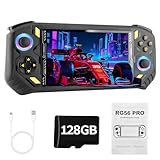
This 5.5-inch IPS unit leans on an open Linux system and a beefy 5000mAh battery, so it lasts through marathon sessions. With a huge bundled library and a 128GB card, it is a thoughtful gift-grade device that still satisfies serious tinkerers.
35XXPRO
The compact 35XXPRO packs a 3.5-inch IPS screen into a truly pocketable shell, then backs it with 5G WiFi, Bluetooth, and HDMI output for big-screen play. Its 64GB card arrives loaded with thousands of titles, making it a fantastic starter handheld.
MVMOD XF40V
For purists who love a snappy 4:3 panel, the MVMOD XF40V offers a 4.0-inch 4K-class IPS screen and a clean open-source Linux build with 18,000-plus games. It is a tidy, no-nonsense option focused squarely on 8-bit through PSP-era enjoyment.
What to Look For in an Emulation Handheld
Most models in this class look alike, so the decision comes down to chip class, screen shape, and how much software support surrounds the device.
Chip Class Decides Which Consoles Run Well
The processor sets the ceiling on what you can emulate. Sources broadly agree on three tiers, although the details at the low end vary between reviewers.
| Chip class | Typically handles | Typically struggles with |
|---|---|---|
| Allwinner H700 and Rockchip RK3566 | 8-bit and 16-bit systems, PS1, N64, many Dreamcast and PSP titles | PS2 and GameCube |
| Unisoc T618 | N64, Dreamcast, most of PSP, lighter PS2 and GameCube games | Demanding GameCube and PS2 titles |
| Snapdragon 865 class | Most of the PS2 and GameCube libraries at full speed | Many Switch titles |
| Snapdragon 8 Gen 2 and newer | Playable Switch emulation | Heavier Switch games still vary |
The RG VITA in this list uses the Unisoc T618, an octa-core chip with two Cortex-A75 and six Cortex-A55 cores, 3 GB of memory, and a 5.46-inch 1280 x 720 screen. Reviewers describe its Android emulation support as the most thorough of its class, and place it at the lighter end of GameCube territory rather than comfortably inside it.
Screen Shape and Scaling
Classic consoles output in 4:3 or similar shapes, so a 4:3 screen fills the display without borders. Widescreen panels leave black bars on retro games unless you stretch the image, which distorts pixels. Integer scaling matters for crisp pixel art, and a 720-line panel does not divide evenly into the native resolution of some PSP and Vita games, so those can look slightly soft. Small 3.5-inch screens at 640 x 480 are well matched to 8-bit and 16-bit libraries, but too small for comfortable PSP play.
Operating System: Android or Linux
Android devices run a wider range of emulators and handle PSP, Dreamcast, and PS2 more flexibly, and they can also install streaming and store apps. Linux-based handhelds boot quickly, use less memory, and offer simple front-end menus, but support only the emulators bundled in their firmware or community builds. Pick Android if you want to experiment, and Linux if you want a console-like experience with minimal setup.
Battery, Storage, and Ergonomics
A 5000 mAh battery is typical of larger Android models, while compact vertical devices use smaller cells, often around 3000 mAh. Look for microSD slots, since ROM collections grow quickly. Analog sticks with Hall-effect sensors resist drift better than potentiometer sticks, and a gyroscope helps in a few games. Weight matters over long sessions, because devices near 270 g become tiring in one hand.
Which One Should You Buy?
| If you… | Choose… |
|---|---|
| want a larger 720p Android screen and a chip with broad emulator support | RG VITA |
| want a very small pocket device for 8-bit and 16-bit games | 35XXPRO |
| are comparing lesser-known models | whichever of XF45V, Rhesusco RG56PRO, or MVMOD XF40V openly lists its chip, RAM, and screen resolution |
Common Mistakes When Buying an Emulation Handheld
- Buying for a console the chip cannot run. Match the chip class in the table above to the most demanding system you want, then add a margin.
- Trusting listing claims of thousands of preloaded games. Preloaded libraries often have legal problems and are commonly full of duplicates. Emulators themselves are generally legal, while distributing copyrighted game files is not, so the lawful route is to dump games you own.
- Ignoring the screen ratio. A 16:9 panel looks great for Android games but wastes space on 4:3 retro titles.
- Assuming all handhelds with the same chip perform the same. Thermals, memory amount, and firmware tuning change real-world results.
- Overlooking storage and cards. Low-quality microSD cards cause stutter and corrupted saves, so use a reputable brand and keep backups of saves.
Setup Tips for the First Evening
- Update the firmware or launcher first, since early builds often have emulator bugs.
- Test one demanding game per system before filling the card, so you know the real limits.
- Set shader and resolution options per emulator rather than globally.
- Back up the save folder to a computer once a week.
Matching Your Game Library to the Hardware
| Library focus | Native screen shape | What to check |
|---|---|---|
| 8-bit and 16-bit consoles | Close to 4:3 | A 4:3 screen and responsive D-pad |
| Game Boy Advance | 3:2 | A wider screen with minimal borders |
| PS1, N64, Dreamcast | 4:3 | Enough chip power for 3D, and a good analog stick |
| PSP | 16:9 | A widescreen panel and a comfortable grip |
| PS2 and GameCube | 4:3 or 16:9 | A strong chip, good cooling, and adequate memory |
Collectors who focus on one era can buy a lower-tier device and be content. Players who want one device for every era need to pay for the chip tier, because the demanding systems set the requirement for everything else.
Controls and Comfort Considerations
Button layout matters as much as chip power for long sessions. Look for a proper D-pad for platformers and fighting games, since poor pads cause missed diagonals. Shoulder triggers are required for many PS1, PSP, and GameCube games, and a missing second set of triggers limits what you can play. Hall-effect analog sticks are less prone to drift than older potentiometer designs. Finally, consider thermals: devices that run hot during PS2 emulation become uncomfortable to hold, so fans and vents are worth noticing. Speakers and headphone output also deserve a glance, since a weak, tinny speaker spoils soundtrack-heavy classics, and a dedicated 3.5 mm jack avoids the need for adapters.
Frequently Asked Questions
Do I need an Android handheld or is Linux enough?
Linux devices are cheaper and excel through the PSP era. If you want Dreamcast, PS2, or GameCube, choose an Android unit like the RG VITA with more RAM and a faster chip.
Are these handhelds legal to use?
The hardware is perfectly legal. You should only play games you legally own and have dumped yourself; distributing or downloading copyrighted ROMs you do not own is not permitted.
How long do the batteries last?
Expect roughly 4 to 6 hours from units with 4000 to 5000mAh cells, depending on screen brightness and how demanding the emulator is. Simpler 8-bit games extend runtime considerably.
Can I connect these to my TV?
Many models, including the 35XXPRO and units with HDMI output, support TV connection so you can play couch co-op on a big screen with wireless controllers.
Final Thoughts
The best 2026 emulation handheld depends on how far up the console ladder you want to climb. Grab the RG VITA for the widest emulation ceiling, the XF45V for a battery-friendly Linux all-rounder, or the 35XXPRO if pocket-size portability wins. Any of these gets you playing decades of classics within minutes of unboxing.