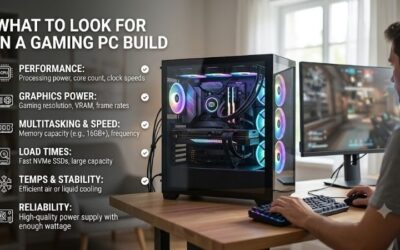
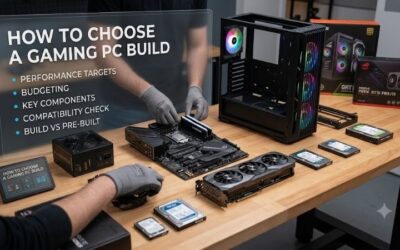
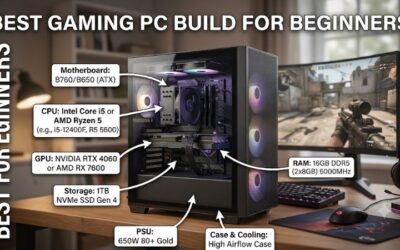
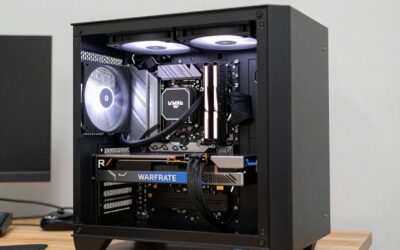
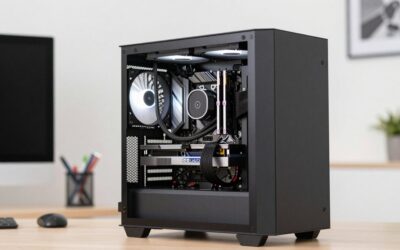
Building the best budget gaming PC in 2026 means targeting smooth 1080p performance at high refresh rates while still being capable at 1440p in most titles. This build pairs AMD’s Zen 5 architecture with NVIDIA’s latest mainstream GPU to deliver a platform that handles competitive esports titles effortlessly and pushes AAA games well past the 60 fps threshold at 1080p. The total parts cost sits at roughly $1,850–$1,900 at October 2026 prices, which positions this as a value-focused mid-range system rather than an ultra-budget entry — but the component selection prioritizes longevity and upgrade flexibility to justify the spend over time.
- Best Budget Gaming PCs in 2026: The Short Answer
- Build at a Glance
- Parts List
- Compatibility Check
- Expected Performance
- Alternative Parts: Cheaper, Stronger and Safer Swaps
- All-AMD Build: Ryzen 5 9600X With Radeon RX 9060 XT 16GB
- Three Ways to Scale This Build
- Cheapest PC Build Possible: Where to Cut First
- Where to Save and Where Not to Cut Corners
- Upgrade Path
- Assembly and First Boot Checklist
- What Else to Budget For
- Monitors That Match This Gaming PC Build
- Build It Yourself or Buy a Prebuilt?
- FAQ
- Sources and Methodology
Updated October 2026 – parts, compatibility limits and price ranges were rechecked against manufacturer pages this month.
Quick answer: For most people in 2026, the best budget gaming pc build 2026 is the CPU — our #1 rated choice. See the full ranked comparison, alternatives and buying advice below.
Best Budget Gaming PCs in 2026: The Short Answer
The best budget gaming PCs in 2026 put most of the money into the graphics card and a 6-core CPU, then save on the case, storage tier and extras. This guide’s top budget build pairs the AMD Ryzen 5 9600X with the GIGABYTE GeForce RTX 5060 WINDFORCE OC 8G on an ASRock B650M PG Lightning WiFi board, for roughly $1,850–$1,900 in parts.
- Top pick, balanced build: Ryzen 5 9600X · RTX 5060 8GB · 32GB DDR5-6000 CL30 · 1TB Gen4 SSD · roughly $1,850–$1,900
- Cheapest version: Ryzen 5 9600X · Intel Arc B580 12GB · 16GB DDR5-6000 CL30 · 1TB Gen4 SSD · roughly $1,250–$1,300
- Best for 1440p: Ryzen 5 9600X · Radeon RX 9060 XT 16GB · 32GB DDR5-6000 CL30 · 2TB Gen4 SSD · roughly $2,000–$2,050
Memory and graphics card prices moved sharply through 2026, so treat these totals as ranges and re-check them the week you order.
Build at a Glance
If you only read one section, read this one. The build below is a balanced 1080p high-refresh machine that also handles 1440p in most games, built on a platform with a real upgrade path.
- Target: 1080p at high settings and high refresh rates, with 1440p as a capable secondary target.
- Platform: AMD AM5 (Ryzen 5 9600X, B650 chipset, DDR5-6000 CL30), which leaves room for later Ryzen drop-in upgrades.
- Graphics: RTX 5060 8GB with DLSS 4, or a 12GB or 16GB alternative covered further down if VRAM matters more to you.
- Total cost: roughly $1,850–$1,900 at current prices including a tower cooler, with memory as the most volatile line item.
- Biggest compromise: 8GB of VRAM at 1440p with maximum textures in the newest titles.
- Cheapest way to cut the bill: drop to a 16GB DDR5-6000 kit, which saves more than any other single change.
Parts List
| Part | Model | Approx. Price | Why |
|---|---|---|---|
| CPU | AMD Ryzen™ 5 9600X 6-Core, 12-Thread Unlocked Desktop Processor | Roughly $170–$190 | Strong single-core clocks at an accessible AM5 price point |
| GPU | GIGABYTE GeForce RTX 5060 WINDFORCE OC 8G | Roughly $450–$480 | 8GB GDDR7 and DLSS 4 make it the clear mainstream performer |
| Motherboard | ASRock B650M PG Lightning WiFi (Micro-ATX) | Roughly $115–$130 | Micro-ATX fit for the Q300L; 6+2+1 power stages, Wi-Fi 6E, 2.5GbE and three M.2 slots |
| RAM | Kingston FURY Beast 32GB (2x16GB) 6000MT/s DDR5 CL30 | Roughly $770–$810 | 32GB with tight timings and EXPO tuning for Ryzen |
| Storage | Crucial P310 1TB SSD, PCIe Gen4 NVMe M.2 2280 | Roughly $165–$180 | Fast sequential reads keep load times minimal |
| PSU | Corsair CX650M (2025), 650 Watt, ATX 3.1, Cybenetics Bronze, semi-modular | Roughly $75–$90 | Ample headroom for this platform, with a native 12V-2×6 cable |
| Case | Cooler Master Q300L V1, High Airflow, Transparent Panel | Roughly $28–$40 | Ventilated front panel and a pre-installed rear fan; takes Micro-ATX boards |
CPU: AMD Ryzen™ 5 9600X
The 9600X delivers 6 cores and 12 threads based on Zen 5, with boost clocks reaching 5.4 GHz. Launch coverage from outlets such as Tom’s Hardware found modest single-thread gains over the prior 7600X at a similar price. It handles modern games without bottlenecking the RTX 5060 and leaves thermal headroom for any AM5 processor AMD ships through the platform’s lifespan. If you want more threads for productivity, the 9700X is the natural swap, though it costs noticeably more without changing gaming outcomes much.

AMD Ryzen™ 5 9600X 6-Core, 12-Thread Unlocked Desktop Processor
Included for 'Best Budget Gaming PC Build 2026: Full Parts List and Expected FPS' as a representative home product in this roundup; selection reflects the product set returned for this topic.
View on AmazonGPU: GIGABYTE GeForce RTX 5060 WINDFORCE OC 8G

GIGABYTE GeForce RTX 5060 WINDFORCE OC 8G Graphics Card, Cooling System, 8GB 128-bit GDDR7, PCIe 5.0, Manufactured by NVIDIA, DisplayPort & HDMI - Video Output Interface, GV-N5060WF2OC-8GD Video Card
Included for 'Best Budget Gaming PC Build 2026: Full Parts List and Expected FPS' because the listing adds cooling or gel-infused layers, which is the attribute this article compares.
View on AmazonThis dual-fan WINDFORCE OC variant clocks slightly above reference and uses a 128-bit GDDR7 bus with 8GB of VRAM. Launch-period benchmarks put it roughly 20-30% ahead of the RTX 4060 in rasterized workloads, with the gap widening under DLSS 4 frame generation. The 8GB buffer is the main limitation to watch at 1440p in the most demanding titles. A swap to a 16GB RTX 5060 Ti would extend viability but adds significant cost beyond a budget target.
Motherboard: ASRock B650M PG Lightning WiFi

ASRock B650M PG Lightning WiFi 6E AMD Ryzen 9000/8000/7000 Series Socket AM5 B650 DDR5 up to 7200+ (OC) MHz 256 GB SATA3 6.0 Gb/s Micro ATX Motherboard M.2 RGB LED BIOS Flashback
Included for 'Best Budget Gaming PC Build 2026: Full Parts List and Expected FPS' as a representative home product in this roundup; selection reflects the product set returned for this topic.
View on AmazonThe B650 chipset provides PCIe 4.0 and DDR5 support on AM5 without the premium of X670 boards. The ASRock B650M PG Lightning WiFi is a Micro-ATX board, which matters because the Cooler Master Q300L V1 case takes Micro-ATX and Mini-ITX boards but not full-size ATX. Its 6+2+1 Dr.MOS power stage design is ample for a 65W Ryzen 5 9600X, and it adds Wi-Fi 6E, 2.5GbE LAN, three M.2 storage slots (one Gen5, two Gen4) and BIOS Flashback, so you do not need a separate wireless adapter. You could step down to an entry-level B650 or A620 board to save a little, but you would give up M.2 slots and some of the power-delivery headroom that matters for future upgrades.
RAM: Kingston FURY Beast 32GB DDR5-6000 CL30

Kingston FURY Beast 32GB (2x16GB) 6000MT/s DDR5 CL30 Desktop Memory | AMD EXPO | Kit of 2 | KF560C30BBEK2-32
Included for 'Best Budget Gaming PC Build 2026: Full Parts List and Expected FPS' as a representative home product in this roundup; selection reflects the product set returned for this topic.
View on AmazonDDR5-6000 CL30 is the sweet spot for Zen 5, as it lets the memory controller run at a 1:1 ratio with the memory clock for low latency. The 32GB capacity ensures you won’t need to upgrade for gaming for several years. EXPO profiles mean one-click tuning in the BIOS. This kit is priced high in the current market; if budget is tight, a 16GB kit at the same speed would save meaningful money for pure gaming, though 32GB is increasingly comfortable for multitasking and future titles.
Storage: Crucial P310 1TB SSD

Crucial P310 1TB SSD, PCIe Gen4 NVMe M.2 2280, Up to 7,100MB/s, for Laptop, Desktop (PC), & Handheld Gaming Consoles, Includes Acronis Data Recovery Software, Solid State Drive - CT1000P310SSD801
Included for 'Best Budget Gaming PC Build 2026: Full Parts List and Expected FPS' as a representative home product in this roundup; selection reflects the product set returned for this topic.
View on AmazonThe P310 delivers up to 7,100 MB/s sequential reads over PCIe Gen4, making it one of the faster drives in this capacity tier. For gaming, the difference between this and a mid-tier Gen4 drive is negligible, but the extra headroom helps with large file transfers and OS responsiveness. No included heatsink, so rely on your motherboard’s M.2 shield. If you need more capacity, a 2TB variant drops into the same slot without any other changes.
PSU: Corsair CX650M (2025)

CORSAIR CX650M (2025) Semi Modular ATX 3.1 PCIe 5.1 Low-Noise 650W Power Supply with 12V-2x6 Cable – Cybenetics Bronze Efficiency, LLC Topology, 105°C Capacitors – Black
Included for 'Best Budget Gaming PC Build 2026: Full Parts List and Expected FPS' as a representative home product in this roundup; selection reflects the product set returned for this topic.
View on Amazon650 watts of Cybenetics Bronze-rated output is generous for a system drawing roughly 250-300 watts under full gaming load. The 2025 CX650M is built to the ATX 3.1 standard and ships with a native 12V-2×6 cable, so it connects to newer graphics cards without an adapter. Corsair describes the CX-M series as using an LLC topology with 105°C capacitors, and the semi-modular cabling lets you leave unused leads out of the Q300L’s tight cable space, though the motherboard and CPU cables stay fixed. It is a budget-tier design that suits this platform but is not ideal for high-end GPUs drawing over 300W. Swapping to a Corsair RM650e for fully modular cables and better transient response is a worthwhile upgrade if the budget allows, and the RM750e covered below adds more headroom still.
Case: Cooler Master Q300L V1
The Q300L V1 is a Micro-ATX tower: it takes Micro-ATX and Mini-ITX boards but not full-size ATX, which is why this build uses a Micro-ATX motherboard. The ventilated front panel and transparent side panel give decent airflow, and a 120mm rear fan comes pre-installed. Cooler Master lists clearance of 159mm for CPU coolers and 360mm for graphics cards, so the WINDFORCE OC fits easily. The build quality is basic for the price, and you may want to add intake fans for better thermals, but for under $40 it delivers exactly what it promises.
Cooler: Thermalright Peerless Assassin 120 SE — Best Value Tower Cooler for This Build

Thermalright Peerless Assassin 120 SE CPU Cooler, 6 Heat Pipes AGHP Technology, Dual 120mm PWM Fans, 1550RPM Speed, for AMD:AM4 AM5/Intel LGA 1700/1150/1151/1200/1851,PC Cooler
Included for 'Best Budget Gaming PC Build 2026: Full Parts List and Expected FPS' as a representative home product in this roundup; selection reflects the product set returned for this topic.
View on AmazonAMD’s specifications list the Ryzen 5 9600X without a bundled thermal solution, so the retail box has no cooler and this tower is a required part of the build rather than an optional upgrade. A dual-tower unit is also one of the best-value parts in the whole build. The Peerless Assassin 120 SE uses six heat pipes, two 120mm PWM fans and mounting hardware for AM4, AM5 and current Intel sockets, so it drops straight onto the B650 board.
On a 6-core Zen 5 chip it keeps boost clocks steady through long gaming sessions and runs noticeably quieter than a small top-down cooler under all-core loads such as shader compilation or video exports. The detail to confirm is height: the cooler stands roughly 155mm tall, and the Q300L’s published CPU cooler clearance is about 159mm, so it fits with little to spare. Standard-height memory like the Kingston kit generally sits clear of the front fan, and the fan clips let you raise it slightly if needed. Expect to pay roughly $30–$40, with thermal paste included in the box.
Pros
- Dual-tower cooling capacity well beyond what a 65W-class chip needs
- AM5 mounting included, quiet at gaming loads
- Low cost relative to the performance and noise benefit
Cons
- Tight fit in the Q300L, so measure before ordering if you change cases
- Large heatsink makes RAM installation easier to do before mounting the cooler
Case Fans: ARCTIC P12 PWM PST 5-Pack — Best Cheap Airflow Upgrade

ARCTIC P12 PWM PST (5 Pack) - PC Fans, 120mm Case Fan, PWM Sharing Technology (PST), Pressure-optimised, Quiet Motor, Computer, 200–1800 RPM (0 RPM <5%) - Black
Included for 'Best Budget Gaming PC Build 2026: Full Parts List and Expected FPS' as a representative home product in this roundup; selection reflects the product set returned for this topic.
View on AmazonThe case section above recommends adding intake fans, because the Q300L ships with only a single rear fan, and a five-pack of ARCTIC P12 PWM PST fans is the most economical way to do that while also filling any empty intake mounts. These are 120mm pressure-optimised fans, which helps when air has to pass through a mesh front panel and dust filter. The fan speed range runs from about 200 to 1,800 RPM, and the fans stop entirely at very low PWM signals, so the system can stay near-silent at idle.
The PST part matters in a budget build. PWM Sharing Technology lets you daisy-chain the fans so that several of them run from a single motherboard fan header, which keeps cabling tidy in a compact case and means every fan follows the same temperature curve. For a balanced setup, run two intakes at the front, one exhaust at the rear and keep the spares for a future case or radiator. Expect to pay roughly $25–$35 for the pack.
Pros
- Five fans for roughly the price of two premium ones
- Daisy-chain design saves motherboard headers and cable clutter
- Zero-RPM mode keeps idle noise very low
Cons
- Plain black design with no lighting
- You may not need all five in a case this size
Compatibility Check
Socket: The 9600X is AM5 and the ASRock B650M PG Lightning WiFi is AM5 — direct match. RAM type: The board requires DDR5 and the Kingston kit is DDR5 6000MT/s, compatible with EXPO. PSU headroom: The RTX 5060 recommends a 550W supply; the 650W CX650M provides about 100W of headroom. GPU length: The GIGABYTE WINDFORCE OC is listed at about 200mm, well within the Q300L’s 360mm limit. Form factor: the ASRock board is Micro-ATX, which the Q300L V1 supports (full ATX boards do not fit). Cooler: the 9600X ships without a cooler, and the 155mm Peerless Assassin 120 SE sits just under the case’s 159mm limit.
Expected Performance
The following figures are approximate ranges based on published launch-period reviews of the RTX 5060, mainly TechSpot, TechPowerUp and Gamers Nexus. They represent typical results and will vary by game, settings, drivers, test scene and system configuration.
1080p
Competitive titles like Counter-Strike 2 and Valorant typically run well above 144 fps at high settings. AAA titles such as Cyberpunk 2077 and Hogwarts Legacy land at roughly 80-110 fps at high/ultra presets without ray tracing; TechSpot measured about 100 fps on average in both. Enabling DLSS Quality adds further headroom. At this resolution the graphics card, rather than the Ryzen 5 9600X, is the limiting part in most AAA games.
1440p
At 1440p high settings, expect roughly 55-80 fps in demanding AAA titles without upscaling, depending on the game and test scene: TechSpot measured Cyberpunk 2077 at about 66 fps on average and Gamers Nexus at about 55 fps. TechPowerUp’s review treats 1080p as the natural resolution for this card and suggests DLSS Balanced or Quality to make 1440p workable in newer games. Esports titles remain well above 150 fps. The 8GB VRAM becomes a watchpoint in the most texture-heavy titles at maximum settings.
4K
4K is beyond this build’s target. The RTX 5060 is an 8GB card aimed at 1080p and 1440p, and reviewers generally treat 4K as impractical for it without aggressive upscaling and lowered settings. DLSS 4 frame generation can raise the displayed frame rate in lighter titles, but it does not remove the VRAM limit. Treat 4K as a stretch scenario rather than a supported use case.
Alternative Parts: Cheaper, Stronger and Safer Swaps
The core parts list is a balanced starting point, not the only correct answer. Prices on graphics cards and memory have moved sharply through 2026, so the right build for you depends on which line items are expensive the week you order. Every swap below drops into the same AM5 platform without changing anything else in the build unless noted.
Intel Arc B580 12GB (Sparkle Titan OC) — Best for More VRAM on a Tighter Budget

Sparkle Intel Arc B580 Titan OC, 12GB GDDR6, Torn Cooling 2.0, Axial Fan, Breathing Light, Metal Backplate, SB580T-12GOC
Included for 'Best Budget Gaming PC Build 2026: Full Parts List and Expected FPS' because the listing adds cooling or gel-infused layers, which is the attribute this article compares.
View on AmazonIf the 8GB buffer on the RTX 5060 is your main worry and you would rather save money than spend more, the Arc B580 is the swap to consider. It carries 12GB of GDDR6 on a 192-bit bus, which gives it more room for high-resolution textures than any 8GB card, and Intel’s XeSS upscaling and frame generation cover a growing list of recent games. The Sparkle Titan OC version adds a factory overclock, a metal backplate and a larger cooler than entry-level models.
In raw frame rates it generally trails the RTX 5060, so treat it as a VRAM-for-speed trade rather than a straight upgrade. Two practical notes: enable Resizable BAR in the BIOS, because Arc cards depend on it, and expect less consistent results in some older DirectX 11 titles. It typically sells for roughly $350–$390.
Pros
- 12GB of VRAM for less than the RTX 5060
- Comfortable headroom for 1440p texture settings
Cons
- Lower average frame rates than the RTX 5060
- Requires Resizable BAR; older games can be uneven
ASUS Dual Radeon RX 9060 XT 16GB — Best for 1440p and Longevity
If you can stretch the budget, this is the most sensible graphics upgrade for this platform. The RX 9060 XT 16GB uses AMD’s RDNA 4 architecture with 16GB of GDDR6, and launch-period benchmarks from the outlets listed in our sources placed it a tier above the RTX 5060 and close to the RTX 5060 Ti 16GB in rasterized games. The 16GB buffer removes the VRAM question at 1440p for the foreseeable future, and RDNA 4 supports FSR 4, AMD’s machine-learning upscaler.
The trade-offs are on the feature side. NVIDIA still leads in heavy ray tracing, and DLSS is supported in more games than FSR 4. The ASUS Dual is a two-fan design; confirm its listed length against the case limit, although cards in this class usually fit the Q300L comfortably. It typically sells for roughly $520–$540, so plan on about $60–$90 more than the RTX 5060.
Pros
- 16GB of VRAM for 1440p at high texture settings
- Faster than the RTX 5060 in most rasterized games
Cons
- Pushes the build well past a budget price point
- Ray tracing and upscaler support trail NVIDIA
AMD Ryzen 5 7600X3D — Best CPU Swap for CPU-Heavy Games

AMD RYZEN 5 7600X3D Raphael AM5 4.1GHZ 6-CORE Boxed Processor - HEATSINK NOT Included
Included for 'Best Budget Gaming PC Build 2026: Full Parts List and Expected FPS' as a representative home product in this roundup; selection reflects the product set returned for this topic.
View on AmazonThe 7600X3D keeps the same 6-core, 12-thread layout and the same AM5 socket, but adds AMD’s stacked 3D V-Cache, which gives it a much larger L3 cache than the 9600X. That extra cache helps most in CPU-bound situations: high-refresh esports play, simulation and strategy games, and large open-world titles that hammer the processor. It also runs at lower clocks, so the 9600X remains slightly better for productivity work.
Be realistic about the pairing. With an RTX 5060 at 1080p and 1440p, most AAA games are limited by the graphics card, so the cache advantage shows up mainly in the CPU-heavy genres above or after a future GPU upgrade. The listing states that no cooler is included, so the Peerless Assassin recommendation still applies. It typically costs roughly $240–$260.
Pros
- Large cache boosts CPU-limited games and high-refresh play
- Same socket, board and memory as the main build
Cons
- Costs more than the 9600X for little gain in GPU-bound games
- Slightly slower in productivity work
KLEVV FIT V 16GB DDR5-6000 CL30 — Best Way to Cut the Total Cost

KLEVV FIT V DDR5 16GB (2x8GB) 6000MHz CL30 SK Hynix A-Die 1.35V Gaming Desktop Ram Memory XMP 3.0 / AMD Expo Ready - Silver (KD58GU880-60A300F)
Included for 'Best Budget Gaming PC Build 2026: Full Parts List and Expected FPS' as a representative home product in this roundup; selection reflects the product set returned for this topic.
View on AmazonMemory is the most inflated line item in the parts list, and dropping from 32GB to 16GB is the single biggest saving available. This KLEVV kit keeps the important specification identical: two 8GB modules at 6000MT/s and CL30, built on SK Hynix A-die chips at 1.35V, with both XMP 3.0 and AMD EXPO profiles. That means you keep the low-latency 1:1 memory ratio that suits Zen 5 and the one-click setup in the BIOS.
For a dedicated gaming PC, 16GB in dual channel still covers most current titles at 1080p and 1440p. The limits appear when you stream, keep a browser full of tabs open while gaming or play memory-hungry simulation games. Plan any later upgrade as a replacement 32GB pair rather than adding two more sticks, because four DDR5 modules on AM5 often cannot hold the same speed as two. At current prices the kit typically costs roughly $260–$280, about a third of the price of the 32GB kit in the main list.
Pros
- Same 6000MT/s CL30 specification as the main kit
- Saves more money than any other single swap
Cons
- Less headroom for streaming and heavy multitasking
- Upgrading later usually means replacing the pair
Corsair RM750e — Best Power Supply Upgrade
The CX650M is adequate for the base build, but if you expect to move up to an RTX 5070-class card or simply want a quieter, tidier system, the RM750e is the upgrade worth considering. It is a 750W, fully modular unit built to the ATX 3.1 standard and listed as PCIe 5.1 ready, so it is prepared for the power connectors and short load spikes of current graphics cards, with Gold-class efficiency.
Fully modular cabling is a genuine advantage in the Q300L, where space behind the motherboard tray is limited: you only install the cables you use. It typically sells for roughly $85–$110, so the upgrade adds roughly $10–$30 over the CX650M, which makes the extra headroom fairly inexpensive.
Pros
- Fully modular cables simplify a compact build
- Headroom for a future mid-range GPU upgrade
- ATX 3.1 design for current graphics card connectors
Cons
- More wattage than the base build strictly needs
- Adds cost to a build that is already above entry level
All-AMD Build: Ryzen 5 9600X With Radeon RX 9060 XT 16GB
An all-AMD gaming PC from this list needs one change: swap the GIGABYTE GeForce RTX 5060 WINDFORCE OC 8G for the ASUS Dual Radeon RX 9060 XT 16GB. The Ryzen 5 9600X, the ASRock B650M PG Lightning WiFi board and the Peerless Assassin 120 SE cooler are already AMD or AMD-platform parts, so the case, memory and storage stay the same.
- What you gain: 16GB of VRAM for 1440p texture settings, plus FSR 4, which runs on Radeon RX 9000-series cards.
- What you give up: DLSS support, which reaches more games than FSR 4, and the stronger ray tracing NVIDIA still offers.
- Setup tip: enable Resizable BAR (AMD calls it Smart Access Memory) and the EXPO memory profile in the BIOS, then install the chipset and graphics drivers from AMD.
- Cost: about $60–$90 more than the RTX 5060 version, which puts the parts total near the 1440p-Ready column at roughly $2,000–$2,050 with the 32GB memory kit.
Pair it with a 1440p monitor and the same 650W to 750W power supply covered in the swaps above, and the system is ready for 1440p at high settings in most current games.
Three Ways to Scale This Build
Most budget guides split builds into price tiers. Because every part here shares the same AM5 platform, you can move between tiers by swapping only a few components. The motherboard, SSD and case stay the same unless noted, and a tower cooler is included in all three.
| Component | Lean 1080p | Balanced (this build) | 1440p-Ready |
|---|---|---|---|
| CPU | Ryzen 5 9600X | Ryzen 5 9600X | Ryzen 5 9600X or 7600X3D |
| Cooler | Peerless Assassin 120 SE | Peerless Assassin 120 SE | Peerless Assassin 120 SE |
| GPU | Arc B580 12GB | RTX 5060 8GB | RX 9060 XT 16GB |
| Memory | 16GB DDR5-6000 CL30 | 32GB DDR5-6000 CL30 | 32GB DDR5-6000 CL30 |
| Storage | 1TB Gen4 NVMe | 1TB Gen4 NVMe | 2TB Gen4 NVMe |
| Power supply | CX650M | CX650M | RM750e |
| Approximate total | roughly $1,250–$1,300 | roughly $1,850–$1,900 | roughly $2,000–$2,050 |
| Best for | Esports and 1080p AAA on a tighter budget | High-refresh 1080p, solid 1440p | 1440p at high textures for years |
Totals are estimates based on typical pricing in 2026 and will swing with memory and graphics card prices. If the gap between tiers narrows in a given week, the 1440p-Ready column is usually the better long-term value.
Cheapest PC Build Possible: Where to Cut First
The cheapest PC build possible on this AM5 platform keeps the Ryzen 5 9600X, the Peerless Assassin 120 SE cooler and the ASRock board, and trims only the parts that cost the most. Memory and graphics are where the money goes in 2026, so the cuts below follow that order. Think of it as the budget PC build 2026 version of the list for readers who cannot stretch to the balanced tier.
Cheapest cuts for a budget PC build in 2026, largest saving first
| Cut | What changes | Approximate saving | What you give up |
|---|---|---|---|
| Memory | 32GB kit to the KLEVV FIT V 16GB DDR5-6000 CL30 | Roughly $500–$540 | Headroom for streaming and heavy multitasking |
| Graphics card | RTX 5060 8GB to Intel Arc B580 12GB | Roughly $80–$100 | Some average fps; needs Resizable BAR; older DirectX 11 games can be uneven |
| Case fans | Skip the ARCTIC P12 5-pack at first and rely on the pre-installed rear fan | Roughly $25–$35 | Lower airflow in long sessions until you add intake fans |
Together these cuts put the total near the Lean 1080p column of the scaling table, roughly $1,250–$1,300, while keeping the drop-in upgrade path to later Ryzen chips.
Three things are not worth cutting even on the cheapest build: the power supply (buy an established brand), the CPU cooler (the 9600X does not include one) and dual-channel memory (two matched sticks). Below this price you leave the current AM5 platform. Older AM4 and DDR4 parts or used components can lower the bill further, but they end the upgrade path and need their prices checked part by part.
Where to Save and Where Not to Cut Corners
A budget build succeeds or fails on where the money goes. These are the trade-offs that hold up across most builds at this price.
Safe places to save:
- Memory capacity, not memory speed. 16GB at DDR5-6000 CL30 beats 32GB of slow, loose-timing memory for pure gaming.
- Storage tier. A mid-range Gen4 drive loads games almost as fast as a flagship one. Spend on capacity before sequential speed.
- Case extras. RGB, glass and premium styling add cost without frames. Airflow is the only case feature that matters for performance.
- The CPU tier. A 6-core Ryzen is enough for a single mainstream GPU. Moving to 8 cores rarely changes gaming results.
Places not to cut:
- Power supply quality. Stick with established brands and a known platform. An unknown-brand unit is the one part that can damage everything else.
- Cooling. A proper tower cooler costs little and protects boost clocks and noise levels for the life of the PC.
- Dual-channel memory. Always use two matched sticks. A single module can cost a meaningful share of performance in CPU-heavy games.
- VRAM if you play at 1440p. If 1440p is your main resolution, a 12GB or 16GB card ages better than saving on the graphics card now.
Upgrade Path
The AM5 socket remains supported through at least the next generation of Ryzen processors, so dropping in a faster 9700X or a future Zen 5 refresh requires only a BIOS update. The ASRock board has two more M.2 storage slots for additional drives. The 650W PSU handles a single GPU upgrade to an RTX 5070-class card if the 8GB VRAM limit on the 5060 becomes a problem. The case has space for a larger GPU and a tower air cooler should you move to a higher-TDP chip.
Assembly and First Boot Checklist
None of these steps are difficult, but doing them in the right order saves the most common first-build headaches. Keep the motherboard manual open throughout, because slot labels and header positions differ between boards.
- Step 1 — Build on the box first. With the motherboard sitting on its box, install the CPU by lining up the triangle marker on the chip with the one on the socket. AM5 keeps its pins in the socket, so never touch the socket contacts.
- Step 2 — Install the SSD and memory. Fit the M.2 drive under the motherboard’s heatsink and remove the protective film from the thermal pad. Install the two memory sticks in the slots the manual recommends for two modules, usually the second and fourth from the CPU.
- Step 3 — Mount the cooler. Fit the AM5 mounting hardware and cooler before the board goes into the case. Check that the fans blow front to back, toward the rear exhaust.
- Step 4 — Prepare the case. Install the power supply and route the main cables before the motherboard goes in. Fit the I/O shield if the board does not have one pre-installed.
- Step 5 — Install the board and graphics card. Secure the motherboard on its standoffs, then seat the graphics card in the top full-length PCIe slot and connect its power cable fully.
- Step 6 — Connect front-panel and fan cables. Power switch, USB, audio and fan headers are the fiddliest part of the build; follow the manual’s header diagram rather than guessing.
- Step 7 — First power-on. The first boot on AM5 can sit on a black screen for several minutes while the board trains the memory. Do not power off during this step.
- Step 8 — BIOS setup. Update the BIOS if the board shipped with older firmware, then enable the EXPO profile so the memory runs at 6000MT/s instead of its slower default. Enable Resizable BAR, which is essential for Arc cards and helpful for others.
- Step 9 — Install Windows and drivers. Plug the monitor into the graphics card, not the motherboard. Install the chipset driver from AMD and the latest graphics driver before installing games.
- Step 10 — Check temperatures. Run a demanding game for 20–30 minutes while watching CPU and GPU temperatures in a monitoring tool, and set a fan curve in the BIOS if the system is louder than you would like.
What Else to Budget For
The parts list covers the tower itself. A first build usually needs a few more things before it is ready to play:
- Operating system: a Windows 11 license is the most commonly forgotten cost, at up to roughly $140 for a full retail copy.
- Monitor: a 1080p panel at 144–180Hz suits this build best and usually costs $100–$180. A 1440p panel at 165Hz or higher typically runs $180–$300 and is worth it if you choose the 1440p-Ready tier.
- Keyboard, mouse and headset: functional budget peripherals add roughly $60–$150 combined.
- USB flash drive: an 8GB or larger drive for the Windows installer.
- Surge protector: an inexpensive way to protect the power supply and everything connected to it.
Thermal paste is included with the recommended cooler, and the motherboard includes Wi-Fi antennas, so neither needs a separate purchase.
Monitors That Match This Gaming PC Build
A budget gaming PC build is only as good as the screen it drives. For the balanced tier, a 1080p panel at 144Hz to 180Hz is the best match. For the 1440p-Ready tier with the RX 9060 XT 16GB, a 27-inch 1440p IPS panel at 165Hz to 180Hz makes better use of the extra graphics power. Connect both monitors below with DisplayPort to be sure of the full refresh rate.
ViewSonic VX2428A – Best 1080p Monitor for the Balanced Build
The ViewSonic VX2428A is a 24-inch Full HD IPS panel that tops out at 180Hz, which is well within what an RTX 5060 can feed in most games at 1080p. IPS gives wider viewing angles and better color than the VA panels common at this price, and FreeSync support keeps motion smooth when the frame rate dips. It typically costs roughly $100–$130.
- 23.8-inch 1920×1080 IPS panel
- 180Hz refresh rate, 0.5ms MPRT response
- AMD FreeSync adaptive sync
- One DisplayPort and two HDMI 1.4 inputs
- Tilt-only stand with 100x100mm VESA mounting
Pros
- IPS color and viewing angles at an entry-level price
- 180Hz matches the balanced build’s 1080p target
- FreeSync works with both Radeon and recent GeForce cards
Cons
- Tilt-only stand with no height adjustment
- No USB ports
Skip it if you plan to play at 1440p on the RX 9060 XT 16GB, where a sharper panel is the better match.
Acer Nitro KG271U – Best 1440p Monitor for the 1440p-Ready Tier
The Acer Nitro KG271U N3bmiipx is a 27-inch 1440p IPS monitor rated for 180Hz over DisplayPort, a natural partner for the Radeon RX 9060 XT 16GB or the RTX 5060 with DLSS enabled. The resolution is sharp enough for a 27-inch panel, and the wide color coverage suits single-player games. It typically costs roughly $150–$200.
- 27-inch 2560×1440 IPS panel
- 180Hz over DisplayPort, 144Hz over HDMI
- 1ms GTG response and AMD FreeSync
- About 95% DCI-P3 color coverage, with HDR10 support
- One DisplayPort 1.2 and two HDMI 2.0 inputs, with built-in speakers
Pros
- 1440p sharpness with a strong refresh rate for the price
- Wide color coverage for an affordable IPS panel
- Includes DisplayPort and HDMI cables in the box
Cons
- Full 180Hz needs the DisplayPort connection
- Tilt-only stand with no height adjustment
Skip it if you only play fast esports titles at 1080p, where the cheaper ViewSonic is enough.
Build It Yourself or Buy a Prebuilt?
At this price, a prebuilt with similar headline specs can look competitive. The difference is usually in the parts that are not printed on the box: unbranded power supplies, single-stick memory, entry-level SSDs and cases with limited airflow. Building yourself also means every part carries its own warranty, so a failed component can be replaced without sending the whole system away.
A prebuilt still makes sense if you want one warranty for the whole machine, have no time for assembly, or find a sale where the listed power supply, memory configuration and storage are clearly identified. Compare the full component list, not just the CPU and GPU names.
Used parts can stretch the budget further, with some care. Graphics cards from sellers with a clear return policy, cases and CPUs are reasonable used purchases. Power supplies and heavily used SSDs are worth buying new, and AM4 or DDR4 parts from an older PC will not work on this AM5 platform.
FAQ
Is 8GB VRAM enough for gaming going forward?
At 1080p, yes — most titles stay under 8GB at high settings today. At 1440p with maximum textures, a handful of newer games already exceed that threshold, which is why DLSS and FSR become important tools rather than optional extras.
Do I need a separate CPU cooler?
Yes. AMD lists no bundled cooler for the Ryzen 5 9600X, so the retail box does not include one, and the Wraith Stealth bundled with the non-X Ryzen 5 9600 is a different product. Budget for an AM5-compatible cooler such as the Thermalright Peerless Assassin 120 SE used in this build, which costs roughly $30–$40 and keeps the 65W chip cool and quiet.
Can I use this build for content creation?
The 6-core/12-thread CPU and 32GB of RAM make it capable for light video editing in DaVinci Resolve or streaming with OBS. For heavier multi-threaded workloads like 3D rendering, a 9700X or 9900X swap would shorten export times meaningfully without changing anything else.
Should I wait for prices to drop?
DDR5 pricing has been volatile, and the RAM line item here dominates the total cost. If 16GB suffices for your use case, swapping to a 16GB kit at the same speed saves roughly half the RAM budget. Otherwise, GPU and CPU prices have stabilized after their initial launch-period fluctuations.
How long does it take to build this PC for the first time?
Plan on three to four hours for a first build, including cable management, BIOS setup and the Windows installation. Experienced builders often finish the hardware in about an hour, but rushing the front-panel connectors and memory setup is where most first-boot problems start.
Is the RTX 5060 or the RX 9060 XT 16GB better for a budget build?
The RTX 5060 is the better value if you mostly play at 1080p and want DLSS 4 and stronger ray tracing. The RX 9060 XT 16GB is the better long-term choice for 1440p because its 16GB buffer avoids VRAM limits, but it typically costs about $60–$90 more.
Do I need to update the BIOS for a Ryzen 9000 processor?
Possibly. B650 boards built before the Ryzen 9000 launch need a newer BIOS to recognize these chips, while recent stock usually ships ready. Check the support list for your board, and if an update is needed, use the board’s BIOS flashback feature described in the manual, which can work without a CPU installed.
Can I reuse parts from my old PC?
Some of them. SATA and NVMe drives, case fans and sometimes the case itself can carry over. DDR4 memory and AM4 coolers without AM5 brackets will not fit this platform, and an older power supply should be replaced if it lacks the connectors your graphics card needs or is several years past its warranty.
What monitor should I pair with this build?
A 1080p monitor at 144Hz to 180Hz is the best match for the balanced build, because the RTX 5060 can feed those refresh rates in most games. If you choose the 16GB graphics card or mainly play slower-paced single-player games, a 1440p monitor at 165Hz is a worthwhile step up.
Is 650W enough if I upgrade the graphics card later?
For a mid-range upgrade, generally yes. A quality 650W unit covers an RTX 5070-class card alongside the 9600X, as noted in the upgrade path. If you plan to go beyond that class, a 750W unit such as the RM750e gives more margin for load spikes.
What are the best budget gaming PCs in 2026?
The best budget gaming PCs in 2026 pair a 6-core CPU with a modern 8GB-to-16GB graphics card and spend little on the case and extras. In this guide that means the Ryzen 5 9600X with the GIGABYTE GeForce RTX 5060 WINDFORCE OC 8G for 1080p, or the ASUS Dual Radeon RX 9060 XT 16GB for 1440p. Prebuilt systems rarely match the component quality at the same price, so compare the full part list.
What is the cheapest PC build possible for gaming in 2026?
The cheapest sensible gaming build on this platform is the Lean 1080p tier at roughly $1,250–$1,300 in parts, using the Intel Arc B580 12GB and a 16GB memory kit. Cutting further usually means AM4 or DDR4 parts or used components, which saves money now but ends the upgrade path. The cheapest-build table above shows each cut and what it costs you.
How much does an all-AMD gaming PC with a monitor cost in 2026?
An all-AMD build around the Ryzen 5 9600X and Radeon RX 9060 XT 16GB costs roughly $2,250–$2,500 once a 1440p monitor and basic peripherals are added. A budget of about 1.5 lakh rupees is roughly $1,650–$1,750 depending on the exchange rate, which fits the Lean tier with a 1080p monitor rather than the all-AMD tier. Indian retail prices differ from US prices, so check local listings before ordering.
Sources and Methodology
This guide is built from research, not from assembling or benchmarking the parts ourselves. Specifications come from the manufacturer pages for AMD, GIGABYTE, ASRock, Cooler Master, Thermalright, Crucial, Corsair and Intel. Performance ranges are summarized from published launch reviews at TechSpot, TechPowerUp and Gamers Nexus (graphics card) and Tom’s Hardware (processor), and price ranges reflect typical October 2026 retail listings, which move often. Compatibility limits such as case form factor, cooler height and graphics card length were checked against each maker’s published dimensions. Re-check live prices and your own case clearance before ordering.
This site has not independently measured the components in this build. Performance figures are approximate and indicative only, and will vary with the game patch, driver version, test scene and system configuration.
Ready to decide? Our #1 pick for 2026 is the CPU.
Live price & availability on Amazon.