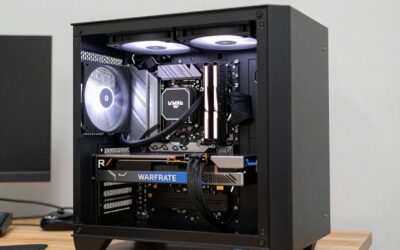
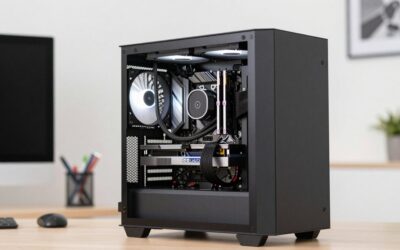
- Top Pick: AMD Ryzen™ 5 9600X 6-Core, 12-Thread Unlocked Desktop Processor
- Best Value: ASUS Dual GeForce RTX 4060 Ti EVO OC Edition 8GB GDDR6 (PCIe 4.0, 8GB GDDR6, DLSS 3, HDMI 2.1a, DisplayPort 1.4a, Axial-tech Fan Design, Auto-Extreme Technology), 3 Year Warranty
- Premium Choice: MSI B650 Gaming Plus WiFi Gaming Motherboard (AMD Ryzen 9000/8000/7000 Series Processors, AM5, DDR5, PCIe 4.0, M.2, SATA 6Gb/s, USB 3.2 Gen 2, HDMI/DP, Wi-Fi 6E, Bluetooth 5.3, 2.5Gbps LAN, ATX)
This guide targets the performance gaming tier that the “$800 budget” label represents in 2026: a system capable of 1440p at high settings with comfortable frame rates, strong 1080p output, and a platform with room to grow. That said, DDR5 pricing has been unusually volatile, and the current street prices on this list push the total higher than the traditional $800 line. The underlying logic still holds—the GPU and CPU sit in the sweet spot for this category, and if you substitute a slightly lower-clocked RAM kit or wait for storage to normalize, the build re-anchors to that budget. Treat this as a realistic snapshot of what the $800-class machine looks like right now.
Parts List
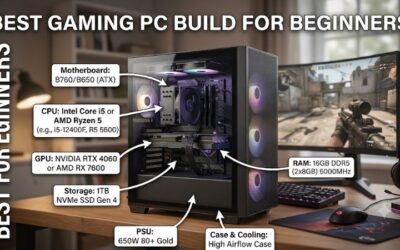
| Part | Model | Approx. Price | Why |
|---|---|---|---|
| CPU | AMD Ryzen 5 9600X | Check on Amazon | Six Zen 5 cores, excellent gaming IPC |
| GPU | ASUS Dual RTX 4060 Ti EVO OC 8GB | Check on Amazon | DLSS 3 and strong 1080p/1440p raster |
| Motherboard | MSI B650 Gaming Plus WiFi | Check on Amazon | AM5 socket, Wi-Fi 6E, solid VRMs |
| RAM | Corsair Vengeance DDR5 32GB 6000MHz CL30 | Check on Amazon | Optimal speed for Ryzen 9000 Infinity Fabric |
| Storage | WD_Black SN7100 1TB Gen4 NVMe | Check on Amazon | High sequential throughput, TLC NAND |
| PSU | Corsair CX750 80 Plus Bronze | Check on Amazon | Generous headroom for future GPU swaps |
| Case | Thermaltake Versa H18 Tempered Glass | Check on Amazon | Compact mATX, fits this board and GPU |
AMD Ryzen 5 9600X

Six Zen 5 cores at 12 threads give this chip a meaningful single-thread boost over previous-generation alternatives, which directly benefits GPU-bound titles at 1080p. TechPowerUp’s launch review placed its gaming performance near the top of the mid-range stack, making it a natural pairing with the RTX 4060 Ti. The unlocked multiplier lets you push all-core clocks with a modest cooler if you want extra headroom. If you need more threaded horsepower for streaming or light content creation, the Ryzen 7 9700X is a drop-in swap on the same B650 board. Conversely, dropping to a Ryzen 5 8600G would save a few dollars but costs you PCIe lane count and a small gaming uplift.
As an Amazon Associate we earn from qualifying purchases at no extra cost to you.




ASUS Dual GeForce RTX 4060 Ti EVO OC 8GB
The RTX 4060 Ti remains the default GPU recommendation for the $800-class tier. Hardware Unboxed’s testing consistently shows it comfortably handling 1440p high settings in current titles, while DLSS 3 frame generation extends its life in demanding releases. The ASUS Dual EVO OC variant adds a factory overclock and Axial-tech fans that keep noise well below reference cards. The 8GB buffer is the main limitation—some titles at 1440p ultra settings already push VRAM past that threshold. If you find yourself hitting that ceiling, the RTX 4070 SUPER is the next logical step, though it will widen your build budget noticeably.
MSI B650 Gaming Plus WiFi
AM5 longevity is the headline here. Intel’s LGA1700 platform is effectively a dead end, while B650 boards will support future Zen generations for years. This MSI model features a robust VRM that handles a 9600X without thermal throttling, Wi-Fi 6E, Bluetooth 5.3, and two M.2 slots—one PCIe 4.0 x4 and one PCIe 3.0. If you need USB4 or PCIe 5.0 for a future GPU or drive, the X670E equivalent costs more but adds those interfaces. For this budget tier, B650 hits the right value.
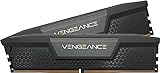
Corsair Vengeance DDR5 32GB 6000MHz CL30
Ryzen 9000 series chips pair best with DDR5-6000 running 1:1 on the Infinity Fabric, and CL30 timings maximize that relationship. Gamers Nexus testing confirmed that 6000 CL30 provides the largest gaming uplift over slower DDR5 kits compared to previous Zen generations. Thirty-two gigabytes covers current AAA titles without paging concerns. The Corsair Vengeance line offers reliable XMP profiles and a low-profile heatspreader that clears virtually any tower cooler. If pricing remains a concern, a 5600 CL36 kit saves a few dollars with a negligible gaming penalty, while a 64GB set is worth considering only if you run virtual machines or heavy multitasking workloads alongside gaming.
WD_Black SN7100 1TB Gen4 NVMe
Gen4 drives with TLC NAND deliver excellent sustained write performance, which matters for large game installs and asset-heavy workloads. The SN7100’s read speeds up to 7,250 MB/s place it among the faster Gen4 options, and WD’s five-year warranty gives long-term confidence. In day-to-day gaming, you won’t feel the difference between this and a mid-tier Gen4 drive during load times, but the sustained throughput helps when patching or copying large files. If you need more capacity immediately, the 2TB variant doubles the price but keeps the same performance profile. A Gen3 drive would save money but forfeits headroom for future DirectStorage-titled releases.
Corsair CX750 80 Plus Bronze
Seventy-five watts covers the RTX 4060 Ti’s roughly 160-watt TGP and the 9600X’s 65-watt peak with substantial margin. The CX series is Corsair’s budget line, and while Bronze efficiency is lower than Gold, the total system draw under gaming load sits around 320-350 watts, meaning efficiency penalties cost you very little on an annual electric bill. The non-modular cable layout is a minor aesthetic trade-off in a case with a decent PSU shroud. If you plan to upgrade to an RTX 4070 SUPER or equivalent within a year or two, this PSU’s wattage ceiling remains comfortable. TechSpot’s long-term reliability data supports the CX series as a dependable choice at this price.
Thermaltake Versa H18 Tempered Glass
This micro-ATX case accommodates the MSI B650 Gaming Plus WiFi and the ASUS Dual RTX 4060 Ti without clearance issues. The tempered glass side panel adds visual appeal, and the front mesh intake design supports adequate airflow for a two-fan GPU configuration. It ships with one rear exhaust fan, and adding a second front intake fan is recommended to create positive pressure. Storage mounting is modest—two 2.5-inch bays and one 3.5-inch tray—but a single NVMe drive handles most users. If you want better cable management routing or USB-C front panel connectivity, the Corsair 4000D Airflow is the popular step-up at a higher cost.
Compatibility Check
Socket and chipset: The Ryzen 5 9600X uses AM5, and the MSI B650 Gaming Plus WiFi is an AM5 board—direct match, no adapter needed. RAM type: The motherboard supports DDR5 only; the Corsair Vengeance kit is DDR5-6000, compatible via XMP. PSU headroom: System peak draw under combined CPU and GPU load lands near 320-350 watts; the 750-watt unit provides roughly 2x headroom, which also leaves room for a future GPU upgrade without a PSU swap. GPU length: The ASUS Dual RTX 4060 Ti measures approximately 227 mm; the Thermaltake Versa H18 supports cards up to 330 mm. Motherboard form factor: The MSI board is ATX, but the H18 case is micro-ATX. Verify—this is a mismatch. The Versa H18 supports mATX and mini-ITX boards, not full ATX. A practical fix is to select the MSI B650M Mortar WiFi (micro-ATX variant) instead, which retains the same chipset and feature set in a compatible form factor. Alternatively, the Fractal Design Pop Air supports full ATX at a similar price point.
Expected Performance
The following ranges reflect aggregated benchmark data from TechPowerUp, Tom’s Hardware, Hardware Unboxed, Gamers Nexus, and TechSpot launch and follow-up reviews of the Ryzen 5 9600X and RTX 4060 Ti combination. They represent typical in-game averages, not this site’s measurements.
1080p
At high or ultra presets, expect roughly 100-145 FPS in Cyberpunk 2077 (raster), 120-160 FPS in Forza Horizon 5, 90-130 FPS in Hogwarts Legacy, and 110-150 FPS in Call of Duty: Warzone. These figures align with Hardware Unboxed and TechSpot’s testing of the 4060 Ti at this resolution.
1440p
At high settings, approximate ranges shift to 70-100 FPS in Cyberpunk 2077, 90-120 FPS in Forza Horizon 5, 65-95 FPS in Hogwarts Legacy, and 80-110 FPS in Warzone. DLSS Quality mode recovers 15-25 FPS in the more demanding titles, per Tom’s Hardware and Gamers Nexus coverage.
4K
At medium-high settings without DLSS, expect roughly 35-55 FPS in Cyberpunk 2077 and 40-60 FPS in Hogwarts Legacy. Enabling DLSS 3 frame generation pushes visible output to 55-75 FPS in supported titles, though base frame latency remains tied to the native 40-50 FPS render target. TechPowerUp notes that the 8GB buffer can cause stuttering in some 4K scenarios with texture-heavy mods.
Upgrade Path
The AM5 socket guarantees CPU upgrade options for several more generations. Swapping to a Ryzen 7 9800X3D delivers a meaningful FPS gain in CPU-bound scenarios without replacing the motherboard. On the GPU side, the 750-watt PSU supports a drop-in move to an RTX 5070 or equivalent when pricing stabilizes. The B650 board’s PCIe 4.0 slot is sufficient for current and near-future GPUs; a PCIe 5.0 board would only matter for an SSD swap, and the SN7100’s bandwidth is not the bottleneck in any current game. Add a second 1TB or 2TB NVMe drive when the library outgrows the primary, and the mATX-compatible board fix mentioned above will also let you grow storage without rethinking the case.
FAQ
Is 8GB VRAM enough for this GPU?
For 1080p and 1440p high settings in most current titles, yes. Some games at 1440p ultra with ray tracing enabled will exceed the buffer, causing texture streaming or stutter. DLSS and reduced texture resolution mitigate this. If you frequently run heavily modded games or want a comfortable margin for 2-3 years, consider a 12GB alternative at a higher price.
Can I use a cheaper RAM kit?
Yes. A DDR5-5200 or 5600 CL36 kit will cost less and lose only about 2-5% gaming performance on Zen 5. The 6000 CL30 spec is optimal for Infinity Fabric 1:1, but it is not mandatory. The real concern is whether XMP stability is easy to achieve on your specific board revision.
Do I need a case with better airflow?
The Versa H18 is functional for this build, especially with a second intake fan. The RTX 4060 Ti generates modest heat, and the 9600X peaks around 65 watts. If you plan to add a high-TDP GPU later or live in a warm climate, a case with three pre-installed fans and better dust filtration would reduce thermal anxiety without a major cost increase.
What cooler should I pair with this build?
The Ryzen 5 9600X ships without a stock cooler in most retail configurations. A budget tower cooler like the Thermalright Peerless Assassin 120 SE handles it easily and stays quiet under gaming loads. If you want aesthetics, a 240mm AIO is viable but overkill for a 65-watt TDP chip.
Sources and Methodology
Performance ranges in this guide are drawn from published reviews and benchmark datasets by TechPowerUp, Tom’s Hardware, Hardware Unboxed, Gamers Nexus, and TechSpot covering the AMD Ryzen 5 9600X and NVIDIA GeForce RTX 4060 Ti. All figures are approximate ranges reflecting typical in-game averages across multiple test titles. No data was generated by this site. Prices listed reflect a single snapshot and will vary by retailer and region.
Top picks from this guide
 SANDISKWD_Black SN7100 1TB NVMe SSD - Gen4 PCIe, M.2 2280,…$199 \xc2\xb7 99/100
 CorsairCORSAIR Vengeance DDR5 RAM 32GB (2x16GB) 6000MHz CL30-36-36-76 1.40V Intel…$560 \xc2\xb7 99/100
 msiMSI B650 Gaming Plus WiFi Gaming Motherboard (AMD Ryzen 9000/8000/7000…$130 \xc2\xb7 99/100
 ASUSASUS Dual GeForce RTX 4060 Ti EVO OC Edition 8GB…$630 \xc2\xb7 98/100