
Choosing a ultrawide curved monitor white starts with your workload and how much of the display actually needs to be white. The Samsung ViewFinity S65TC is a practical starting point for a coordinated laptop desk; the LG 38WR85QC-W suits mixed work and gaming; and the LG 40U990A-W targets a sharper, larger workspace. This roundup compares six candidates, including one discontinued alternative, while separating white housings from mixed-color designs and advertised specifications from measured performance.
- Quick verdict: Choose the screen around your main task
- How we selected these monitors
- Samsung ViewFinity S65TC: For a coordinated laptop desk
- LG 38WR85QC-W: For work and gaming on one screen
- LG 40U990A-W: For a sharper workspace on newer hardware
- LG 40WP95C-W: For an established Thunderbolt workflow
- CRUA CR340HDM: A white gaming candidate with evidence limits
- LG 49WQ95C-W: A discontinued super ultrawide alternative
- How to choose a ultrawide curved monitor white
- Frequently asked questions
- Final verdict
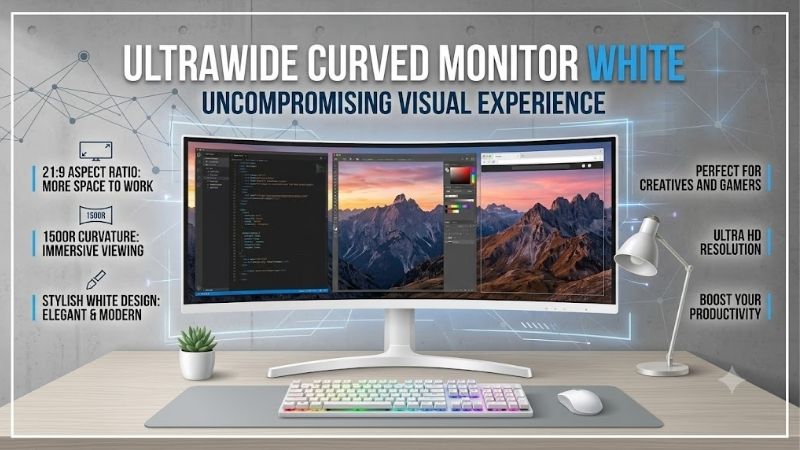
Quick verdict: Choose the screen around your main task
For a 34-inch workspace with a cohesive white finish, investigate the Samsung ViewFinity S65TC first. For a larger screen that combines productivity features with a higher refresh ceiling, consider the LG 38WR85QC-W.
If text density and detailed work matter most, compare the two 40-inch LG options. They represent different generations of connectivity and refresh capability rather than interchangeable purchases.
The CRUA CR340HDM is a candidate for buyers prioritizing a white 34-inch gaming specification. It carries more uncertainty about independently verified performance. The LG 49WQ95C-W belongs on a separate legacy shortlist because LG marks it discontinued.
These recommendations describe suitable use cases. Comparable current US offers were not established, so no model receives a price-dependent “best budget” or “best value” award.
White ultrawide curved monitor comparison
| Model | Suitable use | Panel and resolution | Advertised refresh ceiling | White-design qualification | Main compromise |
|---|---|---|---|---|---|
| Samsung ViewFinity S65TC, LS34C650TANXGO | Laptop-centered office desk | 34-inch VA, 3440 × 1440 | 100Hz | White front; warm-white rear and stand | Strong 1000R curve; verify stock |
| LG 38WR85QC-W | Work with gaming after hours | 38-inch Nano IPS, 3840 × 1600 | 144Hz | White rear housing with contrasting trim | Lower pixel density than 40-inch 5K2K |
| LG 40U990A-W | Detailed work on newer hardware | 39.7-inch Nano IPS Black, 5120 × 2160 | 120Hz | White exterior elements; dark screen border | Full capability needs a suitable host |
| LG 40WP95C-W | Established Thunderbolt workstation | 39.7-inch Nano IPS, 5120 × 2160 | 72Hz | White rear with silver stand | Lower refresh ceiling |
| CRUA CR340HDM | White 34-inch gaming candidate | 34-inch VA, 3440 × 1440 | 165Hz advertised | Manufacturer specifies white housing | Limited independently verified performance evidence |
| LG 49WQ95C-W | Broad multiwindow workspace | 49-inch Nano IPS, 5120 × 1440 | 144Hz | White rear with contrasting front and stand | Discontinued; unusually wide footprint |
The table summarizes manufacturer specifications, not measured response times or guaranteed operating modes through every connection.
How we selected these monitors
Each candidate needed a curved display surface, an ultrawide aspect ratio, and a documented white exterior or white housing component. Flat white monitors and conventional 16:9 curved displays were excluded.
The selection includes conventional ultrawides and one 32:9 super ultrawide. Their different shapes are identified because a 49-inch model should not be treated as a straightforward upgrade from every 34-inch screen.
Manufacturer specifications establish the listed features. They do not establish real-world motion clarity, factory calibration quality, reliability, or universal docking compatibility. No detailed research or original measurements were supplied for this article.
Product availability is also separate from eligibility. A manufacturer support page can remain online after retail stock changes. Check the exact seller, condition, accessories, and service terms before purchasing. Amazon US listings were not independently verified.
Samsung ViewFinity S65TC: For a coordinated laptop desk
Why this model belongs here
The US variant LS34C650TANXGO combines a 34-inch curved VA screen, 3440 × 1440 resolution, and a 100Hz ceiling. Samsung specifies a white front and warm-white rear and stand, making its finish more cohesive than monitors with only a white back.
Thunderbolt 4 with up to 90W charging, Ethernet, a KVM switch, and integrated speakers are the main reasons to investigate it. Those features can reduce separate accessories around a compatible laptop.
Its 1000R curve deserves particular attention: choose it because you prefer that shape, rather than assuming stronger curvature is automatically better. The direct US listing showed unavailable delivery and pickup during research, so confirm a current offer.
Buy if or skip if
Buy if you want a white office-oriented display and can use its connection features.
Skip if your main requirement is high-refresh competitive gaming or a gentler curve. Compare the LG 38-inch model for mixed use and the CRUA for a gaming-oriented specification. Verify laptop power requirements separately; a charging ceiling does not guarantee full-power operation for every laptop.
LG 38WR85QC-W: For work and gaming on one screen
A useful middle ground in screen shape
The 38WR85QC-W offers a curved Nano IPS panel, 3840 × 1600 resolution, and a 144Hz ceiling. Its white rear housing suits a coordinated setup, although contrasting exterior elements prevent a uniformly white appearance.
The taller pixel grid is its practical distinction from 3440 × 1440 alternatives. It can suit buyers who want additional vertical workspace without moving directly to a 5K2K desktop.
LG documents USB-C with 90W power delivery, a built-in KVM, speakers, and an adjustable stand. For the advertised 144Hz capability, LG identifies compatible DisplayPort 1.4 or HDMI 2.1 graphics hardware as a requirement.
Buy if or skip if
Buy if one display must accommodate documents, multitasking, and gaming.
Skip if your priority is maximum text density or a genuinely white front-facing design. Compare the 40-inch 5K2K models for detailed work. This recommendation rests on the feature balance; it does not claim that the panel matches a specialist gaming monitor in measured motion handling.
LG 40U990A-W: For a sharper workspace on newer hardware
Why its connection requirements matter
The 40U990A-W combines 5120 × 2160 resolution, a 2500R curve, and a maximum 120Hz refresh rate. Its Nano IPS Black panel technology should not be confused with the exterior color: LG identifies the model as white, and its US imagery describes a white stand.
Thunderbolt 5 and up to 96W charging distinguish it from the older 40WP95C-W. LG states that accessing the full 5120 × 2160 at 120Hz capability requires Thunderbolt 5 or DisplayPort 2.1 support.
Treat that requirement as a purchase gate. An older laptop or existing dock may not provide the intended operating mode.
Buy if or skip if
Buy if you need a detailed desktop and have verified a compatible signal path.
Skip if your current computer cannot use the features that justify the purchase. Compare the older 40-inch model before paying for capabilities you cannot access. Neither the panel name nor a wide gamut specification establishes suitability for every color-critical workflow without appropriate measurements.
LG 40WP95C-W: For an established Thunderbolt workflow
An older 5K2K option with a clear limitation
The 40WP95C-W provides a curved 39.7-inch Nano IPS display with 5120 × 2160 resolution. Its white rear housing and silver stand make it a mixed-color option.
Thunderbolt 4, stand adjustment, and integrated audio suit an office or creative workstation. Its maximum 72Hz specification is the important distinction from the newer 120Hz model. Confirm the supported timing for your selected connection rather than assuming every input offers the same mode.
It remains relevant when its documented capabilities match an existing computer and the actual offer is competitive.
Buy if or skip if
Buy if detailed desktop work matters more than high refresh and you find an appropriate US offer.
Skip if faster refresh is a central requirement. Compare it directly with the 40U990A-W using your computer’s actual capabilities and total purchase cost. Do not infer better value merely because this generation is older, and do not import another region’s service terms into a US purchase.
CRUA CR340HDM: A white gaming candidate with evidence limits
Focus on the exact curved VA configuration
CRUA’s CR340HDM page specifies a white 34-inch housing, a 1500R curved VA panel, and 3440 × 1440 resolution. It advertises up to 165Hz, FreeSync, Picture-in-Picture, and Picture-by-Picture.
This configuration is distinct from similarly named CRUA ultrawides with other panel descriptions. Match the complete model identifier rather than choosing from a title that combines multiple variants.
The advertised refresh ceiling makes it relevant to gaming shoppers. However, it does not establish measured pixel response, overshoot, input lag, or a guaranteed maximum refresh rate through each port.
Buy if or skip if
Buy if its specifications match your needs and the seller provides clear configuration and return information.
Skip if you require independently established motion performance before buying. Compare the LG 38-inch option for a different feature balance. Do not interpret an advertised gamut percentage as proof of accurate calibration, and request connection-specific timing information if 165Hz is essential to your decision.
LG 49WQ95C-W: A discontinued super ultrawide alternative
Consider it as a separate purchasing category
The 49WQ95C-W offers a curved Nano IPS display with 5120 × 1440 resolution and a 144Hz ceiling. Its white rear casing can complement a white desk, while the front and stand introduce contrasting finishes.
LG lists USB-C with 90W power delivery, a KVM switch, and Picture-by-Picture among its features. These make it worth investigating for users who want a broad multiwindow canvas.
However, LG’s US page explicitly marks the monitor discontinued. Treat remaining stock, refurbished units, and used examples as individual transactions rather than assuming normal direct availability.
Buy if or skip if
Buy if you specifically need the extra width and find a documented unit with acceptable protections.
Skip if you need current direct availability or more vertical pixels. Compare a 40-inch 5K2K model when height and detail matter more than width. Measure the installation carefully and check the included stand and accessories before assessing the offer.
How to choose a ultrawide curved monitor white
Choose the pixel layout before the diagonal
Different ultrawide resolutions solve different problems. A 3440 × 1440 display expands the width of a conventional QHD workspace. Moving to 3840 × 1600 adds pixels in both directions. A 5120 × 2160 screen prioritizes a denser, taller desktop, while 5120 × 1440 emphasizes horizontal room.
Using the listed resolutions, the approximate pixel counts are 5.0 million, 6.1 million, 11.1 million, and 7.4 million respectively. These are arithmetic comparisons, not performance benchmarks.
For gaming, more pixels can increase rendering demand, but the effect depends on the game, settings, and hardware. Avoid estimating frame rates from pixel ratios alone.
Plan the windows you actually use
Write down your usual arrangement before shopping. A browser beside a document is a different requirement from three dashboards, a timeline, or a remote desktop session.
Try arranging those windows on your current screen. Identify whether the real limitation is width, height, or readability. A wider panel may solve the first problem while leaving the others unchanged.
Remember that larger interface scaling reduces the amount of logical workspace available. Decide on readable text first, then evaluate how many useful windows fit. Do not judge productivity from a promotional image containing tiny, unreadable application panels.
Match curvature to the task
A smaller curvature radius indicates a stronger curve. It does not establish a universal comfort improvement or prescribe an exact sitting distance.
Consider whether you work centered in front of the display, share the screen with someone nearby, or inspect straight-line geometry. Those tasks can produce different preferences.
If you cannot see a comparable display in person, prioritize workable return terms. Evaluate reading, spreadsheets, and precise visual work at your normal desk. A shape that looks dramatic in a photograph may feel different during a full working session.
Inspect every visible surface
“White” can describe the front frame, rear shell, stand, or only selected components. Check all of them before assuming a monitor will match your setup.
For a desk facing a wall, the front and stand may dominate your view. For a desk visible from across the room, the rear shell may matter more. Warm white and cooler white finishes can also look different beside existing equipment.
Use exact-model photographs and seller confirmation where needed. If you plan to fit an arm, evaluate the monitor without its supplied stand rather than paying for a finish you will remove.
Verify the entire connection path
List the computer output, dock, adapter, cable, and monitor input. Every component must support the intended resolution and refresh combination.
A USB-C connector alone does not prove video support, charging capability, or compatibility with every Thunderbolt feature. VESA explains that DisplayPort over USB-C uses DisplayPort Alt Mode. Confirm the host specification and adapter requirements.
For a laptop desk, check charging wattage separately from video capability. Also determine how keyboard, mouse, Ethernet, and other peripherals connect. A monitor can simplify the desk only if those connections serve your particular computer and switching routine.
Separate refresh rate from motion quality
A high refresh ceiling identifies how frequently a display can update under supported conditions. It does not describe every pixel transition or guarantee low overshoot.
For fast games, seek measurements of the exact model at the refresh rates you expect to use. Check adaptive-sync behavior and the supported connection as well.
For mixed office use, decide how much faster scrolling and animation matter relative to resolution and connectivity. A specification that sounds impressive may provide little value if your main workload cannot use it or another feature matters more.
Measure the complete installation
Check monitor width, stand depth, screen height, and cable clearance. Include speakers, a webcam, a laptop stand, and anything mounted behind the desk.
If using an arm, verify the mounting pattern, supported screen size, weight capacity, and attachment clearance. The desk must also suit the clamp or mounting method.
Keep the keyboard in a comfortable position while planning. A large base can force other equipment forward even when the screen technically fits. Mark the intended position with removable tape to judge the arrangement before ordering an unusually wide display.
Compare the transaction as well as the monitor
Calculate the complete cost of the usable setup: monitor, required cables, adapters, mounting hardware, and any missing accessories.
Then compare seller identity, condition, return costs, and applicable US coverage. For older models, request confirmation of what is included and whether the manufacturer recognizes the unit for service.
A discontinued display can still be useful, but its offer needs independent assessment. Do not reuse a launch price, historical discount, or another region’s warranty as evidence that today’s purchase is attractive. Keep screenshots and the exact model description with your order records.
Frequently asked questions
Can one ultrawide replace two monitors?
It can, particularly when your work benefits from one continuous desktop. It is less suitable when you need independent physical screen positions or frequently share one entire display during meetings. Test your window arrangement and screen-sharing routine before giving up a second monitor.
Are these all completely white?
No. Some have white housings with dark bezels or silver stands. The comparison identifies those distinctions. Choose according to the surfaces visible in your room, and confirm exact-model photographs before buying.
Should console gaming determine this purchase?
If a console is your main source, verify its supported output formats and the monitor’s scaling behavior first. Do not assume a console will fill an ultrawide panel correctly. A conventional aspect ratio may suit that use better.
Does this roundup confirm Amazon stock?
No. Exact Amazon US offers, sellers, conditions, and model variants were not verified. Match the full identifier to manufacturer documentation before purchasing. A broad family name is insufficient when listings combine several panels or generations.
Final verdict
Start with the Samsung S65TC for a coordinated laptop desk, the LG 38WR85QC-W for mixed work and gaming, or the LG 40U990A-W for a detailed desktop on suitable hardware. Assess the older LG 40-inch model, CRUA candidate, and discontinued 49-inch alternative against their specific limitations. Choose the resolution, connection path, and physical fit that support your daily work before settling the exterior finish.









