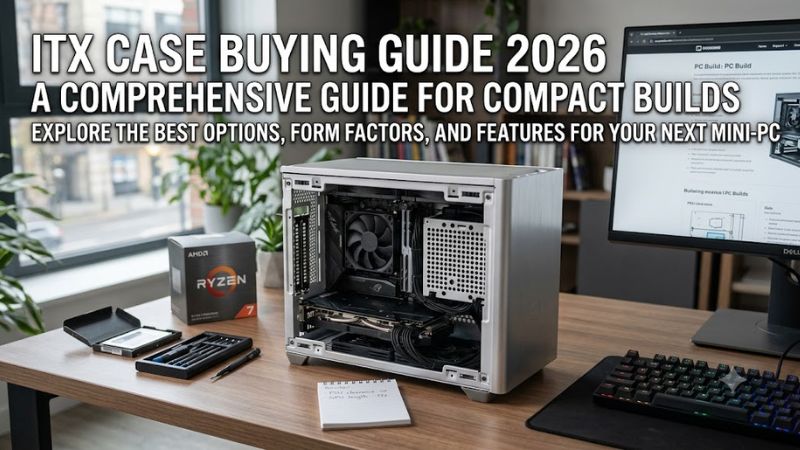
ITX case buying guide 2026 is useful when a compact build creates major compatibility questions. A Mini-ITX case can look remarkably compact on a desk yet impose stringent limits on the GPU, cooler, power supply, radiator, and cable path. The wrong layout can turn a compatible parts list into a frustrating final assembly.
How to Choose an ITX Case
A good ITX case is not simply the smallest enclosure you can find. This ITX case buying guide 2026 compares four real-world choices and turns their differences into practical buying rules. You will see where each case fits, what compromise it makes, and which builder should choose it before ordering expensive components.
Case Volume and Layout
Volume tells you how compact a case feels, but internal layout matters just as much. A sandwich design such as the Fractal Terra or Lian Li A4-H2O is space-efficient, while the roomier Cooler Master MasterBox NR200P V2 gives components more generous cable-routing workspace. For a first build, that extra space is worthwhile.
Treat volume as a starting-point metric, not a buying target. A smaller case can demand stricter cable paths and tighter cooler choices, while a larger ITX enclosure accepts familiar parts. The Fractal Terra suits minimum-footprint goals, the A4-H2O favors dense performance builds, and the NR200P V2 favors easier assembly.
GPU Clearance
GPU clearance is often the first hard limit because modern cards vary sharply in length, height, and thickness. The Cooler Master MasterBox NR200P V2 reaches 357 mm in its published configuration, while the Corsair 2000D AIRFLOW allows 365 mm. Both are sensible choices when the graphics-card fit is the main sizing concern.
Length is only part of the fit calculation because thickness and power-connector position matter too. A card can meet the published length yet collide with a panel, radiator, or cable bend. The NR200P V2 suits builders needing broad GPU room, while the 2000D AIRFLOW is the more forgiving tower-style option for long cards.
Cooling and Radiator Support
Cooling capacity should match the CPU you plan to run, not the case’s marketing-oriented size. The Lian Li A4-H2O supports a top 240 mm radiator, the NR200P V2 supports 280 mm-capable cooling, and the Corsair 2000D AIRFLOW reaches 360 mm. Those differences create substantially different upgrade paths for sustained high-load CPU workloads.
Do not assume the largest radiator always makes sense. A 360 mm option can be excessive for a modest mainstream CPU, while a low-profile air cooler can be practical in a compact-space design. The A4-H2O is the focused 240 mm choice, the NR200P V2 the flexible middle ground, and the 2000D AIRFLOW the cooling-capacity option.
PSU Fit and Cable Access
Power-supply installation access can save more time than another few liters of overall volume. ITX systems commonly depend on SFX or SFX-L units, and the internal arrangement decides how easily cables reach after the board and GPU are installed. The NR200P V2, Terra, A4-H2O, and 2000D AIRFLOW reward different priorities.
PSU length should be checked with GPU and radiator placement because these parts compete for compact space. SFX-L support is useful, but a shorter SFX unit simplifies routing in tighter-case designs. The Terra and A4-H2O emphasize compactness, while the NR200P V2 and 2000D AIRFLOW leave more room around the main components.
Top Picks
Top Picks in this ITX case buying guide 2026 are separated by build priorities rather than one ranking. The NR200P V2 favors balance, the 2000D AIRFLOW favors cooling capacity, the Terra favors minimum volume, and the A4-H2O targets compact 240 mm liquid cooling. That separation makes the comparison easier to apply.
| Product | Best For | Key Spec | Watch Out For |
|---|---|---|---|
| Cooler Master MasterBox NR200P V2 | Best Overall | 18.25L; up to 280 mm radiator; up to 357 mm GPU; SFX/SFX-L (Cooler Master) | 67 mm CPU cooler clearance; larger than ultra-compact options |
| Corsair 2000D AIRFLOW | Best Value | 458 × 200 × 271 mm; 360 mm radiator; 365 mm GPU; SFX (CORSAIR) | Tall tower layout; 130 mm PSU limit |
| Fractal Terra | Best For Smallest Footprint | 10.4L; 322 mm GPU; 48–77 mm CPU cooler clearance; 120 mm side radiator (Fractal Design) | Spine adjustment creates tight cooler/GPU trade-offs |
| Lian Li A4-H2O | Best For 240 mm AIO | 11L; top 240 mm radiator; 55 mm total stack limit; 322 mm GPU (Lian Li) | Tight radiator stack and limited drive support |
Cooler Master MasterBox NR200P V2
The Cooler Master MasterBox NR200P V2 is the best overall starting point in this ITX case buying guide 2026 because its 18.25-liter layout gives beginners usable practical working room without sacrificing serious GPU-and-radiator support. It accepts Mini-ITX motherboards, SFX or SFX-L PSUs, and full-length GPUs up to 357 mm.
Its main advantage is flexibility: it supports top 240 or 280 mm radiators, includes a PCIe 4.0 riser and GPU holder, and offers tool-free access. The trade-off is size. At 18.25 liters, it is well short of the smallest ITX enclosure, so choose it when straightforward building matters more than minimum desk-space usage.
Corsair 2000D AIRFLOW
The Corsair 2000D AIRFLOW is the best value choice in this ITX case buying guide 2026 when cooling hardware and large graphics cards matter more than the shortest case. Its 458 mm height and 365 mm GPU limit make it accommodating, while Mini-ITX support and an SFX PSU requirement keep the overall design deliberately focused.
Its strongest practical advantage is cooling flexibility, with support for up to a 360 mm radiator and multiple fan arrangements. The downside is its tall tower shape and larger footprint for an ITX case, so it is less appealing when you want a low-profile desktop enclosure instead of maximum vertical cooling potential.
Fractal Terra
The Fractal Terra is the best choice for the smallest footprint in this ITX case buying guide 2026. At 10.4 liters, it supports GPUs up to 322 mm and SFX or SFX-L power supplies, while its adjustable spine trades GPU space against CPU cooler height. It suits builders who value compactness above easy component selection.
That adjustable spine is why the Terra demands careful parts-matching. CPU cooler clearance can range from 48 to 77 mm depending on the setting, and the case supports a 120 mm side radiator under specific conditions. Its compact construction is excellent, but the layout leaves little room for improvisation after choosing parts.
Lian Li A4-H2O
The Lian Li A4-H2O is the best choice in this ITX case buying guide 2026 for compact liquid-cooling builds because it combines an 11-liter volume with a top-mounted 240 mm radiator position. Its 322 mm GPU clearance and SFX/SFX-L support make it a strong fit for performance-focused, space-conscious systems.
The main benefit is a true 240 mm AIO-cooling path without growing into NR200P V2 territory. The catch is the very strict 55 mm maximum total thickness for the radiator-and-fan stack, plus a 55 mm CPU cooler limit and one 2.5-inch drive position. Check compatibility before assembly; clearances remain highly unforgiving.
Frequently Asked Questions
Frequently Asked Questions in this ITX case buying guide 2026 focus on real-world fit-and-compatibility decisions that cause the most problems. Small cases reward planning, so the answers below concentrate on volume, GPU dimensions, cooling method, and PSU format instead of generic advice that applies to every desktop PC build.
How Much Case Volume Do You Need?
How much case volume do you actually need for a Mini-ITX build? For a first build, around 18 liters is usually much easier than 10-liter or 11-liter designs because you gain room for dedicated cable-routing room, cooling hardware, and less-restrictive placement space. That is why the NR200P V2 is the safer starting point for most beginners.
When a smaller footprint is the real objective, the calculation changes. The Terra and A4-H2O save substantial volume, but their tighter layouts make every millimeter more consequential. Measure the GPU and cooler as complete assemblies, including plugs, brackets, and fan or radiator thickness, before choosing the smallest enclosure.
Can ITX Cases Fit Large GPUs?
Can an ITX case handle a large modern high-end graphics card? Yes, but only when the specific card fits its length, height, and thickness limits together. The NR200P V2 reaches 357 mm in its published maximum clearance, while the 2000D AIRFLOW reaches 365 mm, so both are sensible starting points for oversized high-end GPUs.
Do not treat a published maximum as a universal promise. Connector position, support brackets, radiator placement, and cable bend space can reduce practical clearance. A card that technically fits can still create a difficult installation, so compare the complete GPU dimensions with the exact case configuration you plan to build.
Do You Need a 240 mm AIO?
Is a 240 mm AIO necessary in a small ITX PC? No. A properly matched air cooler can be simpler, especially in a case designed around low-profile cooling. An AIO becomes more attractive when sustained CPU loads are high and the enclosure provides a clean radiator-mount position, making the A4-H2O a purpose-focused choice.
The important exception is clearance, not fashion or aesthetics. The Terra can become restrictive around cooler height as its internal spine shifts toward maximum GPU clearance, while the NR200P V2 gives more radiator and cooler flexibility. Match cooling to the CPU, GPU, and case instead of assuming liquid cooling is automatically better.
Should You Use SFX or SFX-L?
Should you choose SFX or SFX-L for an ITX build? Choose SFX when you want broadest compatibility with space-constrained layouts and easier cable routing; choose SFX-L only when the case explicitly supports it and the extra length serves your specific power target. The NR200P V2, Terra, and A4-H2O all support both formats.
The Corsair 2000D AIRFLOW uses SFX-format power supplies and allows a PSU up to 130 mm long. A longer supply can consume space needed for cables, storage, or radiator hardware, so wattage alone should not decide the purchase. Confirm PSU length before ordering when your GPU and cooling setup fill the case.
Final Thoughts
An ITX case should be selected around the build you intend to assemble, not around a generic size category. For this ITX case buying guide 2026, the NR200P V2 is the balanced overall choice, the 2000D AIRFLOW favors cooling capacity, the Terra prioritizes minimum volume, and the A4-H2O targets compact 240 mm AIO systems.