A small amount of the right lubricant can turn a scratchy mechanical keyboard into a smooth, quiet board. Less friction between the stem and the housing rails, and springs that stop ringing after each press, drive the change. The wrong lubricant, or too much of it, can make a tactile switch feel vague or a linear switch feel slow, so matching the grease to the switch matters more than the brand on the jar.
This guide covers five lubricants for different jobs inside a mechanical switch. Thick greases suit linear switches and stabilizer housings, thinner greases suit tactile switches, and a light oil suits springs. Each pick below lists confirmed specifications and the exact listing code.
As an Amazon Associate, we earn from qualifying purchases.
Quick Answer
For most linear switches, a thick PFPE grease such as Krytox GPL 205 gives the smoothest result in a thin coat. For tactile switches, TriboSys 3203 preserves the bump better because it is thinner, while TriboSys 3204 sits between the two and suits mixed collections. A syringe format helps with measured application, and a thin GPL 105 oil belongs on springs, not stems.
Krytox GPL 205 Grease 0.5 oz Tube

The Chemours Krytox GPL 205 tube is the industrial original behind many keyboard greases. It is a PFPE oil thickened with PTFE, with no additives, arriving as a white, buttery grease in a 0.5 fluid ounce tube. Builders use it on linear switch stems, housing rails, and stabilizer housings, where its thick body damps vibration and removes the dry, scratchy feel of an unlubed switch.
One distinction deserves attention: this tube holds standard GPL 205, which Chemours rates as NLGI Grade 2. The community term 205g0 refers to the Grade 0 variant, which is thinner and usually sold by repackagers in small syringes. The Grade 2 tube still works well on linear switches and stabilizers, but it needs a lighter hand than a Grade 0 product, and it is a poor match for pronounced tactile switches because its thickness can soften the bump.
The published temperature range runs from minus 36 to 204 degrees Celsius, and the base oil viscosity is 160 centistokes at 40 degrees Celsius. The grease is H1 certified and nonflammable, and it does not migrate far once applied. One tube covers many keyboards when applied thinly.
Specs
| Spec | Detail |
|---|---|
| Form | Grease, PFPE oil thickened with PTFE |
| Size | 0.5 fluid ounces, tube |
| Grade | NLGI Grade 2 (not Grade 0) |
| Temperature range | Minus 36 to 204 degrees Celsius |
| Base oil viscosity | 160 centistokes at 40 degrees Celsius |
| Model number | D10170248 |
| ASIN | B00MWLDALQ |
TriboSys 3204 Lubricant

TriboSys 3204 is the middle option in the Miller-Stephenson keyboard grease range and the most versatile pick in this guide. It is a Grade 0 semi-fluid grease with a base oil viscosity of 177 centistokes at 20 degrees Celsius, thinner than Krytox 205g0 and thicker than its sibling 3203. That middle position makes it a good single purchase for a collection that mixes linear and tactile switches.
It ships in a syringe with Luer tips for measured application. A thin coat on the bottom housing rails and the stem rails smooths travel without burying the feel of the switch. On tactile switches it preserves more of the bump than a thick grease, provided the lubricant stays off the stem legs and the metal contact leaf. On linear switches it gives a clean glide with less damping than a heavy grease.
It also works on stabilizer housings, though its thinner body may need reapplication sooner than a thick grease. The worked penetration range of 355 to 385 keeps the grease in place, and the formula does not migrate or degrade over time according to the maker.
Specs
| Spec | Detail |
|---|---|
| Form | Grade 0 semi-fluid grease, PFPE-based |
| Base oil viscosity | 177 centistokes at 20 degrees Celsius |
| Worked penetration | 355 to 385 |
| Container | Syringe with Luer tips |
| Sizes offered | 3 ml and 7.5 ml |
| Best for | Linear and tactile switches, stabilizers |
| ASIN | B0CXSS69PK |
TriboSys 3203 Lubricant

TriboSys 3203 is the thinnest grease here, and the pick for tactile switches. Its base oil viscosity is 82 centistokes at 20 degrees Celsius, roughly half that of 3204, which makes it the easiest grease in the range to spread in a thin, even film. A light coat smooths the stem travel while leaving the tactile bump intact, which is the main goal when lubing a tactile switch.
It is a Grade 0 semi-fluid PFPE formula in a syringe with Luer tips. Because it is thin, it suits first-time work: mistakes are easier to correct, and a heavy hand is less likely to turn a tactile switch into a linear one. It also suits clicky switches better than thick greases, though many builders leave click mechanisms dry.
Note that 3203 can run thinner in warm conditions, so store the syringe upright and stir the grease before use if it has sat for a long time. It works on stabilizer housings too, but its thin body damps rattle less than a thick grease.
Specs
| Spec | Detail |
|---|---|
| Form | Grade 0 semi-fluid grease, PFPE-based |
| Base oil viscosity | 82 centistokes at 20 degrees Celsius |
| Worked penetration | 355 to 385 |
| Container | Syringe with Luer tips |
| Sizes offered | 3 ml and 7.5 ml |
| Best for | Tactile and clicky switches |
| ASIN | B0CXSSK514 |
Vanfree GPL 205G0 Keyboard Lube Syringe 3.5 ml

The Vanfree GPL 205G0 syringe is a keyboard-focused repack of Grade 0 grease in a 3.5 ml syringe with a standard Luer needle tip and lock. It suits builders who want the 205g0 consistency without buying an industrial tube, and the syringe dispenses a small, measured amount onto a brush. The listing states a pure PFPE and PTFE formula, and the grease is intended for linear and tactile switches, stabilizers, and springs.
The small size is the main appeal: a 3.5 ml syringe covers a single keyboard comfortably, so it suits a first project. The listing also offers 4 ml and 7.5 ml sizes for bigger jobs. Because this is a repackaged product rather than a Chemours-branded tube, confirm the label reads Grade 0 before ordering, since a thicker variant can arrive by mistake.
Apply a nearly transparent coat on the rails, with the stem legs and contact leaf left dry on tactile switches. The syringe tip places grease exactly where it belongs, and the lock keeps it secure. Keep the cap on between sessions, since the grease can separate if left standing.
Specs
| Spec | Detail |
|---|---|
| Form | Grade 0 grease, PFPE and PTFE |
| Size | 3.5 ml, 0.28 fluid ounces, syringe |
| Container | Syringe with Luer needle tip and lock |
| Other sizes offered | 4 ml and 7.5 ml |
| Material | Polytetrafluoroethylene |
| Best for | Linear and tactile switches, stabilizers |
| ASIN | B0CQV2TXLB |
StreamStands Krytox 105 Keyboard Lube 10 g
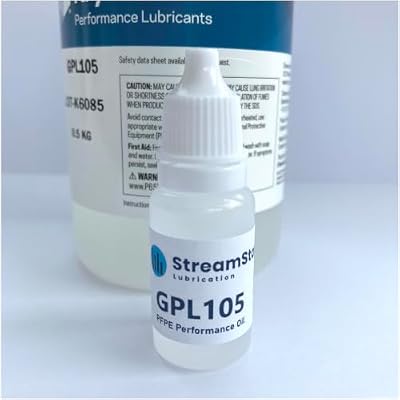
The StreamStands Krytox 105 is a thin PFPE oil in a dropper bottle, filling the one job grease cannot do well: springs. A few drops in a sealed bag coat a full batch of springs quickly, and the thin oil removes spring ping without adding drag to the stem travel. It is the lightest lubricant in this guide, and it should never replace grease on stem rails or housing rails.
The bottle holds 10 grams of oil, more than most single-keyboard projects need, but the dropper makes measured application simple. Krytox GPL 105 has a viscosity of 160 centistokes at 40 degrees Celsius and a temperature range from minus 36 to 204 degrees Celsius. The maker is Chemours, part number KYTX GPL 105, and the listing states compatibility with Krytox 205g0, 205g2, and 105 lubricants.
Use this oil sparingly. Too many drops leave springs oily and make the batch harder to control, and oil that reaches the stem legs can soften a tactile bump. For clicky switches, a light spring treatment is the only safe lubrication, since grease on the click mechanism can mute the sound.
Specs
| Spec | Detail |
|---|---|
| Form | Thin PFPE oil |
| Size | 10 grams, 5 ml, dropper bottle |
| Oil viscosity | 160 centistokes at 40 degrees Celsius |
| Temperature range | Minus 36 to 204 degrees Celsius |
| Maker | Chemours |
| Part number | KYTX GPL 105 |
| ASIN | B0BZQPQKY3 |
How to choose
Match the lubricant to the switch first. Linear switches take the thickest grease well, so Krytox GPL 205 or the Vanfree 205G0 syringe suit them. Tactile switches need a thinner grease that preserves the bump, so TriboSys 3203 is the safer pick, with 3204 as the middle ground for a mixed collection. Springs always take thin oil.
Consider the container next. A syringe gives measured doses for precise work, while a tube gives more grease and suits several boards. A dropper bottle suits bag lubing springs. If you own no switch tools yet, a kit with an opener and pullers may serve better than a standalone grease.
Check the label before ordering: the keyboard community uses Grade 0 for switch grease, and a standard Grade 2 tube is thicker. Confirm the grade, the size, and the seller, since repackaged greases vary.
Who should skip it
Skip lubrication entirely if your keyboard uses clicky switches and you love the click sound, since grease on the click mechanism can mute it. Skip it if your board is soldered and you have no desoldering equipment. Skip thick grease on pronounced tactile switches unless you accept a softer bump.
Also skip the job if your switches already feel smooth and quiet. Factory lubrication has improved, and many modern switches need no extra work. Lubrication helps scratchy or pinging switches most.
Frequently Asked Questions
Which lubricant is best for linear switches?
A thick Grade 0 grease such as the Vanfree 205G0 syringe, or the Krytox GPL 205 tube applied thinly, gives the smoothest result on linear switches. The thick body damps vibration and removes scratch. Apply a nearly transparent coat and test one switch before doing the full board.
Which lubricant is best for tactile switches?
TriboSys 3203 is the best match for tactile switches because it is the thinnest grease here and preserves the bump. Keep it off the stem legs and the metal contact leaf, since grease there softens tactility. TriboSys 3204 works too, but it needs a lighter hand on pronounced tactile designs.
Can I use GPL 105 oil on switch stems?
No. GPL 105 is a thin oil meant for springs, too thin to replace grease on stem rails or housing rails. It runs off surfaces that need lasting lubrication. Use it for bag lubing springs only, with a few drops per batch.
How much lubricant should I apply?
Less than you expect. Load the brush, then wipe almost all the grease back onto the jar edge before touching the switch. The coat should catch the light without looking white. If you can see a visible layer, you have used too much, and the switch may feel slow.
Final verdict
For a single purchase that covers most boards, TriboSys 3204 is the most flexible grease here, sitting between thick and thin. For linear switches and stabilizers, the Krytox GPL 205 tube or the Vanfree 205G0 syringe gives the deepest smoothing. For tactile switches, TriboSys 3203 protects the bump best. Add the StreamStands Krytox 105 oil for springs, and keep each lubricant on its own job. Confirm every listing code and stock status before ordering, since repackaged greases can vary by seller.
Product and ASIN Reference
| Product | ASIN | Value group |
|---|---|---|
| Krytox GPL 205 Grease 0.5 oz Tube | B00MWLDALQ | premium |
| TriboSys 3204 Lubricant | B0CXSS69PK | mid-range |
| TriboSys 3203 Lubricant | B0CXSSK514 | mid-range |
| Vanfree GPL 205G0 Keyboard Lube Syringe 3.5 ml | B0CQV2TXLB | budget |
| StreamStands Krytox 105 Keyboard Lube 10 g | B0BZQPQKY3 | budget |