A gaming PC is a space heater that also runs games. A high-end rig pours hundreds of watts of warm air into a closed room, and after an hour-long session the air around the desk turns thick and stale. A fan that moves real air across the room makes the biggest immediate difference. Pedestal fans aim a focused breeze at the desk, while box fans sit in a window and pull hot air out or draw cooler evening air in. This roundup covers both: three pedestal fans and two 20-inch box fans. Every pick below is a true pedestal or a true box fan — no tower fans, no desk fans, no bladeless loops.
- How to choose a pedestal or box fan for a gaming room
- 1. Dreo TurboPoly Fan 704S Smart Pedestal Fan
- 2. Rowenta Turbo Silence Extreme Pedestal Fan VU5670
- 3. Vornado 683DC Energy Smart Medium Pedestal Air Circulator
- 4. Lasko 20-Inch Premium Box Fan 3723
- 5. Air King 9723 20-Inch Box Fan
- Pedestal and box fans compared
- FAQ
- Conclusion
As an Amazon Associate, we earn from qualifying purchases.
How to choose a pedestal or box fan for a gaming room
Start with the job. A pedestal fan stands beside the desk and blows air across you and the rig. It is the right call when the desk zone gets warm but the room itself is comfortable. A box fan belongs in a window or on the floor against a wall, where it exchanges air with the rest of the house or the outside. It moves a large volume of air in one direction, which is what you want when the whole room needs a reset.
Airflow is measured in cubic feet per minute (CFM), and the numbers on fan listings are best read as a ranking, not a laboratory measurement. The shape of the airflow matters as much as the number: a wide, sweeping pedestal cools a seating area, while a focused circulator pushes a column of air across the whole room.
Motor type decides noise and control. Direct-current (DC) motors run quieter at low speeds, sip less power, and usually offer more speed steps — nine speeds on the smart Dreo below, versus three on a classic AC pedestal. For streamers, a DC fan at its lowest setting is far less likely to show up on the mic. AC motors are simpler and proven, but tend to be louder at the same airflow.
A pedestal that sweeps side to side covers a wider area but never holds a steady breeze on one spot. A whole-room circulator does the opposite: it fires a steady column of air that bounces off walls and stirs the entire room. Neither is better in the abstract: a streamer who sits still wants the steady column, while two people sharing a room want the sweep.
Noise figures deserve skepticism. A decibel number on a listing is usually measured at the lowest speed, in a quiet room, at a fixed distance the maker does not always disclose. Use the figures below to compare fans within this list. Height adjustment matters: a fan that drops to 32 inches suits a low desk, while one rising past 50 inches clears a monitor shelf. Check the practical details too: a remote you can reach from the chair, a timer for overnight sessions, a stable base, and a fused safety plug on any fan that runs unattended.
1. Dreo TurboPoly Fan 704S Smart Pedestal Fan

The Dreo 704S is the most capable fan here and the only one with smart controls. Its brushless DC motor drives air up to 110 feet, and the head sweeps 150 degrees horizontally and 120 degrees vertically, so it can wash the whole desk area in a slow, even breeze or hold a narrow stream on one chair. Nine speeds and six modes give finer control than any three-speed fan. Control comes through the Dreo app, a remote, or voice commands with Alexa and Google Assistant. Height adjusts from 37.5 to 43 inches.
One detail to confirm before ordering: the listing carries a banner pointing to a newer position-based oscillation version, so confirm the listing shows the original 704S, model DR-HPF004S in Silver. The maker’s own store shows the 704S out of stock at the time of writing, so confirm the live offer.
Specs
- Type: Smart DC pedestal fan, Silver
- Model: DR-HPF004S
- Height: 37.5 to 43 inches, adjustable
- Airflow: 1,400 CFM, up to 110 ft reach
- Oscillation: 150 degrees horizontal, 120 degrees vertical
- Speeds: 9 speeds, 6 modes
- Noise: 20 dB
- Power: 48 watts
- Timer: 12 hours
- Controls: Wi-Fi app, remote, Alexa and Google Assistant voice control
- Dimensions: 13.7 x 8.7 x 43 inches
- Weight: 14.1 lb
- ASIN: B0CSKB93MH
2. Rowenta Turbo Silence Extreme Pedestal Fan VU5670

Rowenta’s VU5670 is the quiet heavyweight of this list. It stands 53 inches tall with a 16-inch, five-blade head, moves up to 2,436 CFM — the highest airflow figure here — and holds noise to 35 dB(A) at its lowest speed. The speed control is the part most listings get wrong: the fan has five speed settings, not three. Three are standard speeds, and Turbo Boost and Silent Night mode round out the five, so you can drop to a near-silent overnight setting or push maximum air during a summer afternoon session. The remote docks on the fan itself, and the eight-hour timer and energy-save mode cover overnight use. At 19.6 pounds it is the heaviest fan here, which reads as stability once it is assembled.
Specs
- Type: Pedestal fan, Silver
- Model: VU5670
- Height: 53 inches
- Head: 16 inches, 5 blades
- Airflow: Up to 2,436 CFM
- Speed settings: 5 (3 speeds plus Turbo Boost and Silent Night mode)
- Noise: 35 dB(A) at lowest speed
- Power: 35 watts
- Timer: 8 hours
- Controls: Remote with on-board storage
- Features: Energy-save mode
- Weight: 19.6 lb
- ASIN: B071JBX9MQ
3. Vornado 683DC Energy Smart Medium Pedestal Air Circulator
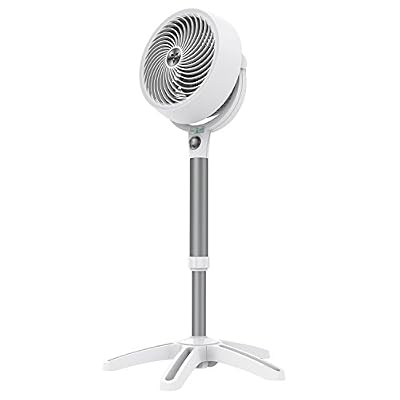
The Vornado 683DC takes a different approach: it does not sweep side to side. Its deep-pitched blades and spiral grille fire a focused column of air up to 80 feet, and the pivoting head aims that column where you want it. The air bounces off the far wall and circulates back through the room, which is why Vornado calls it a whole-room circulator rather than a fan. The DC motor is the upgrade over the standard 683 — up to 80 percent more energy-efficient per the maker — and the variable speed control lets you dial in exactly the airflow you want. Height adjusts from 32 to 38 inches, the tool-free base assembles in minutes, and the five-year limited warranty is the longest backing here. If your desk sits against one wall and the room needs steady circulation rather than a sweeping breeze, this is the pick.
Specs
- Type: DC pedestal air circulator, White
- Model: CR1-0275-73
- Height: 32 to 38 inches, adjustable
- Circulation: Up to 80 ft
- Motor: DC, up to 80 percent more energy-efficient per the maker
- Speed control: Variable
- Airflow style: Pivoting head, no side-to-side sweep
- Base: Tool-free assembly
- Warranty: 5-year limited
- Weight: 7.9 lb
- ASIN: B01N4TZOHE
4. Lasko 20-Inch Premium Box Fan 3723

The Lasko 3723 is the classic window box fan, and its job is simple: move a large volume of air in one direction. The 20-inch, five-blade head runs at three speeds, and the Wind Ring system boosts air velocity by up to 30 percent per the maker. Set it blowing outward to pull hot air out, or reverse it in the evening to draw cooler air in. At five pounds with a carry handle, it is light enough to move between rooms or lift into a window frame without a second pair of hands. The fused safety plug cuts power if the motor draws a fault current. At 65 dB on high it is the loudest fan here, so it suits window duty and whole-room air exchange better than sitting beside a microphone.
Specs
- Type: Box fan, White
- Model: 3723
- Blade: 20 inches, 5 blades
- Speeds: 3
- Airflow system: Wind Ring, up to 30 percent more air velocity per the maker
- Power: 112 watts
- Noise: 65 dB
- Dimensions: 22-3/8 x 21-1/4 x 4-3/4 inches
- Weight: 5 lb
- Features: Carry handle, fused safety plug
- ASIN: B000HHJ2I2
5. Air King 9723 20-Inch Box Fan

The Air King 9723 is the sturdier of the two box fans here, built around a permanently lubricated 1/25-horsepower motor that needs no maintenance. It moves 2,163 CFM on high per the maker’s current spec sheet, with power stepping down from 105 to 87 to 65 watts and noise from 60 to 55 to 51 dBA across its three speeds. The impact-resistant grilles stand up to knocks, and the eight-foot cord reaches distant outlets. Like the Lasko it works best as a window exhaust or floor-level air mover, and its published airflow figure lets you compare it directly with the pedestals above. Older copies of the maker’s spec sheet show different wattage and noise figures — the numbers here come from the current 2023 sheet.
Specs
- Type: Box fan, White
- Model: 9723
- Blade: 20 inches
- Speeds: 3
- Airflow: 2,163 CFM on high
- Motor: 1/25 HP, permanently lubricated
- Power: 105, 87, and 65 watts across speeds
- Noise: 60, 55, and 51 dBA across speeds
- Cord: 8 ft
- Grilles: Impact-resistant
- ASIN: B0007Q3RMA
Pedestal and box fans compared
| Fan | Type | Airflow | Speeds | Noise |
|---|---|---|---|---|
| Dreo TurboPoly 704S | Smart pedestal | 1,400 CFM | 9 speeds, 6 modes | 20 dB |
| Rowenta VU5670 | Pedestal | Up to 2,436 CFM | 5 settings | 35 dB(A) lowest |
| Vornado 683DC | Pedestal circulator | Up to 80 ft reach | Variable | Not stated |
| Lasko 3723 | Box fan | Wind Ring system | 3 speeds | 65 dB |
| Air King 9723 | Box fan | 2,163 CFM | 3 speeds | 51 to 60 dBA |
The Dreo leads on controls and sweep, the Rowenta on quiet airflow, the Vornado on steady circulation, and the box fans on window duty.
FAQ
Should I buy a pedestal fan or a box fan for my gaming room?
Buy a pedestal fan if you want airflow aimed at the desk and chair — it stands beside you, adjusts in height, and points exactly where the heat builds up. Buy a box fan if the whole room needs air exchange: set it in a window blowing outward to exhaust hot air, or inward in the evening to pull cooler air in. Many gaming rooms end up with one of each, since they solve different problems.
Can a box fan in a window actually cool a gaming room?
It can move hot air out and cooler air in, which is what cooling means for a fan — fans move air, they do not refrigerate it. A box fan exhausting through a window pulls warm air out while replacement air enters through a door or a second window. It works best in the evening when outside air is cooler than the room, and it works poorly against a closed room with no intake path.
What does CFM mean, and how much do I need?
CFM — cubic feet per minute — measures the volume of air a fan moves. Higher is more air, but the number alone does not tell you how the air is shaped: a 2,436 CFM pedestal spreads air widely, while a circulator can still reach 80 feet in a focused column. For a typical 10-by-12-foot gaming room, anything above 1,000 CFM moves plenty of air; beyond that, noise, oscillation, and placement matter more than the raw number.
Which of these fans work with voice control or an app?
Only the Dreo 704S. It connects over Wi-Fi to the Dreo app and responds to Alexa and Google Assistant voice commands, so you can change speed without leaving the game. The Rowenta uses a remote control, the Vornado uses a variable speed control on the unit, and both box fans use manual speed switches. If hands-free control matters, the Dreo is the only pick here that offers it.
Conclusion
A pedestal fan and a box fan solve different halves of the same problem: the pedestal keeps the desk zone comfortable, and the box fan exchanges the room’s air with the world outside. The Dreo 704S leads on controls and sweep; the Rowenta VU5670 moves the most air quietly; the Vornado 683DC circulates a whole room from a small footprint; and the Lasko 3723 and Air King 9723 cover window duty. Pick the fan that matches where your room traps heat, confirm the listing shows the exact model number, and give the room a full session to judge the difference.