Most PC builds never need hot air. But the moment a USB-C port snaps off a motherboard or a capacitor bulges on a graphics card, a soldering iron alone cannot finish the job. An iron heats one pin at a time, while a multi-pin connector needs every joint molten at once. A hot air rework station blows a controlled stream of hot air over the whole component so it lifts cleanly, and reflows a replacement into place without cooking nearby parts.
- How to Choose a Hot Air Rework Station for PC Building
- 1. YIHUA 8786D I 2-in-1 Hot Air Rework and Soldering Station — Best Overall
- 2. YIHUA 959D Digital Hot Air Rework Station — Best Standalone Hot Air
- 3. Quick 861DW Hot Air Rework Station — Best for Heavy Rework
- 4. ATTEN ST-862D Hot Air Rework Station — Best Temperature Stability
- 5. WEP 858D Hot Air Rework Station — Best Simple Station
- How the Five Compare
- FAQ
- Conclusion
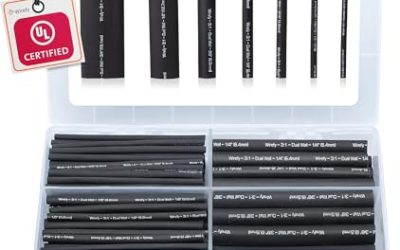
Hot air also handles smaller jobs: heat shrink tubing, conformal coating removal, and warped plastic brackets. The five stations below run from a 2-in-1 combo to a 1000-watt gun built for thick boards and lead-free solder.
As an Amazon Associate, we earn from qualifying purchases.
How to Choose a Hot Air Rework Station for PC Building
Power. Wattage decides how fast the gun heats up and how well it holds temperature against a big ground plane. The 700-watt stations here handle small chips, ports, and capacitors on standard boards. The 1000-watt guns recover faster and suit lead-free solder, thick boards, and large BGA packages.
Temperature and airflow. Most rework happens between 600 and 800 degrees Fahrenheit, with lead-free joints needing the upper end. Every station here reaches at least 896 degrees, and two reach 932. PID control holds the set point as you move the gun. Airflow tops out near 120 L/min on most bench stations: high airflow spreads heat over a large chip, low airflow keeps heat on one small part without blowing neighbors off the board.
Nozzles, presets, and safety. A wide nozzle covers a whole chip, a narrow one targets a single row of pins. Three or four nozzles cover most PC work. Three preset channels store your common temperature and airflow combinations for one-press switching. If you do not already own a good soldering iron, a 2-in-1 station is the sensible buy; if you do, a dedicated hot air station gives you a better gun for the same bench space. Look for automatic sleep, automatic cooling, and an ESD-safe design. Every station here is a 110-volt US model.
1. YIHUA 8786D I 2-in-1 Hot Air Rework and Soldering Station — Best Overall

The YIHUA 8786D I is the station most PC builders should buy first, because it covers both sides of board work in one box. The iron handles normal joints, the hot air gun removes parts, and each has its own display, power switch, and PID temperature control.
The hot air side runs from 212 to 896 degrees Fahrenheit with airflow up to just under 120 liters per minute from a brushless motor. Four nozzles in 4.4, 7, 9, and 12 mm cover single capacitors to wide QFP chips. The iron side runs from 392 to 896 degrees Fahrenheit and ships with 10 tips, a desoldering pump, an IC extractor, and a roll of lead-free solder.
The gun sleeps in its holder, and a fail-safe sounds an alarm and cuts the heater if airflow stops. One listing note: the iron wattage is stated differently in different parts of the product page, so treat 740 watts as the total for the whole station.
Specs
- Power: 740 watts total (hot air plus iron)
- Hot air temperature range: 212 to 896 degrees Fahrenheit (100 to 480 degrees Celsius)
- Iron temperature range: 392 to 896 degrees Fahrenheit (200 to 480 degrees Celsius)
- Airflow: Under 120 L/min, brushless motor
- Nozzles: 4 (4.4, 7, 9, and 12 mm)
- Display: Dual LED displays with PID temperature control
- Features: Sleep mode, in-holder standby, air-failure fail-safe, cool and hot air conversion, ESD-safe
- Size: 5.8 x 3.9 x 5.3 inches
- Included: 10 soldering tips, 4 nozzles, desoldering pump, IC extractor, lead-free solder roll
- ASIN: B07SCPZJYS
2. YIHUA 959D Digital Hot Air Rework Station — Best Standalone Hot Air

If you already own a soldering iron you like, the YIHUA 959D is the better buy than a combo. It is a dedicated hot air station with no iron taking up bench space, and it puts its whole 700 watts into the gun. The temperature range runs from 212 to 932 degrees Fahrenheit, the highest top end of the 700-watt stations here, with airflow up to 120 liters per minute from a brushless motor.
Three preset channels store your most-used temperature settings, so switching between leaded rework, lead-free rework, and heat shrink takes one press. The brushed aluminum front panel resists scorch marks, and the LED Nixie tube display is easy to read. In-holder standby cools the gun when you park it, and a fail-safe cuts the heater if airflow stops. The kit includes three nozzles, two pairs of ESD-safe tweezers, an IC extractor, and a heat-resistant silicone work mat.
One listing quirk: one section shows a shorter range that belongs to a different model; the specification table and title both confirm 212 to 932 degrees Fahrenheit.
Specs
- Power: 700 watts
- Temperature range: 212 to 932 degrees Fahrenheit (100 to 500 degrees Celsius)
- Airflow: Up to 120 L/min, brushless motor
- Presets: 3 memory channels
- Nozzles: 3
- Display: LED Nixie tube with PID temperature control
- Features: In-holder standby, gun fail-safe, digital temperature calibration, Fahrenheit and Celsius display, ESD-safe
- Voltage: 110 to 127 volts
- Included: 3 nozzles, 2 pairs ESD-safe tweezers, IC extractor, silicone work mat
- ASIN: B08BK3M6YW
3. Quick 861DW Hot Air Rework Station — Best for Heavy Rework
The Quick 861DW is the professional pick in this group, and the one repair shops reach for when a board fights back. Its 1000-watt heater drives a temperature range of 212 to 932 degrees Fahrenheit with airflow up to 120 liters per minute, and the extra power shows up as faster heat-up and steadier temperature on thick boards with heavy ground planes.
Three programmable channels store temperature and airflow together, so each preset is a complete working setup rather than a temperature alone, plus password protection and a key lock. Automatic sleep engages when the gun sits in its magnetic holder, and automatic cooling runs the fan after shutdown to protect the element. Three nozzles ship in the box; the maker and manual disagree on their sizes, so this guide does not state diameters.
Confirm the listing is the 110-volt US model: the 861DW is also sold in other markets with different mains plugs, and the wrong version needs a transformer.
Specs
- Power: 1000 watts
- Temperature range: 212 to 932 degrees Fahrenheit (100 to 500 degrees Celsius)
- Airflow: Up to 120 L/min, brushless fan
- Presets: 3 programmable channels (temperature plus airflow)
- Nozzles: 3
- Display: LCD with real-time temperature and airflow
- Features: Automatic sleep, automatic cooling, password protection, key lock, magnetic holder switch, ESD-safe
- Voltage: 110 volts AC (US model)
- Size: 7.4 x 9.7 x 5.3 inches
- ASIN: B08L67R484
4. ATTEN ST-862D Hot Air Rework Station — Best Temperature Stability

The ATTEN ST-862D matches the Quick on power at 1000 watts but wins on temperature stability, holding within 1 degree Celsius of the set point according to the listing. That steadiness matters for lead-free work, where the window between a joint that flows and a board that scorches is narrow. The range runs from 212 to 896 degrees Fahrenheit with airflow up to 120 liters per minute, and three presets switch between stored combinations.
Four nozzles ship in the box, in 5, 8, 8, and 10 mm, split between straight and spiral wind types. The spiral nozzles swirl the air around a chip for even heating, while the straight nozzles focus it on one spot. A silicone gun cord stays flexible and resists melting if it brushes a hot iron.
The menu interface takes a little learning, but the three preset keys cover daily use. The station is antistatic and ships with a ground wire, holder, and manual. The US listing is a 110-volt model; the specification table’s 230-volt line is a different market version.
Specs
- Power: 1000 watts
- Temperature range: 212 to 896 degrees Fahrenheit (100 to 480 degrees Celsius)
- Airflow: Up to 120 L/min
- Temperature stability: Within 1.0 degree Celsius
- Presets: 3 quick-access setting groups
- Nozzles: 4 (5, 8, 8, and 10 mm, straight and spiral types)
- Display: Digital display with menu-style operation
- Features: Silicone gun cord, automatic sleep, antistatic design, ground wire included
- Voltage: 110 volts (US listing)
- Included: 4 nozzles, holder, ground wire, manual
- ASIN: B09HRN6J29
5. WEP 858D Hot Air Rework Station — Best Simple Station
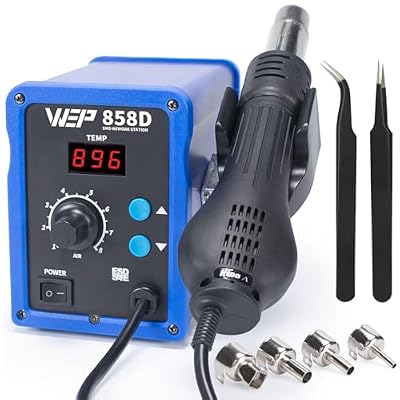
The WEP 858D is the simplest station in this guide, and that is its appeal. It does one job, hot air, with a digital temperature control, adjustable airflow, and three nozzles. The 700-watt heater covers a range of 212 to 896 degrees Fahrenheit with airflow up to 120 liters per minute across eight levels, and PID stabilization holds the set temperature while you work. Automatic cooling runs when the gun sits in its holder, and the body, under 6 inches wide, fits a crowded bench.
What you give up against the pricier stations is presets and power. There are no memory channels, so you dial in temperature and airflow each time, and the 700-watt heater takes longer on thick boards than the 1000-watt guns. For occasional repairs, that trade is easy to accept.
Naming warning: 858D is a shared platform sold under dozens of brands with different specifications. This pick is the WEP 858D specifically; do not mix its figures with other brands’ 858D listings.
Specs
- Power: 700 watts
- Temperature range: 212 to 896 degrees Fahrenheit (100 to 480 degrees Celsius)
- Airflow: Up to 120 L/min, 8 levels, brushless fan
- Nozzles: 3
- Display: LED Nixie tube with PID temperature control
- Features: Automatic cooling and standby, fast heat-up
- Voltage: 110 to 127 volts
- Size: 5.9 x 3.94 x 5.12 inches
- Included: 3 hot air nozzles
- ASIN: B0BXN5JD3T
How the Five Compare
The YIHUA 8786D I is the best starting point for most builders because it is the only station here with a soldering iron included. The YIHUA 959D is the better choice if you already own an iron, with the highest ceiling of the 700-watt stations and three presets.
For heavy work, the Quick 861DW and the ATTEN ST-862D share the 1000-watt top tier. The Quick reaches 932 degrees Fahrenheit and stores temperature plus airflow in each preset, while the ATTEN holds a tighter stability figure and ships four nozzles including spiral types. The WEP 858D suits occasional repairs and tight benches at the smallest footprint here.
FAQ
Do I need a hot air station for PC repair?
You need one if you remove surface-mount parts, USB-C ports, or chips with many pins. An iron heats one pin at a time, so a multi-pin connector cannot come off cleanly, and forcing it lifts pads off the board. Hot air heats every joint at once so the part lifts free. If you only solder wires and through-hole parts, an iron is enough.
What temperature should I use for SMD rework?
Most leaded solder work happens between 600 and 700 degrees Fahrenheit at the nozzle, with lead-free joints needing 700 to 800 degrees. Start at the low end and raise the temperature only if the solder does not flow within a few seconds. Keep the gun moving in small circles, and protect nearby plastic with heat-resistant tape.
Should I buy a 2-in-1 combo or a dedicated hot air station?
Buy the 2-in-1 combo if you do not already own a temperature-controlled soldering iron. Buy a dedicated hot air station if you already have an iron you trust, because the dedicated units put all their power into the gun.
Can a hot air station damage a motherboard?
Yes, if used carelessly. Sustained heat above 800 degrees Fahrenheit can delaminate a board, melt plastic connectors, and damage nearby capacitors. Work in short passes, keep the nozzle moving, and shield heat-sensitive parts with tape or a metal shield.
Conclusion
A hot air rework station turns board repair from a gamble into a routine job. The YIHUA 8786D I covers the most ground for a first bench with its iron and gun in one box, the YIHUA 959D is the cleanest upgrade for builders who already own an iron, and the Quick 861DW and ATTEN ST-862D bring 1000-watt power for thick boards and lead-free work. The WEP 858D keeps things simple for occasional repairs. Match the station to your work, confirm the 110-volt US listing, and practice on a dead board first.