A trading card collection outgrows shoeboxes fast. Once you are sorting a full set of Pokemon, Magic: The Gathering, Yu-Gi-Oh, or sports cards, the binder becomes the collection itself: the pages you flip through at trade night, the album that keeps foils flat, and the first thing a buyer asks to see. The wrong binder bends corners, lets cards slide out, or fills up just as a new set drops.
- How to Choose a Trading Card Binder
- 1. Vault X Exo-Tec 9-Pocket Zip Binder, Green
- 2. Ultra Pro Vivid 9-Pocket Zippered PRO-Binder, White
- 3. Ultra Pro 9-Pocket Black PRO-Binder
- 4. Fabmaker Premium Zip Card Binder 12-Pocket, Teal
- 5. CardGuard Premium 3-Inch 3-Ring Trading Card Binder
- Comparison: Which Binder Fits Your Collection?
- Frequently Asked Questions
- Conclusion
This guide covers five binders that take different approaches to the same job: three zip folios with permanently bound pages, one classic strap album, and one true 3-ring binder you can expand with fresh pages. Every pick uses side-loading pockets and acid-free, non-PVC pages, so the choice comes down to capacity, closure, and how you use your collection.
As an Amazon Associate, we earn from qualifying purchases.
How to Choose a Trading Card Binder
Read the pocket math before the headline number. A “9-pocket” count is per side of a page. Every page in this guide is double-sided, so one sheet holds 18 cards: 9 pockets on the front and 9 on the back. A 20-page 9-pocket binder therefore holds 360 cards (9 x 2 x 20), and a 38-page 12-pocket binder holds 912 (12 x 2 x 38). When a listing gives only a page count, do the arithmetic yourself.
Side-loading pockets beat top-loading for cards that travel. A side-loading pocket opens on the inner edge of the page, so gravity and the neighboring page keep cards seated when the binder tips sideways in a bag. Top-loading pages suit a binder that never leaves a shelf, but every pick here is side-loading for a reason.
Zip folio, strap album, or 3-ring binder is a real fork in the road. A zip folio seals the whole album shut, the safest option for transport and for keeping dust out. A strap album is lighter and faster to open, and lies flatter on a table. A 3-ring binder is the only format you can expand: when the included pages fill up, you buy more pages instead of a second binder. The trade-off is the rings themselves. Cards in the pockets nearest the spine can pick up dents from the metal rings, especially if the binder is overfilled or stored on its side. D-ring binders spread the load better than round rings and dent less, and a ringless zip folio avoids the issue entirely. That is why the 3-ring pick here is framed as the expandable, budget-friendly option rather than the protection pick: the most flexible binder here, not the safest for high-value singles.
Check the page material, not just the cover. All five picks use acid-free, non-PVC pages, which is the minimum for long-term storage. PVC pages can yellow and stick to card surfaces over years; acid-free polypropylene will not. If a listing does not state its page material, treat that as a gap.
Mind sleeve fit. Most collectors sleeve cards in penny sleeves or Deck Protector sleeves before they go into a binder. A pocket sized for a bare card will fight a sleeved one, and a double-sleeved card needs more room still. The picks below state sleeve fit where the listing confirms it.
Toploaders are a different product. A standard 9-pocket page holds sleeved cards, not rigid toploaders. If your collection lives in toploaders, you need a toploader binder with wider, deeper pockets; forcing one into a standard pocket will stretch it.
1. Vault X Exo-Tec 9-Pocket Zip Binder, Green

The Vault X Exo-Tec is the premium zip pick here, and the one most often recommended at card shops. Its Exo-Tec cover is a padded polyurethane that is water-resistant and non-slip, with a full zipper that seals the album shut. Inside are 20 double-sided pages with 9 side-loading pockets per side, for 360 cards total. The pockets are 200-micron thick, noticeably sturdier than the thin sleeves in budget albums, and a layer of padding between each page keeps foil cards from pressing against each other when the binder is full.
The listing states the binder fits single or double-sleeved cards. The Green colorway covered here is one of six; other colors are separate listings, so match the color to the ASIN.
Specs
- Capacity: 360 cards (20 double-sided pages, 9 side-loading pockets per side)
- Cover: Padded Exo-Tec polyurethane, water-resistant, non-slip
- Pockets: 200-micron thick, acid-free, PVC-free
- Closure: Full zipper
- Size: 26 x 35 cm (10.2 x 13.8 in)
- Sleeve fit: Single and double-sleeved cards
- Model: VX-EX01-09GN
- ASIN: B082J4H9D3
2. Ultra Pro Vivid 9-Pocket Zippered PRO-Binder, White

Ultra Pro has made card storage for decades, and the Vivid line is its colorful zippered album. The White version pairs a padded leatherette cover with a matching zipper and pull tab, and the same 20-page, 9-pocket layout as the Vault X: 360 cards in Deck Protector sleeves. What sets the Vivid apart is the page backing: a low-friction black backing separates the front pockets from the back pockets, so cards do not rub against each other through the page, and the black background gives every card a framed look.
The Vivid is the pick for collectors who want the zip folio format with a softer, leatherette feel rather than the Vault X’s rigid padded shell, and it is widely stocked, which makes it easy to match colors across a set of albums.
Specs
- Capacity: 360 cards (20 double-sided pages, 9 side-loading pockets per side)
- Cover: Padded leatherette with matching zipper and pull tab
- Pages: Low-friction black backing between front and back pockets
- Material: Acid-free, non-PVC
- Closure: Full zipper
- Color: White
- Model: 16176
- ASIN: B0BWP1MD24
3. Ultra Pro 9-Pocket Black PRO-Binder

The classic Ultra Pro PRO-Binder is the album that defined the category. It skips the zipper entirely: an elastic strap holds the binder shut, and the embossed black web cover gives cards a framed look behind the clear pockets. The layout is the familiar 20 side-loading 9-pocket pages for 360 cards in Deck Protector sleeves, in archival-safe, acid-free, non-PVC materials.
Without a zipper, this binder is lighter and quicker to open than the two zip folios above, and it lies flatter when you flip through pages at a table. The trade-off is protection in transit: the strap keeps the cover closed but does not seal the edges the way a zipper does. For a binder that mostly lives on a shelf, that trade-off is easy to accept, and the Black PRO-Binder is the simplest album in this guide.
Specs
- Capacity: 360 cards (20 double-sided pages, 9 side-loading pockets per side)
- Cover: Embossed black web material
- Closure: Elastic strap (no zipper)
- Material: Archival-safe, acid-free, non-PVC
- Weight: 16 oz
- Color: Black
- UPC: 074427826000
- ASIN: B004T2CBD4
4. Fabmaker Premium Zip Card Binder 12-Pocket, Teal
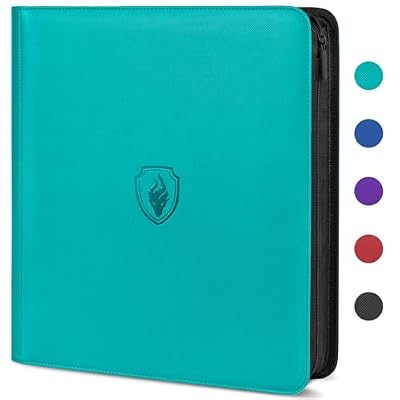
If 360 cards is not enough, the Fabmaker 12-pocket binder more than doubles the room: 912 cards across 38 double-sided pages with 12 side-loading pockets per side, the max-capacity pick here by a wide margin. The cover is polyurethane with a zipper closure, and the pages are acid-free and non-PVC. At 15 x 13.6 inches, it is also the largest binder in this guide, so check your shelf depth before ordering.
The 12-pocket layout suits collectors who organize by set number in long runs, since a single spread holds 24 cards, and anyone consolidating several smaller albums into one. The Teal colorway is the listing covered here; Royal Blue, Pink, and Black are separate listings with their own ASINs.
Specs
- Capacity: 912 cards (38 double-sided pages, 12 side-loading pockets per side)
- Cover: Polyurethane (PU) with zipper closure
- Pages: Side-loading, acid-free, non-PVC
- Size: 15 x 13.6 in
- Color: Teal
- Part number: 01A0207-1801A
- ASIN: B0D8KPH65Z
5. CardGuard Premium 3-Inch 3-Ring Trading Card Binder

The CardGuard is the only true ring binder in this guide, and the only one you can grow. It ships with 100 included 9-pocket side-loading pages in a 3-inch 3-ring binder, and when those pages fill up, you add more standard 9-pocket pages instead of buying a second album. The pages are acid-free and non-PVC with a hologram seal.
Two things to know before buying. First, the listing states no total card count, so this guide states the included page count only: 100 pages. By double-sided arithmetic, 100 pages x 9 pockets x 2 sides works out to 1,800 pockets, but that figure is our arithmetic, not a number from the listing. Second, the ring-dent caveat applies here more than anywhere: keep the rings well under capacity, store the binder upright, and do not leave valuable singles in the pockets closest to the spine. Used that way, the CardGuard is the most flexible storage in this lineup.
Specs
- Included pages: 100 side-loading 9-pocket pages (listing states no total card count)
- Rings: 3-inch, 3-ring
- Pages: Acid-free, non-PVC, hologram seal
- Size: 11.38 x 11.5 x 2.88 in
- UPC: 097629550610 / 097712527901
- ASIN: B075Q4P3P8
Comparison: Which Binder Fits Your Collection?
| Binder | Pockets per page | Pages | Total cards | Closure | Best for |
|---|---|---|---|---|---|
| Vault X Exo-Tec 9-Pocket, Green | 9 | 20 | 360 | Zipper | Premium protection, double-sleeved cards |
| Ultra Pro Vivid 9-Pocket, White | 9 | 20 | 360 | Zipper | Leatherette zip folio, framed look |
| Ultra Pro 9-Pocket Black PRO-Binder | 9 | 20 | 360 | Elastic strap | Classic shelf album, quick access |
| Fabmaker 12-Pocket, Teal | 12 | 38 | 912 | Zipper | Max capacity, long set runs |
| CardGuard 3-Inch 3-Ring | 9 | 100 included | 100 pages (see note) | 3-ring | Expandable storage, growing collections |
For most collectors, the choice is between the two 360-card zip folios: the Vault X for the thickest pockets and the most protective shell, the Ultra Pro Vivid for the leatherette cover and black-backed framed pages. The strap PRO-Binder wins when the album rarely leaves the house, the Fabmaker when one binder must hold a whole collection, and the CardGuard when the collection keeps growing and you would rather buy pages than albums.
Frequently Asked Questions
How many cards does a 9-pocket binder actually hold?
A 9-pocket binder with 20 double-sided pages holds 360 cards. The pocket count is per side, so each page holds 18 cards: 9 on the front and 9 on the back. Multiply pockets per side by 2 sides by the number of pages to get the true capacity of any binder.
Are side-loading pockets better than top-loading pockets?
For cards that travel, yes. A side-loading pocket opens on the inner edge of the page, so the neighboring page and gravity keep the card seated when the binder tips sideways. Top-loading pockets let cards slide out the top if the binder is carried upside down or jostled in a bag. All five binders in this guide use side-loading pockets.
Can I store double-sleeved cards in these binders?
The Vault X Exo-Tec listing states it fits single and double-sleeved cards. The Ultra Pro binders are sized for cards in Deck Protector sleeves, the standard single sleeve most collectors use. Double-sleeved cards are thicker, so confirm pocket depth on the listing before ordering if you double-sleeve everything.
Do 3-ring binders damage trading cards?
They can, in one specific way: cards in the pockets nearest the spine can pick up dents from the metal rings, especially if the binder is overfilled, stored on its side, or carried by the rings. D-ring binders spread the load better than round rings and dent less, and ringless zip folios avoid the issue entirely. If you use a 3-ring binder, keep the rings well under capacity, store it upright, and keep your most valuable singles away from the spine-side pockets.
Conclusion
A good binder is the cheapest insurance a card collection has. The Vault X Exo-Tec is the strongest all-around pick here, with the thickest pockets and a sealed, padded shell that handles travel and trade nights. The Ultra Pro Vivid is the zip folio for collectors who prefer a leatherette cover and the framed look of black-backed pages, and the classic Black PRO-Binder remains the simplest shelf album you can buy. For sheer capacity, nothing here touches the 912-card Fabmaker, and for a collection that never stops growing, the expandable CardGuard is the only pick that grows with it.