Undervolt GPU checklist 2026 helps you shop for a graphics card that can cut heat and power without turning tuning into guesswork. The best picks combine sensible stock power, strong coolers, and accessible voltage controls, so you have room to find a quieter, more efficient setting while keeping gaming performance close to stock.
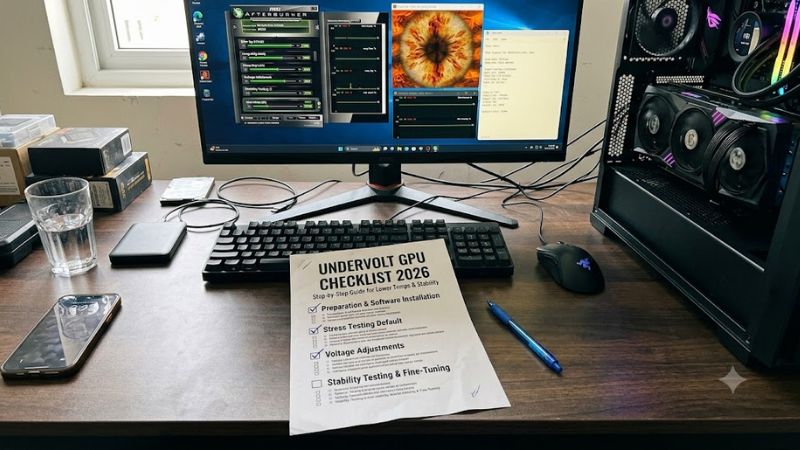
How to Choose a GPU for Undervolting
This undervolt gpu checklist 2026 starts with a simple truth: a GPU must sustain a target clock at less voltage, but every chip has its own stability limit. For a buying guide, prioritize cooler capacity, clear tuning software, and a power profile that leaves useful headroom instead of chasing the lowest practical wattage.
Power Target
The first filter in an undervolt gpu checklist 2026 is the card’s stock power target. Higher-power GPUs can gain more absolute watts from tuning, yet they create more heat to manage. The ASUS TUF Gaming RTX 5070 Ti has a 300W class design, while the ASRock B580 is lighter at the platform level, making cooling notably easier.
Power is most important when your goal is lower fan noise or a smaller PSU margin, not a benchmark score. A 250W RTX 5070 can be an easier efficiency project than a hotter flagship. For bigger performance targets, the Sapphire NITRO+ RX 9070 XT gives more performance headroom to trade for watts during sustained gaming loads.
Cooler Capacity
Cooler design determines how useful your voltage cut feels in real games. A larger heatsink can hold a chosen clock with less fan speed, while a slim cooler may force higher temperatures sooner. The MSI RTX 5070 VENTUS 2X and ASRock B580 Challenger use compact dual-fan layouts suited to moderate tuning and mainstream cases.
Look at card thickness, heatpipe coverage, and airflow before assuming undervolting will make any GPU silent. The ASUS TUF RTX 5070 Ti uses a large 3.125-slot cooler, making it the stronger choice for sustained high-end loads. The Sapphire NITRO+ RX 9070 XT also uses a substantial triple-fan cooler for heavy gaming and rendering.
Resolution And VRAM Needs
Resolution changes how much performance you can give up before noticing it, so an undervolt gpu checklist 2026 should start with your target workload. At 1080p, a modest clock reduction may barely matter; at 4K, memory bandwidth and sustained clocks can matter more than a tiny voltage change during demanding scenes and long sessions.
For 1440p value systems, the ASRock Intel Arc B580 Challenger offers 12GB of GDDR6 and a 2740MHz factory engine clock, giving budget builders a clear baseline for efficient tuning. For heavier 4K gaming, the Sapphire NITRO+ RX 9070 XT brings 16GB across a 256-bit bus, leaving more room for demanding textures and higher presets.
Tuning Software
Tuning controls are the difference between a repeatable setup and endless trial and error. AMD Software exposes automatic and manual GPU tuning on supported Radeon cards, while NVIDIA cards commonly use a voltage-frequency editor in tools such as MSI Afterburner. That makes software access part of the purchase decision.
Intel is also more capable than early Arc buyers may remember: Intel’s graphics tuning software provides voltage-limit, power-limit, and voltage-frequency controls for B580-class cards. That gives the ASRock B580 Challenger a legitimate tuning path, while ASUS GPU Tweak III makes the TUF RTX 5070 Ti easy to adjust within its ecosystem.
Top Picks
These picks cover four different reasons to undervolt: maximizing overall efficiency, stretching a value build, taming a high-end card, or fitting a practical 1440p system. The goal is not the biggest voltage cut; it is a stable setting that lowers unnecessary heat and power while preserving the frame rate you actually need.
| Product | Best For | Key Spec | Watch Out For |
|---|---|---|---|
| Sapphire NITRO+ AMD Radeon RX 9070 XT OC 16GB | Best Overall | 16GB GDDR6, 256-bit, up to 3060MHz | 3.2-slot, about 330.8mm long |
| ASRock Intel Arc B580 Challenger 12GB OC | Best Value | 12GB GDDR6, 2740MHz, 19Gbps | Driver quirks in some older games |
| ASUS TUF Gaming GeForce RTX 5070 Ti 16GB GDDR7 | Best For High-End Quiet Gaming | 16GB GDDR7, 256-bit, 2452MHz default boost | 3.125-slot, 850W recommended PSU |
| MSI GeForce RTX 5070 12G VENTUS 2X OC | Best For Efficient 1440p Builds | 12GB GDDR7, 250W, 2542MHz boost | 12GB VRAM and 192-bit bus |
Sapphire NITRO+ AMD Radeon RX 9070 XT OC 16GB — Best Overall
Sapphire NITRO+ AMD Radeon RX 9070 XT OC 16GB is Best Overall for owners who want substantial 4K-class performance with AMD’s accessible tuning stack. The card uses 16GB GDDR6 on a 256-bit interface and reaches as high as 3060MHz, while AMD rates the RX 9070 XT at 304W typical board power at the GPU level during full load.
The NITRO+ model adds Tri-X cooling, a substantial metal structure, and premium power delivery, useful traits for sustained loads. Its downside is size: this 3.2-slot card measures about 330.8mm long and 65.7mm high. That makes it a strong efficiency canvas, but a poor match for short or tightly packed cases with limited clearance.
ASRock Intel Arc B580 Challenger 12GB OC — Best Value
ASRock Intel Arc B580 Challenger 12GB OC is Best Value for 1440p buyers who want direct voltage-frequency controls without paying flagship money. It carries 12GB of GDDR6, a 2740MHz engine clock, and a 19Gbps memory rate, while Intel’s B580 platform is rated at 190W TBP, giving an efficient starting point for measured tuning.
Its 249mm length and 2-slot thickness make the Challenger easier to place in mainstream builds, and its dual-fan cooler includes 0dB operation at low temperatures. The compromise is driver maturity across older or unusual games, so buyers should expect more game-specific troubleshooting than with NVIDIA or AMD in some titles.
ASUS TUF Gaming GeForce RTX 5070 Ti 16GB GDDR7 — Best For High-End Quiet Gaming
ASUS TUF Gaming GeForce RTX 5070 Ti 16GB GDDR7 is Best For High-End Quiet Gaming when you want a powerful card that can trade some stock voltage for lower thermals. It has 8960 CUDA cores, 16GB GDDR7 on a 256-bit bus, a 28Gbps memory rate, and a 2452MHz default boost clock, giving ample performance headroom for efficiency tuning.
The TUF cooler, 3.125-slot construction, and robust physical design are well suited to long gaming sessions where fan noise matters. The weakness is case compatibility: at 329 x 140 x 62.5mm and with an 850W recommended PSU, it needs a roomy build and sensible power-delivery planning, particularly around the 16-pin plug.
MSI GeForce RTX 5070 12G VENTUS 2X OC — Best For Efficient 1440p Builds
MSI GeForce RTX 5070 12G VENTUS 2X OC is Best For Efficient 1440p Builds that need a smaller footprint than large flagship cards. MSI lists 12GB of GDDR7, a 2542MHz boost clock, 250W power consumption, and dimensions of 236 x 126 x 50mm, making the platform easy to size in a mid-tower or compact ATX build with normal airflow.
The VENTUS 2X OC uses a compact dual-fan layout and remains a sensible target for a moderate voltage curve rather than an extreme performance experiment. Its main limitation is the 12GB memory capacity and 192-bit bus, which can become more relevant at high resolutions or with demanding texture settings in newer games.
Frequently Asked Questions
Most buyers do not need to chase a record undervolt. This undervolt gpu checklist 2026 focuses on stable profiles that survive the games and workloads you actually run, with no driver resets, visual corruption, or repeatable crashes. The questions below cover what changes during tuning and when leaving stock settings is smarter.
Can Undervolting Lower GPU Heat And Power?
Yes, undervolting can lower GPU power, temperature, and fan noise while retaining much of the original performance. AMD explicitly describes its Undervolt GPU preset as reducing voltage while maintaining clock speeds on supported Radeon cards, while MSI notes similar benefits from a voltage-frequency curve. Results vary by chip.
The important exception is silicon variation: one card may hold a clock at a voltage another card cannot. Start conservatively, change one variable at a time, and test with a repeatable game or benchmark. A profile that passes one light workload can still fail after a longer, heavier session, especially as temperatures rise.
Should I Save A Stock Profile Before Undervolting?
No. A good undervolt gpu checklist 2026 should include a way back to stock settings before you change anything. Record the factory clock, memory, power, and fan behavior first, then save a known-good profile so a failed experiment does not become a troubleshooting project. That baseline also helps compare before-and-after results.
For recovery, use the tuning software’s reset command and avoid changing controls at once. If a driver crash occurs, return to the last stable profile before lowering voltage again. Keeping a stock profile also makes it easier to separate a tuning problem from a driver or game update issue, which may otherwise look similar.
What Voltage Should I Start With?
A useful starting range is not universal because GPU silicon, cooler quality, game load, and factory settings vary. The practical approach is to choose a modest voltage reduction, keep the desired clock near stock, then test before making another small change rather than copying someone else’s exact curve or voltage point.
The safest target is the lowest voltage that remains stable for your real workload, not the lowest number a slider allows. Heavy ray tracing, shader compilation, or long sessions can expose instability that short tests miss. For this reason, benchmark results should confirm the profile, not define it, and game testing still matters.
When Should I Leave A GPU At Stock Settings?
Leave the GPU stock when the small power savings are not worth the added testing, or when you depend on maximum out-of-the-box stability for work. An undervolt gpu checklist 2026 is most useful when noise, heat, power limits, or sustained clocks are genuine concerns rather than problems you invented for tuning without a clear goal.
Stock settings are also sensible when a case already has good acoustics, temperatures are comfortably low, and performance is the priority. A card such as the ASUS TUF RTX 5070 Ti has enough cooling to explore efficiency tuning, but there is no requirement to change it just because the software offers the controls or profiles.
Final Thoughts
For most buyers, the Sapphire NITRO+ RX 9070 XT is the strongest all-around efficiency project, while the ASRock B580 Challenger wins on value. The ASUS TUF RTX 5070 Ti suits quiet high-end gaming, and MSI’s RTX 5070 is the balanced 1440p option. Use this undervolt gpu checklist 2026 as a buying filter, not a promise of identical results.