🛒 Best Price Today on Amazon
Prime members get fast, free shipping on everything above, plus member-only deals. New members get a 30-day free trial — cancel anytime.
Thermal Paste: The Most Overlooked PC Maintenance Task
Thermal paste fills the microscopic gaps between your CPU heat spreader and the cooler’s contact plate, sharply improving thermal conductivity. Over time (2–4 years), it dries out, cracks, and loses its bite. Replacing it is one of the highest-impact maintenance jobs going — dropping CPU temps by 5–20°C for free.
Signs You Need to Replace Thermal Paste
- CPU temperatures are higher than when you first built the PC (5°C+ increase)
- CPU hitting 90°C+ under gaming load despite a clean heatsink
- Thermal throttling (CPU clock drops under load)
- PC is 2+ years old and has never had paste replaced
- Removing the cooler for any reason (always re-paste after cooler removal)
Best Thermal Paste in 2026
| Thermal Paste | Type | Performance | Best For |
|---|---|---|---|
| Thermal Grizzly Kryonaut | Non-conductive | Excellent | Most builds — safest choice |
| Thermal Grizzly Conductonaut | Liquid metal | Best possible | Advanced users — delidded CPUs only |
| Noctua NT-H2 | Non-conductive | Very good | Reliable mainstream option |
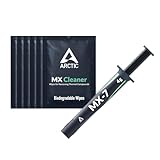
| Arctic MX-6 | Non-conductive | Very good | Best budget option |
| IC Diamond 24 Carat | Non-conductive | Good | Long-term stability focus |
Step-by-Step: How to Reapply Thermal Paste
Step 1: Gather Materials
You’ll need: thermal paste, isopropyl alcohol (90%+), a lint-free cloth or coffee filters, a screwdriver, and optionally latex gloves. IPA 90% is essential — don’t use rubbing alcohol (70%), as it leaves residue.
Step 2: Power Down and Remove Cooler
Power off completely and unplug the PC. Remove the cooler by loosening the mounting screws in a diagonal pattern (loosen all of them slightly before fully removing any). For Intel LGA coolers, turn push-pins counter-clockwise before pulling. For AM5 coolers, back the screws out evenly. The cooler may stick a little — gently twist rather than yank straight up.
Step 3: Remove Old Thermal Paste
Apply IPA 90% to a lint-free cloth and wipe the CPU heat spreader and cooler contact plate in one direction. Don’t scrub in circles — wipe one direction each pass. Repeat until no grey residue is left on either surface. Both should end up clean and slightly shiny.
Step 4: Apply New Thermal Paste
The pea-sized dot method works best for most CPUs: drop a pea-sized (3–4mm) dot of paste in the center of the heat spreader. Mounting the cooler spreads it evenly under pressure. Do NOT overdo it — excess paste squeezes out the sides and can (rarely) reach the socket.
For large CPUs (Intel LGA1851, AMD AM5 high-end chips), a cross or X pattern improves coverage across the bigger die area.
Step 5: Reinstall Cooler
Lower the cooler straight down onto the CPU. Tighten the mounting screws in a diagonal/star pattern — snug all four gradually for even pressure. Don’t overtighten. Reconnect the CPU fan header to the motherboard (usually the CPU_FAN header).
Step 6: Verify Results
Boot into Windows and run Prime95 or Cinebench R23 for 10–15 minutes while watching temperatures in HWiNFO64. Compare to your old numbers. A successful re-paste typically drops peak temps by 5–15°C. If temps went up, the cooler may not be making proper contact — re-seat it.
As an Amazon Associate we earn from qualifying purchases at no extra cost to you.




How long does thermal paste last?
Can too much thermal paste damage components?
Do I need thermal paste with a new cooler?
What’s the difference between thermal paste and thermal pads?
Frequently Asked Questions
How often should I reapply thermal paste on my CPU?
Most quality pastes last three to five years before drying out, so reapplication is rarely needed on a regular schedule. Redo it whenever you remove the cooler, notice climbing idle temperatures, or see thermal throttling during gaming that a good cleaning does not resolve.
How much thermal paste should I apply?
A small pea-sized dot in the center of the integrated heat spreader is enough for most consumer CPUs. The cooler’s mounting pressure spreads it evenly across the surface. Too much paste can ooze onto the socket or actually insulate rather than transfer heat.
What should I use to clean off the old paste?
Use 90 percent or higher isopropyl alcohol with a lint-free cloth, coffee filter, or microfiber pad. Avoid paper towels that shed fibers and never use water. Let the surface dry completely before applying fresh paste so no moisture is trapped underneath.
Do I need to remove the CPU from the socket?
No, and you should not. Leave the CPU seated in its socket and only clean the top of the heat spreader. Removing it exposes delicate pins or contacts to damage. Simply detach the cooler, wipe both mating surfaces, then apply new paste.
Is liquid metal better than regular paste?
Liquid metal conducts heat far better and can drop temperatures several degrees, but it is electrically conductive and can short components or corrode aluminum coolers if it spills. For most users a premium non-conductive paste is safer and delivers excellent results without the risk.
Ready to decide? Our #1 pick for 2026 is the Thermal Grizzly Kryonaut.
Live price & availability on Amazon.
Top picks from this guide
 Thermal GrizzlyThermal Grizzly Kryonaut - 1 Gram Thermal Paste Extremely High…$9 \xc2\xb7 99/100
 BSFFThermal Paste CPU 1.8g with Toolkit for CPU GPU IC…$5 \xc2\xb7 98/100
 HiSoloHiSolo 2‑Pack 8g Total (4g Each) 13W/m‑K High‑Grade Thermal Paste…$4 \xc2\xb7 97/100
 ARCTICARCTIC MX-4 (4 g) - Premium Performance Thermal Paste for…$5 \xc2\xb7 96/100