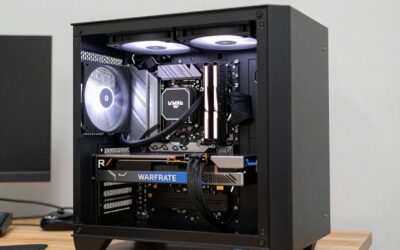
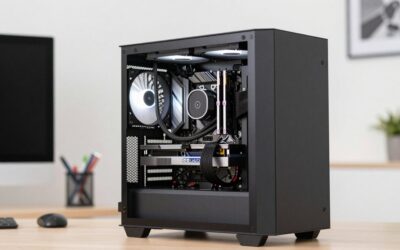
- Top Pick: Skytech Gaming O11 Vision Gaming PC, AMD Ryzen 7 7700X 4.5GHz, NVIDIA RTX 5070 12GB, X670 Board, 1TB Gen4 NVMe SSD, 32GB DDR5 RAM 5600, 850W Gold ATX 3 PSU, 360 ARGB AIO, Wi-Fi, Win 11, Desktop
- Best Value: Skytech Gaming PC King 95, Ryzen 7, RX 9070 XT, 32GB RAM, 1TB SSD
- Premium Choice: Skytech Gaming Chronos Mini Gaming PC, Ultra 7 U7 270K Plus, RTX 5060
Building the best gaming PC build for Minecraft requires understanding how the game interacts with modern PC hardware. While vanilla Minecraft will run on budget office laptops, heavily modded instances, high render distances, high-resolution texture packs, and modern shader suites (such as Complementary, Iris, or SEUS) transform the game into one of the most hardware-demanding titles in PC gaming. Minecraft Java Edition places extreme emphasis on single-core CPU frequency and memory latency, while heavy post-processing and ray tracing demand high GPU rasterization and dedicated tensor cores. As we look at the hardware landscape in 2026, building on a modern, upgradable platform ensures you can run massive 300+ modpacks at 1440p and 4K without frame drops, stuttering, or memory bottlenecks.
Parts List
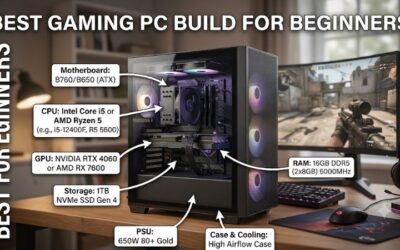
| Part | Model | Approx. Price | Why |
|---|---|---|---|
| Processor (CPU) | AMD Ryzen 5 7600X | Check on Amazon | High single-core clocks essential for Minecraft Java tick rates and simulation. |
| CPU Cooler | Thermalright Peerless Assassin 120 SE | Check on Amazon | Exceptional dual-tower thermal dissipation at an accessible price point. |
| Motherboard | MSI PRO B650-S WIFI | Check on Amazon | Stable AM5 power delivery, integrated Wi-Fi 6E, and multiple M.2 NVMe slots. |
| Memory (RAM) | G.Skill Flare X5 32GB (2 x 16GB) DDR5-6000 CL30 | Check on Amazon | Low-latency sweet-spot memory for allocating 8GB to 12GB to modded JVMs. |
| Storage (SSD) | Crucial T500 1TB PCIe Gen4 NVMe M.2 SSD | Check on Amazon | Ultra-fast random read/write speeds for fast chunk loading and world generation. |
| Graphics Card (GPU) | ASUS Dual GeForce RTX 4070 Super 12GB | Check on Amazon | Superior shader performance, DLSS support, and Bedrock RTX acceleration. |
| Case | Fractal Design Pop Air RGB ATX Mid Tower | Check on Amazon | High-airflow mesh front panel with three pre-installed 120mm fans. |
| Power Supply (PSU) | Corsair RM750e (Fully Modular, 80+ Gold) | Check on Amazon | Reliable power delivery, ATX 3.0 compliance, and plenty of headroom. |
Processor: AMD Ryzen 5 7600X
Minecraft Java Edition runs its primary game loop and simulation engine on a single thread. The AMD Ryzen 5 7600X features six cores, twelve threads, and a boost clock reaching up to 5.3 GHz on the modern Zen architecture, providing the single-thread performance needed to prevent world-tick slowdowns (server lag) when running complex automated farms or hundreds of entity entities. If your budget is tighter, you can swap to the non-X Ryzen 5 7600 to save money while retaining roughly 95% of the performance. If you have extra budget, stepping up to the Ryzen 7 7800X3D provides massive 3D V-Cache benefits in heavily modded setups.
As an Amazon Associate we earn from qualifying purchases at no extra cost to you.


CPU Cooler: Thermalright Peerless Assassin 120 SE
The Thermalright Peerless Assassin 120 SE is a premier air-cooling solution on the market. Featuring dual aluminum heatsink towers and six 6mm heat pipes paired with two 120mm PWM fans, it easily manages the thermal profile of the Ryzen 5 7600X under sustained loads. Sustaining low temperatures ensures your CPU maintains its maximum boost clocks during heavy world generation. If you prefer liquid cooling for aesthetics, you can swap this unit for an Arctic Liquid Freezer III 240, or choose a DeepCool AK620 if you prefer a different minimalist visual style.
Motherboard: MSI PRO B650-S WIFI
The MSI PRO B650-S WIFI offers an excellent balance of core features and affordability on the AM5 socket. It features robust power delivery, dual PCIe 4.0 M.2 slots for rapid storage, integrated Wi-Fi 6E, 2.5Gbps Ethernet, and comprehensive DDR5 memory support. The AM5 platform ensures long-term upgradeability without requiring a motherboard replacement for future processor generations. If you need additional USB ports or heavier heatsinks, consider swapping to the Gigabyte B650 AORUS Elite AX or the ASUS TUF Gaming B650-PLUS WIFI.
Memory: G.Skill Flare X5 32GB (2 x 16GB) DDR5-6000 CL30
Java-based gaming demands rapid memory access. The G.Skill Flare X5 kit runs at DDR5-6000 with a low CAS latency of CL30, representing the optimal 1:1 memory-controller ratio for modern Ryzen platforms. Having 32GB allows you to safely allocate 8GB to 12GB to the Java Virtual Machine for heavy modpacks like All The Mods or ATM9, while leaving ample memory for background applications, Discord, and system processes. If this specific kit is unavailable, the Corsair Vengeance DDR5-6000 CL30 or TeamGroup T-Create Expert 32GB DDR5-6000 CL30 serve as direct drop-in equivalents.
Storage: Crucial T500 1TB PCIe Gen4 NVMe M.2 SSD
Minecraft constantly reads and writes chunk data to disk, especially when flying across terrain with Elytras or generating new modded dimensions. The Crucial T500 utilizes PCIe 4.0 architecture to deliver sequential reads up to 7,300 MB/s alongside exceptional random 4K read performance. This virtually eliminates stutter when loading assets and saving large worlds. If you require more capacity for archiving dozens of large server backups and mod instances, you can easily swap or expand to a 2TB Crucial T500, Kingston KC3000, or Western Digital Black SN850X.
Graphics Card: ASUS Dual GeForce RTX 4070 Super 12GB
While base Minecraft is CPU-bound, running high-end shaders such as SEUS PTGI, Complementary Reimagined, or BSL at high render distances shifts the entire workload onto the GPU. The ASUS Dual GeForce RTX 4070 Super features 12GB of GDDR6X VRAM, exceptional rasterization performance, and dedicated RT cores required for native ray tracing in Minecraft Bedrock RTX. Furthermore, NVIDIA’s OpenGL and Vulkan driver pipelines offer smooth compatibility with Iris and Sodium mods. If your budget is tighter, an AMD Radeon RX 7800 XT or NVIDIA GeForce RTX 4060 Ti 16GB can be swapped in, though ray tracing performance will decrease.
Case: Fractal Design Pop Air RGB ATX Mid Tower
The Fractal Design Pop Air RGB provides great thermal efficiency straight out of the box with its open mesh front panel and three pre-installed 120mm Aspect 12 RGB fans. Excellent airflow keeps both the CPU tower cooler and graphics card supplied with fresh air during long gaming sessions. Cable management channels and dedicated SSD mounting trays make building straightforward. If you want an alternate aesthetic, the Lian Li Lancool 216 or the NZXT H5 Flow are excellent alternative chassis that offer comparable thermal performance and component clearance.
Power Supply: Corsair RM750e 750W 80+ Gold
Powering this system is the Corsair RM750e, an 80+ Gold certified fully modular power supply. It complies with modern ATX 3.0 and PCIe 5.0 power standards, providing native 12VHPWR cabling directly to the RTX 4070 Super without requiring clumsy dual 8-pin adapter splitters. The fully modular design means you only install the cables you need, keeping internal airflow unobstructed. If you plan to upgrade to ultra-high-end halo graphics cards later, you could swap to an 850-watt unit like the Seasonic Focus GX-850 or be quiet! Pure Power 12 M 850W.
Compatibility Check
Before purchasing components, verifying physical and electrical compatibility ensures a seamless build process:
- Socket and Chipset: The AMD Ryzen 5 7600X fits directly into the AM5 socket on the MSI PRO B650-S WIFI motherboard without requiring any legacy BIOS updates.
- Memory Type: The motherboard supports dual-channel DDR5 desktop memory. The chosen G.Skill Flare X5 kit features native AMD EXPO profiles for one-click setup in BIOS.
- PSU Headroom: The estimated peak power consumption of this system is approximately 380 to 420 watts under combined synthetic CPU and GPU load. The 750W Corsair RM750e provides more than 300 watts of headroom, operating within its peak efficiency curve.
- GPU Length: The ASUS Dual RTX 4070 Super measures 267mm in length. The Fractal Design Pop Air supports GPUs up to 405mm, leaving abundant space for front fans and clear cable runs.
- Cooler Clearance: The Thermalright Peerless Assassin 120 SE stands 155mm tall, easily fitting within the Pop Air chassis’s 170mm maximum CPU cooler clearance. Low-profile Flare X5 RAM ensures zero fan-overhang clearance issues.
Expected Performance
Performance in Minecraft varies depending on whether you play vanilla, use optimization mods like Sodium and Iris, or enable ray tracing. The following performance ranges reflect aggregate launch and review data compiled across leading hardware outlets, including TechPowerUp, Tom’s Hardware, Gamers Nexus, Hardware Unboxed, and TechSpot.
1080p Performance
At 1080p, this configuration crushes any Minecraft scenario. With modern optimization engines like Sodium and Iris enabled alongside high-tier shader packs (such as Complementary Shaders at a 24-chunk render distance), Hardware Unboxed and TechPowerUp data on comparable architectures show sustained performance in the 160 to 240 FPS range. Vanilla Minecraft runs well into the 400 to 700 FPS range. In conventional AAA titles, TechSpot testing shows the RTX 4070 Super delivering approximately 110 to 135 FPS in Cyberpunk 2077 (Ultra settings, no ray tracing) and 150 to 180 FPS in Forza Horizon 5.
1440p Performance
At 1440p—the native target resolution for this build—Minecraft with ultra shaders, 24-chunk render distance, and high-resolution texture packs runs smoothly in the 110 to 160 FPS range according to aggregated shader testing methodologies. In official Minecraft Bedrock RTX worlds with hardware path tracing enabled, public review data from Tom’s Hardware indicates frame rates between 75 and 100 FPS with DLSS enabled. In other mainstream titles at 1440p Ultra, TechPowerUp review figures show the RTX 4070 Super achieving approximately 80 to 95 FPS in Cyberpunk 2077 and 130 to 155 FPS in Shadow of the Tomb Raider.
4K Performance
Pushing Minecraft to 4K resolution requires serious GPU power when shaders are active. With Iris and Complementary Shaders set to medium/high profiles at 16-chunk render distance, the system maintains approximately 55 to 80 FPS based on TechPowerUp and Hardware Unboxed GPU scaling benchmarks. Bedrock RTX with DLSS Quality delivers roughly 45 to 65 FPS. In traditional games at native 4K Ultra, Tom’s Hardware and Gamers Nexus data show the card achieving around 45 to 55 FPS in Cyberpunk 2077 and 75 to 90 FPS in Forza Horizon 5.
Upgrade Path
A major advantage of building on the AM5 platform is future-proofing. When you are ready to upgrade down the line, several easy improvements are available without rebuilding your core machine:
- Processor Upgrades: AMD has committed to supporting the AM5 socket with future CPU architectures. You can drop in an X3D processor (such as the Ryzen 7 7800X3D or next-generation equivalents) to dramatically boost simulation performance in 500+ mod environments.
- Memory Expansion: The motherboard has four DIMM slots. While 32GB is plenty for today, adding a matching 32GB kit for a total of 64GB allows you to run local Minecraft dedicated servers simultaneously while playing with high render distances.
- Secondary NVMe Storage: The MSI PRO B650-S WIFI motherboard features a second high-speed M.2 PCIe 4.0 slot, allowing you to install a 2TB or 4TB drive strictly for storing massive game libraries and world backups.
- Graphics Card Upgrades: The 750W ATX 3.0 power supply provides sufficient power delivery and native cabling to support up to 80-class GPUs in the future.
Frequently Asked Questions
Is an NVIDIA GPU better than AMD for Minecraft?
For standard vanilla Minecraft, both AMD and NVIDIA perform excellently. However, NVIDIA maintains a distinct advantage when using heavy shader packs (Iris/OptiFine) and ray tracing. Many popular community shaders are optimized specifically for NVIDIA’s CUDA and OpenGL architectures. Additionally, Minecraft Bedrock RTX officially requires hardware-accelerated ray tracing, where NVIDIA’s RT cores deliver significantly higher frame rates than equivalent AMD cards.
How much RAM should I allocate to Minecraft Java Edition?
For vanilla Minecraft, 2GB to 4GB is ideal. For lightly modded setups (under 50 mods), allocate 4GB to 6GB. For heavy modpacks (150 to 300+ mods like All The Mods or DawnCraft), allocating 8GB to 10GB is recommended. Avoid allocating more than 12GB to Java unless strictly necessary, as Java’s Garbage Collector can cause micro-stutters when managing excessively large heap allocations.
Does Minecraft benefit from an AMD X3D processor?
Yes. Minecraft Java Edition benefits significantly from large L3 caches because the game constantly processes entity positions, world block states, and redstone ticks. AMD’s 3D V-Cache allows the processor to store vast amounts of active game data directly on the CPU die, which substantially improves minimum 1% low frame rates and eliminates frame drops in complex automated bases.
Can this build handle Minecraft Bedrock with RTX ray tracing?
Yes. The ASUS Dual GeForce RTX 4070 Super features 3rd-generation RT cores and DLSS support, making it fully capable of running Minecraft Bedrock RTX maps at 1440p and 4K with smooth, playable frame rates above 60 FPS.
Sources and Methodology
Performance figures, architectural comparisons, and power estimations referenced in this guide are derived from aggregated launch reviews and comprehensive benchmark datasets conducted by independent hardware outlets, specifically TechPowerUp, Tom’s Hardware, Gamers Nexus, Hardware Unboxed, and TechSpot. Hardware metrics reflect standardized testing across modern operating systems using standard benchmark sequences, rasterization passes, and ray-tracing evaluation suites.