Best budget am5 cpu choices make sense only when the processor fits the whole build. A cheap chip can leave money for a better GPU, while a faster model can add cooling and platform costs. This guide compares four AM5 options by gaming, workload, cooling, and value so you can spend with a clear purpose without wasting budget.
How to Choose a Budget AM5 CPU
Finding the best budget am5 cpu starts with platform cost, not the CPU label. You pay for DDR5 memory, a motherboard, cooling, and a discrete GPU. Efficient six-core chips preserve graphics budget, while X3D cache or extra cores justify higher spending only when games or applications can exploit them. That is the value equation.
Architecture And Boost Behavior
For the best budget am5 cpu, architecture matters because two six-core AM5 CPUs can behave differently. Zen 5 improves core design over Zen 4, while boost clocks show a ceiling rather than guaranteed sustained speed. The Ryzen 5 9600X is the strongest modern example when the motherboard and graphics hardware are well matched.
Do not buy on boost frequency alone because sustained speed also depends on cooling and power limits. The Ryzen 5 9600X combines 6 cores, 12 threads, a 3.9 GHz base clock, and up to 5.4 GHz boost at 65W. Favor it when single-core throughput is the priority for gaming and general-purpose productivity workloads.
Gaming Cache And Frame Consistency
Games can respond to cache during GPU-rich, lower-resolution scenarios. The Ryzen 5 7600X3D uses 3D V-Cache to add substantial L3 capacity, helping it punch above its six-core count in CPU-limited games. Prioritize this feature for high-refresh gaming and competitive frame-rate targets where processor latency becomes visible.
The tradeoff is that extra cache does not improve application throughput universally. For the best budget am5 cpu, the Ryzen 5 7600X3D reaches 4.7 GHz boost and carries 102 MB of total cache. It fits gaming-first systems better than workstation-focused builds, so let the Ryzen 5 7600X3D lead when gaming is the priority.
Core Count And Multitasking
Core count matters once your PC does more than run a game. Video exports, software builds, compression, virtual machines, and heavy browser sessions can keep threads busy. An eight-core processor can retain value longer than a faster six-core chip in mixed-use systems, especially when background workloads continue during active work.
The Ryzen 7 7700 gives 8 cores and 16 threads, a 65W default TDP, and up to 5.3 GHz boost. It also includes AMD’s Wraith Prism cooler, helping budget builds that need stronger multitasking without another cooling purchase. That makes the Ryzen 7 7700 the productivity-oriented choice for demanding mixed workloads at 65W.
Cooling And Graphics Requirements
Cooling and graphics needs can change real CPU cost. Integrated graphics can provide a troubleshooting display path, while an F-series chip expects a discrete card. For dedicated-GPU systems, that distinction matters less than total bundle cost and how much money remains for graphics, memory, or storage capacity elsewhere.
The Ryzen 5 7500F has 6 cores, 12 threads, a 3.7 GHz base clock, up to 5.0 GHz boost, 65W TDP, and a Wraith Stealth cooler. AMD requires a discrete graphics card, making this model especially attractive when a GPU is already planned and the CPU budget must stay lean for the Ryzen 5 7500F.
Top Picks
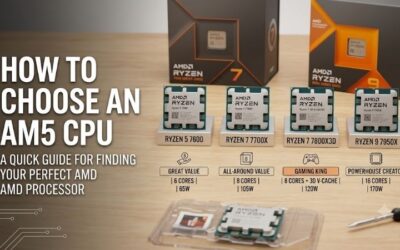
The shortlist uses four differentiated roles. The Ryzen 5 9600X covers balanced performance, the Ryzen 5 7500F targets value, the Ryzen 5 7600X3D targets gaming, and the Ryzen 7 7700 targets heavier workloads. The best budget am5 cpu depends on your workload, so each pick has a defined job, workload fit, and upgrade rationale.
| Product | Best For | Key Spec | Watch Out For |
|---|---|---|---|
| AMD Ryzen 5 9600X | Best Overall | Zen 5, 6C/12T, up to 5.4 GHz, 65W | No boxed cooler |
| AMD Ryzen 5 7500F | Best Value | Zen 4, 6C/12T, up to 5.0 GHz, 65W | Requires discrete GPU |
| AMD Ryzen 5 7600X3D | Best For High-Refresh Gaming | 6C/12T, up to 4.7 GHz, 102 MB cache, 65W | No bundled cooler, locked multiplier |
| AMD Ryzen 7 7700 | Best For Multitasking | Zen 4, 8C/16T, up to 5.3 GHz, 65W | Gaming edge is smaller than X3D |
AMD Ryzen 5 9600X — Best Overall
The Ryzen 5 9600X is the balanced choice for a new AM5 build needing strong gaming and general-purpose performance. It uses Zen 5 with 6 cores and 12 threads, runs at 3.9 GHz base and up to 5.4 GHz boost, and carries a 65W TDP. Its efficiency leaves additional graphics budget for the final build.
Its main weakness is the missing boxed cooler, so the build needs aftermarket cooling. It makes less sense when a cheaper 7500F already meets your frame-rate target. Choose the 9600X for modern six-core performance without moving to an eight-core class. Keep the cooling cost inside the platform budget and final system total.
AMD Ryzen 5 7500F — Best Value
For buyers chasing the best budget am5 cpu, the Ryzen 5 7500F is the value-oriented choice when marginal-dollar savings should upgrade remaining-system hardware. Its Zen 4 architecture provides 6 cores, 12 threads, a 3.7 GHz base clock, up to 5.0 GHz boost, and 65W default TDP. AMD specifies a Wraith Stealth CPU cooler.
The catch is the F suffix: AMD requires a discrete graphics card because there is no integrated graphics path. That is easy to accept in a gaming tower with a dedicated GPU, but less convenient for troubleshooting or a no-GPU setup. For price-focused builders, it is a fair trade when the graphics card is already planned and installed.
AMD Ryzen 5 7600X3D — Best For High-Refresh Gaming
The Ryzen 5 7600X3D is the pick for gamers wanting high CPU performance without moving to an eight-core X3D chip. It has 6 cores, 12 threads, a 4.1 GHz base clock, up to 4.7 GHz boost, 65W TDP, and 102 MB total cache. The 3D V-Cache drives its gaming advantage in CPU-limited titles.
The downside is focus. Tom’s Hardware found it close to the Ryzen 7 7800X3D in gaming while trailing newer mainstream CPUs in application work, and it has no bundled cooler or traditional multiplier overclocking. Those tradeoffs are easier to accept for esports and high-refresh gaming than for mixed workstation workloads.
AMD Ryzen 7 7700 — Best For Multitasking
The Ryzen 7 7700 suits a budget-conscious creator, developer, or multitasker who can use 16 threads. Its Zen 4 design has 8 cores, 16 threads, a 3.8 GHz base clock, up to 5.3 GHz boost, and 65W TDP. The included Wraith Prism also reduces the parts budget for mixed workloads and sustained application use.
The tradeoff is that its gaming advantage is less dramatic than the 7600X3D’s cache-focused approach in CPU-limited titles. Still, eight cores add useful headroom for rendering, compiling, streaming, and demanding applications. Choose it when workload capacity matters as much as gaming, because those extra threads have value.
Frequently Asked Questions
The best budget am5 cpu depends on what your PC is meant to accomplish. A low-cost gaming system does not need the same CPU as a workstation that also renders video or compiles large projects. These questions cover the practical choices that matter most once you narrow the list to real-AM5-processors and defined-workloads.
Is An AM5 CPU Worth Buying For A Budget PC?
Yes, the best budget am5 cpu can be a strong choice when motherboard and DDR5 costs stay controlled. The platform offers efficient six- and eight-core processors without forcing a flagship purchase. The key is spending the saved CPU budget where it changes system performance most, rather than paying for cores you rarely use.
For gaming, that usually means protecting the graphics-card budget instead of chasing the newest CPU. The 7500F is the low-cost starting point, while the 9600X makes sense when a modest step up buys stronger CPU-side performance. Your monitor resolution and GPU should decide how far up the CPU ladder you go, not generation alone.
Is The Ryzen 5 7500F Better Value Than The 9600X?
Usually, yes, for a lower-cost dedicated-GPU gaming build. The 7500F has six Zen 4 cores, twelve threads, and up to 5.0 GHz, while the 9600X brings Zen 5 and up to 5.4 GHz. The better value depends on the current performance gap and street-price gap, not generation alone. Compare the full platform cost.
The 7500F includes a Wraith Stealth cooler, which helps a tight budget, but it requires a discrete-GPU. The 9600X has integrated graphics but needs a separate cooler, so compare the complete parts list rather than the CPU line item alone. That check can change which chip is truly cheaper after every required component.
How Many CPU Cores Do I Need For Budget Gaming?
For most budget gaming PCs, six cores and twelve threads remain a sensible floor. The Ryzen 5 7500F, Ryzen 5 9600X, and Ryzen 5 7600X3D all use that configuration, while the 7600X3D’s large cache can matter more than adding two cores in gaming-focused workloads. The GPU often remains the main limiter in GPU-bound scenarios today.
Eight cores become more useful when gaming is only one sustained-task. Streaming, editing, compiling, and virtual machines can use more threads, which is where the Ryzen 7 7700 earns its place. Do not buy eight cores simply for a larger number if your workload is light, because that budget may help more when moved to the GPU.
Do I Need A Separate Cooler With Every AM5 CPU?
No, but check the exact model before budgeting. The Ryzen 5 7500F includes a Wraith Stealth cooler, and the Ryzen 7 7700 includes a Wraith Prism. The Ryzen 5 9600X and Ryzen 5 7600X3D do not include boxed coolers, so their build cost includes additional cooling. Confirm the retail package before ordering.
A bundled cooler can be enough for a restrained 65W processor, although a quieter aftermarket cooler may be worthwhile. Compare complete system cost because a CPU that looks cheaper can lose that advantage after cooling and graphics requirements are added. This matters most when the budget is strict and future upgrade room is limited.
Final Thoughts
The best budget am5 cpu depends on where each saved dollar goes. Choose the 7500F for a low-cost dedicated-GPU build, the 9600X for balanced modern performance, the 7600X3D for high-refresh gaming, or the 7700 for heavier multitasking. Each pick earns its place for a different reason, so spending more should have a clear purpose.