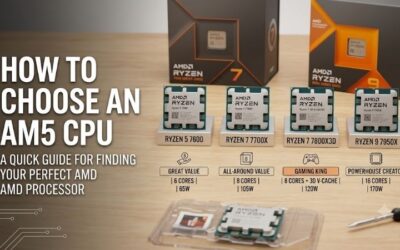
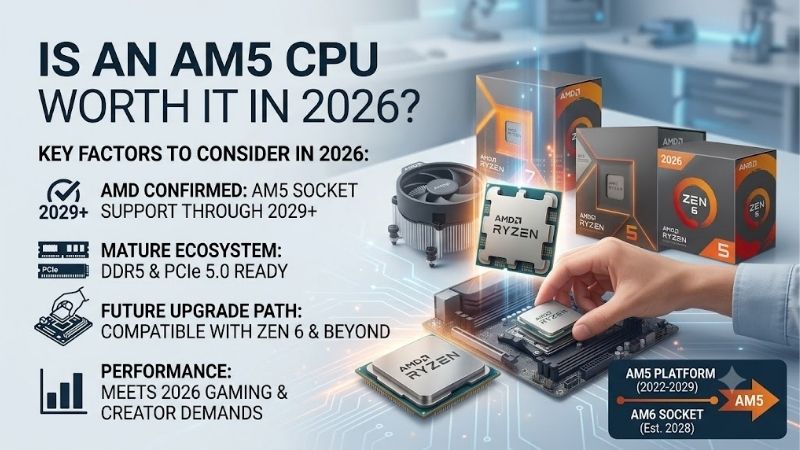
Is an am5 cpu worth it in 2026? Yes, AMD AM5 suits many new builds, but upgrading also involves a motherboard and DDR5 memory. Replacing a capable existing system requires measurable justification. These four processors show where platform expenditure improves performance and where postponing migration remains sensible.
How to Choose an AM5 CPU
This roundup answers is an am5 cpu worth it in 2026 through four workload-specific purchases: a balanced mainstream processor, an affordable entry, a gaming specialist, and a production-focused model. The criteria compare complete platform costs and workload fit. Recommendations reflect verified specifications rather than claimed personal testing.
Complete Platform Cost
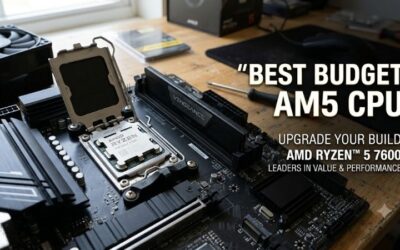
Platform cost includes the processor, motherboard, compatible memory, and required cooling hardware. Moving from AM4 requires motherboard and DDR4 replacement, so a tempting CPU discount can conceal migration costs. Compare complete baskets before choosing; the AMD Ryzen 5 7600 is particularly useful when its boxed cooler reduces costs.
Motherboard spending should follow connection requirements, storage expansion, and CPU support over chipset prestige. A suitable B650 board provides mainstream connectivity after compatibility verification. The AMD Ryzen 5 7600 preserves graphics and storage expenditure when its complete platform bundle undercuts newer alternatives.
Core Count and Application Scaling
Six cores support mainstream gaming and applications, while heavily parallel production tasks justify more resources. Application scaling matters more than CPU branding: parallel workloads exploit additional threads; others benefit minimally. For a mainstream build, the AMD Ryzen 5 9600X offers six Zen 5 cores without workstation-level spending.
For render queues, software compilation, and simultaneous demanding applications, sustained throughput can justify additional expenditure. Ask is an am5 cpu worth it in 2026 through measured completion times rather than benchmark rankings. The AMD Ryzen 9 9950X becomes compelling when its sixteen cores address a measurable processing bottleneck.
Gaming Cache and Graphics Balance
Gaming value depends on the graphics card, resolution, and intended refresh rate. Demanding 4K graphics settings frequently create GPU bottlenecks, limiting processor-upgrade benefits. Lower-resolution competitive games can expose CPU constraints more clearly, making a premium gaming processor valuable with powerful supporting hardware.
Additional cache can improve performance in receptive games through reduced external-memory access, but benefits vary between engines. Compare results for your titles before purchasing premium X3D hardware. The AMD Ryzen 7 9800X3D deserves consideration for CPU-limited gaming, especially when discounted against newer alternatives.
Cooling Requirements and Sustained Loads
Cooling requirements affect purchase costs, noise, and sustained performance. Default TDP is a thermal design specification, rather than guaranteed electrical consumption. The AMD Ryzen 5 9600X carries a 65W default rating and requires separate cooling hardware, making it a practical choice when prioritizing a mainstream cooling setup.
A sixteen-core production system requires thermal planning beyond mainstream gaming. Check cooler mounting compatibility, case clearance, airflow, and motherboard support before purchase; follow instructions with power disconnected. Choose the AMD Ryzen 9 9950X when production throughput justifies its 170W thermal-design requirements.
Top Picks
These picks make is an am5 cpu worth it in 2026 a workload decision rather than an expensive flagship-shopping exercise. All four use AM5 and DDR5, with substantially different capabilities. Compare final bundle prices before choosing, especially when a discounted older model competes with a newer processor or includes useful cooling hardware.
| Product | Best For | Key Spec | Watch Out For |
|---|---|---|---|
| AMD Ryzen 5 9600X | Best Overall | 6 cores, 12 threads; up to 5.4GHz; 65W default TDP | Separate cooler; limited heavily threaded capacity |
| AMD Ryzen 5 7600 | Best Value | 6 cores, 12 threads; 65W default TDP; boxed Wraith Stealth cooler | Older architecture; compare complete bundle prices |
| AMD Ryzen 7 9800X3D | CPU-Limited Gaming | 8 cores, 16 threads; 96MB L3 cache | Gaming premium; cooler excluded |
| AMD Ryzen 9 9950X | Parallel Production | 16 cores, 32 threads; 170W default TDP | Substantial cooling requirements; unnecessary for basic workloads |
AMD Ryzen 5 9600X: Best Overall
The AMD Ryzen 5 9600X is the overall recommendation balancing gaming, desktop responsiveness, and platform expenditure. It provides six cores, twelve threads, and boost frequency up to 5.4GHz, using Zen 5 architecture. Its 65W default TDP supports straightforward cooling arrangements without necessitating an expensive flagship motherboard.
Its main compromise is limited parallel capacity against processors featuring additional cores, and the retail package includes no cooler. Buyers asking is an am5 cpu worth it in 2026 should compare its complete cost with the 7600. Choose the 9600X when the newer architecture commands a reasonable premium including appropriate aftermarket cooling.
AMD Ryzen 5 7600: Best Value
The AMD Ryzen 5 7600 is the value selection when a discounted boxed package substantially reduces platform expenditure. Its six cores and twelve threads suit gaming, while the included Wraith Stealth cooler eliminates aftermarket-cooling expenditure. AMD specifies boost frequency up to 5.1GHz and a 65W default TDP for this Zen 4 processor.
The tradeoff is buying an older architecture, becoming uncompetitive against similarly priced newer alternatives. The included cooler also favors economical operation over quiet operation under sustained loads. For buyers asking is an am5 cpu worth it in 2026, the 7600 becomes worthwhile through savings supporting graphics or storage upgrades.
AMD Ryzen 7 9800X3D: Best for CPU-Limited Gaming
The AMD Ryzen 7 9800X3D is the specialist pick for CPU-limited gaming rather than inexpensive platform migration. It combines eight cores, sixteen threads, and 96MB of L3 cache, with boost frequency up to 5.2GHz. Its extra cache distinguishes it from ordinary mainstream processors, particularly within cache-sensitive gaming workloads. amd.com
Its weakness is a gaming-focused premium that offers limited improvements under existing graphics bottlenecks. It also excludes a cooler. The newer Ryzen 7 9850X3D offers a higher advertised boost, requiring a purchase-price comparison. Prefer the 9800X3D when meaningful savings outweigh prioritizing advertised clock specifications.
AMD Ryzen 9 9950X: Best for Parallel Production
The AMD Ryzen 9 9950X targets CPU-based rendering, compilation workloads, and demanding multitasking. Its sixteen cores and thirty-two threads provide greater parallel capacity than six-core alternatives, with boost frequency up to 5.7GHz. For supported production applications, parallel processing capacity supplies a clear purchase justification.
The disadvantages are its 170W default TDP, separate cooling requirement, and unnecessary capacity for browsing or GPU-limited gaming. Evaluate is an am5 cpu worth it in 2026 through production-software completion times. This is a workload-specific investment, not the automatic gaming upgrade implied by flagship branding.
Frequently Asked Questions
Common upgrade questions clarify is an am5 cpu worth it in 2026 beyond isolated benchmark results. The answer changes with your existing platform, compatible components, and measurable bottlenecks. These practical distinctions explain processor-only upgrades, mandatory component replacements, and worthwhile reasons for postponing migration.
Can You Put an AM5 CPU in an AM4 Motherboard?
No, an AM5 processor cannot operate in an AM4 motherboard, because the sockets and electrical interfaces differ. Moving from AM4 requires an AM5 board and DDR5 memory, despite perfectly functional existing DDR4. Treat migration as a platform purchase requiring component-by-component compatibility verification before ordering replacements.
Your graphics card, SSDs, case, and power supply remain reusable after verifying connections, dimensions, and sufficient electrical capacity. Cooler reuse requires checking the manufacturer’s mounting guidance, especially when replacing the stock backplate. Confirm compatibility component by component rather than assuming universal compatibility.
Should You Upgrade from a Ryzen 7 5800X3D?
No, owners of a capable Ryzen 7 5800X3D system do not automatically need AM5 because of the calendar. If your games already meet frame-rate targets, platform replacement may deliver marginal improvements. Production workloads or measured CPU limitations can justify migration, but calendar-based purchasing provides insufficient justification.
Compare representative workloads on your current system including frame consistency and project completion times. If lower graphics settings produce negligible improvement, investigate possible CPU constraints and engine limits. If reduced resolution substantially increases performance, graphics expenditure becomes the more direct intervention.
Do You Need an Expensive Motherboard for AM5?
No, buying the most expensive AM5 motherboard is unnecessary for these processors. Connection layout, supported memory, power delivery, and expansion requirements matter more than premium branding. A compatible, suitably equipped board can serve the 7600 or 9600X without diverting money toward unnecessary specifications or premium features.
Check the manufacturer’s CPU support list for the exact board revision and required BIOS version before purchasing. An older B650 board may require updating for Ryzen 9000, despite sharing the socket. When initial processor compatibility prevents booting, a documented CPU-less BIOS update function can simplify initial platform commissioning.
Is an X3D Processor Always the Better Choice?
No, an X3D processor is not universally preferable to a conventional Ryzen CPU. Its additional cache targets receptive gaming workloads, while production software benefits according to parallelism and processor architecture. The 9800X3D suits gaming priorities; the 9950X addresses heavily threaded production requirements.
Software-specific comparisons matter when one PC handles gaming and professional workloads. Weigh export or compilation improvements alongside desired gaming performance, rather than selecting solely from gaming charts. A six-core mainstream option remains sensible with occasional production workloads and constrained expenditure.
Final Thoughts
The answer to is an am5 cpu worth it in 2026 is yes for many new builds, but conditional for upgrades. Choose the 9600X for balance, the 7600 for meaningful savings, the 9800X3D for CPU-limited gaming, or the 9950X for parallel production. Retain capable existing hardware until improvements justify motherboard, memory, and cooling costs.