Is a micro atx case worth it in 2026 when limited desk space conflicts with oversized graphics cards? Yes, provided motherboard and cooling requirements match the enclosure. Downsizing becomes less attractive when compatibility problems require replacing functional components, purchasing specialized accessories, or abandoning planned upgrades.
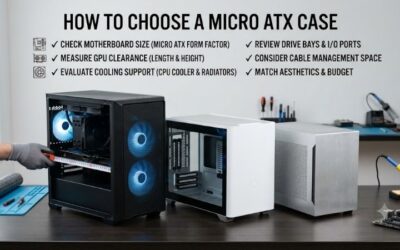
How to Choose a Micro ATX Case
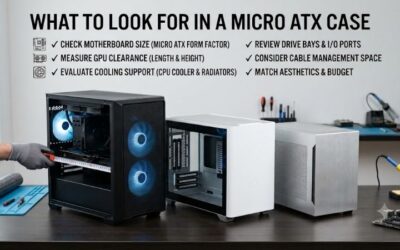
To answer is a micro atx case worth it in 2026, this guide compares four enclosures through graphics clearance, cooling compatibility, external dimensions, and complete purchase costs. Each recommendation addresses a different priority, helping you distinguish worthwhile space savings from compromises that complicate assembly or increase spending.
GPU Clearance and Power Supply Fit
Graphics compatibility includes card length, thickness, and connector clearance rather than one advertised measurement. Side panels can interfere with power cables even when card length satisfies the specification. Evaluate your exact graphics model against the proposed configuration, following manufacturer recommended cable bend clearance.
When considering is a micro atx case worth it in 2026, power supply placement can affect graphics clearance. Advertised maximum dimensions sometimes describe mutually exclusive configurations. Choose the Lian Li A3-mATX when its documented bracket arrangement accommodates your graphics card, power supply, and required cooling hardware.
Cooling Support and Fan Budget
Cooling compatibility combines heatsink height, radiator placement, and ventilation. These specifications establish whether components fit; they cannot establish operating temperatures without testing. Prioritize suitable cooling for your processor’s workload rather than selecting a case for impressive radiator capacity.
Retaining a compatible air cooler can save money and simplify installation, while liquid cooling requires space for radiator thickness, fans, and tubing. Large radiator support matters primarily when your cooling plan requires it. Choose the ASUS Prime AP201 rather than the Pop Mini Air for a configuration requiring a 360 mm radiator.
External Size and Access for Assembly
External dimensions determine desk compatibility rather than motherboard format. A shorter enclosure may remain surprisingly deep, particularly once rear connections require clearance. Measure available depth and width alongside height, allowing access for maintenance instead of assuming that every micro ATX chassis occupies minimal space.
The answer to is a micro atx case worth it in 2026 depends partly on whether reduced volume actually improves your workspace. Compact interiors can require more deliberate assembly and cable routing. Choose the 26.3 liter Lian Li A3-mATX for reduced enclosure volume, or the ASUS Prime AP201 when removable panels better match your priorities.
Included Parts and Total Purchase Cost
Complete purchase cost includes fans, replacement components, and optional connectivity rather than the enclosure price alone. Comparing equipment bundles without those additions can produce misleading savings. Existing compatible accessories improve the economics, whereas purchasing missing components may reverse your initial preference.
Check version accessories when comparing prices, since similar product names can conceal different equipment. Choose the Fractal Design Pop Mini Air RGB when its three included fans suit your cooling requirements, or the Cooler Master MasterBox Q300L when existing spare fans preserve its advantage at a lower checkout price.
Top Picks
For shoppers asking is a micro atx case worth it in 2026, these recommendations address four purchasing priorities. Overall balance, conditional value, straightforward first builds, and reduced enclosure volume deserve separate consideration. The selections reflect published specifications and layout analysis rather than claimed hands on testing.
| Product | Best For | Key Spec | Watch Out For |
|---|---|---|---|
| ASUS Prime AP201 | Best Overall | 33 L; 338 mm GPU support | Long GPU fit |
| Cooler Master MasterBox Q300L | Best Value | 159 mm air cooler clearance | One included fan |
| Fractal Design Pop Mini Air RGB | First builds | Three included 120 mm fans | USB-C module sold separately |
| Lian Li A3-mATX | Compact builds | 26.3 L; up to 415 mm GPU | Clearance depends on layout |
ASUS Prime AP201: Best Overall
The ASUS Prime AP201 earns my overall recommendation for balancing compact dimensions with component flexibility. Its 33 liter enclosure accommodates a 360 mm radiator and graphics cards measuring up to 338 mm. Tool free side panels provide maintenance access, particularly for builders anticipating occasional storage changes or cleaning.
Its limitation is graphics length: cards exceeding 338 mm eliminate this option irrespective of motherboard compatibility. Buyers asking is a micro atx case worth it in 2026 should verify that measurement before selecting components. The mesh AP201 makes sense when existing hardware fits, avoiding replacement expenses for downsizing.
Cooler Master MasterBox Q300L: Best Value
The Cooler Master MasterBox Q300L becomes my value recommendation when its delivered price leaves budget for necessary fans. Published limits include 360 mm graphics cards and 159 mm processor coolers. Its repositionable I/O panel offers practical flexibility when placement makes front connections awkward from a shelf or desk corner.
The original Q300L includes only one 120 mm rear fan, increasing build cost when intake ventilation is required. Its acrylic window also scratches more readily than glass. Select this model for modest hardware when the complete configuration undercuts alternatives; extra cooling purchases can eliminate its apparent savings.
Fractal Design Pop Mini Air RGB: Best for First Builds
The Fractal Design Pop Mini Air RGB suits first builds prioritizing a familiar layout and included ventilation hardware. Two front 120 mm fans and one rear fan reduce accessory decisions, while its 170 mm cooler clearance accommodates substantial air cooling. The appeal is a straightforward starting configuration rather than minimum volume.
Check its drawbacks before ordering: front USB-C requires a separately purchased module, and the specified PSU length limit is 150 mm. Either detail can complicate reuse or increase expenditure. Choose this enclosure when its included ventilation and conventional arrangement outweigh those connectivity and power supply constraints.
Lian Li A3-mATX: Best for Compact Builds
The Lian Li A3-mATX suits builders prioritizing reduced enclosure volume and comfortable planning layouts. Its 26.3 liter chassis supports coolers measuring up to 165 mm tall. A relocatable power supply bracket provides flexibility, allowing compatible hardware arrangements that would otherwise be difficult within such compact dimensions.
Compatibility requires attention: installing 25 mm bottom fans reduces permitted graphics thickness to 61 mm. When asking is a micro atx case worth it in 2026 for large hardware, evaluate the assembled configuration rather than maximum specifications. The A3-mATX rewards careful planning but creates frustration when purchased without layout checks.
Frequently Asked Questions
The question is a micro atx case worth it in 2026 often conceals concerns about performance, motherboard compatibility, spending, and future expansion. Enclosure dimensions alone cannot resolve those decisions. These answers identify the circumstances that favor downsizing and the exceptions that justify retaining a larger, roomier chassis.
Does a Micro ATX Case Reduce Gaming Performance?
No, a micro ATX enclosure does not inherently reduce gaming performance. Equivalent CPUs and GPUs operating at the same power and clock settings do not slow solely because motherboard dimensions differ. Sustained performance instead depends partly on whether the completed cooling configuration manages temperatures under demanding workloads.
An obstructed graphics intake or undersized processor cooler can undermine that result during long gaming sessions. Evaluate ventilation and cooling suitability rather than treating board format as a speed rating. More enclosure space becomes worthwhile when it accommodates suitable cooling or improves the clearance around demanding components.
Can You Put an ATX Motherboard in These Cases?
No, these four enclosures support micro ATX or Mini ITX motherboards rather than full size ATX models. Support for an ATX power supply does not imply compatibility with an ATX motherboard; these describe separate parts. Verify the precise motherboard format before ordering instead of interpreting PSU support as universal compatibility.
Retaining an existing full size ATX motherboard and purchasing a compatible tower may cost less than replacing functional hardware to downsize. Downsizing becomes more attractive during a new build, when motherboard selection remains flexible. Confirm the exact model, because similarly named boards within a product family can use different formats.
Is Micro ATX Cheaper Than Mini ITX?
Micro ATX can cost less than Mini ITX, but complete build pricing determines the outcome. Some compact Mini ITX arrangements require smaller PSUs or specific coolers, whereas these recommendations accept standard ATX supplies within size limits. Compare equivalent motherboard features rather than assuming either format guarantees a price advantage.
Discounted Mini ITX components can reverse that comparison, while premium micro ATX motherboards can absorb case savings. Calculate motherboard, chassis, power supply, cooling, and accessory expenditure together at checkout. Reusing compatible components often provides a stronger advantage than selecting a format based on reputation.
Will a Micro ATX Case Limit Future Upgrades?
Yes, micro ATX cases can restrict upgrades requiring more physical space, although case size imposes no fixed CPU performance ceiling. Longer graphics cards, taller heatsinks, and expansion cards may exceed available space. Motherboard socket and memory compatibility remain separate constraints that purchasing a larger enclosure cannot resolve.
Plan around plausible upgrades rather than unknown future hardware. A capture card beneath a thick GPU requires checking motherboard slot placement alongside chassis clearance. Frequent component changes or several expansion devices can justify a larger tower, even when your current configuration fits inside a smaller enclosure.
Final Thoughts
So, is a micro atx case worth it in 2026? Yes, when reduced dimensions improve your workspace without requiring costly replacements. Choose the AP201 for balance, Q300L for conditional value, Pop Mini Air RGB for included ventilation, or A3-mATX for reduced volume. Retain a larger enclosure when compatibility costs outweigh space savings.