How to choose a b650 motherboard comes down to matching the board with your CPU, case, memory, storage, and connectivity needs. This guide compares four proven B650 options and explains the trade-offs that actually matter before you buy, so the specification sheet becomes easier to read and your shortlist becomes clearer.
Quick answer: Our top pick in 2026 is the MSI MAG B650 Tomahawk WiFi — our #1 rated choice. See the full ranked comparison, alternatives and buying advice below.
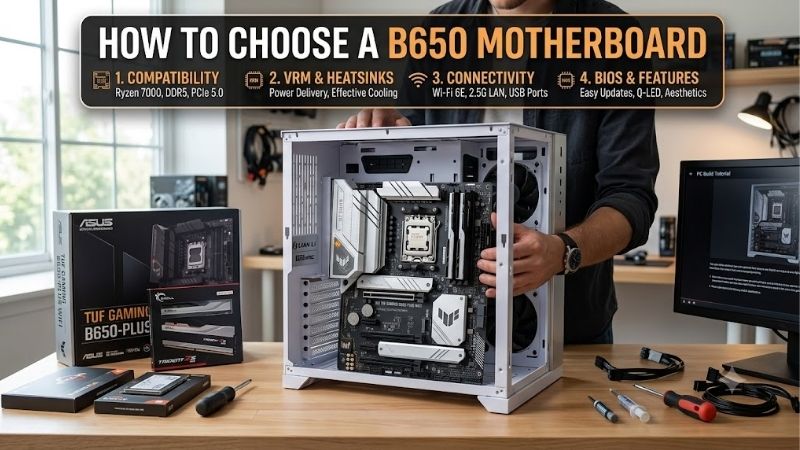
How to Choose A B650 Motherboard
For how to choose a b650 motherboard, the challenge is matching AM5 support without paying for unused extras. CPU upgrades, several NVMe drives, fast DDR5, or a smaller case can each change the decision, so chipset branding alone is a poor shortcut when planning an AM5 gaming system in real-world builds.
VRM And CPU Power
For how to choose a b650 motherboard, treat VRM as a CPU-matching question, not a race for the highest phase count. Stronger power delivery matters with high-core-count Ryzen chips and long rendering/compiling loads, where heat exposes weak cooling. Mainstream gaming CPUs can spend less, especially when running stock-settings.
Power Stages And Cooling
Compare phase-design, power-stage ratings, and heatsink coverage rather than counting phases alone. Gigabyte B650 Aorus Elite AX V2 uses a twin 12+2+2 digital design with substantial VRM cooling, while ASRock B650M Pro RS WiFi uses 8+2+1 Dr.MOS. Both suit their class, but Gigabyte leaves more thermal margin.
M.2 Storage Capacity
M.2 capacity and PCIe generation decide how easily your storage plan can expand. Three M.2 sockets are useful for an OS drive, game library, and project SSD. Gen5 matters more for heavy file movement and future-drive upgrades, while good Gen4 NVMe remains fast enough for most practical gaming workloads in everyday-gaming-builds.
PCIe Lane Layout
Check lane routing as carefully as socket count. For how to choose a b650 motherboard, ASUS TUF Gaming B650-Plus WiFi offers three M.2 slots, with the primary supporting PCIe 5.0 x4 on Ryzen 9000/7000. ASRock B650M Pro RS WiFi also provides one Gen5 M.2 slot, making both practical storage-focused choices before adding more drives.
Network And I/O Needs
Networking matters when a wired-link is capped below internet/NAS speed. 2.5GbE helps local transfers, while Wi-Fi 6E adds 6GHz when the router supports it. If the PC stays wired, wireless extras should not outweigh storage or expansion for the build you actually intend, especially in bandwidth-heavy homes using high-throughput equipment.
Wired Or Wireless Setup
For a wired-first machine, MSI MAG B650 Tomahawk WiFi combines 2.5GbE, generous rear-USB connectivity, and optical audio. For how to choose a b650 motherboard, note that Gigabyte B650 Aorus Elite AX V2 and ASRock B650M Pro RS WiFi add Wi-Fi 6E. Pick MSI for I/O density, or either model when 6GHz matters network-dependent.
Form Factor And Expansion
Form factor affects more than case compatibility. ATX boards provide wider spacing and more expansion room, while micro-ATX can simplify compact builds without dropping to mini-ITX. Also check BIOS recovery, debug indicators, fan headers, and rear I/O before buying, because these influence installation, maintenance, and troubleshooting.
BIOS And Build Convenience
ASUS TUF Gaming B650-Plus WiFi uses ATX spacing with BIOS FlashBack and Q-LED, while ASRock B650M Pro RS WiFi keeps a 9.6 by 9.6-inch footprint with BIOS Flashback. Choose ASUS for a roomier DIY build, or ASRock when compact dimensions matter most in a space-limited case with fewer expansion needs.
Top Picks
The four boards below cover different buying priorities rather than repeating the same design at similar prices. For how to choose a b650 motherboard, MSI emphasizes I/O and SATA storage, Gigabyte focuses on a Gen5 SSD path, ASUS adds recovery features, and ASRock packs useful storage and networking into a compact layout.
| Product | Best For | Key Spec | Watch Out For |
|---|---|---|---|
| MSI MAG B650 Tomahawk WiFi | Best Overall | 3 PCIe 4.0 M.2, 6 SATA, 2.5GbE, Wi-Fi 6E | No Gen5 M.2 |
| ASRock B650M Pro RS WiFi | Best Value | Micro-ATX, 1 Gen5 M.2, 2 Gen4 M.2, 2.5GbE | PCIe 4.0 graphics slot, ALC897 audio |
| Gigabyte B650 Aorus Elite AX V2 | Best For Gen5 Storage | 1 Gen5 M.2, 2 Gen4 M.2, 2.5GbE, Wi-Fi 6E | PCIe 4.0 x16 graphics slot |
| ASUS TUF Gaming B650-Plus WiFi | Best For First-Time Builders | 3 M.2, 1 Gen5 M.2, 2.5GbE, BIOS FlashBack | Wi-Fi 6, not Wi-Fi 6E |
MSI MAG B650 Tomahawk WiFi
Best Overall goes to MSI MAG B650 Tomahawk WiFi for builders wanting broad connectivity and ample storage without moving beyond B650. It supports Ryzen 7000/8000/9000 processors, 4 DDR5 slots up to 256GB, 3 PCIe 4.0 M.2 slots, and 6 SATA ports for mixed-drive setups. It is the flexible baseline for mainstream-gaming builds.
Its rear panel includes 20Gbps USB-C, 2.5GbE, Wi-Fi 6E, optical audio, and a Flash BIOS button. The trade-off is that all 3 M.2 slots are Gen4, so buyers planning a Gen5 SSD should look elsewhere. MSI therefore fits I/O-heavy, storage-diverse builds where SATA drives remain useful across mixed-drive systems.
ASRock B650M Pro RS WiFi
Best Value is ASRock B650M Pro RS WiFi, a micro-ATX board that keeps useful features while fitting smaller cases. It supports Ryzen 9000/8000/7000 processors, 4 DDR5 DIMMs up to 256GB, 1 PCIe 5.0 x4 M.2 slot, 1 Gen4 x4 slot, and 1 Gen4 x2 slot. It is a strong compact option for space-conscious-budget-builds.
At 9.6 by 9.6 inches, ASRock leaves less expansion room than ATX alternatives, but still provides 2.5GbE, Wi-Fi 6E, BIOS Flashback, and 4 SATA ports. Its 8+2+1 Dr.MOS power design and ALC897 audio are more basic, so the value case is strongest when compact size and storage flexibility come first.
Gigabyte B650 Aorus Elite AX V2
Best for Gen5 Storage is Gigabyte B650 Aorus Elite AX V2 for users wanting a high-speed SSD path without a premium chipset. It supports Ryzen 7000/8000/9000 processors, 4 DDR5 DIMMs up to 256GB, 1 PCIe 5.0 x4 M.2 slot, and 2 PCIe 4.0 x4 M.2 slots for expansion. Its Gen5 layout suits buyers planning ahead.
The board also brings 2.5GbE, Wi-Fi 6E, Q-Flash Plus, and an ATX layout with strong VRM cooling. One limitation is the primary graphics slot, which runs PCIe 4.0 x16, so its Gen5 advantage is storage-focused rather than GPU-focused. That matters when future-expansion plans center on graphics add-in cards.
ASUS TUF Gaming B650-Plus WiFi
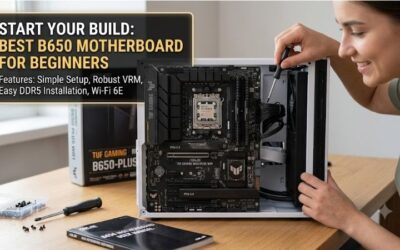
Best for First-Time Builders is ASUS TUF Gaming B650-Plus WiFi because its hardware makes routine setup and recovery less intimidating. It supports Ryzen 9000/8000/7000 processors, 4 DDR5 DIMMs up to 256GB, 3 M.2 slots, and 1 PCIe 5.0 x4 M.2 connection with Ryzen 9000/7000 CPUs for fast storage upgrades and a simpler DIY path.
ASUS adds Q-LED status indicators, Q-Latch, a pre-mounted I/O shield, BIOS FlashBack, 2.5GbE, and 8 rear USB ports. The compromise is Wi-Fi 6 rather than Wi-Fi 6E, and the third M.2 socket shares bandwidth with the secondary full-length slot. That is reasonable when setup and troubleshooting matter more than wireless speed.
Frequently Asked Questions
Questions about B650 usually come from four concerns: CPU support, memory capacity, storage speed, and whether a newer platform is necessary. This is the practical side of how to choose a b650 motherboard, because exact boards can change PCIe layouts, BIOS tools, wireless modules, and memory limits under the same chipset.
Is B650 Still Worth Buying In 2026?
Yes. B650 remains useful in 2026 for AM5 systems using Ryzen 7000/8000/9000 processors, provided the specific board supports your CPU and has suitable firmware. Its appeal is modern DDR5, fast NVMe storage, and 2.5GbE without paying for every feature offered by a higher-tier chipset or platform in current-generation-systems.
The key exception is a build that needs more PCIe connectivity, more high-speed USB, or a particular expansion layout. Compare the complete board specification rather than the chipset name. MSI MAG B650 Tomahawk WiFi, for example, has 6 SATA ports, while several alternatives in this roundup have 4 SATA ports.
Does B650 Support Ryzen 9000?
Yes, but check BIOS compatibility before assembly. MSI MAG B650 Tomahawk WiFi, Gigabyte B650 Aorus Elite AX V2, ASUS TUF Gaming B650-Plus WiFi, and ASRock B650M Pro RS WiFi all list Ryzen 9000 support. A board’s published CPU list is safer than assuming every retail unit ships with the newest firmware.
BIOS recovery can reduce upgrade friction when older firmware is installed. Gigabyte uses Q-Flash Plus, ASUS offers BIOS FlashBack, MSI has a Flash BIOS button, and ASRock includes BIOS Flashback. Follow the exact manufacturer procedure and power requirements; do not assume one vendor’s update process works the same way on another board.
Do I Need A Gen5 M.2 SSD?
No. Gen5 M.2 support is useful, but it is not required for a gaming PC. PCIe 4.0 NVMe drives already deliver fast load times and strong everyday performance, so Gen5 mainly makes sense for very large file moves or a planned faster drive later, without changing the motherboard or storage layout for gaming-first-workloads.
This is where board selection becomes practical. Gigabyte B650 Aorus Elite AX V2, ASUS TUF Gaming B650-Plus WiFi, and ASRock B650M Pro RS WiFi offer Gen5-M.2, while MSI MAG B650 Tomahawk WiFi keeps all 3-M.2 slots at Gen4. In how to choose a b650 motherboard, buy Gen5 for real-workload/upgrade plans, not simply because the label is newer.
How Much DDR5 RAM Should I Install?
For most AM5 gaming systems, 2 matched DDR5 modules are the easiest starting point. Four DIMM slots leave room to expand, but higher memory speeds can become harder to stabilize as modules are added. These boards support EXPO, while listed maximum speeds vary by model and depend on CPU and memory configuration.
Buy the capacity you expect to need, then check the motherboard memory support list for the kit. A 32GB/64GB two-DIMM setup is easier to plan than filling every slot immediately. If a future upgrade is likely, 4-slot support gives you more flexibility later without changing platforms, especially when the original memory kit remains available.
Final Thoughts
Knowing how to choose a b650 motherboard starts with the CPU, then moves to case size, M.2 needs, network requirements, and BIOS features. MSI fits I/O-heavy builds, Gigabyte suits Gen5 storage plans, ASUS favors hands-on setup, and ASRock targets compact systems. That framework keeps the purchase tied to hardware needs.
Ready to decide? Our #1 pick for 2026 is the MSI MAG B650 Tomahawk WiFi.
Live price & availability on Amazon.