For the better part of a decade, the wireless-versus-wired debate in gaming audio had a simple answer: if you cared about latency or sound quality, you plugged in. That answer no longer holds. By 2026, low-latency 2.4GHz dongles, mature codec support, and 60- to 100-hour battery cells have closed nearly every gap that used to make wired headsets the default recommendation. The result is a market where the two categories overlap far more than they diverge, and where the right pick depends less on raw performance and more on how and where you actually play.
That said, wired headsets have not gone away, and the people who still prefer them have good reasons. Choosing well in 2026 means understanding which trade-offs are real and which are marketing residue from 2018. Below, we break down how the two formats compare on latency, audio, microphone performance, comfort, and long-term cost — and which type of player each one genuinely suits.
As an Amazon Associate we earn from qualifying purchases at no extra cost to you. Product prices and availability are accurate as of the date shown and are subject to change.




⚡ Save on Your Next PC — Amazon Prime
Prime members get fast free shipping on the systems above, plus early access to Prime Day & Black Friday PC deals. New members get a 30-day free trial.
Watch: Wireless vs Wired Gaming Headset in 2026 — Video Review
Quick Verdict
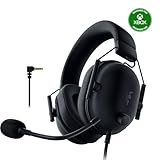
Wireless is the right default for most gamers in 2026. If you play on a console, switch between a PC and a handheld, share a living room, or simply want to stand up without unplugging, a modern 2.4GHz headset like the SteelSeries Arctis Nova 5 or Razer BlackShark V3 X HyperSpeed delivers latency you will not perceive in normal play. Wired remains the smarter buy if you have a fixed desk setup, want the most driver quality per dollar, compete in tournaments that mandate a cable, or hate managing another charge cycle.
Key Differences
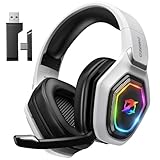
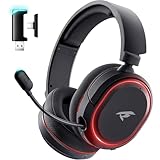
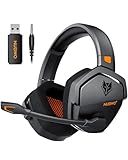
- Latency: Wired is effectively instantaneous; modern 2.4GHz wireless sits in the low tens of milliseconds — the NUBWO headset advertises 23ms sync, which is below the threshold most players can detect. Bluetooth, by contrast, is still too slow for competitive shooters.
- Power: Wired headsets never need charging. Wireless now mitigates this with huge cells — 40 hours on the Ozeino, 60 on the Arctis Nova 5, and up to 100 on the NUBWO and similar 7.1 surround models — but the charge cycle never fully disappears.
- Audio fidelity: At the same price, wired usually puts more money into drivers and less into radios and batteries. At mid-tier prices and above, the difference is small and often inaudible in games.
- Microphone: Wired analog mics avoid compression entirely. Wireless mics have improved sharply — the ClearCast Gen2.X on the Nova 5 is a good example — but heavily compressed budget wireless mics remain the weakest link in cheap sets.
- Multi-device flexibility: Wireless wins outright. Triple-mode headsets (2.4GHz, Bluetooth, and USB-C or 3.5mm) let one set cover a PS5, PC, Switch, and phone; wired means replugging or buying adapters.
- Long-term cost: Wired headsets often outlive their owners’ interest in them. Wireless batteries degrade after a few hundred cycles, which can shorten usable life even when the drivers are fine.
Wireless Gaming Headsets
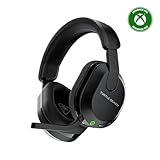
The strongest argument for wireless in 2026 is that the compromises are now marginal. A 2.4GHz dongle running on a dedicated link — not shared Bluetooth bandwidth — sits comfortably inside the frame time of a 60fps game. Console support has also matured: the Turtle Beach Stealth 600 covers Xbox, PS5, PC, and mobile from a single design, which historically required buying platform-specific hardware. Multi-system compatibility is now the norm rather than a premium feature.
Battery anxiety has largely been engineered away. The Ozeino headset’s 40-hour rating already covers a typical week of evening sessions, and the 100-hour class — including the NUBWO and comparable 7.1 surround models — turns charging into a monthly chore. The genuine caveats are weight (radios and cells add grams that you feel after hour three), the fact that a lost or damaged dongle can sideline the whole headset, and battery health declining over two or three years of daily use.
Wired Gaming Headsets
Wired headsets survive because they solve problems wireless still cannot. There is no pairing, no firmware handshake, no dongle to lose, and no scenario where your headset dies mid-raid. For anyone on a strict budget, a wired set at a given price will almost always have better drivers and a better microphone than a wireless one, because none of the budget goes to a transmitter or a battery. Many esports events also require wired connections outright.
The costs are exactly what you would expect. Cable management becomes a permanent, minor irritation; snagging the cord on a chair arm yanks the headset off your head; and you are tethered to one device. For living-room console play, where the couch may be several metres from the console, wired is frequently impractical without an extension. If your setup is a single desk and a single PC, though, that tether costs you very little.
Which Should You Buy?
- For competitive FPS on PC: pick either — a low-latency 2.4GHz set like the Razer BlackShark V3 X HyperSpeed is imperceptibly different from wired for all but the most sensitive players.
- For PS5 and Xbox living-room play: pick wireless. The Turtle Beach Stealth 600 or SteelSeries Arctis Nova 5 remove the tether problem entirely.
- For marathon sessions and travel: pick wireless with a large cell — the 100-hour NUBWO or the 40-hour Ozeino, depending on how much weight you want on your head.
- For the tightest budgets: pick wired. You will get better sound and a better microphone per dollar than any comparably priced wireless set.
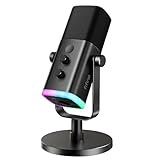
- For streamers and creators: pick wired for the headset, and use a separate dedicated microphone regardless of which you choose.
Frequently Asked Questions
Is wireless gaming audio still noticeably laggy in 2026?
Not over 2.4GHz. Figures in the 20–40ms range, like the 23ms the NUBWO headset quotes, fall below what most players can consciously detect in gameplay. Bluetooth is a different story and should be reserved for music, calls, and single-player games.
Does wireless sound worse than wired?
At budget prices, often slightly — more of the cost goes to the radio and battery. From the mid-range upward, the difference in games is negligible, and features like the Arctis Nova 5’s audio presets can matter more to your experience than the connection type.
How long will a wireless headset battery actually last?
Expect the rated figure at moderate volume without RGB or active noise cancellation, and roughly two to three years before you notice meaningful capacity loss. Headsets that also work over USB or 3.5mm give you a fallback once the cell ages.
Can I use a wireless headset with a cable?
Frequently, yes. Many triple-mode models include a wired option, which is useful for tournaments, charging while playing, or extending the headset’s life. Confirm this before buying, as some wireless-only designs offer no passive fallback.
Final Verdict
Buy wireless unless you have a specific reason not to. In 2026 the latency argument is settled, battery life has stopped being a daily concern, and multi-platform support means one headset can genuinely cover your console, PC, and phone. Wired remains the value champion and the choice for fixed desk setups and tournament play — but for most gamers, the freedom of a modern 2.4GHz headset is worth far more than the small technical margin they give up.