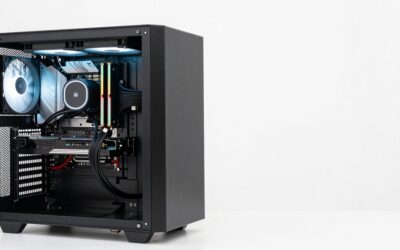
The i5-12400F pairs best with a card in the RTX 5060 Ti to RTX 5070 range, with the RTX 4060 Ti 16GB, RTX 4070 Super, and RX 9070 as reasonable alternatives. Stepping above that mostly buys frames this six-core, locked chip cannot fully use at 1080p, and it adds power draw your budget supply may not like.
Most people who search this phrase are building or upgrading on a tight budget, usually around a B660 board and a modest power supply. For them, the question behind “best GPU” is really “what is the biggest card I can run safely on the parts I already own?” That is the lens used here, with power supply decisions up front rather than as an afterthought.
Start With the Supply, Not the Card
The 12400F has six performance cores, twelve threads, and a 65W base power rating. It does not overclock, which keeps its power behavior predictable. That predictability is useful: you can plan your supply around the card without worrying about CPU spikes. A rough rule of thumb is to add the card’s board power, around 100W for the CPU under load, and 150W for everything else plus headroom. That gives a minimum wattage that you then round up to the next common size.
For a 250W card, that arithmetic lands in the mid-500s of watts, so a good 650W supply is comfortable. For a 300W card, a 750W unit is the safer target. Always compare your result with the maker’s recommended system power on the card’s spec page, since they account for transient spikes.
Card Choices for a Six-Core Locked Chip
| Card | VRAM | Board power | Launch MSRP | Supply tier (rule of thumb) | Match |
|---|---|---|---|---|---|
| RTX 5060 | 8GB | 145W | $299 | 500-550W class | 1080p only; VRAM limited |
| RTX 5060 Ti 16GB | 16GB | 180W | $429 | 550-650W class | 1080p and 1440p |
| RTX 4060 Ti 16GB | 16GB | 160W | $499 | 550-650W class | Older generation |
| RTX 5070 | 12GB | 250W | $549 | 650W class | Best 1440p fit |
| RTX 4070 Super | 12GB | 220W | $599 | 650W class | Efficient 1440p |
| RTX 5070 Ti | 16GB | 300W | $749 | 750W class | Upper limit |
MSRP is the launch price, not the current one. Look at the product listing for the live price.
Why the 12400F Limits Stop Near the 5070 Ti
Hardware Unboxed and Gamers Nexus tested the 12400F on faster cards when it launched and found it was a strong value processor that held up well at 1440p. As the card tier rises, the gap to faster Intel and AMD chips widens in CPU-limited titles. In practice, the 12400F with an RTX 5070 Ti is usable, but you leave performance on the table at 1080p, and some newer games with heavy CPU demands show stutter on six cores.
If you aim at a pairing, the sweet spot is a 5070 or 9070 at 1440p, or a 5060 Ti 16GB at 1080p high refresh.
Cases Where This Changes
Memory matters here. A B660 board with DDR4 is cheaper and works fine, but a slow single stick halves bandwidth; use two matched modules. If your board is the budget H610 type, check whether the card’s slot is the full-length x16 and whether the board has enough VRM cooling for sustained loads. If you stream while gaming, six cores can feel tight and a 12600K-class upgrade might improve the whole system more than a bigger GPU.
Verifying Your Own Parts
- Read your PSU label. Note total wattage, the 12V rail rating, and the number of PCIe cables.
- Check that the supply is from a reputable maker; a 650W unit with a weak rail can fail below its label.
- Check board and BIOS versions for Resizable BAR support. Modern cards benefit from it on this platform.
- Count RAM sticks and confirm dual-channel operation.
- Check the case for card length and for gaps between the card and front intake.
If the Supply Stays Put
If you cannot replace the supply, the RTX 5060 Ti 16GB and RTX 4060 Ti 16GB are the easiest cards to feed. They draw less than 200W and use standard power cables. If your supply is older or unbranded, replacing it is a better use of money than buying the bigger card first. A quality 650W unit is a small portion of the cost of a 5070 and removes a common failure point.
What About the 8GB Cards?
The RTX 5060 and the 8GB versions of the RTX 5060 Ti and RTX 4060 Ti are the cheapest ways onto this platform, and they are tempting for a budget build. The trade-off is memory. Newer games at higher texture settings can exceed an 8GB buffer, and when they do, the card spills into system memory and you see stutter that no CPU can fix. On a 1080p monitor and with settings turned down a notch, an 8GB card can be perfectly acceptable. If you expect to keep the machine for several years or move to a 1440p screen, the 16GB versions or a 12GB RTX 5070 are the safer long-term choice, and the difference in launch MSRP is modest compared with the whole build.
FAQ
Is the i5-12400F good for gaming in 2026?
For 1080p and 1440p with a mid-tier card, yes. It is a budget-friendly chip, not a high-refresh esports monster.
Will a 12400F bottleneck an RTX 5070?
At 1440p the effect is small in most games. At 1080p, expect some CPU-bound titles to cap frame rates.
Can I run an RTX 5080 with a 12400F?
It will run, but it is not a balanced pairing. Spend on the CPU and supply first.
Do I need DDR5?
No. DDR4 on a B660 board is fine for this tier.
Sources and Methodology
The qualitative CPU-scaling statements reflect public reviews of the 12400F and the cards listed from TechPowerUp, Tom’s Hardware, Gamers Nexus, Hardware Unboxed, and TechSpot. The supply tiers are a rule of thumb, not manufacturer guidance, and no figure is measured by this site. VRAM, board power, and MSRP values are launch specifications.