- Top Pick: The Zorin OS Developer Workstation: Building a Production-Ready Linux Environment for Programming, DevOps, and Cloud Engineering
- Best Value: AI WORKSTATION GUIDE: A Practical Handbook for Developers, Data Scientists And Home AI Lab Builders on Hardware Selection, GPU Setup, LLM Deployment And Performance Optimization
- Premium Choice: 10 Inch Rack Mount Compatible with NVIDIA Jetson Orin Nano, 1U Dual Bracket
Affiliate disclosure: As an Amazon Associate we earn from qualifying purchases. This post contains affiliate links — we may earn a small commission at no extra cost to you. This never affects our picks.
- What a Builder Should Look for in 2026
- Builder Budget Tier Pick Table
- Bootstrapped Tier: The Two Thousand Dollar Builder
- Mid-Career Tier: The Five Thousand Dollar Builder
- No-Compromise Tier: The Nine Thousand Dollar Builder
- Software Pairing for the Builder
- Builder’s Verdict
- Related Articles
- Frequently Asked Questions
- Related Articles
- Related Guides
Building a developer workstation from scratch is a different exercise than buying a finished system off the shelf. You make every call yourself, tune it to your own workflow, and sidestep the compromises mass-market systems force on you. You also leave yourself plenty of rope to make mistakes if you do not know what matters and what does not. This is the builder’s buyer’s guide we wish we had when we put together our first proper engineering workstation, sorted into three budget tiers so you can find the build that fits your cash flow without overpaying for capability you will not touch.
As an Amazon Associate we earn from qualifying purchases at no extra cost to you.


The three tiers we lay out are the bootstrapped engineer around two thousand dollars total, the mid-career engineer around five thousand, and the no-compromise engineer around nine thousand. These are not aspirational figures. They are realistic price tags for complete builds including the chair and the monitor — line items most build guides quietly drop even though they are often the most expensive things on the list. Leaving them out of your budget is the most common mistake we see from new builders.
Before the tiers, the builder’s principle to absorb: the parts you touch and look at every day deserve the most budget, while the parts buried in your case deserve adequate but not extravagant spend. The classic mistake is dumping eighty percent of the budget into the tower and twenty percent into the keyboard, mouse, monitor, and chair. The result is a blistering-fast box you hate sitting in front of. Flip the priority — forty percent on chair, monitor, keyboard, and mouse, sixty on the tower — and you get a workstation you actually enjoy using.
🛒 Best Price Today on Amazon
Prime members get fast, free shipping on everything above, plus member-only deals. New members get a 30-day free trial — cancel anytime.
Start 30-Day Prime Free Trial →See Today’s Amazon DealsWhat a Builder Should Look for in 2026
The 2026 hardware landscape rewards builders who pin down their workload first. If you mostly write web and mobile apps in TypeScript, Python, or Ruby, a sixteen-core processor is wasted on you, and the compile-speed gap between eight and sixteen cores is meaningless for your daily work. If you mostly write Go, Rust, or C++ services with frequent cold compiles, the sixteen-core Ryzen 9 7950X or the new Intel Core Ultra 9 285K with twenty-four mixed cores will measurably cut your build times and earn its price. Be honest about which camp you fall in.
RAM is the universal builder priority. Sixty-four gigabytes of DDR5 is the minimum we recommend for a new 2026 build, whatever CPU tier you pick. A hundred and twenty-eight gigabytes is the future-proof move if you intend to keep the build five-plus years or do anything memory-hungry like running multiple VMs, training small models, or wrangling large datasets. The DDR5-6000 CL30 sweet spot stays stable across both AMD AM5 and Intel Core Ultra platforms without custom BIOS tuning.
Storage is the easy part. Two terabytes of Gen4 NVMe for your primary drive holding project files and Docker volumes. A bigger, slower secondary drive for backups, VM images, and bulk storage. Skip Gen5 NVMe altogether unless a specific workload leans on sustained sequential writes, because the heat and price premium are not worth the marginal speed for typical developer work. GPU choice rides entirely on whether you do local AI inference. If not, integrated graphics on the Intel Core Ultra or a cheap discrete card for display output is plenty. If so, an RTX 5070 with twelve gigabytes of VRAM is the entry point for serious local model work.
Builder Budget Tier Pick Table
| Component | Bootstrapped Tier | Mid-Career Tier | No-Compromise Tier |
|---|---|---|---|
| Chair | Branch Verve ($450) | Steelcase Gesture ($1,200) | Herman Miller Embody ($1,900) |
| Keyboard | Keychron Q1 V2 ($170) | Kinesis Advantage 360 ($450) | Kinesis Advantage 360 ($450) |
| Mouse | Logitech MX Master 3S ($95) | Logitech MX Master 3S ($95) | Logitech MX Master 3S + MX Ergo ($200) |
| Monitor | 27″ 4K ($350) | Dell U3225QE ($1,300) | Dell U3225QE + vertical ($1,600) |
| CPU | Ryzen 7 7700X ($310) | Ryzen 9 7950X ($550) | Intel Core Ultra 9 285K ($620) |
| RAM | 32GB DDR5-6000 ($130) | 64GB DDR5-6000 ($240) | 128GB DDR5-6000 ($520) |
| NVMe | 1TB Samsung 990 Pro ($110) | 2TB Samsung 990 Pro ($190) | 2TB + 4TB secondary ($430) |
| Stream Deck | Skip ($0) | MK.2 ($150) | MK.2 + Mini ($230) |
| Approximate Total | $2,000-$2,300 | $4,800-$5,400 | $8,500-$9,500 |
Bootstrapped Tier: The Two Thousand Dollar Builder
The bootstrapped tier is for the engineer building a first proper workstation on a genuine budget. Think the junior dev who just landed a first job, the bootcamp grad moving off a student laptop, or the freelancer rebuilding after losing gear. The principle is to spend on the parts that matter most for long-term career sustainability and accept compromise on the ones you can upgrade later without losing the original spend.
Branch Verve Chair
At four hundred and fifty dollars, the Branch Verve is genuinely the best chair under a thousand dollars for engineers. It uses a mesh back rather than a gaming chair’s foam, supports lumbar adjustment, and carries a seven-year warranty. Build quality clearly beats the office-store chairs at the same price, and the design is aimed squarely at remote-working software professionals. Several of our team started on the Verve and kept it as a secondary chair after moving up to an Embody, because it stays genuinely good even after the upgrade.
Keychron Q1 V2 Keyboard

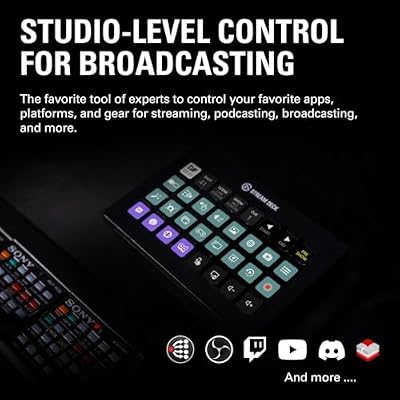
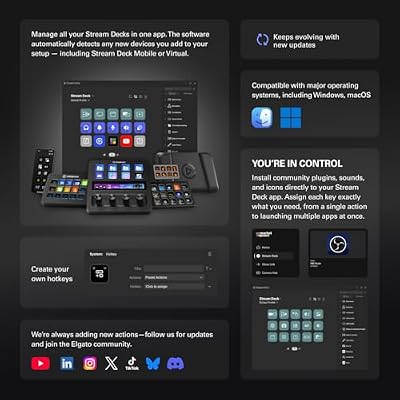
Elgato Stream Deck XL Advanced Studio Controller, 32 Keys | Instantly trigger unlimited actions, Powerful integrations, Visual feedback, Custom icon packs, Works with Mac and PC



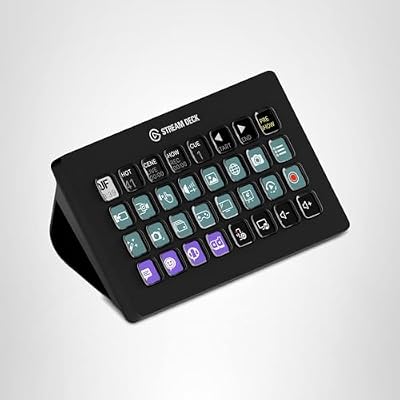
As an Amazon Associate we earn from qualifying purchases. Product prices and availability are accurate as of the date/time indicated.
At one hundred and seventy dollars, the Keychron Q1 V2 is the bootstrapped tier mechanical keyboard pick. Full aluminum case, hot-swappable switches so you can change the feel without re-soldering, and both wired USB-C and Bluetooth connections. The build quality here is genuinely premium and the board will outlive several computers. The seventy-five percent layout keeps the function row and arrow keys engineers actually use, unlike sixty-percent boards that bury basic navigation behind layer combos.
The bootstrapped compromise is that you do not yet have a split ergonomic keyboard. The Keychron is much kinder to your wrists than a generic membrane board and will hold up for years, but if you are past thirty and code full-time, plan to move to a split design within eighteen months as cash flow allows.
Logitech MX Master 3S Mouse

Logitech MX Master 3S Wireless Bluetooth Mouse, Ultra-Fast Scrolling 8K DPI | MagSpeed Scrolling , 8K DPI Any-Surface, Quiet Clicks, Windows/Mac/Chrome/Linux, USB-C, Bluetooth, Logi Bolt USB Receiver


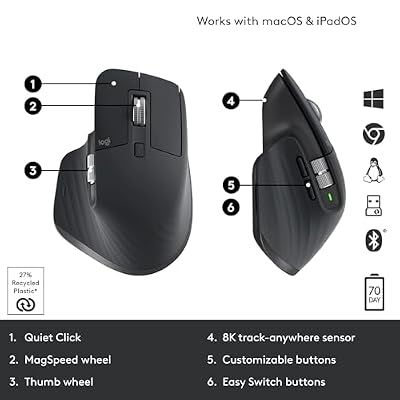


As an Amazon Associate we earn from qualifying purchases. Product prices and availability are accurate as of the date/time indicated.
At ninety-five dollars, the MX Master 3S is the universal pick across all three tiers, because there is genuinely no better productivity mouse at any price for software work. The eight programmable buttons, the MagSpeed wheel that flips between ratcheted and free-spin, and the seventy-day battery are the right feature mix for code review, IDE navigation, and general use. Buy this mouse first and never think about mice again for years.
Twenty-Seven Inch 4K Monitor
A 27-inch 4K monitor around three hundred and fifty dollars from a reliable brand like LG, Dell, or ASUS gives you the resolution and real estate to work effectively on one display. The bootstrapped compromise is going without the USB-C delivery, KVM, and IPS Black panel of the Dell U3225QE — but you save almost a thousand dollars, and basic 4K is still massively better than any 1440p or 1080p alternative for code.
Ryzen 7 7700X CPU and 32GB DDR5 RAM
At three hundred and ten dollars, the Ryzen 7 7700X with thirty-two gigabytes of DDR5-6000 RAM is the bootstrapped CPU and memory combo. Eight cores and sixteen threads chew through anything short of cold Rust release builds. Thirty-two gigabytes is the bare minimum for modern web development and is plausibly upgradeable to sixty-four by dropping in a second kit when budget allows. The compromise is that you will feel some RAM pressure under heavy container workloads, but the bootstrapped tier deliberately trades capacity for total budget.
One Terabyte Samsung 990 Pro NVMe
At a hundred and ten dollars, the Samsung 990 Pro at one terabyte is the bootstrapped storage pick. One terabyte fills faster than you expect once professional dev work piles up, but the bootstrapped tier accepts adding a second drive within a year. The 990 Pro keeps its Gen4 speed and five-year warranty at the smaller capacity. Budget for a second 2TB drive within twelve months of regular professional use.
Mid-Career Tier: The Five Thousand Dollar Builder
The mid-career tier is for the engineer in a stable senior or staff role with the budget to invest properly in a workstation that lasts five to seven years without compromise. This is where the rig starts feeling like a professional tool rather than a budget-constrained makeshift. Every part is chosen for performance and longevity instead of price-optimization.
Steelcase Gesture Chair
At twelve hundred dollars, the Steelcase Gesture is the mid-career chair pick. Its standout strength is the arm system that adjusts in four directions to support keyboard work, tablet use, and the reaching and twisting of modern computer work. Breathable fabric, full lumbar adjustment, and a twelve-year warranty plant it firmly in the professional tier. We point engineers to the Gesture when they find the Embody’s dynamic support too aggressive and prefer a more traditional ergonomic feel.
Kinesis Advantage 360 Split Keyboard

Noctua NF-A12x25 PWM, High-Performance Quiet Fan 120mm | High Airflow and Static Pressure Low Noise 25mm Thick Fan for Coolers/Radiators/Cases, Rich Accessory Kit, 2000rpm PWM


As an Amazon Associate we earn from qualifying purchases. Product prices and availability are accurate as of the date/time indicated.
At four hundred and fifty dollars, the Kinesis Advantage 360 enters at the mid-career tier and stays through the no-compromise tier. The split ergonomic design shields your wrists from the slow-onset injuries that end engineering careers. The bowled key wells, column-staggered layout, and thumb-cluster modifiers cut total finger travel and wrist deviation measurably. The wireless dual-half design lets each hand sit at your natural shoulder width instead of forcing your shoulders inward.
The two-week learning curve is real, but so are the long-term productivity and health gains. Several engineers on our team have run the Advantage 360 for three-plus years and now type five to ten percent faster than they did on conventional boards, with zero wrist or RSI symptoms across ten-hour coding days. This is the single highest career-longevity investment in the whole build.
Dell U3225QE 32-Inch 4K Monitor

CORSAIR 4000D AIRFLOW Tempered Glass Mid-Tower ATX Case - High-Airflow - Cable Management System - Spacious Interior - Two Included 120 mm Fans - Black


As an Amazon Associate we earn from qualifying purchases. Product prices and availability are accurate as of the date/time indicated.
At thirteen hundred dollars, the Dell U3225QE is the mid-career monitor that fixes real workflow pain. The mix of 32-inch native 4K, an IPS Black panel with deep contrast, 90-watt USB-C power delivery for laptop charging, and a built-in KVM is the killer feature set. The KVM in particular flips your whole desk between your desktop tower and your work-issued laptop with one keyboard shortcut — the most common workflow for engineers juggling separate personal and corporate machines.
The IPS Black panel deserves a callout. Its contrast ratio near two thousand to one dwarfs the thousand to one of conventional IPS, and the difference jumps out in the dark IDE themes every working engineer runs. The Thunderbolt 4 connection drives four kilometers of pixels at a hundred twenty hertz, which feels noticeably smoother than the old sixty hertz standard when dragging windows and scrolling.
Ryzen 9 7950X CPU and 64GB DDR5 RAM
At five hundred and fifty dollars, the Ryzen 9 7950X with sixty-four gigabytes of Corsair Vengeance DDR5-6000 CL30 is the mid-career compute and memory combo. Sixteen cores and thirty-two threads handle any developer workload — parallel compiles of large codebases, heavy container loads, multiple VMs, the odd local inference task. The 7950X’s efficiency on the AM5 platform keeps cooling reasonable and noise low under sustained load.

COOFANDY Mens Hawaiian Shirt Short Sleeve Floral Button Down Shirts Tropical Beach Shirts


As an Amazon Associate we earn from qualifying purchases. Product prices and availability are accurate as of the date/time indicated.
Sixty-four gigabytes of RAM is the new sweet spot. The Corsair Vengeance kit is the stability-tested choice that runs full advertised speeds on AMD AM5 without custom BIOS tuning or undervolting. The dual-channel sixty-four gigabyte config leaves headroom for browsers, IDEs, language servers, containers, meeting apps, and the OS at once without swapping to disk under normal use.
Two Terabyte Samsung 990 Pro NVMe

Samsung SSD 990 PRO 2TB, PCIe 4.0 M.2 2280, Up to 7,450 MB/s | NVMe Internal Solid State Hard Drive for High End Computing, Gaming, and Heavy Duty Workstations, (MZ-V9P2T0B/AM)


As an Amazon Associate we earn from qualifying purchases. Product prices and availability are accurate as of the date/time indicated.
At a hundred and ninety dollars, the Samsung 990 Pro at two terabytes is the mid-career storage pick. Two terabytes is the right size for a primary developer drive because it comfortably absorbs the OS, apps, project files, Docker volumes, dependency caches, and language server indexes that pile up over years of work. The Gen4 speeds, especially random reads, are exactly what file-system-heavy developer workloads want.
Elgato Stream Deck MK.2

Elgato Stream Deck MK.2 Studio Controller, 15 Macro Keys | Trigger actions in OBS, Twitch, YouTube and more, Visual feedback, Hundreds of plugins, Works with Mac and PC


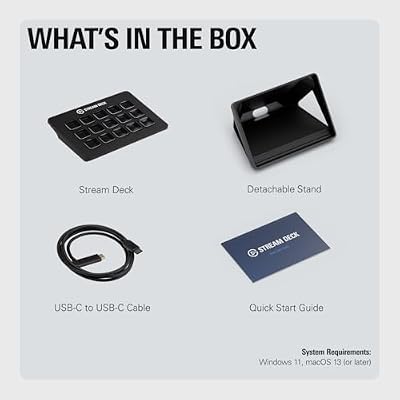

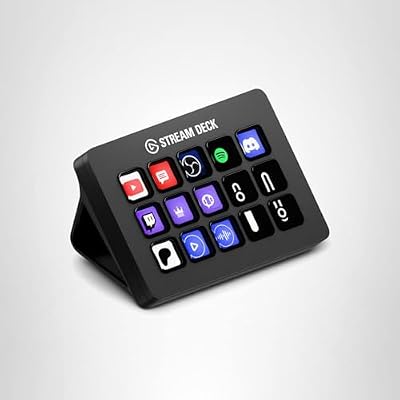
As an Amazon Associate we earn from qualifying purchases. Product prices and availability are accurate as of the date/time indicated.
At a hundred and fifty dollars, the Stream Deck MK.2 enters at the mid-career tier because its workflow gains compound over years. Fifteen programmable LCD keys sit beside your keyboard and fire any action you can express as a script or hotkey. The mid-career engineer has the workflow complexity to exploit custom Git, Docker, IDE, and meeting profiles, and the Stream Deck pays back its cost within months in saved cognitive bandwidth.
No-Compromise Tier: The Nine Thousand Dollar Builder
The no-compromise tier is for the senior or staff engineer who can justify the full spend and wants a workstation that lasts seven-plus years without a second thought about upgrades. The principle is to over-provision the parts that age slowly and pick the absolute best version of every category. The total looks steep in absolute terms but amortizes to less than the cost of one workday of lost productivity per month over the build’s life.
Herman Miller Embody Chair

Logitech G502 Hero Wired Gaming Mouse - Black | High performance, 25,600 DPI, RGB, adjustable weights, 11 programmable buttons, on-board memory, PC/Mac





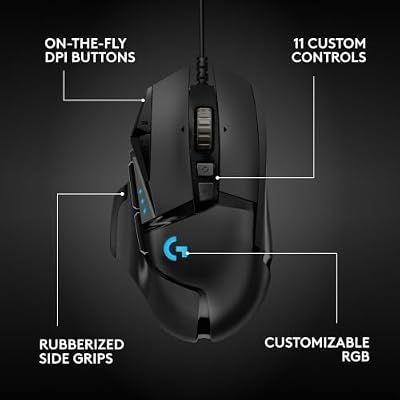
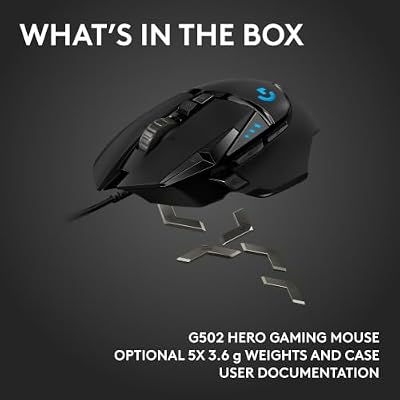
As an Amazon Associate we earn from qualifying purchases. Product prices and availability are accurate as of the date/time indicated.
At nineteen hundred dollars, the Herman Miller Embody is the chair upgrade for the no-compromise builder. The dynamic matrix back, twelve-year warranty, and design built for full-time computer work make it the gold standard. The cost amortizes to roughly fifty cents per working hour over the twelve-year warranty, which is laughable next to the back and neck pain it prevents over the same span. This is one of the few parts where we genuinely recommend the most expensive option in the category for any builder who can swing it.
MX Master 3S and MX Ergo Combination
The no-compromise mouse setup pairs the MX Master 3S as the primary pointing device with an MX Ergo trackball as the secondary for long stretches where you want to cut wrist movement. Alternating between the two over the day is a genuinely useful ergonomic habit several long-career engineers in our community swear by. The pair runs about two hundred dollars, trivial in a no-compromise build.
Dell U3225QE Plus Vertical Secondary Monitor
The no-compromise display setup is the Dell U3225QE as primary plus a 27-inch 1440p monitor rotated to portrait on your dominant-hand side. The vertical secondary is the right shape for documentation, Slack, reference material, and chat, while the primary carries the IDE and terminal. The pair runs about sixteen hundred dollars, and the productivity gain over a single monitor is substantial.
Intel Core Ultra 9 285K and 128GB RAM
At six hundred and twenty dollars, the Intel Core Ultra 9 285K with a hundred and twenty-eight gigabytes of Corsair Vengeance DDR5-6000 is the no-compromise compute and memory tier. The 285K’s twenty-four mixed cores power through parallel compiles, container loads, and any local AI inference task. The hundred and twenty-eight gigabyte config gives genuine headroom for any conceivable developer workload, including running multiple VMs at once, training small ML models, and operating local language models for AI-augmented development.
Two Terabyte Primary Plus Four Terabyte Secondary NVMe
The no-compromise storage setup is a Samsung 990 Pro 2TB primary paired with a 4TB Gen4 NVMe secondary for backups, VM images, datasets, and bulk storage. The pair runs about four hundred and thirty dollars, and the result is a workstation you never think about storage on for the life of the build. The dual-drive split also separates OS and apps on one drive from project work on the other, which simplifies backups and OS reinstalls.
Stream Deck MK.2 Plus Mini
The no-compromise Stream Deck setup is the fifteen-key MK.2 as primary plus the six-key Mini as a portable companion for travel and coffee-shop work. The Mini syncs with your primary device, so the same profiles travel everywhere. The pair runs about two hundred and thirty dollars, and the cross-location workflow consistency is genuinely valuable for engineers who work from several places.
Software Pairing for the Builder
The 2026 builder’s software stack should match the hardware spend. For coding, VS Code with GitHub Copilot or Cursor for AI-augmented editing handles general work. JetBrains products stay best in class for Java, Python, and Go work where deep language understanding pays off. Pick one editor and master it rather than churning between them, because the payoff from editor mastery dwarfs any single editor feature.
For containers, Docker Desktop is the default. OrbStack on macOS is the faster alternative if you mainly work on Mac. For Git, Fork is the visual client we recommend for builders who want a polished tool that handles complex merges well. For API testing, Bruno is the modern pick, with file-format version control that fits Git workflows naturally. Postman remains the corporate default for compatibility reasons.
For the terminal, Warp is the modern AI-augmented option that covers most needs. iTerm2 plus tmux stays the traditional choice for engineers who like scripting their own terminal experience. Windows builders should run WSL2 with Ubuntu or Debian for any serious development. macOS users get a near-Linux developer experience natively, with Homebrew handling package management.
For local AI inference, LM Studio and Ollama are the easiest entry points. With the no-compromise tier’s twenty-four cores and a hundred and twenty-eight gigabytes of RAM, you can run models up to about thirty billion parameters comfortably on CPU inference. Add an RTX 5070 with twelve gigabytes of VRAM and you move into reasonable speed territory for code-completion-sized models. Builders who do not need local inference can skip the GPU and use a cheap discrete card or integrated graphics.
Builder’s Verdict
For the bootstrapped builder, go with the Branch Verve chair, the Keychron Q1 V2 keyboard, the MX Master 3S mouse, a 27-inch 4K monitor, the Ryzen 7 7700X with thirty-two gigabytes of RAM, and a 1TB Samsung 990 Pro NVMe. Around two thousand dollars total and a solid foundation you can upgrade incrementally as cash flow allows. For the mid-career builder, go with the Steelcase Gesture, the Kinesis Advantage 360, the MX Master 3S, the Dell U3225QE, the Ryzen 9 7950X with sixty-four gigabytes of RAM, a 2TB Samsung 990 Pro, and the Stream Deck MK.2. Around five thousand dollars total and a workstation that will not bottleneck any reasonable developer workflow.
For the no-compromise builder, go with the Herman Miller Embody, the Kinesis Advantage 360, the MX Master 3S plus MX Ergo trackball, the Dell U3225QE primary with a 27-inch vertical secondary, the Intel Core Ultra 9 285K with a hundred and twenty-eight gigabytes of RAM, a 2TB primary plus 4TB secondary NVMe config, and the Stream Deck MK.2 plus Mini combo. Around nine thousand dollars total and a workstation that will carry you seven-plus years without compromise.
For further reading on building out your complete setup, see our builder’s guide to setting up dual monitors, our list of best graduation gifts for new programmers, our builder-focused review of the best ergonomic keyboards of 2026, our detailed comparison of 4K monitors for programming work, our budget-tiered review of Herman Miller versus Steelcase chairs, our build-it-yourself guide to desk setups for software engineers, and the builder’s-perspective list of the best mechanical keyboards for programmers. Each of these covers a single component of the workstation puzzle in the depth a builder needs to make an informed choice.
Related Articles
Want to dig deeper on this? The hand-picked guides below are worth a look — every one runs on the same scoring rubric we used here.
Frequently Asked Questions
How much RAM does a software developer workstation need?
32GB is the comfortable baseline for running an IDE, containers, browsers, and databases together. Developers using virtual machines, large monorepos, or many Docker containers benefit strongly from 64GB. Memory pressure causes swapping and sluggish builds, so err toward more RAM than you think you currently need.
Do developers need a powerful GPU?
Most general and web development needs only a basic GPU for the display. A strong GPU matters if you do machine learning, run local large language models, build games, or work in graphics. For typical backend and app development, invest that budget in CPU, RAM, and fast storage instead.
Is a many-core CPU worth it for compiling code?
Yes, compilation and test suites parallelize well across cores, so more cores directly cut build times on large projects. High single-core speed still helps IDE responsiveness and lightly threaded tasks. A balanced high-core CPU with good clocks gives fast builds without sacrificing snappy everyday interaction.
Should I run Linux, Windows, or macOS for development?
Choose based on your stack. Linux offers native tooling and matches most server environments. macOS suits iOS and Apple ecosystem work with a Unix base. Windows with WSL2 bridges both worlds, running Linux tooling alongside Windows apps. Container workflows reduce how much the host OS matters.
How many monitors do developers actually benefit from?
Two monitors is the productivity sweet spot, letting you keep code on one screen and documentation, terminals, or a browser on the other. A single ultrawide is an alternative that avoids a bezel gap. Beyond two screens, gains taper off and neck strain from constant turning can increase.
Ready to decide? Our #1 pick for 2026 is the Chair.
Live price & availability on Amazon.
Top picks from this guide
ElgatoElgato Stream Deck XL Advanced Studio Controller, 32 Keys |…$234 \xc2\xb7 98/100COOFANDYCOOFANDY Mens Hawaiian Shirt Short Sleeve Floral Button Down Shirts…$15 \xc2\xb7 96/100Logitech GLogitech G502 Hero Wired Gaming Mouse - Black | High…$38 \xc2\xb7 96/100NoctuaNoctua NF-A12x25 PWM, High-Performance Quiet Fan 120mm | High Airflow…$35 \xc2\xb7 96/100