The best robotic pool cleaner for most in-ground pool owners is the Dolphin Nautilus CC Plus Wi-Fi. It is a corded, wall-climbing machine with top-load filtration and app scheduling, which means it never sits idle waiting for a charge and it comfortably handles pools up to roughly 40 feet as long as an outlet sits within cable reach. If you cannot run a cable — a rental property, a detached pool, or a deck with no power — the Aiper Scuba S3 is the strongest cordless pick here, pairing auto-parking and alerts with waterline attention at a premium price. Buyers working to a tight budget who still want cordless convenience should look at the WYBOT B1 or the BRINBO C1, both of which trade navigation sophistication and filter volume for a far lower entry price. This roundup compares all twelve models on pool-size limits, cleaning coverage, cord versus battery power, filter capacity, and the running costs that only show up after the box is open.
- Top 3 Picks
- Quick Comparison
- How We Chose
- 1. Dolphin Automatic Robotic Pool Vacuum (Wall-Climbing, Smart Navigation) – Best for Large In-Ground Pools
- 2. Dolphin Nautilus CC – Best for a First Robotic Cleaner
- 3. Aiper Scuba S3 – Best Premium Cordless with Auto-Parking and Alerts
- 4. BRINBO C1 (2026 Upgrade) – Best Budget Cordless with Long Stated Runtime
- 5. Wybot C2 Cordless Pool Vacuum – Best Cordless for In-Ground Pools Without an Outlet
- 6. Dolphin (2026 Model) Nautilus AG – Best for Above-Ground Pools
- 7. Dolphin Nautilus CC Plus Wi-Fi – Best Overall for Set-and-Forget Scheduling
- 8. Aiper Scuba S1 (2026) – Best Mid-Range Cordless for Full-Surface Cleaning
- 9. CZYBYTE Cordless Robotic Pool Vacuum – Best Budget Pick with App Support
- 10. Beatbot Sora 30 – Best for Shallow Areas and Surface Parking
Top 3 Picks
Best overall: Dolphin Nautilus CC Plus Wi-Fi
A corded, wall-climbing cleaner with Wi-Fi scheduling and top-load filtration, this is the model that best fits the average in-ground pool owner: no battery to charge, no runtime anxiety, and a filter you can rinse in under two minutes. It is premium-priced, but the money goes into navigation and build quality rather than batteries that will need replacing in two or three seasons. It suits pools up to roughly 40 feet with a nearby outlet and a deck where a cable can live semi-permanently.
Best budget: WYBOT B1 Cordless Robotic Pool Vacuum
For the price of a mid-range corded unit’s accessories, the WYBOT B1 gives you a genuinely cordless, battery-powered cleaner aimed at in-ground pools. Coverage and filter volume are entry-level, so it rewards owners who run it often rather than owners who expect one long pass to do everything. It is the right answer for smaller pools, seasonal use, and anyone who refuses to manage a 50-foot cable.
Best premium cordless: Aiper Scuba S3
The Scuba S3 is the cordless cleaner for people who want the machine to handle its own logistics: auto-parking at the surface or wall when the cycle ends, alerts when something needs attention, and cleaning that reaches beyond the floor. It costs premium money and its battery is a consumable, but for pools with awkward geometry or no practical power run, it removes the single biggest friction point in robotic cleaning.
Quick Comparison
Every model below is grouped by how it is powered, because that decision drives almost everything else: cable management, runtime, filter size, and long-term cost. Spec values are given as classes rather than single figures — manufacturers revise hardware between production runs, and the listing is always the final word.
| Product | Best for | Power | Cleaning coverage | Filter class | Pool size class | Price tier |
|---|---|---|---|---|---|---|
| Dolphin Automatic Robotic Pool Vacuum (Wall-Climbing, Smart Navigation) | Large in-ground pools, heavy debris | Corded, swivel cable | Floor, walls, waterline scrub | Large top-load cartridge | Large in-ground | Premium |
| Dolphin Nautilus CC | First robotic cleaner for an in-ground pool | Corded, swivel cable | Floor and walls | Top-load cartridge | Medium in-ground | Mid-range |
| Aiper Scuba S3 | Cordless premium with alerts and auto-parking | Cordless, rechargeable | Floor, walls, waterline | Dual-layer basket | Medium to large in-ground | Premium |
| BRINBO C1 (2026 Upgrade) | Budget cordless with long stated runtime | Cordless, rechargeable | Floor-focused | Single basket | Small to medium | Budget |
| Wybot C2 Cordless | Cordless cleaning without an outlet run | Cordless, rechargeable | Floor-focused | Single basket | Small to medium in-ground | Budget |
| Dolphin Nautilus AG (2026 Model) | Above-ground pools | Corded | Floor, walls, active scrub brush | Top-load cartridge | Above-ground | Mid-range |
| Dolphin Nautilus CC Plus Wi-Fi | Set-and-forget scheduling | Corded, swivel cable | Floor, walls, waterline | Top-load cartridge | Medium to large in-ground | Premium |
| Aiper Scuba S1 (2026) | Full-surface cordless cleaning on a mid-range budget | Cordless, rechargeable | Floor, walls, waterline, shallow areas | Double filtration basket | Medium in-ground | Mid-range |
| CZYBYTE Cordless Robotic Pool Vacuum | App-connected budget cleaning | Cordless, rechargeable | Floor-focused | Single basket | Small | Budget |
| Beatbot Sora 30 | Shallow areas and surface parking | Cordless, rechargeable | Four-mode, shallow-area emphasis | Multi-stage basket | Medium in-ground | Mid-range |
| WYBOT B1 Cordless | Budget cordless for in-ground pools | Cordless, rechargeable | Floor-focused | Single basket | Small to medium in-ground | Budget |
| Polaris VRXIQ+ Smart Robotic | App-linked cleaning on a pressure-cleaner brand’s platform | Corded, swivel cable | Floor, walls, waterline | Large cartridge | Large in-ground | Premium |
Read the table as a filter, not a ranking. Find your pool type first, then your debris load, then your tolerance for cable management. Most buyers who are unhappy with a robotic cleaner bought the wrong power class for their yard rather than the wrong brand.
How We Chose
This roundup is built from published manufacturer specifications, listing descriptions, and well-documented category behaviour rather than from any physical testing — no units were purchased, borrowed, or run for this article. Selection started with a shortlist of models that are actually listed and available, then narrowed by five criteria.
First, category fit: the cleaner had to solve a real problem for a specific pool type, whether that is a 30-foot in-ground pool under trees or a 24-foot above-ground pool with a vinyl liner. Second, coverage: floor-only cleaning is a legitimate design choice, but it had to be priced accordingly, and models claiming wall, waterline, or shallow-area coverage were judged against what their drive system can plausibly deliver. Third, power architecture: corded and cordless machines have different failure modes, so both are represented at every price tier instead of pretending one is universally better.
Fourth, filter capacity and serviceability — how much debris the basket holds, how easy it is to remove without tools, and whether replacement parts are commonly available. Fifth, ongoing cost: electricity is trivial for any of these machines, but battery replacement, cartridge replacement, and brush wear are not, and a budget cleaner with a two-season battery can cost more over four years than a corded unit that never needs one. Upgrade path mattered too: a model that leaves you with no better option two years later scored lower than one sitting in a range you can grow within.
1. Dolphin Automatic Robotic Pool Vacuum (Wall-Climbing, Smart Navigation) – Best for Large In-Ground Pools

Dolphin Automatic Robotic Pool Vacuum Cleaner, Wall Climbing Scrubber Brush, Smart Navigation, Ideal for In-Ground Pools up to 40FT in Length - Nautilus CC Plus
Included for 'Best Robotic Pool Cleaners Reviewed: Top Picks' because the listing specifies Wall Climbing Scrubber Brush and Smart Navigation, details this guide uses to compare options.
View on AmazonThis is the Dolphin for the big, open, debris-heavy in-ground pool. The listing describes wall-climbing scrubbing, a dedicated scrubber brush for the floor-to-wall transition, and smart navigation that maps the pool rather than bumping around it. It is a corded machine, which is the right call at this size: a battery large enough to clean a 40-foot pool thoroughly would be heavy, expensive, and another consumable to replace. It suits owners who can leave a cable connected at the pool’s edge all season and who would rather schedule a clean than carry a unit to a charger.
Key specs
- Power: mains corded with a swivel connection to reduce cable tangling as the unit turns
- Coverage: pool floor, walls, and the waterline band via the scrubber brush
- Navigation: smart scanning with programmed passes rather than random bounce
- Filtration: large top-load cartridge class, sized for coarse debris plus fine silt
- Pool type: in-ground, at the larger end of residential sizes
- Control: onboard program selection; scheduling handled by an external timer if desired
The strongest argument for this model is that it does the parts of pool cleaning people actually hate. Floor-only robots leave a visible ring of debris at the waterline and a film on the walls that you still have to brush by hand, and that hand-brushing is the job most owners are trying to eliminate. A wall-climbing unit with a transition brush addresses both, which changes the maintenance rhythm from “robot plus weekly brushing” to “robot plus occasional spot checks.”
Filtration volume matters just as much at this size. A larger cartridge holds more before flow drops, so the unit keeps picking up fines instead of redistributing them. In practice, a large-cartridge machine on a leaf-heavy pool might need rinsing every few cycles during peak fall, while a small-basket budget unit in the same pool needs rinsing after every single run. That difference is invisible in a spec sheet and very visible in how often you handle the thing.
Smart navigation is the third pillar. Random-pattern cleaners do eventually cover a floor, but they cover it unevenly, and on a large pool the uneven parts are obvious. A cleaner that runs defined passes gets more of the floor in the same hour, which is why the corded premium tier exists at all. The trade-off is that navigation systems are the most repair-prone part of any robotic cleaner, and corded units have no battery to blame when something stops working.
Pros
- Wall and waterline coverage removes the need for routine manual brushing
- No battery means no runtime limit and no replacement cost down the line
- Large filter cartridge suits heavy leaf and silt loads
- Swivel cable reduces tangling on long, complex pool shapes
- Mature, widely serviced brand with commonly available wear parts
Cons
- Requires an outdoor outlet within cable reach of the pool
- Cable handling is a genuine chore for some owners, especially on tight decks
- Premium price for a category where the mid-range option cleans most pools nearly as well
- No app-level scheduling unless you add an external timer
How it compares
Against the Dolphin Nautilus CC Plus Wi-Fi, the choice comes down to control versus price. The Nautilus CC Plus Wi-Fi adds app scheduling and a slightly friendlier ownership experience but sits in the same premium tier; if you want to start a clean from your phone while driving home, that is the one to pick. Against the Polaris VRXIQ+, which offers app-linked control through its own ecosystem, this Dolphin is the more brand-neutral purchase with a longer history of parts availability. Against the mid-range Nautilus CC, it is the upgrade you buy when your pool is genuinely large or your debris load is genuinely heavy — not when you simply want a nicer cleaner.
2. Dolphin Nautilus CC – Best for a First Robotic Cleaner

Dolphin Nautilus CC Automatic Robotic Pool Vacuum Cleaner, Wall Climbing Scrubber Brush, Top Load Filter Access, Ideal for Above/In-Ground Pools up to 33 FT in Length
Included for 'Best Robotic Pool Cleaners Reviewed: Top Picks' because the listing specifies Wall Climbing Scrubber Brush and Top Load Filter Access, details this guide uses to compare options.
View on AmazonThe Nautilus CC is the sensible entry point into the Dolphin range: a corded, wall-climbing robotic vacuum with a top-load filter access, aimed at in-ground pools that are not extreme in size or debris load. It suits the owner who has been vacuuming by hand or running a suction-side cleaner and wants to stop, without jumping to a premium price. Because it is corded, it is also the right first robot for someone who is unsure how much they will actually use one — there is no battery quietly ageing on a shelf between swims.
Key specs
- Power: mains corded with swivel cable management
- Coverage: floor and walls, with scrubbing on vertical surfaces
- Navigation: scanning pattern navigation typical of the Nautilus line
- Filtration: top-load cartridge, removable without tools
- Pool type: in-ground, medium residential sizes
- Control: onboard program selection
The top-load filter is the feature that most affects daily ownership. Bottom-load designs require you to flip the unit and unclip a base plate while it drips on your deck; top-load designs let you lift the basket out, hose it off, and drop it back in with the machine still upright. Over a season of two or three rinses a week, that difference is measured in minutes but felt in willingness — owners with awkward filters rinse less often, and a clogged filter is the single most common reason a robotic cleaner “stops working.”
Wall climbing on this model is a practical inclusion rather than a marketing one. It means the unit spends part of its cycle on vertical surfaces, which keeps the wall-to-floor seam from developing the brown line that floor-only cleaners leave behind. It does not replace occasional brushing on a heavily soiled pool, but it substantially stretches the interval between manual sessions.
The honest limitation is coverage speed. This is a mid-tier cleaner, and on a large pool it will take longer to complete a full pass than a premium unit with more sophisticated mapping. If your pool is 30 feet or more with heavy tree cover, the extra cost of a premium model buys real time back. If your pool is a modest rectangle with normal debris, the difference is mostly theoretical, and you have saved a meaningful amount of money.
Runtime is not a factor at all here, and that is the quiet advantage of the corded class. A cordless cleaner’s performance degrades as the battery ages, and its cleaning window is fixed by the pack. A corded unit cleans the same on day one and day one thousand, provided the filter is clean and the brushes have material left on them. For a first purchase, that predictability is worth more than cordless convenience.
Pros
- Top-load filter access makes routine rinsing genuinely quick
- Wall climbing reduces manual brushing between sessions
- No battery to charge, degrade, or replace
- Lower entry price than premium Dolphin models with similar floor results
- Widely available consumables and service documentation
Cons
- Requires a nearby outdoor outlet
- Slower full-pool coverage than premium navigation systems
- No app control or remote scheduling
- Filter capacity is mid-tier, so heavy leaf loads need frequent rinsing
How it compares
Against the 2026 Nautilus AG, the difference is pool type rather than quality: the AG version is configured for above-ground pools, with the brush and climbing behaviour tuned for a vinyl or steel-walled pool rather than a plaster or pebble in-ground shell. If your pool is above-ground, buy that one instead — the Nautilus CC is not the right machine for it. Against the Nautilus CC Plus Wi-Fi, you are paying the premium for app scheduling and a slightly more capable chassis; if you never intend to use a phone app, this model delivers most of the cleaning result for less. Against a budget cordless unit, the Nautilus CC wins on filter volume and wall climbing but loses on setup freedom.
3. Aiper Scuba S3 – Best Premium Cordless with Auto-Parking and Alerts
The Scuba S3 is the cordless cleaner for owners who want the machine to manage its own logistics. The listing highlights auto-parking — the unit returning to a defined spot at the end of a cycle rather than stopping wherever it ran out — and alerts that tell you when something needs attention. That combination matters more than it sounds: a cordless robot that dies mid-pool is a robot you have to fish out with a pole, and one that parks itself at the wall or surface is one you simply lift out. It suits medium to large in-ground pools where running a cable is impractical or simply unwanted.
Key specs
- Power: cordless, rechargeable battery, charged out of the water
- Coverage: floor, walls, and waterline attention
- Navigation: guided patterns with obstacle handling typical of the Scuba line
- Filtration: multi-layer basket separating coarse debris from fines
- End of cycle: auto-parking plus status alerts
- Pool type: in-ground, medium to large residential
Auto-parking is the feature that changes the ownership experience most. Without it, every cycle ends with the same routine: find where the unit stopped, hook it with a pole, drag it to the edge, and lift a water-laden machine out of the pool. With it, the unit surfaces or parks at a wall, and retrieval becomes a single motion. On a pool you clean three or four times a week, that is dozens of small irritations removed per season.
Alerts are the second half of that idea. A cordless cleaner that stops early because of a blocked intake or a low battery is indistinguishable from one that finished normally unless it tells you. Status reporting turns a mystery into a maintenance prompt. It is not a substitute for checking the basket, but it removes the guesswork from “did it actually clean, or did it quit after twenty minutes?”
The premium price buys coverage breadth as well as convenience. Reaching walls and the waterline cordlessly is harder engineering than doing it on a cable, because the unit carries its own power and must manage buoyancy and grip without unlimited draw. That is why cordless machines at the top of the range cost more than corded equivalents with the same coverage claims. The honest trade-off is the battery itself: it is a consumable with a finite number of cycles, and it will eventually need replacement, which is a cost a corded cleaner never incurs.
Charging discipline matters too. A cordless unit used twice a week and charged between uses will outlast one left discharged for months at a time. If you are the kind of owner who cleans the pool in bursts — intensively for a week, then not at all for a fortnight — a corded machine suits your habits better and will not punish you for the gaps.
Pros
- No cable to route, tangle, or trip over
- Auto-parking makes retrieval a one-step job
- Status alerts distinguish “finished” from “stopped early”
- Wall and waterline coverage in a cordless package
- Suits pools with no practical outlet run
Cons
- Premium price for a battery-powered machine
- Battery is a consumable that will need replacement eventually
- Runtime is bounded per charge, unlike a corded unit
- Requires charging discipline between sessions
How it compares
Against the Aiper Scuba S1 2026, the S3 is the upgrade for owners who value convenience features as much as cleaning result: auto-parking and alerts are the differentiators, and both models share the same full-surface, double-filtration approach. If your pool is medium-sized and you mostly care about the floor and walls, the S1 delivers most of the result for less. Against the Beatbot Sora 30, the S3 leans toward general in-ground coverage while the Sora 30 emphasises shallow-area work and surface parking; if your pool has a large shallow shelf or a sun ledge, that is worth weighing. Against a corded premium Dolphin or Polaris, the S3 wins on setup freedom and loses on unlimited runtime.
4. BRINBO C1 (2026 Upgrade) – Best Budget Cordless with Long Stated Runtime

(2026 Upgrade)BRINBO C1 Robot Pool Cleaner with 180 Mins, Frosted Gray Blue
Included for 'Best Robotic Pool Cleaners Reviewed: Top Picks' because the listing specifies Frosted Gray Blue, details this guide uses to compare options.
View on AmazonThe BRINBO C1 is a budget cordless cleaner whose listing states a 180-minute runtime, which is a long figure for this price class and the main reason to consider it. It suits owners of small to medium pools who want cordless convenience without paying premium money, and who understand that the trade-off shows up in navigation sophistication and filter volume rather than in the headline number. If your pool is a straightforward shape with moderate debris, this class of machine does the job.
Key specs
- Power: cordless, rechargeable, charged outside the pool
- Runtime: 180 minutes stated in the listing — verify against your pool’s cycle time
- Coverage: floor-focused cleaning typical of the budget cordless class
- Filtration: single removable basket
- Pool type: small to medium, in-ground or above-ground depending on configuration
- Finish: frosted gray-blue housing
The stated 180 minutes deserves context rather than celebration. Runtime claims are usually measured at a moderate average draw, and a cleaner that spends part of its cycle climbing walls or fighting a current draws more than one cruising a flat floor. In the worked calculation later in this guide, a mid-size battery pack can drop from roughly two hours to about seventy minutes when the unit moves into a high-draw mode. So treat a long stated runtime as a ceiling, not a promise, and ask whether it still covers your pool if you halve it.
Filter volume is the second thing to understand at this price. A single-basket design holds less before flow drops, and once flow drops the cleaner stops capturing fines and starts stirring them. On a pool with leaf litter, that means rinsing the basket after every cycle, not every third one. It is not a defect — it is what the price buys — but it changes the routine, and owners who skip the rinses conclude the robot is broken when it is simply full.
Where budget cordless machines genuinely win is setup friction. There is no cable to run, no outlet to find, no tripping hazard on the deck, and no swivel joint to wear out. For a rental property, a pool with no nearby power, or an owner who cleans the pool in short bursts, that is worth more than better navigation. The cost is a battery with a finite life and a filter that fills quickly.
Serviceability is the last consideration. Budget models vary widely in whether replacement brushes, baskets, and batteries are easy to source two seasons later. Before buying in this tier, check that consumables are listed as separate items rather than only sold as part of a kit. A cheap cleaner with no parts channel becomes a disposable cleaner, which changes the four-year cost calculation considerably.
Pros
- Long stated runtime for the price class
- Fully cordless setup with no outlet requirement
- Low entry price makes it a reasonable second cleaner or a starter unit
- Simple single-basket design is easy to understand and clean
Cons
- Floor-focused coverage; walls and waterline need manual attention
- Small filter basket fills quickly under leaf load
- Stated runtime will not match real-world cycles at high draw
- Battery replacement and parts availability are the long-term question marks
How it compares
Against the WYBOT B1, the two are close in class and price tier, and the decision usually comes down to which one is available at the better price when you buy and whether you prefer the longer stated runtime here or the in-ground tuning of the B1. Against the CZYBYTE cordless unit, the BRINBO’s longer runtime claim is the differentiator, while CZYBYTE leans on app support. Against any mid-range cordless such as the Aiper Scuba S1, both budget units give up wall and waterline coverage — that is the real step up in price, not the battery.
5. Wybot C2 Cordless Pool Vacuum – Best Cordless for In-Ground Pools Without an Outlet
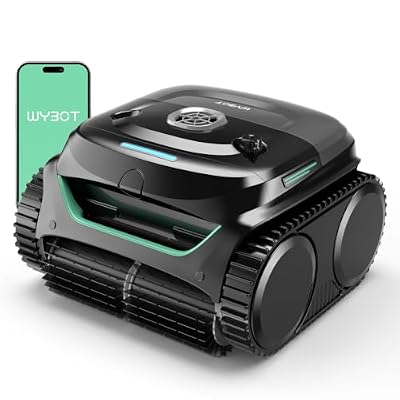
Wybot C2 Cordless Pool Vacuum for Inground Pools, Robotic Pool Cleaner
Included for 'Best Robotic Pool Cleaners Reviewed: Top Picks' because the listing specifies Robotic Pool Cleaner, details this guide uses to compare options.
View on AmazonThe Wybot C2 is a cordless robotic vacuum aimed specifically at in-ground pools, which distinguishes it from the many budget cordless units designed with above-ground or small pools in mind. It suits owners whose pool is in-ground but whose deck has no convenient power, or whose cable run would be long enough to be a genuine nuisance. Coverage is floor-focused at this price tier, so it rewards an owner who runs it regularly rather than expecting one pass to handle everything.
Key specs
- Power: cordless, rechargeable battery
- Coverage: floor cleaning, with the drive system tuned for in-ground pool surfaces
- Filtration: removable debris basket
- Pool type: in-ground, small to medium residential
- Setup: no cable, no outlet required during operation
- Class: budget cordless
The reason “for in-ground pools” is a meaningful phrase in this price bracket is surface and volume. Above-ground pools are typically shallower and smaller, with vinyl liners and simple flat floors; a small cordless robot can cover one comfortably in a single charge. In-ground pools are larger, often deeper, frequently irregular, and may have slopes, steps, or a hopper that a small unit has to find and climb. A machine marketed for in-ground use is usually built with more drive authority and a larger battery than a comparable above-ground unit, even if the two look similar in photos.
Depth and volume also affect the practical runtime. A deeper pool means longer wall and slope transitions, which draw more power than cruising a flat floor. That is why the same battery class that gives a small above-ground pool a comfortable margin can leave a larger in-ground pool only partly finished. The safest approach in this tier is to plan on two shorter cycles rather than one long one, and to run the cleaner more often than you would a corded unit.
Filtration follows the same logic. A budget basket fills faster, and in an in-ground pool with a mix of leaves, grass clippings, and sand, that fill rate is high. Rinsing after each cycle keeps flow up and keeps the machine effective. Owners who treat the basket as a monthly task will find the cleaner’s performance declining steadily and blame the robot rather than the routine.
What this model does not do is walls and waterline at any serious level. That is not a flaw at the budget tier — it is the honest boundary of the class. If you need wall climbing and waterline scrubbing, you are shopping in the mid-range cordless tier at minimum, and more likely in the corded mid-range where unlimited runtime makes full-surface coverage practical.
Pros
- Designed for in-ground pools rather than adapted from an above-ground design
- No cable, no outlet, no deck trip hazard
- Budget-tier pricing makes it low-risk to try robotic cleaning
- Simple maintenance with a single removable basket
Cons
- Floor-focused coverage only
- Bounded runtime per charge, with real-world figures below the ideal
- Basket capacity suits frequent rinsing rather than weekly cleaning
- Navigation is basic compared with mid-range and premium machines
How it compares
Against the WYBOT B1, this is a within-brand comparison and the two sit in the same price tier and power class; the practical difference is which is available and how the current listing frames its pool-size suitability, so check the stated pool dimensions on both before choosing. Against the BRINBO C1, the Wybot gives up the long stated runtime in exchange for in-ground-oriented tuning. Against the CZYBYTE unit, the choice is app connectivity versus pool-type focus. If any of these three leave you wanting wall coverage, skip the tier entirely and look at the Aiper Scuba S1 or a corded mid-range model.
6. Dolphin (2026 Model) Nautilus AG – Best for Above-Ground Pools

Dolphin (2026 Model) Nautilus AG Automatic Robotic Pool Vacuum Cleaner, Active Scrubber Brush, Top Load Filters Access, Ideal for Above-Ground Pools up to 33 FT in Length
Included for 'Best Robotic Pool Cleaners Reviewed: Top Picks' because the listing specifies Active Scrubber Brush and Top Load Filters Access, details this guide uses to compare options.
View on AmazonThe Nautilus AG is the above-ground member of the Nautilus family, with an active scrubber brush and top-load filter access, configured for the shallower, smaller, and more gently built pools that above-ground ownership implies. It suits owners of round, oval, or rectangular above-ground pools who want to stop vacuuming by hand but do not need the pool-size capacity of an in-ground machine. Because it is corded, it runs as long as you need and never needs charging.
Key specs
- Power: mains corded
- Coverage: floor and walls, with an active scrubber brush for the wall-to-floor transition
- Filtration: top-load cartridge, removable without tools
- Pool type: above-ground pools
- Control: onboard program selection
- Model year: 2026 revision
Above-ground pools need a different cleaner for physical reasons, not marketing ones. The walls are usually vinyl over a steel or resin frame, and the floor is often a sand or foam base that is more forgiving than a concrete or plaster shell. A cleaner tuned for an in-ground pool can be too aggressive on a vinyl wall, and its weight and grip assumptions may not suit a shallower, curved-bottom pool. The AG designation reflects that tuning: gentler wall contact, a scrubbing brush suited to a liner, and a chassis sized for the pool it will live in.
Above-ground pools also tend to be smaller in volume, which has a pleasant side effect: even a modest filter cartridge and a mid-tier navigation system are enough to cover the whole floor in a single pass. The gap between this model and a premium in-ground cleaner is mostly irrelevant on a 24-foot round pool, which is why buying up in this situation is usually wasted money.
The corded design is a strong fit here for a practical reason. Above-ground pools almost always have a filter and pump nearby, which means there is already power at the pool. Running a cable to a robotic cleaner costs nothing extra in that situation, and you avoid the charging routine entirely. The one thing to watch is cable routing over the top rail — a protective pass-over clip prevents the cable from chafing on the frame over a season.
The active scrubber brush is the feature that does the most visible work. Above-ground pools often develop a scum line at the waterline and a slight film on the walls, and a scrubbing brush on a wall-climbing unit addresses both without manual effort. That said, on a heavily neglected pool, no robot replaces a one-off manual scrub before the first robotic cycle — the robot maintains a clean pool far better than it rescues a dirty one.
Pros
- Configured specifically for above-ground pool construction and liners
- Active scrubber brush handles walls and the waterline band
- Top-load filter access for quick rinsing
- Corded power means unlimited runtime and no battery cost
- Mid-range price is proportionate to the pool it serves
Cons
- Not intended for large in-ground pools
- Requires power at the pool, which is usually available but not universal
- No app control or remote scheduling
- Filter capacity is sized for above-ground volumes, not heavy in-ground debris
How it compares
Against the Nautilus CC, this is purely a pool-type decision: buy the AG for above-ground, the CC for in-ground. Using an in-ground cleaner in an above-ground pool risks unnecessary wall wear, and using this model in a large in-ground pool leaves you with insufficient coverage. Against the Nautilus CC Plus Wi-Fi, you give up app scheduling and some chassis capability, which is a fair trade for a smaller pool. Against a budget cordless unit, the AG wins on wall coverage and filter volume and loses only on the absence of a cable-free setup.
7. Dolphin Nautilus CC Plus Wi-Fi – Best Overall for Set-and-Forget Scheduling

Dolphin Nautilus CC Plus Wi-Fi Automatic Robotic Pool Vacuum Cleaner, Always Cleaning, Never Charging, with Wall Climbing Scrubber Brush, Ideal for In-Ground Pools up to 40 FT in Length
Included for 'Best Robotic Pool Cleaners Reviewed: Top Picks' because the listing specifies Always Cleaning and Never Charging, details this guide uses to compare options.
View on AmazonThe Nautilus CC Plus Wi-Fi is the model most in-ground owners should default to. The listing’s “always cleaning, never charging” framing captures the core advantage of the corded class, and the Wi-Fi layer adds weekly scheduling from a phone rather than a physical timer. It suits medium to large in-ground pools with a deck outlet, and it suits the owner whose actual goal is to stop thinking about pool cleaning rather than to watch a robot do it.
Key specs
- Power: mains corded with swivel cable; no battery, no charging
- Coverage: floor, walls, and waterline
- Control: Wi-Fi app scheduling and cycle selection
- Filtration: top-load cartridge, removable without tools
- Pool type: in-ground, medium to large residential
- Class: premium corded
Wi-Fi scheduling sounds like a novelty until you live with it. Without it, a robotic cleaner runs when you walk outside and press a button, which means it runs when you remember. With it, the cleaner runs on a fixed weekly pattern whether you are home or not, and the pool is consistently clean rather than episodically clean. Consistency is what actually keeps a pool clear, because debris that sits for four days breaks down into fines that a filter has to work harder to capture.
The top-load cartridge compounds that advantage. Because the basket lifts straight out, the rinse takes under two minutes, and a task that takes under two minutes is a task that gets done. A cleaner with a clean filter every cycle performs like a new machine; the same machine with a neglected filter performs like a broken one. This is the single most important maintenance habit in robotic pool cleaning, and the design here makes it easy.
Wall and waterline coverage complete the package. A floor-only robot leaves the transition line and the tile band to you, and those are the most visible parts of the pool. A wall-climbing cleaner with waterline attention keeps them presentable between deeper manual sessions, which is the realistic expectation for any robot.
The trade-offs are the standard corded ones. You need an outlet within reach, and you need to accept a cable on the deck, ideally routed with a pass-over clip or a cable protector at the coping. You also need to accept a premium price. The justification is not that this model cleans dramatically better than a mid-range corded unit on a modest pool — it does not — but that scheduling plus filter access plus waterline coverage remove the manual work more completely than anything cheaper.
Pros
- App-based weekly scheduling keeps the pool clean without intervention
- Corded operation means unlimited runtime and no battery replacement cost
- Top-load filter is quick to rinse, encouraging good maintenance habits
- Full floor, wall, and waterline coverage
- Swivel cable reduces tangling on complex pool shapes
Cons
- Premium price, and cheaper corded models clean most pools nearly as well
- Requires an outdoor outlet within cable reach
- Cable management remains a physical chore, app or not
- Wi-Fi setup adds a step that some owners will never use
How it compares
Against the Nautilus CC, the premium is essentially the price of scheduling and a slightly stronger chassis; if you will not use the app, the CC is the better value and the cleaning result on a medium pool is close. Against the Polaris VRXIQ+, both are premium corded cleaners with app control, but the Polaris ties into its own control ecosystem while the Dolphin sits in a broader, longer-established parts network. Against the Aiper Scuba S3, the choice is architectural: this model never needs charging and never runs out, while the S3 removes the cable entirely at the cost of a battery. For most owners with a deck outlet, the corded option is the lower-stress long-term purchase.
8. Aiper Scuba S1 (2026) – Best Mid-Range Cordless for Full-Surface Cleaning

Aiper Scuba S1 2026 Robotic Pool Cleaner,Floor/Wall/Waterline/Shallow Area Cleaning, Double Filtration, Adaptive Navigation, High-Precision Sensors, App Support-Teal
Included for 'Best Robotic Pool Cleaners Reviewed: Top Picks' because the listing specifies Floor/Wall/Waterline/Shallow Area Cleaning and Double Filtration, details this guide uses to compare options.
View on AmazonThe Scuba S1 is the mid-range cordless model that brings floor, wall, waterline, and shallow-area cleaning into a price band below the premium cordless tier. Its listing highlights double filtration and adaptive behaviour, which together mean it separates coarse debris from fines rather than dumping everything into one basket. It suits owners of medium in-ground pools who want full-surface coverage without a cable, and who are willing to accept a bounded runtime in exchange.
Key specs
- Power: cordless, rechargeable battery
- Coverage: floor, walls, waterline, and shallow areas
- Filtration: double filtration with separate coarse and fine stages
- Navigation: adaptive patterns that respond to pool geometry
- Pool type: medium in-ground residential
- Model year: 2026 revision
Double filtration is the specification most worth understanding at this price. A single basket collects leaves, grass, and sand in the same volume, and the coarse material quickly clogs the surface the fines need to pass through. Two stages let the coarse debris sit in an outer layer while the finer layer keeps capturing silt and pollen. The practical result is that flow stays higher for longer, and the unit keeps picking up fines instead of recirculating them into cloudy water.
Shallow-area cleaning is the second differentiator, and it matters more than it sounds on modern pool designs. Sun ledges, tanning shelves, and entry steps are shallow enough that many robots either cannot reach them or handle them poorly, since their drive and buoyancy assumptions are tuned for a deeper pool body. A cleaner that explicitly addresses shallow zones covers the parts of the pool that are most visible from the house and most likely to collect a film.
Adaptive navigation is the third piece. Rather than running a fixed pattern regardless of geometry, the unit adjusts its behaviour based on what it encounters, which reduces the time spent retracing the same strip. On a medium rectangular pool, the benefit is modest; on an L-shaped or freeform pool, it is the difference between full coverage and a permanently neglected corner.
The honest limitation is runtime. Full-surface cordless cleaning — floor, walls, waterline — draws more energy than floor-only cruising, so the battery drains faster than a budget floor cleaner’s does. On a medium pool with a reasonable cycle, that is fine. On a large or heavily debris-loaded pool, you may need two cycles per clean, which is a real change to your routine and worth planning for before you buy rather than after.
Pros
- Floor, wall, waterline, and shallow-area coverage at a mid-range price
- Double filtration keeps flow up and captures fines better than a single basket
- Adaptive navigation handles irregular pool shapes
- No cable, no outlet, no deck hazard
- 2026 revision reflects current hardware rather than an older design
Cons
- Runtime is bounded and drops faster during full-surface cycles
- Battery is a consumable with a finite service life
- Requires charging discipline between sessions
- Large pools may need two cycles per clean
How it compares
Against the Aiper Scuba S3, the S1 gives up auto-parking and alerts but keeps the same full-surface coverage philosophy at a lower price. If you clean the pool yourself on a predictable schedule and can live with retrieving the unit after each cycle, the S1 is the better value. If you want the machine to park itself and report problems, step up. Against the Beatbot Sora 30, both target full-surface cleaning with an emphasis on shallow zones, and the Sora 30 adds smart surface parking; if parking is the feature you care about most, compare those two directly. Against a corded mid-range Dolphin, the S1 wins on setup freedom and loses on unlimited runtime and long-term simplicity.
9. CZYBYTE Cordless Robotic Pool Vacuum – Best Budget Pick with App Support
The CZYBYTE cordless vacuum is a budget-tier cleaner whose listing highlights app support, which is unusual at this price. It suits owners of small pools who want phone-based control and cordless operation without spending mid-range money. Coverage is floor-focused and the basket is small, so it rewards frequent, short cleaning cycles over occasional long ones.
Key specs
- Power: cordless, rechargeable battery
- Control: app support for cycle control
- Coverage: floor-focused cleaning
- Filtration: single removable basket
- Pool type: small residential pools
- Finish: orange housing for easy spotting in the water
App support at budget pricing is genuinely useful, not decorative. Even without sophisticated mapping, the ability to start a cycle, see remaining runtime, and be told when the unit needs charging removes the guesswork that defines cheap cordless ownership. On a budget machine, the most common failure is a flat battery discovered at the wrong moment; a status view fixes that.
Visibility is a smaller but real advantage. A brightly coloured housing is easy to spot against a pool floor, which matters when you need to retrieve a unit that has stopped under a step or in a corner. Dark-coloured cleaners in deep water can be surprisingly hard to locate, and that turns a ten-second retrieval into a two-minute search.
The constraints are those of the class. Floor-only coverage means walls and the waterline remain your responsibility. A single small basket fills quickly, particularly with leaf litter, so the rinse frequency is high. Runtime is bounded and, as always, the real figure at high draw is below the ideal. None of this is a defect — it is the price tier expressing itself, and the app layer is what makes this one stand out from other budget units.
The decision to buy here should be based on pool size first. On a small pool with light debris, a budget cordless cleaner with app control is a sensible, low-risk purchase. On anything larger, or anything under trees, the frequent rinsing and limited coverage will become irritating quickly, and the money is better spent one tier up.
Pros
- App support is uncommon and genuinely helpful at this price
- Cordless operation with no outlet or cable requirement
- Bright housing is easy to locate in the water
- Low entry price makes it a low-risk introduction to robotic cleaning
Cons
- Floor-only coverage; no wall or waterline cleaning
- Small basket needs frequent rinsing
- Runtime is bounded and lower in practice than on paper
- Best suited to small pools only
How it compares
Against the BRINBO C1, this model trades the longer stated runtime for app connectivity and a brighter, easier-to-spot body — a reasonable trade if you value status visibility over maximum minutes. Against the Wybot C2, the CZYBYTE is aimed at smaller pools while the Wybot is tuned for in-ground use, so pool type should decide it. Against the WYBOT B1, both are budget cordless units for in-ground use, and the app is the clearest differentiator here. If you find yourself wanting wall coverage from any of them, the correct move is to skip the entire budget tier rather than to buy a second budget unit.
10. Beatbot Sora 30 – Best for Shallow Areas and Surface Parking

Beatbot Sora 30 Pool Vacuum Robot, 4-1 Cleaner with Precise Shallow-Area Cleaning, Smart Surface Parking, for Above & In-Ground Pools
Included for 'Best Robotic Pool Cleaners Reviewed: Top Picks' because the listing specifies 4-1 Cleaner with Precise Shallow-Area Cleaning and Smart Surface Parking, details this guide uses to compare options.
View on AmazonThe Beatbot Sora 30 is a four-in-one cordless cleaner built around precise shallow-area cleaning and smart surface parking. It suits owners of medium in-ground pools with sun ledges, tanning shelves, or wide entry steps — the features that many robots handle poorly — and it suits anyone who dislikes fishing a dead robot off the pool floor. It sits in the mid-range cordless tier and competes directly with the Aiper Scuba S1.
Key specs
- Power: cordless, rechargeable battery
- Cleaning modes: four-mode operation covering different pool zones
- Coverage: emphasis on precise shallow-area cleaning alongside standard floor and wall work
- Parking: smart surface parking at the end of a cycle
- Filtration: multi-stage debris basket
- Pool type: medium in-ground residential
Surface parking is the headline convenience. When a cycle finishes, the unit rises to the surface rather than settling wherever it stopped. That means you can see it, reach it, and lift it without a pole or a search along the bottom. On a pool you clean three times a week, that single behaviour removes more daily friction than any cleaning-mode refinement, because it is the part you interact with every single time.
Precise shallow-area cleaning is the second pillar, and it addresses a genuine gap in the category. Most robotic cleaners are designed for the main body of the pool, with drive and buoyancy tuned for a floor at depth. Sun ledges and steps are shallow, often with a different surface material and a different debris profile — sunscreen residue, pollen, and fine grit rather than leaves. A cleaner that explicitly targets those zones keeps the most visible parts of the pool presentable.
Four-mode operation lets you match the cycle to the job rather than running everything