A home lab starts with a switch and a router on a shelf. Then comes a NAS, a patch panel, a small server, a UPS, and a tangle of cables nobody wants to touch. A network rack turns that pile into a system: every device bolted to rails at a known height, cables routed where they can be traced, and airflow moving in one direction.
- How to choose a network rack
- 1. NavePoint 12U Server Cabinet, 600mm — the deep enclosed cabinet
- 2. StarTech RK12WALLOA — the adjustable open-frame wall mount
- 3. VEVOR 12U Open Frame Server Rack — the floor-standing four-post
- 4. RackPath 12U Open Frame Network Rack — the shelf-equipped pick
- 5. NavePoint 12U Server Rack Enclosure, 450mm — the shallow enclosed cabinet
- The five racks side by side
- FAQ
This guide covers network and server racks only — wall-mount racks, open-frame racks, and enclosed cabinets built for 19-inch gear. It does not cover patch panels, which are a separate purchase, or the gear that goes inside the rack. Every pick below is a 12U rack: tall enough for a switch, a patch panel, a short-depth server, and a shelf or two. If 12U is more than you need, a 9U cabinet from the same NavePoint family is worth a look before you buy.
As an Amazon Associate, we earn from qualifying purchases.
How to choose a network rack
Start with depth, not height. A rack’s U count tells you how many 1.75-inch slots it has, but depth decides what actually fits. Switches and patch panels are shallow, usually under 12 inches. A short-depth server or a UPS can need 16 to 24 inches. Measure your deepest device, add two inches for cables at the back, and buy a rack that deep. The two enclosed cabinets here show the split: the 450mm NavePoint cabinet suits shallow networking gear, while the 600mm NavePoint cabinet takes deeper servers.
Capacity needs care. A rack rated for 130 lb on the wall is not the same as a rack rated for 500 lb standing on the floor. Wall-mount capacity assumes the rack is bolted into studs, not drywall anchors. Add up the weight of everything you plan to mount, including a UPS, and leave headroom.
Enclosed or open frame is a question about the room. An enclosed cabinet with a locking glass door keeps hands and dust away from the gear, and its fans move air through a defined path. An open frame gives unrestricted airflow and instant access from every side, but it leaves the gear exposed. In a shared living space, an enclosed cabinet is the polite choice. In a closet or a garage, an open frame is easier to live with.
Finally, check what is in the box. A rack that ships without cage nuts and screws sends you to the hardware store before you can mount a single switch. Shelves matter too: most home-lab gear — modems, consumer routers, a Raspberry Pi — has no mounting ears and needs a shelf to sit on, and vented shelves matter because consumer gear vents through its base.
1. NavePoint 12U Server Cabinet, 600mm — the deep enclosed cabinet

The NavePoint 12U Server Cabinet in the 600mm Performance Series is the enclosed pick for a home lab that includes a server. Its 23.6-inch depth takes short-depth servers and deeper switches that the shallow 450mm cabinets cannot hold, and its 130 lb capacity is the highest of the two NavePoint cabinets here. Two fans sit in the top, the tempered glass door locks, and the side panels are removable and lockable.
This is the cabinet to buy when the rack lives somewhere people walk past. The glass door keeps the gear visible while keeping fingers off the power buttons, and the enclosed steel body keeps dust out of the fans. It ships flat-packed and can stand on the floor as well as mount on the wall. At 60.5 lb empty, it is the heaviest rack in this guide, so plan the wall mounting carefully.
One note on availability: an archived listing from April 2026 showed low stock on this cabinet, so confirm the listing shows a current offer before you order.
Specs
- U height: 12U, 600mm (23.6 in) deep
- Dimensions: 23.5 in deep x 23.5 in wide x 25 in high
- Weight capacity: 130 lb
- Unit weight: 60.5 lb
- Material: alloy steel
- Cooling: 2 fans
- Door: locking tempered glass; removable locking side panels
- Mounting: wall mount or free-standing; flat-packed
2. StarTech RK12WALLOA — the adjustable open-frame wall mount
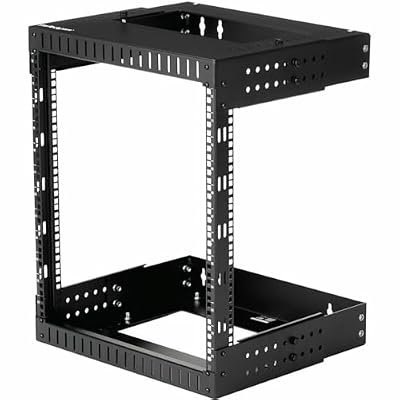
The StarTech RK12WALLOA is a two-post open-frame rack that adjusts from 12 to 20 inches deep in one-inch steps, which makes it the flexible pick for a wall holding a mix of shallow and mid-depth gear. It is built from 2mm SPCC steel, ships flat-packed, and carries the longest warranty in this guide at five years.
Capacity here needs the fine print read carefully. The listing’s bullets rate this rack at 200 lb, while the description lists 198 lb; this guide uses the bullet figure of 200 lb. Do not confuse either number with a 135 lb figure that appears in a variant-family note on the listing — that figure belongs to other models in the family, not the RK12WALLOA. The rack mounts with holes spaced 12 and 16 inches apart, matching common wall-stud spacing, and it includes M6 cage nuts, screws, and washers.
This is the pick for a home lab that changes often. Open frames give you access from every side without removing panels, and the adjustable depth means a new device does not force a new rack. The trade is exposure: no door, no lock, and no dust protection, so it belongs in a closet or a garage.
Specs
- U height: 12U, 19-inch open frame
- Adjustable depth: 12 to 20 in
- Dimensions: 20 in deep x 19.8 in wide x 25.2 in high
- Weight capacity: 200 lb (90 kg); the listing description lists 198 lb
- Unit weight: 32.1 lb
- Material: 2mm SPCC steel
- Warranty: 5 years
- Mounting: wall mount; holes 12 and 16 in apart; EIA/ECA-310; M6 cage nuts, screws, and washers included; flat-pack
3. VEVOR 12U Open Frame Server Rack — the floor-standing four-post

The VEVOR 12U open-frame rack is the only floor-standing four-post rack in this guide, and it has the highest floor capacity here. It adjusts from 23 to 40 inches deep, covering shallow switches to full-depth servers, and it rolls on four casters, so a loaded rack can be moved away from the wall for cabling work. It can also be wall mounted, which is where the two capacity figures come in: read them carefully, because they are very different.
The listing rates this rack at 500 lb standing on the floor and 150 lb mounted on the wall. The spec table shows only the wall figure, so the 500 lb number is easy to miss. If you plan to hang this rack on a wall, 150 lb is the number that governs. The frame is Q235 steel, the model is HT-W6412, and the warranty is two years. The box includes two pallets, 145 screws, four casters, four M10 expansion screws, ten M6 cage nuts, and a grounding wire.
Specs
- U height: 12U, four-post open frame
- Adjustable depth: 23 to 40 in
- Dimensions: 23 in deep x 20.1 in wide x 24.6 in high
- Weight capacity: 500 lb floor-standing / 150 lb wall-mounted
- Unit weight: 31.2 lb
- Material: Q235 steel; model HT-W6412
- Warranty: 2 years
- Included: 2 pallets, 145 screws, 4 casters, 4 M10 expansion screws, 10 M6 cage nuts, grounding wire
4. RackPath 12U Open Frame Network Rack — the shelf-equipped pick

Most of what a home network rack holds was never designed to be racked. A cable modem, a consumer router, a small NAS, and a media box have no mounting ears, and they end up stacked on top of each other or balanced on the frame. The RackPath 12U solves that problem by including two 1U vented shelves, each 14 inches deep, with rear support brackets. The shelves are vented, which matters because consumer gear vents through its base and a solid shelf traps that heat.
The frame itself is a 12U open frame rated at 150 lb, built from alloy steel, and it mounts on a wall or stands on the floor. The shelves are the limitation as well as the feature: at 14 inches deep, they suit modems, routers, and small NAS units, but deeper equipment will overhang.
Buy this rack if most of your kit is consumer gear without mounting ears. If everything you own is already rack-mountable, the shelves are dead weight and one of the other open-frame picks fits better.
Specs
- U height: 12U, 19-inch open frame
- Weight capacity: 150 lb
- Shelves: 2 x 1U vented shelves, 14 in deep, with rear support brackets
- Unit weight: 23.1 lb
- Material: alloy steel; model 00600353
- Mounting: wall mount or floor-standing
- Included: 30 x 10-32 mounting screws, 8 x M5 wood screws
5. NavePoint 12U Server Rack Enclosure, 450mm — the shallow enclosed cabinet

The second NavePoint cabinet in this guide is the 450mm Consumer Series enclosure — a different rack from the 600mm Performance Series cabinet at the top of this guide despite the similar name. The 450mm cabinet is 17.7 inches deep, holds 110 lb, and is built from welded cold-rolled steel with a tempered glass door and lock, removable side panels with locks, and built-in fans. It is the shallow enclosed pick: deep enough for switches, patch panels, and modems, and compact enough to sit on a wall without dominating the room.
That depth split is the point of having two NavePoint cabinets in one guide. The 600mm cabinet at 130 lb takes servers; the 450mm cabinet at 110 lb takes networking gear and costs less wall space. If your deepest device is a switch or a patch panel, the 450mm cabinet is the right size. If you plan to buy a short-depth server, the 600mm cabinet is the one to get.
The welded frame is worth noting: unlike the flat-packed 600mm cabinet, this enclosure arrives as a welded unit, which means less assembly and a stiffer box.
Specs
- U height: 12U, 450mm (17.7 in) deep
- Dimensions: 17.72 in deep x 21.65 in wide x 24.42 in high
- Weight capacity: 110 lb
- Material: welded cold-rolled steel
- Door: tempered glass door with lock; removable side panels with locks
- Cooling: built-in fans
- Mounting: wall mount
The five racks side by side
The two enclosed NavePoint cabinets split on depth and capacity: the 600mm Performance Series cabinet holds 130 lb and takes servers, while the 450mm Consumer Series enclosure holds 110 lb and suits networking gear. Both lock and both have glass doors and fans. The three open-frame racks split on mounting and cargo. The StarTech RK12WALLOA adjusts from 12 to 20 inches deep on the wall, carries 200 lb, and has a five-year warranty. The VEVOR four-post adjusts from 23 to 40 inches, stands on casters, and carries 500 lb on the floor or 150 lb on the wall. The RackPath adds two vented shelves for gear without mounting ears and carries 150 lb. Every pick is 12U, so the decision is about depth, mounting, and whether your gear needs shelves or a door.
FAQ
What size rack does a home lab need?
Most home labs fit in a 12U rack, which gives twelve 1.75-inch slots for a switch, a patch panel, a short-depth server, and a shelf or two. If your gear list is shorter — a switch and a modem, for example — a 9U cabinet leaves a smaller footprint. Measure your deepest device first, because depth limits a rack more often than height does.
Can a network rack hold a full-size server?
A full-depth server needs a rack at least as deep as the server plus room for cables at the back, usually 24 inches or more of usable depth. The VEVOR four-post in this guide adjusts to 40 inches and is the pick for deep gear. The enclosed cabinets here top out at 23.6 inches, which suits short-depth servers and networking equipment.
Should a home lab rack be enclosed or open frame?
An enclosed cabinet with a locking door suits a shared room, keeps dust out, and gives the fans a defined airflow path. An open frame gives better access from every side and unrestricted airflow, which suits a closet or a garage where the gear is out of sight. The room decides.
How much weight can a wall-mounted rack hold?
The wall-mount picks in this guide are rated from 110 lb to 200 lb, and every one of those ratings assumes the rack is bolted into wall studs. A rack rated for 150 lb on the wall is a different product from the same rack rated for 500 lb on the floor, so read the mounting-specific figure for the way you plan to install it.
A rack is a frame, not a feature: it earns its place by making every later change easier. Pick the depth your deepest device needs, the capacity your heaviest load demands, and the form that fits the room it will live in.