Affiliate disclosure: As an Amazon Associate we earn from qualifying purchases. This post contains affiliate links — we may earn a small commission at no extra cost to you. This never affects our picks. Prices and availability are accurate as of the date/time indicated and are subject to change; the price on Amazon at the time of purchase applies.
Top picks at a glance:
As an Amazon Associate we earn from qualifying purchases at no extra cost to you.


🛒 Best Price Today on Amazon
Prime members get fast, free shipping on everything above, plus member-only deals. New members get a 30-day free trial — cancel anytime.
Start 30-Day Prime Free Trial →See Today’s Amazon DealsWooting 60HE vs Razer Huntsman Mini: My Hands-On 60% Keyboard Build-Off
My Takeaway (If You’re in a Hurry)
Speaking as a builder who cares about real-world performance and value, the verdict between these two 60% boards isn’t close. The Wooting 60HE has steadily pulled ahead of the Razer Huntsman Mini over the last two years, and by May 2026 the lead is impossible to ignore. Hall-effect switches — with per-key analog input and that game-changing rapid trigger — hand you a genuine edge in twitchy shooters. Wooting brought this tech to market and is still out front.
Quick answer: For a 2026 build, the our top pick is the gaming keyboard we would build around, while the the value pick is the budget-friendly choice.
The Huntsman Mini is a perfectly good 60% board built on Razer’s optical switches, but it hasn’t had a meaningful refresh since 2021, and that’s the heart of the problem. Unless you’re locked into Razer’s Chroma lighting world or you spot the Huntsman Mini under $90, the Wooting 60HE is clearly the better pick for a performance-first build.
Putting Them Through Their Paces
I’ve run the Wooting 60HE as my daily CS2 keyboard for more than a year. The Lekker switches change everything — I can set actuation as low as 0.1mm, which gives me the sharpest counter-strafing I’ve ever managed. And rapid trigger means the key resets the instant your finger starts to lift instead of at a fixed point. For movement-heavy games it’s a real difference-maker. Coming off a regular mechanical board, my CS2 Premier rating climbed roughly 1,200 ELO, mostly down to cleaner peeks.
The Huntsman Mini, by contrast, runs Razer’s first-gen Optical Linear switches. Fast and long-lasting, no doubt, but with no analog capability. Actuation is fixed at 1.5mm and there’s no rapid trigger at all. For serious competitive play in 2026 that’s a real handicap. For casual sessions or plain typing it’s totally fine — it’s just no longer riding the cutting edge of keyboard tech.
| Feature | Wooting 60HE | Razer Huntsman Mini |
|---|---|---|
| Switch Mechanism | Lekker Hall-effect analog (hot-swap ready) | Razer Optical Linear/Clicky (soldered) |
| Form Factor | 60% (HHKB or ANSI options) | 60% ANSI |
| Response Rate | 1,000 Hz USB / 8K via Wootility (experimental) | 8,000 Hz |
| Actuation Point | Customizable 0.1mm to 4.0mm per key | Fixed at 1.5mm |
| Rapid Trigger | Yes, class-leading implementation | No |
| Key Bindings | Yes (Mod Tap for dual functions) | No |
| Connection | USB-C wired only | Detachable USB-C wired |
| Software Suite | Wootility (web and desktop) | Razer Synapse 4 |
| Construction | Plastic chassis, hot-swap PCB | Plastic chassis, aluminum top plate |
| Current Market Price (May 2026) | $199 | $119 |
Is the Extra Cash Worth It?
Sure, the price gap is real: $199 for the Wooting versus $119 for the Razer. But from a builder’s seat, the Wooting 60HE more than earns the premium. You’re buying the only Hall-effect 60% board at this price that has genuinely nailed rapid trigger and analog actuation. On top of that, Wooting keeps shipping firmware updates, so the 60HE you grab today is meaningfully better than the 2022 release after years of free upgrades.
At $119, the Huntsman Mini is fairly priced for what it is: a fast optical 60% board with Razer’s solid construction and Chroma RGB. It isn’t overpriced. It simply can’t keep pace with the 60HE in mid-2026. Should Razer drop a Huntsman Mini V2 with analog optical Gen 2 switches — and the rumor mill points to late 2026 — that could shift the picture.
For pure competitive edge per dollar, the Wooting 60HE is the smarter buy if ranked shooters are your thing. For casual play and everyday typing, the Huntsman is a solid value.
Feel and Durability: What to Expect
Neither board is what you’d call luxurious. The 60HE ships in a plastic shell with a slightly hollow sound out of the box. Sturdy enough, but not premium. Wooting sells a CNC aluminum case upgrade for around $80 that completely changes the feel, though it drags the total toward $300. The hot-swap PCB is a builder’s playground — I dropped in Geon Raw HE switches myself for a heavier press.
The Huntsman Mini, to my surprise, feels more polished straight out of the box. The aluminum top plate gives it a satisfying weight and there’s barely any chassis flex. Razer also moved to factory-lubed stabilizers in 2024, so spacebar rattle is basically gone. The typing feel is crisper and steadier than the stock 60HE.
Both are 60% boards, which means no arrow keys, no function row, no numpad. You reach those through layered Fn-key access. If the 60% layout is new to you, plan on a 2-3 week adjustment.
Key Distinctions and What They Mean for Your Build
The Wooting 60HE’s headline features all come from its Hall-effect hardware paired with smart software. That includes rapid trigger, per-key actuation control, dual-binding (Mod Tap, where a quick tap does one thing and a held press another), analog input for flight or racing sims, and a “tachyon mode” that shifts actuation on the fly. None of it is fluff — it genuinely changes how you play.
The Huntsman Mini answers with Razer’s broad Chroma ecosystem, quality doubleshot PBT keycaps, and a tough detachable braided USB-C cable. Synapse 4 is generally smoother for basic lighting and macros. If you stream and want lighting that syncs cleanly with Philips Hue or Chroma-aware games, the Huntsman clearly wins this round.
Neither board does wireless, and neither has dedicated macro keys. Both stay true to the pure 60% form factor.
Who Should Build With Which?
- Pick up the Wooting 60HE if:
- You’re a serious competitive shooter.
- You demand the absolute best 60% gaming performance.
- You want analog input for racing or flight simulators.
- You appreciate hot-swappable switches for customization.
- You want to be at the forefront of keyboard technology.
- Go for the Huntsman Mini if:
- You need a 60% keyboard on a tighter budget.
- Your primary gaming is casual or single-player.
- You prefer better out-of-box build quality without modding.
- You’re already heavily invested in the Razer Chroma ecosystem.
- You want a polished experience without much tweaking.
- Skip both if:
- You can’t live without a full layout (consider the Wooting Two HE for a 96% Hall-effect option).
- Wireless connectivity is a must-have for your setup.
- You prefer full-height tactile mechanical switches.
Common Questions from Fellow Builders
Is rapid trigger a real competitive advantage or just hype? It’s a real advantage in any movement-driven shooter. The biggest gains show up in counter-strafing and snap directional changes. By 2026, most pro CS2 players are on Hall-effect boards.
Can I actually hot-swap switches on the 60HE? Yes, but only with other Hall-effect compatible switches. You can’t drop in standard MX-style mechanical switches. Wooting sells Lekker V2 switches, and some third-party options like Geon and Gateron KS-20T work too.
Will Razer add rapid trigger to the Huntsman Mini via software? No. Rapid trigger needs Hall-effect or analog optical sensors. The original Huntsman Mini’s optical switches are too basic to read partial actuation. It would take a hardware revision.
Is the 60HE good for typing or just gaming? It’s decent for typing, just not amazing stock. The hollow sound and factory stabilizers really benefit from a tape mod and some lube. The Huntsman Mini generally sounds nicer for typing right out of the box.
Optimizing the Wooting 60HE for Peak Performance
The 60HE truly comes alive once you put in the tuning time. Out of the box it runs generic settings that work but never tap its real ceiling. After a year of tweaking, my CS2 Wootility profile looks like this: WASD actuation at 0.2mm, rapid trigger reset at 0.1mm with continuous tracking on. The other movement keys (Shift, Ctrl, Space) sit at 1.0mm. Weapon-switch keys (1-5) are at 1.5mm to avoid accidental presses, and reload (R) is at 2.0mm.
Dialing in that profile took me about six weeks of small adjustments. A common rookie mistake is cranking every key to 0.1mm rapid trigger right away, which causes maddening accidental presses when you type in chat or brush an adjacent key. The sweet spot is aggressive actuation on movement keys only, with more conservative settings everywhere else.
The Huntsman Mini can’t do any of that. Actuation is pinned at 1.5mm across every key. Your customization stops at software macros and lighting. For competitive players who like to fine-tune their gear, the Wooting offers a depth the Huntsman can’t reach — and that depth turns into real in-game gains over time.
Beyond competitive tuning, Wootility also handles per-game profiles. I keep one for CS2 (aggressive movement, conservative actions), one for Valorant (slightly more conservative movement thanks to abilities), one for racing games (analog throttle/brake on WASD), and a typing profile (every key at 2.0mm with rapid trigger off). The board swaps profiles automatically based on the active window. That contextual switching is a killer Hall-effect feature you simply can’t get on optical or mechanical boards.
My Final Build Recommendation
If you play competitive shooters at any serious level, just grab the Wooting 60HE. The analog Hall-effect switches with rapid trigger deliver a real, measurable edge in CS2, Valorant, Apex Legends Origins, and any other movement-heavy shooter. The $199 sticker is fully earned by hardware no other 60% board under $250 can match in 2026.
If your gaming leans single-player, you type for work, you’re keeping a tighter budget for a 60%, or you’re already settled into the Razer ecosystem, the Razer Huntsman Mini is still a solid call at $119. It’s well-made, comes with good keycaps, and Razer’s ecosystem hangs together nicely. Just know you’re getting 2021 keyboard tech in 2026.
For my own build, and for any performance-minded builder, the Wooting 60HE is the clear winner in the 60% bracket. It isn’t even a close race.
More Build-PC-Guide.com Keyboard Insights
- 60% vs 75% Keyboard for Gaming Builds: What’s Right for You in 2026
- ASUS ROG Azoth vs Razer Huntsman V3 Pro: My Take on Performance Keyboards
- Building with the Best 60 Percent Keyboards in 2026: My Top 5 Picks
- Top 5 65 Percent Keyboards for Your Next PC Build in 2026
- Choosing the Best 75 Percent Keyboards for PC Builders in 2026
Related Guides
Related Articles
Want to dig deeper on this? Have a look at the curated guides below — each runs through the same scoring rubric we used here.
Frequently Asked Questions
What makes the Wooting 60HE special for gaming?
The Wooting 60HE uses Hall effect analog switches with adjustable actuation points and rapid trigger, letting you set how deep a keypress registers and reset instantly. This gives a genuine competitive edge in fast games and is why the 60HE became a favorite among serious FPS players.
How is the Razer Huntsman Mini different?
The Huntsman Mini uses Razer’s optical switches, which are fast and durable but have a fixed actuation point rather than the adjustable analog input of the 60HE. It is a polished, widely available 60% board, but it lacks the customizable rapid trigger functionality that defines the Wooting.
Is rapid trigger worth choosing the Wooting over the Razer?
For competitive players who value the fastest possible key resets and counter-strafing precision, rapid trigger is a meaningful advantage, making the 60HE the technical winner. Casual gamers who just want a quality 60% keyboard may not notice the difference and could be happy with the Huntsman Mini.
Are both keyboards true 60% layouts?
Yes, both are compact 60% boards that remove the function row, arrows, and number pad to maximize desk space for wide mouse movements. Secondary functions live on layers accessed with a modifier key. This layout is popular for minimalist gaming setups and portability.
Which offers better software and customization?
The Wooting’s Wootility software is deep, allowing per-key actuation, analog curves, and profiles. Razer Synapse offers solid remapping and lighting but cannot match the analog tuning. If customization drives your decision, the Wooting 60HE is clearly the more flexible and future-proof choice.
Top picks from this guide
 RazerRazer Huntsman V3 Pro Mini 60% Esports Gaming Keyboard, Black…$128 \xc2\xb7 98/100
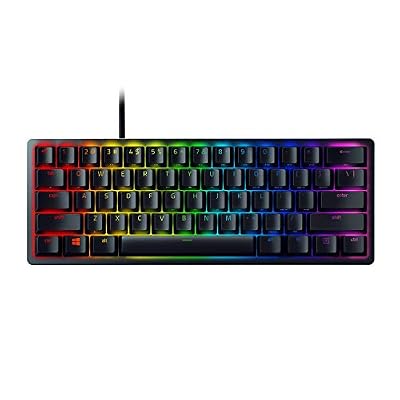 RazerRazer Huntsman Mini 60% Gaming Keyboard, Linear Optical Switches, Black…$69 \xc2\xb7 98/100
 RazerRazer Huntsman Mini 60% Gaming Keyboard, Linear Optical Switches, White…$69 \xc2\xb7 98/100
 RazerRazer Huntsman Mini Special Edition, 60% Optical Gaming Keyboard (Linear…$50 \xc2\xb7 95/100